
How to Run a Therapy Workshop: A Practical Guide for UK Counsellors

Article by
Martin Hogg
I help Private Practice counsellors in the UK set up and grow an ethical Private Practice they love, work with their ideal clients, and earn the income they deserve. All without guesswork and burnout. I have been a private practice counsellor myself for over 20 years, specialising in anger management. I set up a not-for-profit social enterprise, Citizen Coaching and Counselling, which delivers thousands of counselling sessions a year to adults and young people in Birmingham. I am a registered BACP Counsellor and the author of three books, My Anger Coach, My Anxiety Coach and My Relationship Coach. These are available on Amazon.
Most counsellors treat the idea of their first event like a high-stakes clinical assessment, but your audience isn't looking for a diagnosis; they're looking for a bridge. You probably feel that familiar tug of imposter syndrome, wondering if you're "expert" enough or if you'll accidentally trip over the boundary between teaching and therapy. It's a common hurdle, especially when 50% of BACP members say attracting new clients is their biggest struggle. Learning how to run a therapy workshop shouldn't feel like a tech-heavy chore that keeps you awake at night.
I understand the hesitation. You want to grow your practice and help more people, but the thought of wrestling with Canva or booking systems feels overwhelming. I'm here to tell you that people connect with people, not perfectly polished slides. In this guide, I'll show you how to design, market, and facilitate your first event to build professional authority and a genuine sense of community without the usual stress.
We'll walk through a practical plan to get you from a blank page to a live room, using simple tools and a "rough and ready" approach that actually works. You'll learn how to meet your CPD requirements while creating a steady stream of 1-to-1 clients who already trust your voice and your expertise.
Key Takeaways
- Understand the boundary between "teaching" and "therapy" so you can lead with confidence without the fear of the session turning into an unmanaged group encounter.
- Apply the "skateboard model" to your first event by starting with a simple 90-minute Zoom call rather than an overwhelming, tech-heavy weekend retreat.
- Discover how to run a therapy workshop that actually fills up by using a clear, one-sentence offer on your Counselling Directory or Psychology Today profile.
- Learn the "Handout Hack" to provide instant value to your attendees while keeping the session on track and managing over-sharers effectively.
- Build your professional authority and attract more 1-to-1 clients by focusing on human connection rather than polished, expensive presentations.
Why Every Private Practice Needs a Workshop (And Why You Are Scared to Start)
Most of us are quite comfortable behind the closed door of a 1-to-1 session. It's safe, it's familiar, and we know the rhythm. But the moment we think about standing in front of a group, that loud inner critic starts shouting. You might worry you aren't "expert" enough or that you'll look like a fraud. Let's clear that up right now. You don't need to be the world's leading authority on your niche. You just need to be two steps ahead of the people in the room.
Learning how to run a therapy workshop is about scaling your impact, not your ego. Private practice can be incredibly isolating. Honestly, it's a bit repetitive if you're saying the same things to six different clients every week. Workshops provide a community fix for you and your participants. They also act as a massive trust accelerator. When someone spends 90 minutes with you in a group setting, they get a "try before you buy" experience of your personality. It's the fastest way to fill your 1-to-1 diary with people who already like how you work.
Workshop vs. Group Therapy: Knowing the Boundary
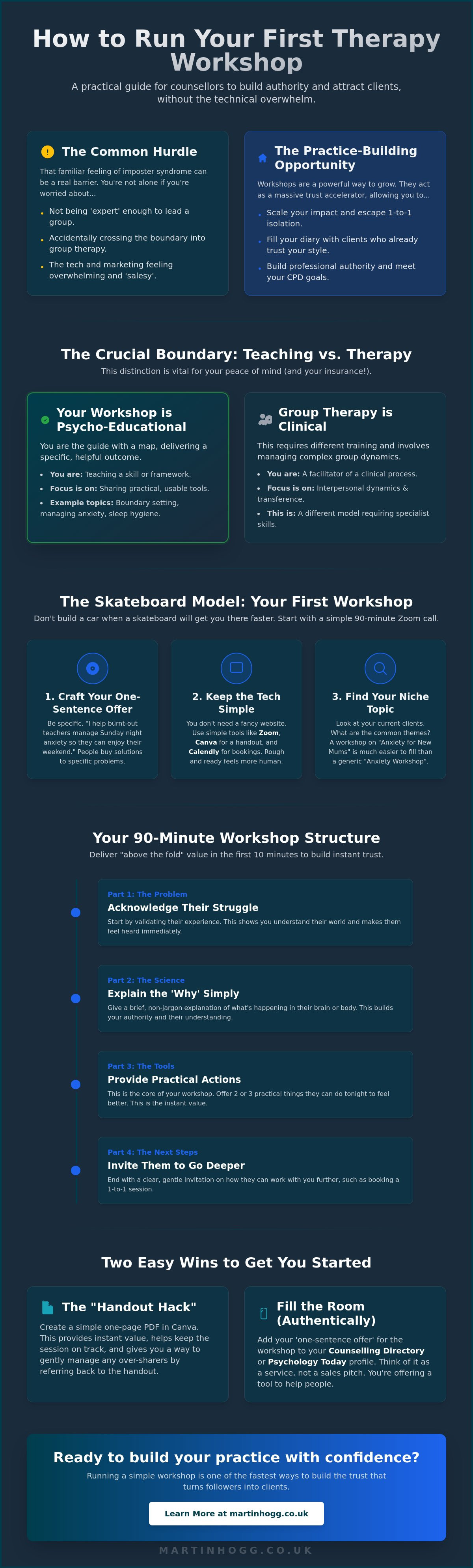
One of the biggest fears is accidentally starting a therapy group without the right training. There's a clear ethical distinction here. While group psychotherapy focuses on deep clinical processing and interpersonal dynamics, a workshop is primarily psycho-educational. You are teaching a skill, sharing a framework, or providing tools for a specific problem like sleep hygiene or boundary setting.
This distinction is vital for your peace of mind and your insurance provider. Teaching feels safer because you are the guide sharing a map, rather than a facilitator managing complex group transferences. It's about delivering a specific outcome. If you want to dive deeper into building this kind of authority without the overwhelm, my Private Practice Success Membership is where we get into the nitty-gritty of niche building and visibility.
The Skateboard Model: Designing Your First Minimum Viable Workshop
I often see counsellors get stuck in "planning paralysis." They want to launch a three-day residential retreat before they've even sent a single marketing email. Instead, I want you to use the skateboard model. If you want to get from A to B, a skateboard is a lot faster to build than a car. When you are figuring out how to run a therapy workshop, your "skateboard" is a 90-minute Zoom session. It's low risk, low cost, and remarkably effective.
Your goal is to create a "One-Sentence Offer." It should be as simple as: "I help burnt-out teachers manage Sunday night anxiety so they can actually enjoy their weekend." If your offer is too broad, nobody will click. People connect with people, and they buy solutions to specific problems. Keep the tech simple too. You don't need a fancy Squarespace site yet. A simple Canva slide deck and a Calendly link for bookings is plenty. Remember, rough and ready content beats polished and corporate every time. It feels more human.
Choosing Your Niche Topic
Don't try to help everyone with everything. Look at your current 1-to-1 client list. What are you last few sessions telling you? If you've seen several new mums this week struggling with intrusive thoughts, that's your workshop. Focusing on a specific niche like "Anxiety for New Mums" makes your marketing much easier than a generic "Anxiety Workshop." If you want to dive deeper into this, the Private Practice Success Membership has some great resources on niche building.
Structuring the 90 Minutes
You need to provide "above the fold" value, which means getting to the useful stuff in the first 10 minutes. Don't spend half an hour on your bio. Use this simple 4-part structure to keep things moving:
- The Problem: Acknowledge their struggle so they feel heard and understood.
- The Science: A brief, non-jargon explanation of what is happening in the brain or body.
- The Tools: Two or three practical things they can do tonight to feel better.
- The Next Steps: A clear invitation on how they can work with you further.
Filling the Room Without Sounding Like a Salesperson
The word "marketing" usually makes counsellors want to hide under their desks. We associate it with being pushy or "salesy," which feels completely at odds with our clinical values. I want you to reframe this entirely. If you have a tool that can help someone move from distress to relief, it isn't a sales pitch to tell them about it. It's a service. When you understand how to run a therapy workshop effectively, the marketing becomes an extension of the help you already provide.
Start with your directory profiles. Your Counselling Directory or Psychology Today page shouldn't just be a list of your qualifications. Use that "one-sentence offer" we discussed earlier. Put it right at the top. If a potential client sees that you're running a specific session on the very thing they are struggling with, you've just made their decision a lot easier. Don't overlook your existing network either. A short, warm email to former clients letting them know about the event is often all it takes to fill half the seats. They already trust you, so the "trust gap" is already bridged.
You can also leverage local BACP networks and therapist peer groups. Often, our colleagues are looking for high-quality resources to refer their own clients to when their 1-to-1 diary is full. Being the person who knows how to run a therapy workshop on a specific niche makes you a valuable asset to the local therapeutic community.
Social Media for the Camera-Shy
If the thought of going live on Instagram gives you palpitations, don't worry. You don't need to be an "influencer." Simple, text-based posts that solve one tiny problem for the reader are incredibly effective. If you do feel brave enough for video, a 60-second "talking head" clip where you share one practical tip works wonders. Remember, marketing for therapists uk is about being helpful, not hypey. People want to see the real you, not a polished corporate version.
If you're feeling stuck on the practical steps, I've put together The Practice Visibility Blueprint to give you a structured marketing plan. It takes the guesswork out of the process so you can focus on the work you actually love doing. To get the support you need to launch your first event and fill your diary, join the Private Practice Success Membership today.
Facilitation Secrets: Delivering Value Without Burning Out
You've done the marketing, you've sent the Zoom link, and now you're staring at a dozen little boxes on your screen. Facilitation is a different muscle than 1-to-1 work. It requires you to be both the guide and the timekeeper. One of the biggest fears counsellors have is the "over-sharer"—that one participant who treats your educational workshop like their personal therapy hour. When you're learning how to run a therapy workshop, you need a polite but firm "parking lot" strategy. You can say, "That's a really important point, let's park that for now and I'll stay for five minutes at the end to discuss it." It keeps the group on track without making anyone feel dismissed.
I also swear by the "Handout Hack." Instead of trying to cram every bit of information onto your slides, create a simple two-page PDF in Canva. Give them the key takeaways and a few exercises they can do later. This reduces your talking time and gives them something tangible to hold onto. It makes you look like a pro and ensures they get value even if they get distracted during the live session. It's a simple way to lower the pressure on yourself to be a perfect "performer."
Managing your own energy is just as vital as managing the room. Never schedule a workshop on a day when you already have five or six 1-to-1 clients. You'll be depleted, and your audience will feel it. Treat the workshop day as a "high-focus" day. If you want to grow your practice without hitting a wall, check out my guide on therapist burnout for more practical advice on pacing yourself.
Post-Workshop Logistics
The work isn't quite over when you hit "End Meeting." You need to capture the "glow"—that moment right after the session when people feel helped and inspired. Send a follow-up email within two hours. Include your handout, a link to book a 1-to-1 discovery call, and a simple feedback form. This is the best time to ask for testimonials that you can use for your next event. If you're looking for a supportive community to help you refine these facilitation skills, the Private Practice Success Membership is the perfect place to start. Learning how to run a therapy workshop is a journey, and you don't have to do it alone.
Take the Leap and Share Your Expertise
Stepping out from behind the 1-to-1 chair can feel daunting, but it's the fastest way to build trust and community in your practice. We've covered how the skateboard model keeps your tech simple and why a clear, one-sentence offer removes the "salesy" feeling from your marketing. Learning how to run a therapy workshop is essentially about extending the same empathy and support you provide in the room to a wider group of people who truly need it.
With over 20 years of experience in the UK counselling landscape and as a BACP-endorsed training provider, I've seen how the right framework can turn anxiety into action. My Practice Visibility Blueprint is designed to take the guesswork out of your growth. You don't have to struggle with the tech or the imposter syndrome alone. If you're ready to impact more lives while building a sustainable business, join the Private Practice Success community to get your workshop off the ground. It's time to stop over-thinking and start facilitating. I'll see you in there.
Frequently Asked Questions
Do I need special insurance to run a therapy workshop in the UK?
You should contact your current insurance provider before you host your first event. Most standard professional indemnity policies for UK counsellors include cover for teaching and training, but it's worth a quick phone call to be certain. If you're hosting an in-person workshop, you'll also need to ensure your public liability cover is active. Specialist insurance packages for qualified therapists are quite affordable, with some annual premiums starting from around £63.50.
How much should I charge for a 90-minute online workshop?
I suggest starting with a price point that roughly matches your standard 1-to-1 hourly rate for a 90-minute session. This makes the workshop an accessible "try before you buy" experience for new clients who might be hesitant to commit to full therapy. It covers your costs and rewards your time while keeping the barrier to entry low enough to fill your Zoom room. As you build your professional authority, you can adjust your fees based on the specific value you provide.
Can I record my workshop and sell it later as a course?
You can record your session, but you must handle the ethics and consent carefully. I recommend recording your teaching segments and pausing the recording during any group Q&A or personal sharing. This protects participant confidentiality and keeps you aligned with BACP ethical standards. Once you have the "teaching" footage, you can use it as evergreen content for your website or as a bonus for your newsletter subscribers.
What happens if only one person signs up for my workshop?
If only one person signs up, I would run the session anyway. It might feel a bit disappointing, but that one person will get an incredible, high-value experience that feels like a private consultation. It's the perfect "rough and ready" practice for you to test your slides and timing. You'll gain the confidence of having actually delivered the material, which makes how to run a therapy workshop feel much less intimidating the next time you announce an event.
Should I provide a certificate of attendance for my participants?
You only need to provide a certificate if your workshop is aimed at other professionals who need to log CPD hours. Most members of the public are looking for practical tools and relief, not a piece of paper to hang on the wall. However, if your audience includes other therapists, a simple PDF certificate is a nice touch. It helps them document their learning for their annual 30-hour BACP or NCPS professional development requirements.
Disclaimer
The information provided on this blog is for general informational purposes only and is not intended to be a substitute for professional medical or mental health advice, diagnosis, or treatment. Reading this content does not create a therapist-client relationship.


