
How to Set Therapy Fees UK: A Practical Guide to Sustainable Practice
What if your therapy fee wasn't just a price tag, but the foundation that keeps your practice from collapsing under the weight of burnout? It's a tough question to face. Many of us feel a pinch of guilt when we think about money, as if charging a fair rate somehow diminishes the compassion we offer. If you've been wondering how to set therapy fees uk practitioners can actually live on, you aren't alone in feeling a bit stuck.
You likely worry that increasing your rates will push away the people you want to support, or perhaps you're simply unsure how to calculate your business costs accurately. It's a common struggle, but you can't pour from an empty cup. I'll show you a straightforward framework to set fees that cover your costs and reflect your expertise, ensuring you stay in this profession for the long run. We'll move past the guessing game and create a structure that feels both ethical and sustainable.
This guide provides a step-by-step process to define your hourly rate based on real-world UK overheads and your professional value. You'll learn how to handle fee reviews with confidence and gain the practical tools needed to build a practice that is truly fit for the future.
Key Takeaways
- Overcome "helper's guilt" by learning how to set a fee that covers your professional costs, personal living, and your own wellbeing.
- Use a step-by-step framework for how to set therapy fees uk that accounts for your non-clinical hours and the hidden costs of running a private practice.
- Learn why focusing on a clinical specialism helps you move beyond local price ceilings and better reflects the expert value you provide.
- Get practical advice on stating your rates with confidence on your website and managing fee increases ethically within your clinical contracts.
- See fee-setting as an ongoing process that ensures your practice remains a stable, supportive, and sustainable resource for your community.
The Psychology of Setting Therapy Fees in the UK
Money is an emotive topic, especially in the UK counselling community. Most of us entered this profession because we care deeply about people, not because we wanted to run a high-turnover business. This often leads to "helper’s guilt," a feeling that charging a fair price somehow contradicts our desire to be compassionate. However, if you don't charge a sustainable fee, you aren't just hurting your bank balance; you are risking the quality of care you provide. A sustainable fee is one that covers your professional insurance, supervision, room hire (which often costs between £10 and £20 per hour in UK cities), and your own cost of living.
When you undervalue your work, resentment starts to creep into the therapy room. You might find yourself checking the clock or feeling drained by a full caseload that barely covers your bills. This is the fast track to burnout. It's helpful to reframe your fee as a clinical boundary. Much like your 50-minute session time or your cancellation policy, a consistent fee provides a sense of safety and stability. It shows the client that you are a professional who is resourced, grounded, and capable of holding their difficult emotions without being distracted by your own financial survival.
Overcoming Imposter Syndrome and the 'Going Rate' Trap
Many therapists start by scrolling through local directories to see what others are charging. They see a range of £45 to £60 and pick something in the middle. This is a mistake. Copying the "going rate" assumes that the therapist down the road has actually done the maths on their own overheads. They might be struggling just as much as you are. When you decide how to set therapy fees uk practitioners often let imposter syndrome take the lead, fearing that "no one will pay" if they charge more than the local average.
There is a vital difference between being expensive and being valuable. A client isn't just paying for an hour of your time. They are paying for your years of training, your clinical intuition, and the transformation they experience in their lives. If your support helps someone return to work or save a relationship, the value of that outcome far outweighs the cost of the session. You don't need to be the cheapest option to be the best option for your clients.
The Ethical Case for Charging a Sustainable Rate
Ethics and money are closely linked. A resourced therapist who has time for rest, self-care, and high-quality supervision provides better clinical outcomes than one who is stressed and overstretched. If you charge a rate that allows you to invest in advanced training, such as a £1,000 trauma specialist course, your clients directly benefit from that expertise. You are effectively reinvesting in their recovery. It is difficult to stay present with a client's trauma when you are worried about your own mortgage payment.
The Sustainable Practice Minimum is the floor below which clinical quality drops.
By setting a professional rate, you ensure that your practice remains a stable fixture in your community for years to come. If you'd like to discuss how these figures look in your specific situation, you can book a slot on my calendar to talk through your practice goals. Taking the time to get your fees right is a practical step toward getting your professional life back on track.
Calculating Your Sustainable Practice Fee: The Business Maths
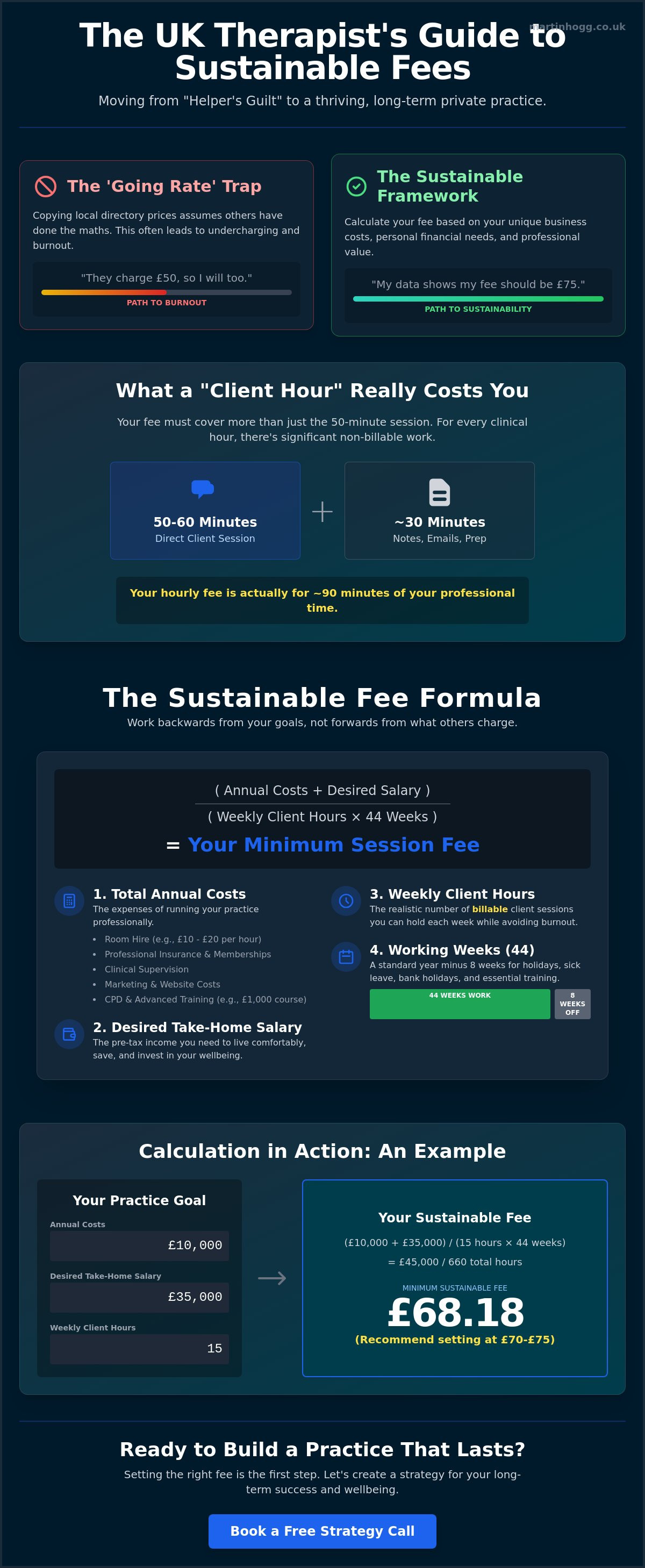
Many therapists pick a session price based on what the person down the road charges. This is a mistake. You aren't that person, and your financial needs are unique. To build a practice that lasts, you must treat your clinical work as a business. This means your hourly rate has to cover far more than just the 50 minutes you spend in the chair with a client.
I often talk to practitioners who feel burnt out because they're seeing 25 clients a week but still struggling to pay the bills. They forgot to account for the non-clinical hours. For every hour of therapy, you likely spend another 30 minutes on clinical notes, emails, and preparation. If you don't charge for that time, you're essentially working for free. When you're figuring out how to set therapy fees uk, start with your life goals first. Decide what you need to take home each year to live comfortably, then work backwards.
The most reliable formula for a sustainable fee is: (Total Annual Costs + Desired Take-Home Pay) / (Weekly Client Hours x 44 Weeks). I use 44 weeks because it allows for eight weeks of holidays, sick leave, and training. If you want to take home £35,000 and your costs are £10,000, you need to generate £45,000. Dividing that by 15 clients a week over 44 weeks gives you a required fee of roughly £68 per session.
A Checklist of UK-Specific Private Practice Overheads
Running a practice in the UK involves several fixed costs that don't go away, even if you have a quiet month. You need to track these monthly to ensure your fee remains accurate and your business stays healthy.
- Professional Fees: Annual memberships for the BACP, UKCP, or NCS typically range from £150 to £300.
- Clinical Supervision: A mandatory requirement that usually costs between £50 and £80 per hour in the UK.
- Legal and Data: Professional Indemnity insurance and your mandatory £35 to £40 ICO data protection fee.
- Space and Tech: Physical room hire, which can be £10 to £20 per hour, or the overheads of a home office and secure marketing software.
Setting aside a minimum 12.5% buffer for Income Tax and National Insurance ensures you aren't caught short when the January tax deadline arrives.
Accounting for Sick Pay, Holidays, and CPD
In employment, someone else pays for your coffee breaks and your annual leave. When you're self-employed, you are the one responsible for those hidden benefits. If you don't build these into your fee, you'll find yourself working while you're unwell just to make ends meet. I recommend factoring in 25 to 30 hours of high-quality CPD every year, as these specialized courses often cost several hundred pounds.
Don't forget the emotional cost of this work. Many of the most effective therapists I know invest in their own personal therapy or specialized coaching to stay grounded. If you're feeling overwhelmed by these numbers, you might find it helpful to book a brief chat with me to look at your specific situation. Budgeting for your own well-being isn't a luxury; it's a professional necessity that keeps your practice safe and effective for your clients.
Moving Beyond the 'Local Average': Positioning Your Niche
Many counsellors in the UK fall into the trap of looking at a local directory, seeing a range of £45 to £60, and picking a number in the middle. While this feels safe, it often leads to a fee ceiling that is difficult to break. If you present yourself as a generalist who can help with any issue, you become a commodity in a crowded market. When clients see you as a commodity, price becomes their primary deciding factor. This makes it incredibly hard to build a practice that is both financially and emotionally sustainable.
When you focus on a specific niche, the conversation around how to set therapy fees uk changes completely. You are no longer just selling an hour of your time; you are offering a specific solution to a pressing problem. This shift in positioning allows you to set rates that reflect your expertise rather than just the local average. To help you bridge this gap, I have developed the Practice Visibility Blueprint, which shows you how to attract the right niche clients who value your specific skills and are willing to pay for them.
Generalist vs. Specialist: A Fee Comparison
A generalist charging £50 per hour often spends a huge amount of energy on marketing just to keep their diary full. They are competing with every other practitioner in a ten-mile radius. In contrast, a specialist charging £90 per hour often finds that their marketing is much more straightforward. If someone is struggling with a specific, painful issue like chronic anger or complex trauma, they are not looking for the cheapest option. They are looking for the person who can help them get their life back on track quickly and effectively. Your expert status justifies a higher rate because it reduces the client's perceived risk. They trust that you have the specific tools to help them, and that trust is worth the investment.
The Role of Professional Credibility in Fee Setting
Building this expert brand requires more than just a title on your website. It is about demonstrating a commitment to your craft through advanced training. For example, completing specialised courses in Working with Men or Anger Management provides you with a distinct edge in the private practice market. These are not just certificates; they are signals of credibility to potential clients who are searching for specific results. BACP-endorsed workshops carry significant weight and allow you to stand out from the crowd of generalists. If you are looking to enhance your expertise and naturally increase your how to set therapy fees uk potential, you can check my CPD calendar for upcoming training sessions designed to build your clinical confidence and professional value.
Communicating Your Fees and Managing Increases Ethically
Talking about money can feel uncomfortable when your primary goal is to help people. However, clear communication about your rates is a vital part of the therapeutic relationship. When you are transparent about how to set therapy fees uk practitioners often find that it actually reduces client anxiety. Most people prefer to know exactly where they stand before they even book an initial consultation. Your website should state your fees clearly, and you should confirm them again during the first enquiry call to ensure there are no surprises later.
Your clinical contract is the safety net for your practice. It needs to include your session rate, your policy on missed appointments, and how you handle late payments. Being upfront about these boundaries isn't being "difficult"; it's being professional. If you choose to offer a sliding scale or low-cost slots, be intentional about it. Many successful UK therapists reserve 10% to 15% of their diary for reduced-rate clients. This allows you to stay accessible while maintaining a sustainable income from your full-fee sessions.
How to Raise Fees for Existing Clients
Raising your rates is a natural part of running a business, but it requires a sensitive touch. I recommend a three-month notice period for any fee increase. This gives your clients time to process the change and discuss any financial concerns within the therapy room. A simple script for this conversation might look like this: "I am writing to let you know that as of [Date], my session fee will increase to £[Amount]. I wanted to give you three months' notice so we can discuss how this affects you."
Sometimes, a fee change can cause a "therapeutic rupture" or feelings of resentment. Don't shy away from this. Use it as a chance to explore the client's relationship with money and value. If a client truly cannot afford the new rate, you might choose to "grandfather" them in at their current rate for a set period or help them find a suitable low-cost alternative.
Managing Payments and Arrears
Consistent payment boundaries are essential for your well-being. Most UK therapists now use BACS for direct transfers or platforms like Stripe, which typically charges around 1.4% to 2.9% plus 20p per transaction for UK cards. While Stripe has a small cost, the automated invoicing can save you hours of admin and reduce the likelihood of arrears. I always recommend a 24-hour cancellation policy; this protects your time and ensures your practice remains viable.
If a client falls behind on payments, address it immediately but kindly. You might say, "I've noticed the last two sessions haven't been paid for yet. I want to check in and see if there's a problem we need to talk about." Ignoring the issue often leads to more stress for both of you. If you need help structuring your practice for better balance, you can book a session with me here to discuss your specific situation.
Building a Sustainable Future with Private Practice Success
Setting your rates isn't just about a number on a website. It's a living part of your business that should evolve as your experience grows and your life changes. Learning how to set therapy fees uk therapists can actually thrive on is the first step toward a practice that lasts for decades. I've seen too many talented counsellors burn out by their third year because they ignored the financial reality of their own lives. You deserve a practice that supports your well-being as much as you support your clients' mental health.
The Power of Community and Mentorship
Working for yourself often feels lonely. Isolation is perhaps the biggest hurdle to financial success in private practice. When you're alone, self-doubt and the fear of charging "too much" can keep your income stagnant, leading to a cycle of overwork and underpayment. Joining a community of like-minded UK therapists changes that dynamic. The Private Practice Success Membership provides a clear blueprint for growth, moving you away from guesswork and toward a structured, profitable business. If you feel ready to expand beyond your current capacity, you might also look into scaling a therapy practice to reach more people without losing your sanity.
Next Steps for Your Practice Growth
I want you to take one practical action this week. Sit down and perform a "fee audit." Look at your current overheads, your pension contributions, and the actual hours you spend on admin versus clinical work. Understanding how to set therapy fees uk practitioners can rely on is about more than just picking a number; it's about valuing your professional expertise. If the numbers don't add up to a comfortable living, it's a signal that your structure needs adjustment.
- Review your total business costs including insurance, room hire, and supervision.
- Calculate the "hidden" hours spent on emails, note-taking, and marketing.
- Compare your current rate against the local UK market average to ensure you aren't underselling your skills.
Many solo practitioners hit an income ceiling because they only trade time for money. Expert coaching helps you move past this by looking at your practice as a whole. If you want bespoke support, one-to-one coaching offers a tailored strategy for your specific situation. You don't have to figure this out by yourself. You can explore the Private Practice Success Membership today to join a group of professionals who are building ethical, profitable, and rewarding practices. Let's get your practice on the right track so you can focus on the work you love.
Build a Practice That Supports Your Life
Setting your fees is a vital part of your professional self-care. It isn't just about picking a random number; it's about ensuring you don't face the burnout that affects so many in our field. Understanding how to set therapy fees uk counsellors can sustain long-term is essential for your well-being. This process requires balancing your actual business overheads with the deep value of your clinical expertise and years of training.
I've navigated these challenges over 20 years of UK private practice. Through my BACP-endorsed workshops and the Practice Visibility Blueprint system, I've helped hundreds of therapists move past the fear of being "too expensive." You deserve a practice that supports your life while you support others. Clear, ethical communication about money builds trust and sets a professional tone from the very first contact.
If you're feeling overwhelmed by the business side of things, you don't have to do it alone. Join the Private Practice Success Membership and get the support you need to grow. You've already done the hard work of training; now it's time to build the stable future you deserve.
Frequently Asked Questions
What is the average hourly rate for a private therapist in the UK?
The average hourly rate for a private therapist in the UK typically falls between £45 and £75 per session. In London or for specialised services like EMDR, rates often rise to £90 or more. When you're deciding how to set therapy fees uk, it's vital to look at your local area and your specific level of experience to ensure your practice stays sustainable.
Is it ethical to charge different fees to different clients?
It's entirely ethical to charge different fees, provided you're consistent and transparent about your sliding scale. Many therapists offer a lower rate for students or those on low incomes to ensure therapy remains accessible. This approach allows you to balance your need for a living wage with your desire to help those in financial hardship without compromising your professional integrity.
How often should I review and increase my therapy fees?
You should review your therapy fees at least once a year, with many practitioners choosing April to match the new financial year. Small, incremental increases of £5 are much easier for clients to manage than one large jump every five years. Regular reviews ensure your practice remains viable as your own costs and inflation rise over time.
Should I display my fees on my therapy website?
I recommend displaying your fees clearly on your website to build immediate trust with potential clients. People often feel anxious about asking for prices, so seeing your rates upfront removes a significant barrier to them reaching out for help. It also ensures that the people who contact you are already comfortable with your pricing structure, saving everyone time.
What should I do if a client says they can no longer afford my fee?
If a client's financial situation changes, start by having a calm, open discussion about what they can realistically manage. You might offer a temporary hardship rate for a set number of weeks or suggest moving to fortnightly sessions. If their budget is permanently reduced, help them find a suitable low-cost service so their progress isn't lost during the transition.
Do I need to charge VAT on my counselling services in the UK?
You only need to charge VAT if your annual business turnover goes above the current HMRC threshold of £90,000. Most individual private practitioners stay below this limit, so they don't need to add 20% to their session prices. It's a good idea to keep a close eye on your earnings each month so you aren't caught out by a surprise tax bill.
How many 'low-cost' slots should a private practice offer?
A sustainable private practice often allocates 15% of its weekly sessions to low-cost or pro-bono work. For a therapist seeing 20 clients a week, this means offering 3 slots at a reduced rate. Setting a firm limit on these spaces protects your income while still allowing you to provide support to those who might otherwise struggle to access help.
Can I charge for missed sessions or late cancellations?
You can and should charge for missed sessions if the client provides less than 24 or 48 hours' notice. This policy isn't about being unkind; it's about valuing your time and maintaining a professional boundary. Ensure you explain this clearly in your initial contract so there are no awkward surprises or misunderstandings when you need to enforce the rule.


