How to Set Therapy Fees UK: A Practical Guide to Sustainable Practice
Setting your therapy fees isn't just a business task; it's a vital clinical boundary that protects both you and your clients from burnout. Most of us entered this profession to help people, not to feel like we're haggling over prices or acting like pushy sales staff. It's completely normal to feel a bit of a wobble when a client asks for your rate, or to worry that raising your fees might mean losing the very people you want to support. However, an exhausted therapist who is struggling to pay their own bills isn't in the best position to hold space for others.
In this guide, you'll learn how to set therapy fees uk practitioners can actually live on. I'll show you how to calculate a rate that covers your professional costs and the 2026/27 tax requirements, while also accounting for your pension and essential time off. By the end of this article, you will have a clear method for determining a fee that reflects your expertise and ensures your practice supports your life instead of draining it. We'll move past the guesswork and find a number you can state with calm, quiet confidence.
Key Takeaways
- Understand why undervaluing your work is a fast track to clinical resentment and how to move past the "helper’s guilt" trap.
- Discover a step-by-step formula for how to set therapy fees uk counsellors can actually live on, covering everything from BACP subs to your pension.
- Learn how focusing on a specific niche, such as anger management or working with men, helps you stand out and justifies a rate that reflects your professional expertise.
- Gain the tools to communicate your fees clearly and handle price inquiries without feeling defensive or apologetic.
The Psychology of Money and the "Helper’s Guilt" Trap
It's a common struggle for counsellors. You spend years learning what is psychotherapy and honing your empathy, only to feel a knot in your stomach when it's time to talk about money. Many of us fall into the "helper’s guilt" trap, feeling that charging a healthy profit is somehow at odds with our desire to help. But let's be straight about this. If you are constantly worrying about your own rent or the rising cost of living, you aren't fully present for your clients.
Undervaluing your work doesn't just hurt your bank balance; it erodes the therapeutic relationship. When you don't charge enough, clinical resentment can quietly creep in. This is a primary driver of therapist burnout. You might find yourself checking the clock or feeling frustrated by a late cancellation because that lost income actually matters. Your fee is a vital boundary. It creates a safe, professional container where the client's needs are the sole focus, not your financial stress.
Many practitioners look at the "local average" and stick to that. It's a myth that keeps people stuck. Just because everyone in your town charges £45 doesn't mean it's a sustainable rate for your specific life and overheads. Learning how to set therapy fees uk therapists can actually thrive on requires looking at your own numbers, not your neighbour's. Relying on what others do often leads to a cycle of poverty that serves no one.
The Ethical Case for Charging a Sustainable Rate
A financially stressed therapist is a distracted therapist. By setting a rate that reflects the true cost of your professional life, you ensure you can stay in this career for the long haul. A sustainable fee also gives you the freedom to offer a limited number of low-cost or pro-bono slots. You can only be generous if your own foundations are solid. Charging properly isn't greedy; it's what allows you to keep the doors open for those who need you most.
Overcoming Imposter Syndrome in Fee Setting
If you're just starting a private practice, you might feel like you haven't "earned" the right to charge more. Remember that your fee isn't just for the 50 minutes you spend together. It covers your years of training, your ongoing supervision, insurance, and the emotional labour of the work. Your value is inherent in the quality of care you provide, not just the time on the clock. Stand firm in that value from day one.
Calculating Your Sustainable Practice Fee: The Business Maths
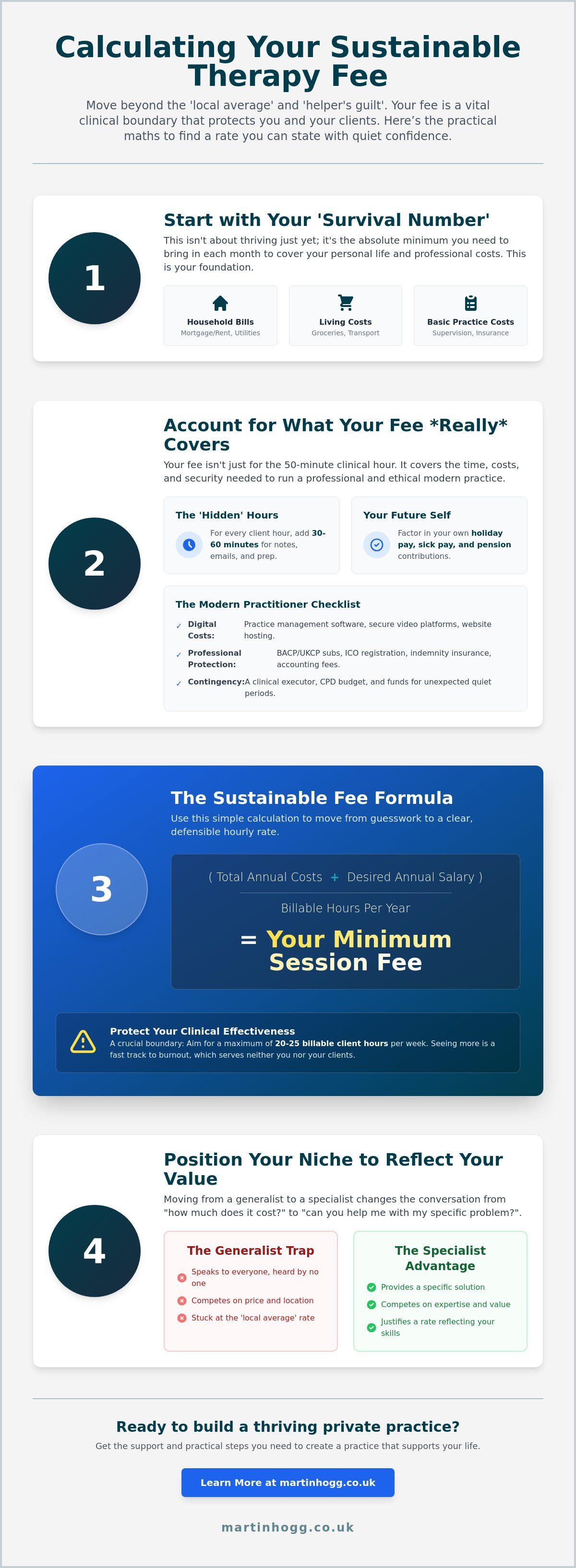
Setting your rate isn't just about picking a number that feels right or matches the therapist down the road. It starts with your "Survival Number." This is the absolute minimum you need to bring in each month to cover your mortgage, groceries, and professional costs. If you aren't sure how to map this out, looking at official government guidance on business planning can help you structure your financial outlook with more clarity.
When you look at how to set therapy fees uk practitioners often forget the "hidden hours." For every hour you spend in the chair, you likely spend another 30 to 60 minutes on notes, emails, and session prep. If you see 20 clients, you're actually working closer to 35 hours. Then there are the 2026 realities to consider. You need to fund your own sick pay, holiday time, and a private pension contribution. Without these, your practice isn't sustainable; it's a ticking clock.
The Modern Practitioner Checklist
Your overheads go beyond room hire and supervision. You have digital costs like practice management software, secure video platforms, and website hosting to maintain. Don't forget professional protection either. You'll need to account for accounting fees, BACP or UKCP subscriptions, ICO registration, and professional indemnity insurance. It's also wise to factor in the cost of a clinical executor to ensure your clients are looked after if you are suddenly unable to work.
The Formula for Your Hourly Rate
To find your fee, use this simple calculation: (Total Annual Costs + Desired Salary) divided by (Billable Hours per Year). I strongly recommend aiming for 20 to 25 billable hours per week. Trying to see 40 clients a week is a direct route to exhaustion and poor clinical work. If you want to dive deeper into building a practice that actually works for you, joining a supportive community like our Private Practice Success membership can provide the practical steps you need to get there.
Positioning Your Niche to Reflect Your Value
When you try to speak to everyone, you often end up being heard by no one. Generalist counsellors frequently find themselves trapped by a local price ceiling because they aren't offering a specific solution to a specific problem. If a client is looking for "any counsellor," they will likely choose based on price or proximity. However, when you develop a clear niche, such as anger management or working with men, the conversation shifts. You are no longer just an hourly cost; you are a specialist providing a targeted path to change.
Understanding marketing for therapists UK wide allows you to move beyond the local competition. Your CPD shouldn't just be about keeping your registration active. It is an investment in your expertise that directly impacts how to set therapy fees uk clients are willing to pay. When you have advanced training in a particular area, you bring a level of depth that a generalist simply cannot match. It's only fair that your fee reflects that specialised knowledge and the better outcomes it provides.
Moving Away from the Local Price Ceiling
In our digital-first world, you are no longer restricted to the average rates of your immediate town or city. You can transition from being a "local counsellor" to a "national specialist." This shift is powerful. By focusing on your unique experience, you can stand out in a crowded market. Clients will often use video calls to see an expert who truly "gets" their specific struggle, regardless of their postcode. This allows you to set fees based on your value rather than your geography.
Refining Your Professional Visibility
Your online presence must "look" like the fee you are charging. If you want to command a specialist rate, your website and directory profiles need to project that professional authority. It's about building trust before the first session even begins. Tools like the Practice Visibility Blueprint can help you align your professional image with the value you provide. If you're ready to stop being a generalist and start growing a sustainable, niche practice, come and see how we support therapists in our Private Practice Success membership.
Communicating Your Fees and Managing Increases Ethically
Transparency is the bedrock of a professional relationship. Hiding your rates until the end of a phone call or the first session creates unnecessary tension for both you and the client. Put your fee front and centre on your website and in your initial contract. When you are clear from the start, you attract clients who are already comfortable with your value and your professional boundaries. It saves time and builds trust before you've even met.
When someone asks about your fee during that first contact, state it clearly. There is no need for stuttering or defensive explanations. If you've done the work to understand how to set therapy fees uk practitioners can actually thrive on, you know your number is fair and necessary. If a client falls behind on payments, address it early. You can be compassionate about their situation while remaining firm about your boundaries. A therapist who ignores arrears often ends up carrying the client's financial stress into the room.
Schedule a regular fee review. Many therapists choose April to align with the start of the new tax year. It makes the conversation a standard part of your business cycle rather than a sudden, scary event. It's much easier to explain an increase when it's a planned, annual occurrence.
The 4-Step Fee Increase Framework
Managing an increase doesn't have to be awkward. Follow these steps to keep the process professional:
- Step 1: Give ample notice. Provide at least 4 to 8 weeks' notice in writing and mention it during a session so it can be processed clinically.
- Step 2: Briefly explain the "why." Mention increased overheads or professional growth, but don't over-apologise. You are a professional running a business.
- Step 3: Offer a grace period. Consider keeping a few "legacy rate" slots for clients in genuine financial hardship for a set period.
- Step 4: Update your clinical contract. Ensure the client consents to the new terms in writing to keep your records straight.
Automating Your Practice for Peace of Mind
Chasing payments is emotionally draining and a poor use of your clinical energy. Use practice management software to handle invoicing and card payments automatically. It removes the "money talk" from the end of the session, keeping the focus entirely on the therapeutic work. If you want to learn more about setting up these business systems, check our Private Practice Success events calendar for upcoming workshops and professional development sessions.
Building a Practice That Supports Your Life
Setting your fees isn't just an administrative task; it's a commitment to your own wellbeing and the long-term health of your practice. We've looked at moving past the guilt of charging, calculating your true overheads, and how a clear niche helps you stand out. By now, you should have a much clearer picture of how to set therapy fees uk practitioners can actually live on, allowing you to work without the constant shadow of financial stress or burnout.
You don't have to figure out the business side of counselling alone. If you're looking for a group of like-minded peers, I'd love for you to join the Private Practice Success Membership to master your business mindset. With over 20 years of experience in practice growth and a range of BACP-endorsed workshops, I've built this supportive community specifically for UK-based therapists who want to grow their work ethically. You've done the hard work of training to help others. Now it's time to ensure your practice takes care of you too. You've got this.
Frequently Asked Questions
What is the average hourly rate for a private therapist in the UK in 2026?
In 2026, the average rate for private therapy in the UK typically falls between £50 and £150 per hour. If you practice in a major city like London, Manchester, or Birmingham, average rates sit between £70 and £90, though many experienced therapists charge up to £150. Specialists in areas like CBT or trauma-focused work often command a 15 to 25 percent premium on these standard rates to reflect their advanced training.
Is it ethical to charge different fees for different clients (sliding scales)?
Yes, it's perfectly ethical to offer sliding scales or concessions as long as you are transparent and consistent with your criteria. Many practitioners set aside a specific number of slots for students or those on lower incomes. The key is to ensure your full-fee clients pay a rate that subsidises these lower-cost spaces. This balance ensures your practice remains financially viable and prevents you from feeling resentful about your work.
How often should I review and increase my therapy fees?
You should review your fees at least once a year, ideally every April to align with the start of the new tax year. This regular check allows you to account for rising professional costs, such as the 2026 BACP membership fee increases or general inflation. Making this an annual habit helps you understand how to set therapy fees uk clients can accept, as it becomes a standard part of your business cycle.
Should I display my fees prominently on my website?
Stating your fees clearly on your website is highly recommended for building trust and transparency. It acts as a helpful filter, ensuring that the people who contact you are already comfortable with your rates. This saves you from having awkward money conversations during initial enquiries and allows you to focus on the clinical work. Clear pricing projects professional confidence and respects the client's time and financial planning.
What should I do if a client says they can no longer afford my increased fee?
If a client struggles with an increase, handle it with a mix of compassion and professional boundaries. You might offer a "grace period" at their current rate for a few months or suggest moving to fortnightly sessions if it's clinically appropriate. If the new rate is truly unaffordable, you have a professional duty to provide a managed ending and offer referrals to lower-cost services so their support isn't simply cut off.

Article by
Martin Hogg
I help Private Practice counsellors in the UK set up and grow an ethical Private Practice they love, work with their ideal clients, and earn the income they deserve. All without guesswork and burnout. I have been a private practice counsellor myself for over 20 years, specialising in anger management. I set up a not-for-profit social enterprise, Citizen Coaching and Counselling, which delivers thousands of counselling sessions a year to adults and young people in Birmingham. I am a registered BACP Counsellor and the author of three books, My Anger Coach, My Anxiety Coach and My Relationship Coach. These are available on Amazon.
Disclaimer
The information provided on this blog is for general informational purposes only and is not intended to be a substitute for professional medical or mental health advice, diagnosis, or treatment. Reading this content does not create a therapist-client relationship.


