
How to Set Therapy Fees UK: Sustainable Pricing Guide

Article by
Martin Hogg
I help Private Practice counsellors in the UK set up and grow an ethical Private Practice they love, work with their ideal clients, and earn the income they deserve. All without guesswork and burnout. I have been a private practice counsellor myself for over 20 years, specialising in anger management. I set up a not-for-profit social enterprise, Citizen Coaching and Counselling, which delivers thousands of counselling sessions a year to adults and young people in Birmingham. I am a registered BACP Counsellor and the author of three books, My Anger Coach, My Anxiety Coach and My Relationship Coach. These are available on Amazon.
Charging a low fee isn't an act of kindness; it's a fast track to resentment and burnout. I know that "money guilt" feeling well. You want to help people, and asking for a professional rate can feel like you're putting a price tag on compassion. If you are wondering how to set therapy fees in the UK that counsellors can actually live on, remember that if your practice doesn't cover your supervision, BACP fees, and your own life, you won't be in a position to help anyone for very long.
I understand the fear that raising prices might drive clients away. However, setting a professional fee is about creating a boundary that protects your energy. I will show you how to move past the guilt and calculate a price that sustains both your practice and your life. We'll look at current UK market rates, account for your overheads, and provide a clear formula so you can state your price without stuttering. It's time to build a practice that works for you as much as it does for your clients.
Key Takeaways
- Drop the "money guilt" by reframing your fees as a professional boundary that prevents burnout and keeps your practice healthy.
- Learn the practical math of how to set therapy fees uk counsellors need to cover personal survival, UK tax, and essential overheads.
- Stop selling "an hour of talk" and start pricing based on the value and specific outcomes you provide through niche building.
- Use the "80% full" rule to know exactly when to raise your rates and get a professional script to tell your clients with confidence.
Moving Past the 'Helper' Guilt: Why Your Fees Matter
I see it all the time with UK counsellors; that sudden stutter when a potential client asks, "How much do you charge?" We often suffer from a deep-seated money awkwardness that suggests charging a fair rate is somehow uncharitable. But here is the truth: sustainable pricing isn't about greed. It is a fee structure that covers your professional growth, your BACP membership, and your future pension while allowing you to stay refreshed.
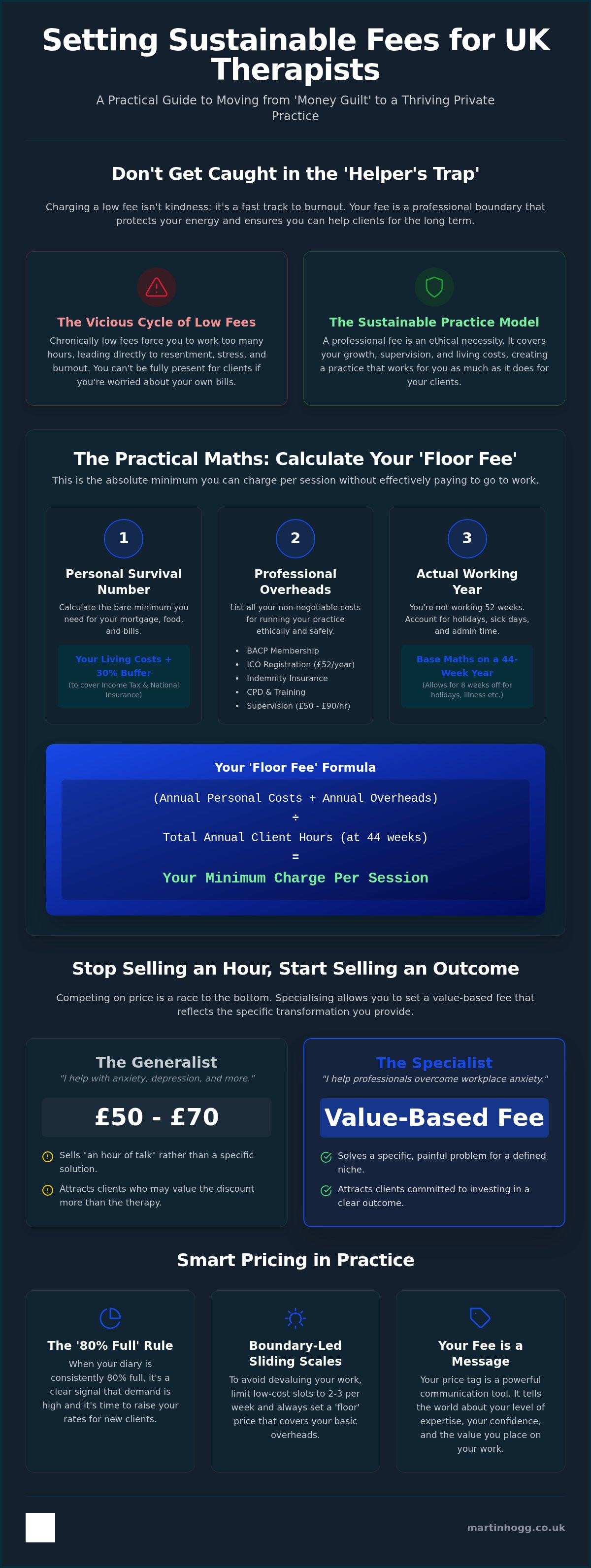
The "Helper's Trap" is a dangerous cycle where chronically low fees lead directly to therapist burnout because you're forced to work too many hours just to keep the lights on. If you're stressed about your own mortgage, you simply cannot be fully present for the delicate work of psychotherapy. Learning how to set therapy fees uk practitioners can actually live on is an ethical necessity, not a business luxury.
The Psychology of the Price Tag
Your fee is a powerful communication tool. It tells the world about your level of expertise and your specific focus. When you engage in niche building for counsellors, your price reflects a specific outcome rather than just a generic hour of talk. There's also a "Value Paradox" at play; I've found that clients often commit more deeply to the therapeutic process when they've made a significant financial investment in their own progress.
Setting Boundaries with Sliding Scales
Sliding scales can help you stay accessible to underserved communities, but they often turn into a "sliding down" scale where you end up undercharging almost everyone. To stop this from devaluing your work, you need firm boundaries. I suggest limiting your low-cost slots to a maximum of two or three per week. Always set a "floor" price that covers your basic overheads so you aren't paying out of your own pocket to see a client.
The Practical Math of a Sustainable Private Practice
Setting your rate by simply looking at the local average on a directory is a mistake. Your practice has its own unique costs that others might not have. First, calculate your 'Personal Survival Number'. This is the bare minimum you need for your mortgage, food, and bills, plus a 30% buffer to cover your 20% Income Tax and 6% Class 4 National Insurance. When you are working out how to set therapy fees uk practitioners often forget that the tax man always takes his cut first.
Next, list your professional overheads. This includes your £52 ICO registration, professional indemnity insurance, and your cpd for counsellors uk requirements. Don't forget supervision costs, which typically range from £50 to £90 per hour. These are non-negotiable costs of doing business safely and ethically.
The real secret to sustainability is accounting for 'Hidden Hours'. You aren't just working when you're in the room with a client. You have admin, marketing, and session notes to handle. I recommend basing your math on a 44-week working year. This allows for holidays and the inevitable winter flu. Divide your total annual costs by your target clinical hours to find your 'Floor Fee'. This is the absolute minimum you can charge without effectively paying to go to work.
Factoring in the 2026 Cost of Living
Old rates from three years ago won't cut it in 2026. Inflation has hit room rents and utility bills hard. If you don't build in a margin for your own sick pay and savings, you're one bad week away from a financial muddle. Planning for these gaps is the 'Self-Employed Tax' you must pay yourself first.
Using the Counsellor Efficiency Bundle
I suggest using the Counsellor Efficiency Bundle to track your time and expenses accurately. Streamlining your admin ensures more of your fee stays in your pocket rather than being wasted on inefficient processes. If you want to discuss these calculations with peers who understand the struggle, come and join our private practice community.
Beyond the 'Average' Rate: Niche and Value-Based Pricing
Competing on price is a race to the bottom that you don't want to win. If you try to be the cheapest counsellor in your postcode, you'll attract clients who value the discount more than the actual transformation. When you're figuring out how to set therapy fees uk practitioners can be proud of, you need to stop thinking like a generalist and start thinking like a specialist. People pay for solutions.
Specialist rates in the UK market are consistently higher because they solve specific, painful problems. While a generalist might charge the average £50 to £70, a specialist using niche building for counsellors can often charge significantly more. You aren't selling "an hour of talk"; you're selling a specific outcome. On directories like Psychology Today, don't be afraid to list your specialist rate. It signals competence rather than looking like a bargain-bin option.
The 'Skateboard Model' for Pricing
I always advocate for the "skateboard model" when testing new fees. Instead of overhauling your entire practice, create a "rough and ready" landing page for a new niche. Test your higher fee there first to see how people respond. Authentic, unpolished content often builds more trust than a corporate-looking site because it feels human and relatable. It is better to be out there with a simple, effective offer than waiting for a "perfect" website that never launches.
Communicating Value Above the Fold
Your "above the fold" content must justify your fee immediately. Use a clear one-sentence offer that states exactly who you help and what you do. Mention your fee clearly on your site, but don't make it the headline. Let the value of your work lead the conversation. By the time they see the price, they should already feel that you understand their struggle deeply.
Raising Your Fees: The Strategy and the Script
Deciding how to set therapy fees uk counsellors can rely on is only half the battle. The real nerves kick in when it's time to increase them. I use the '80% Full' rule. If your diary is 80% occupied, your demand is high enough to justify a price rise. Start by applying the new rate to new enquiries first. This builds your confidence before you approach existing clients.
When you do write that fee increase letter, keep it short. You don't need to justify your mortgage or the price of eggs. A simple, "From [Date], my session fee will be £X," is professional and clear. If a client says they can't pay the new rate, you can choose to 'grandfather' them in for a set period. However, remember that your practice must remain sustainable as part of your wider plan for scaling a therapy practice.
Updating Your Digital Presence
Consistency is key for trust. Make sure your new fees match across your Squarespace site, Psychology Today profile, and any Canva graphics you use for social media. I find using Calendly is a lifesaver here. You can set your new rate in the booking settings so every new enquiry is automatically charged the correct amount. It removes that awkward first conversation about money entirely.
Joining the Private Practice Success Community
Talking about money is still a bit of a taboo in our profession. That is why I encourage therapists to join the Private Practice Success Membership. It is a safe space to get peer feedback on your structure. We even do 'money roleplay' sessions. Practising the words out loud with other therapists helps you state your price without that tell-tale stutter. You'll soon realise that a fair fee is simply a part of a healthy, functioning practice.
Build a Practice That Sustains Your Life
Setting a professional rate is about more than just numbers; it's about the longevity of your career. We've covered the maths of survival and why niche specialism beats competing on price every time. Understanding how to set therapy fees uk practitioners can thrive on means you can finally stop worrying about the bills and start focusing on the transformation you provide in the room. You have the tools to calculate your floor fee and the script to raise your rates with confidence.
Joining our network gives you access to the BACP-endorsed Practice Visibility Blueprint and live training sessions. You don't have to struggle with money talk in isolation; you'll have a supportive therapist network by your side to help you stay grounded.
Your practice is a bridge to a better future for your clients, but it has to be a stable one. I'm here to help you shore up those foundations. Let's get started on making your professional support standard, accessible, and sustainable for the long term.
Common Questions About Setting Therapy Fees
Is it unethical for a therapist to charge a high fee in the UK?
No, it isn't unethical to charge a fee that reflects your expertise and keeps your practice stable. The BACP doesn't set caps on what you can charge. It's actually more unethical to be so stressed about your own mortgage that you can't be fully present for your clients. High fees often allow you to fund low-cost slots for others, which is a very practical way to maintain accessibility.
Should I list my therapy fees on my website or wait until the first call?
I always recommend listing your fees clearly on your website to build trust and save everyone time. When you're deciding how to set therapy fees uk clients can see upfront, remember that transparency filters out people who aren't a fit for your price point. It prevents that awkward moment at the end of a consultation when a client realises they can't afford you, which is better for everyone's wellbeing.
How often should a private practice counsellor increase their rates?
You should review your rates at least once a year to keep up with rising costs like BACP membership and room rent. Most UK therapists find an annual review keeps their practice sustainable without needing a massive, shocking price jump later. If you haven't raised your prices in two years, you're effectively taking a pay cut. I find that small, regular increases are much easier for your clients to digest.
What is the average hourly rate for a private counsellor in the UK in 2026?
The average rate for private counselling in the UK currently sits between £50 and £90 per session. In London, these rates often rise to between £70 and £110. Specialists and psychologists often charge significantly more, with some rates reaching £180 per hour. These figures are based on recent BACP surveys and market research, but remember that your fee must always be based on your own specific overheads and survival number.
How do I handle clients who ask for a discount or a sliding scale slot?
Be direct and kind by stating your policy clearly without over-explaining your reasons. If you have a sliding scale slot available, tell them the specific price and how long it's available for. If you're full, simply say your low-cost slots are currently taken but you can offer a waiting list. This keeps your boundaries firm and prevents your practice from sliding into an unstable model that leads to therapist burnout.
Disclaimer
The information provided on this blog is for general informational purposes only. It is also not intended to be a substitute for professional medical or mental health advice, diagnosis, or treatment. Reading this content does not create a therapist-client relationship.


