
How to Set Your Therapy Fees UK: A Practical Guide for 2026

Article by
Martin Hogg
I help Private Practice counsellors in the UK set up and grow an ethical Private Practice they love, work with their ideal clients, and earn the income they deserve. All without guesswork and burnout. I have been a private practice counsellor myself for over 20 years, specialising in anger management. I set up a not-for-profit social enterprise, Citizen Coaching and Counselling, which delivers thousands of counselling sessions a year to adults and young people in Birmingham. I am a registered BACP Counsellor and the author of three books, My Anger Coach, My Anxiety Coach and My Relationship Coach. These are available on Amazon.
What if I told you that undercharging your clients isn't actually an act of kindness, but a slow-motion recipe for clinical burnout? It's a common trap. You want to be accessible, but scrolling through local directories often triggers a nasty case of comparisonitis that leaves you feeling guilty for wanting a decent living. With the 2026 tax year bringing a 3.5% inflation forecast and BACP membership fees on the rise, simply guessing your rate is no longer a sustainable strategy.
I know how uncomfortable the money conversation can feel. You want to help people, not haggle over pennies. In this guide, I'll show you how to set your therapy fees uk using a clear mathematical formula that accounts for your personal allowance, National Insurance, and those hidden hours spent on notes and emails. You'll learn how to calculate a rate that supports your life and your practice without the stuttering or the helper's guilt. We are going to move from financial anxiety to a grounded, practical fee structure that ensures you can keep doing this vital work for years to come.
Key Takeaways
- Stop using local directories as a price guide; copying the "local average" is usually a fast track to resentment and a struggling practice.
- Learn how to set your therapy fees uk by using a realistic formula that accounts for the 2026/27 tax year and your professional overheads.
- Understand how a specific niche and a clear "one-sentence offer" move you away from being a generalist commodity and justify a professional rate.
- Discover how to state your price with confidence and use tools like Stripe or Calendly to handle payments without the awkwardness.
The Psychology of Pricing: Moving Past the Helper’s Guilt Trap
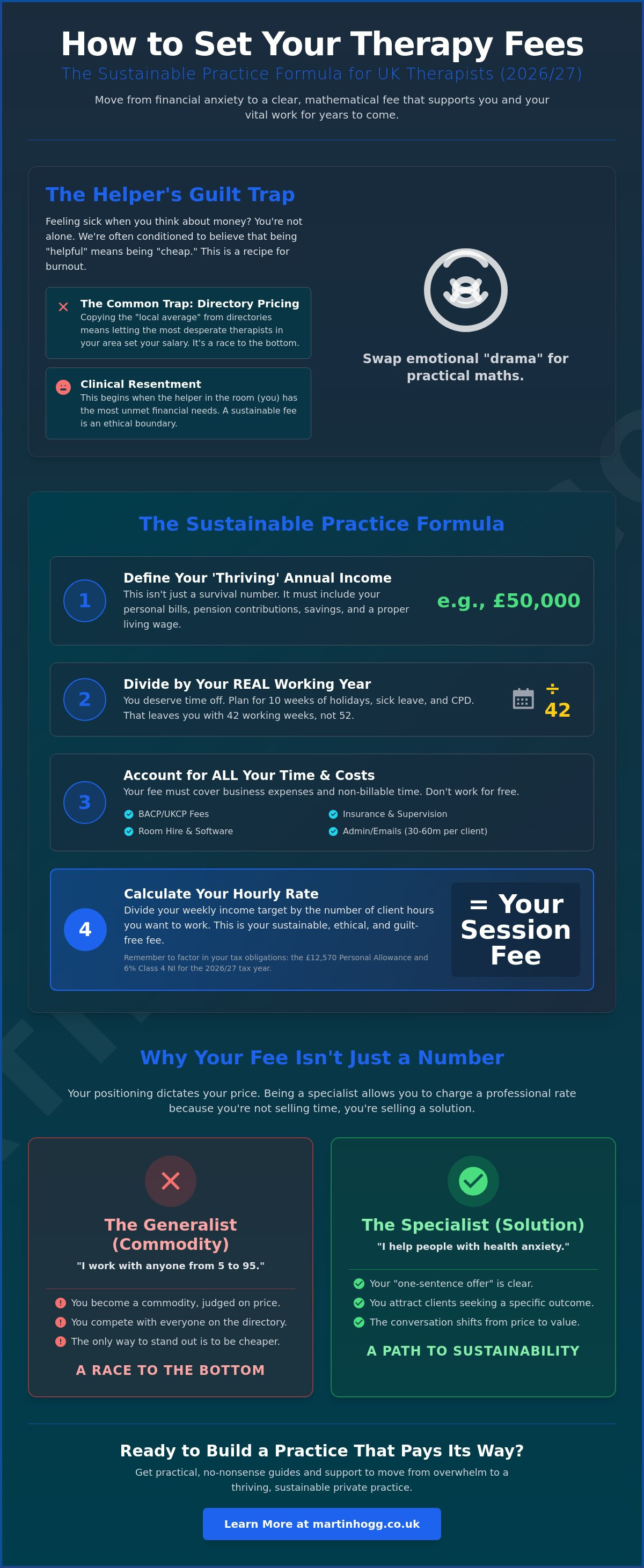
Most counsellors I talk to feel a bit sick when they think about money. We have been conditioned to think that being "helpful" means being "cheap." But here is the truth: a sustainable fee is simply the rate that covers your costs, your 2026/27 taxes, and a proper living wage without you feeling resentful. If you are constantly checking the Counselling Directory to see what the "local average" is, you are essentially letting the most desperate people in your area set your salary. It is a race to the bottom that nobody wins.
Undervaluing your work isn't just bad for your bank account; it is a disservice to the therapeutic process itself. When you charge too little, you are subtly telling the client that the work isn't worth much. Clinical resentment begins the moment the "helper" becomes the person in the room with the most unmet financial needs.
Maths vs Drama: Why Your Stomach Knots at the Word "Fee"
We often wrap our fees in "drama." Thoughts like "I’m not experienced enough" or "They can’t afford me" start to swirl. I want you to separate the maths from the emotion. Understanding The Psychology of Pricing can help you see that your fee is a professional boundary, not a judgment on your client’s character. It is the price of your availability and your stability. When you know how to set your therapy fees uk based on facts rather than feelings, the knots in your stomach start to loosen.
The Ethical Case for a Sustainable Rate
Think of it as the oxygen mask principle. If you are worrying about your own mortgage or the 3.5% inflation forecast for late 2026, you cannot be fully present for the person sitting across from you. A stable income allows you to invest in better CPD and maintain a focused clinical presence. If you need a community that understands this balance, my Private Practice Success Membership is a great place to start. Building a practice that lasts is the most ethical thing you can do for your clients.
The Sustainable Practice Formula: Business Maths for 2026
Let's get the calculator out and look at the cold, hard numbers. Sticking your head in the sand about your overheads is the quickest way to close your doors. When you are figuring out how to set your therapy fees uk for the 2026/27 tax year, you must account for the £12,570 personal allowance and Class 4 National Insurance at 6% on your profits. Professional costs are climbing too; BACP membership fees increased by an average of 2% this year, and UKCP full membership sits at £314. Add in supervision (typically £40 to £80 per hour), insurance, and room hire, and your "take-home" pay can vanish if you aren't careful.
I suggest using the "Skateboard Model" for your overheads. Keep things lean while you are building your visibility. You don't need a mahogany desk or a five-page website yet; you need a practice that pays its way. Remember that your fee must also cover your non-billable hours. For every clinical hour, you likely spend 30 to 60 minutes on admin, emails, and preparation. If you don't charge for that time, you are effectively working for free.
Calculating Your Hourly Rate Step-by-Step
First, identify your "survival" figure (the bare minimum to pay the bills) and your "thriving" figure (which includes a private pension and savings). Divide that annual total by 42 weeks. Why 42? Because you deserve 10 weeks of holidays, sick leave, and training. This gives you a realistic target. If you are worried about filling those slots at your new rate, have a look at my Practice Visibility Blueprint for some practical steps on growing your reach.
The Sliding Scale Dilemma
Many therapists offer a sliding scale out of a sense of duty, but too many low-cost slots will lead you straight to burnout. You must set a "floor" price that you never go below. Being clear about your costs isn't just business; it is part of BACP's Ethical Framework, which requires us to be honest and clear about our financial commitments. If you want to dive deeper into these calculations with a supportive group, come and join us in the Private Practice Success Membership. Having a community to talk these things through makes the process feel much less lonely.
Positioning and Niching: Why Your Fee Isn’t Just a Number
If you describe yourself as a "generalist" who works with "anyone from age five to ninety-five," you are essentially telling the world you are a commodity. Commodities are always judged on price. When you are a generalist, you are competing with every other therapist on the Counselling Directory, and the only way to stand out is to be cheaper. This makes figuring out how to set your therapy fees uk a race to the bottom that leaves you exhausted and underpaid.
Positioning yourself as a specialist changes the conversation entirely. When you have a clear "one-sentence offer" that targets a specific problem like anger management or health anxiety, you stop selling time and start selling a solution. Clients don't actually want to buy a 50-minute hour; they want to buy the transformation that allows them to sleep through the night or stop shouting at their kids. People pay for the restoration of their personal trajectory, not for a slot in your diary.
Your Website as a Value-Signal
Your website and your Psychology Today profile should act as trust-builders before the price is even mentioned. What you place "above the fold" on your site should speak directly to the client's pain and your specific solution. Interestingly, "rough and ready" content often builds more trust than polished, corporate-style headshots. A simple, honest video of you talking about how you help can make a client feel safe enough to pay a professional rate because they connect with the person, not the brand.
The Specialist Premium
Investing in specific CPD for counsellors uk translates directly into fee-setting power. Take my work with men as an example. A therapist who specialises in working with men can often justify a higher fee than a generalist because they understand the unique social stigmas and communication styles that demographic brings to the room. This level of expertise is a clinical asset. Being transparent about your specialist fees is also a key part of BACP's Ethical Framework, which ensures all financial arrangements are fair and clear from the start. If you want to learn how to build a niche that reflects your true value, I'd love to help you in the Private Practice Success Membership.
Handling Fee Conversations and Increases Ethically
I know that stating your price can feel like walking a tightrope. You don't want to sound like a cold corporate machine; you also don't want to stutter over your own value. When someone asks about your rate, the trick is to state it clearly and then stop talking. Over-explaining or apologising for your fee usually signals that you aren't comfortable with it yourself. If you have followed the steps on how to set your therapy fees uk based on your actual costs, you can speak with the confidence of someone who knows their business is sustainable.
Money friction is a real clinical distraction. If you are spending the first five minutes of a session chasing a bank transfer, you are eating into the therapeutic work. I recommend using tools like Stripe or Calendly to automate the process. Letting a client book and pay upfront reduces the "transactional" feeling of the session itself, allowing you both to focus entirely on the work. It is a simple, professional way to keep the boundaries clean.
Increasing fees for existing clients requires a gentle but firm approach. I use a simple 4-step framework:
- Check the contract: Ensure your initial agreement mentions an annual review.
- Give notice: Provide at least two months' notice before the change takes effect.
- Be direct: Send a clear email or letter stating the new fee and the date it starts.
- Allow space: Invite the client to discuss any clinical impact the change might have.
The Annual Fee Review
The best time to talk about fee increases is before they happen. Make fee reviews a standard part of your clinical contract from day one. Many therapists align their reviews with the new tax year in April. This makes the increase feel like a standard professional adjustment rather than a personal decision. If you are worried about the clinical processing of a price rise, remember that being honest about your business needs is a model of healthy, adult boundaries for your clients.
Dealing with Price Enquiries
You will eventually hear someone say, "That’s more than I expected." Your instinct might be to lower your price on the spot, but I urge you not to. Instead, acknowledge their concern and offer alternatives, such as bi-weekly sessions or a referral to a lower-cost service. Holding your line shows that you value your expertise and the stability of your practice. If you find these transitions difficult, you can find plenty of scripts and moral support in the Private Practice Success membership. Having a community behind you makes these money talks much less intimidating.
Building a Practice That Lasts Beyond 2026
You now have the tools to move from "helper's guilt" to a practice that actually pays the bills. We've covered the business maths of the 2026 tax year and why finding your niche is the only way to escape the generalist price trap. Remember that your fee is a boundary that protects your energy. If you aren't financially stable, you can't be the steady presence your clients need.
Mastering how to set your therapy fees uk is just the beginning of your journey. If the thought of spreadsheets and marketing still feels a bit heavy, you don't have to figure it out alone. I'm Martin Hogg, founder of Citizen Coaching, and I've spent over 20 years helping therapists grow sustainable businesses through my BACP-endorsed workshops and coaching.
Join the Private Practice Success Membership for more support with your business maths. You'll get the practical tools and community support you need to turn your passion into a thriving, resilient practice. You've done the hard work of training; now let's make sure your business is built to last.
Frequently Asked Questions
What is the average hourly rate for a private therapist in the UK in 2026?
The average rate currently sits between £50 and £150 per hour. In major cities like Manchester, Birmingham, and London, you will typically find rates between £70 and £90; though experienced therapists in the capital often charge up to £110. While these figures help you understand the market, remember that your specific niche and overheads are the most important factors in how to set your therapy fees uk successfully.
Is it ethical to charge different fees for different clients?
Yes, it is perfectly ethical as long as you are transparent and consistent. Many practitioners maintain a few low-cost slots with a strict "floor" price while charging a specialist premium for others. This approach allows you to support underserved demographics without draining your own bank account. Just ensure your fee structure is clearly explained in your initial contract to avoid any clinical boundary issues later on.
How often should I increase my therapy fees?
I suggest reviewing your fees every year, usually in April to match the start of the new tax year. With UK inflation forecast at 3.5% for the end of 2026 and BACP membership costs rising by 2%, a small annual adjustment is much better than a massive jump every five years. Regular reviews keep your practice sustainable and make the conversation a normal, professional part of your business cycle.
Should I list my fees on my website or wait for the enquiry?
You should definitely list your fees clearly on your website. Hiding your price often leads to "tyre-kickers" and awkward phone calls that waste your time and the client's energy. Being upfront about your rate builds immediate trust and ensures that the people who do get in touch are already comfortable with your pricing. It is a simple way to reduce money friction before the first session even begins.
How do I handle clients who can no longer afford my increased rate?
Offer a fair notice period or a "grandfathered" rate for a set number of sessions to help them finish their current work. If the new fee is genuinely out of reach, have a list of trusted lower-cost services or local trainees ready for referral. Being firm about your professional value doesn't mean you are being unkind; it means you are maintaining the stability required to keep your practice open for everyone.
Disclaimer
The information provided on this blog is for general informational purposes only and is not intended to be a substitute for professional medical or mental health advice, diagnosis, or treatment. Reading this content does not create a therapist-client relationship.


