
How to Set Your Therapy Fees UK: A Practical Guide to Sustainable Pricing

Article by
Martin Hogg
I help Private Practice counsellors in the UK set up and grow an ethical Private Practice they love, work with their ideal clients, and earn the income they deserve. All without guesswork and burnout. I have been a private practice counsellor myself for over 20 years, specialising in anger management. I set up a not-for-profit social enterprise, Citizen Coaching and Counselling, which delivers thousands of counselling sessions a year to adults and young people in Birmingham. I am a registered BACP Counsellor and the author of three books, My Anger Coach, My Anxiety Coach and My Relationship Coach. These are available on Amazon.
Most counsellors treat their fee structure like a guilty secret rather than a business necessity. You probably entered this profession to help people, not to crunch numbers, and asking for money can feel like you're putting a price tag on someone's distress. It's a common struggle; you worry that if you charge a professional rate, your diary will dry up and you'll be left staring at an empty Calendly link.
I understand that tension. You want to be accessible, but you also need to pay your mortgage and fund your own CPD. Learning how to set your therapy fees uk wide is about more than just picking a number out of thin air or copying what the person down the road charges. It's about building a practice that is sustainable for the long haul. I'm going to share a straightforward, guilt-free method to set fees that cover your actual practice costs while reflecting your true value as a clinician.
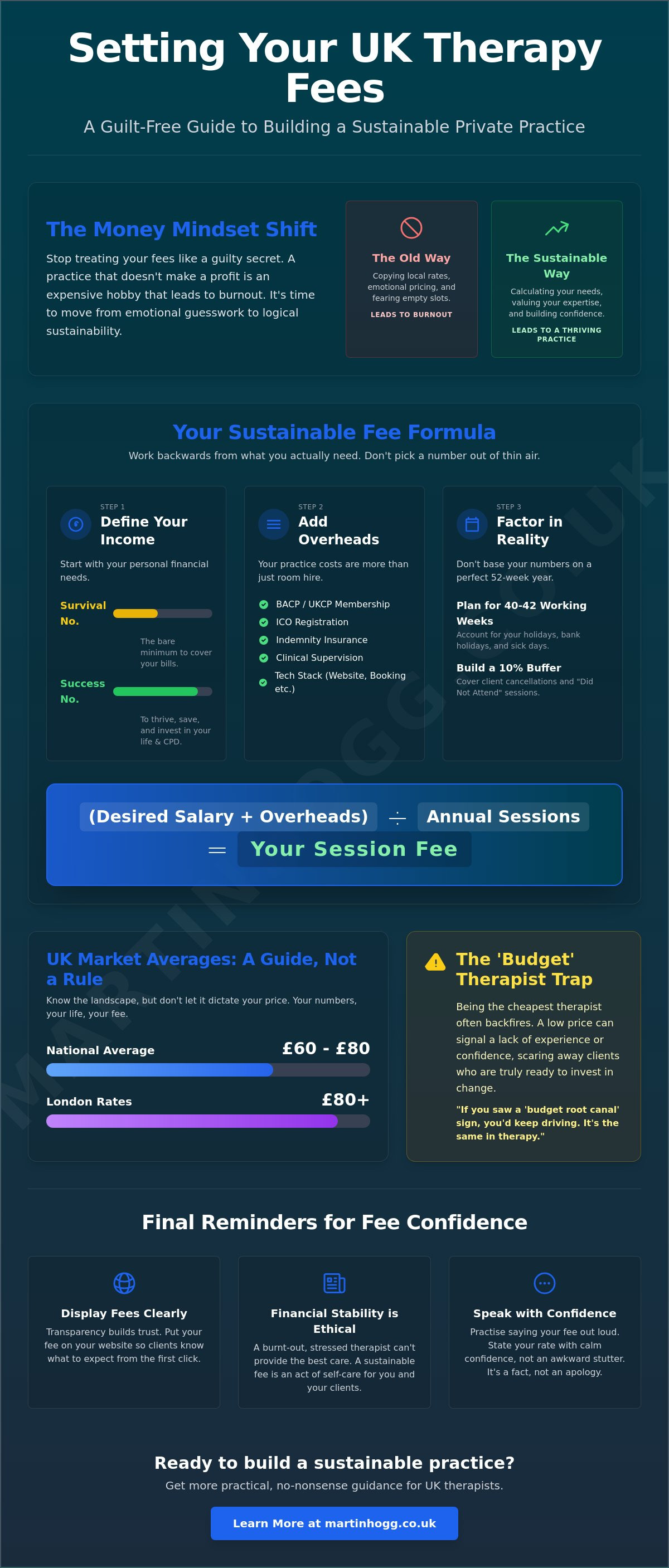
In this guide, we'll look at the latest UK market data, from the £60 to £80 national average to the higher London rates. We will break down your overheads and show you how to find a price point that feels fair to your clients and respectful to your bank account.
Key Takeaways
- Stop treating your fees like a moral dilemma and start seeing them as the engine that keeps your practice running as a sustainable enterprise.
- Get a clear, practical method for calculating your take-home pay after accounting for UK overheads like BACP membership, insurance, and supervision.
- Understand the psychology of pricing and why being the "budget option" often accidentally scares off the very clients who are most ready to commit to the work.
- Learn exactly how to set your therapy fees uk wide and where to display them on your website to build transparency and trust from the first click.
- Pick up a simple approach for talking about money during that first enquiry call so you can state your rate with calm confidence instead of an awkward stutter.
Overcoming the Money Drama: Why Therapy Pricing Feels So Hard
Setting your rate often feels like a moral exam you're destined to fail. I talk to so many counsellors who feel a deep, nagging guilt about charging for their time. We've been trained to provide a service that is deeply human, so putting a price on it can feel a bit grubby. But here's the reality: you aren't a charity. Even if your heart is in the right place, a practice that doesn't make a profit is just an expensive hobby that will eventually lead to burnout.
Shifting your perspective to a "Therapy Fee Mindset" means moving from emotional guesswork to logical sustainability. You need to understand how to set your therapy fees uk style by looking at your business as a social enterprise. This means your fees don't just pay for your time; they pay for your ability to keep showing up. There's also a persistent myth that dropping your prices will magically fill your diary. In reality, being the cheapest person in town often triggers psychological pricing theory in a client's mind. They might wonder why you're so cheap and assume you aren't as experienced as the therapist charging a professional rate. If you want to move past this, joining the Private Practice Success Membership can help you find that confidence alongside other peers.
The Trap of the 'Local Going Rate'
It's tempting to open the Counselling Directory or Psychology Today, look at what everyone else is doing, and pick a number in the middle. I call this the race to the bottom. When you copy your neighbour's fees, you're inheriting their business model without knowing if it actually works. They might have a spouse covering the mortgage or a low-rent room deal you don't have. You need a price that works for your life, not theirs.
Ethics vs. Sustainability
We often talk about ethics in terms of boundaries and CPD, but financial stability is a massive part of being fit to practice. If you're undercharging, you're likely overworking to make ends meet. A burnt-out, stressed therapist who is worrying about their own bills isn't providing the best care. Setting a sustainable fee is actually an ethical act; it ensures you have the energy, the supervision, and the self-care needed to stay in this profession for years, not just months.
The Practical Calculation: Finding Your Sustainable Living Number
Most therapists pick a fee based on what they think people can afford. I want you to flip that. Start with what you need to live. Your "Survival Number" is the bare minimum to keep the lights on. Your "Success Number" is what you need to actually enjoy your life, put money aside for taxes, and buy a decent coffee without checking your bank balance. When you are looking at how to price your services, you have to work backwards from your desired take-home pay.
To get this right, you need to be honest about your clinical hours. You aren't a factory. You cannot see 40 clients a week without losing your mind. Most sustainable practices aim for 15 to 20 clinical hours. If you want to know how to set your therapy fees uk practitioners actually thrive on, you take your total annual costs, add your desired salary, and divide it by your realistic annual sessions.
UK Practice Overheads Checklist
Your overheads are often higher than you think. It isn't just the room hire. Here is what you need to track:
- Professional Memberships: BACP or UKCP annual fees.
- Legal Requirements: ICO registration, which costs £40 for most sole traders.
- Protection: Professional indemnity insurance.
- Clinical Supervision: A fixed monthly cost regardless of your client numbers.
- The Tech Stack: Squarespace or WordPress hosting, Canva Pro for your marketing, and Calendly for booking.
If managing these costs feels like a headache, the Practice Visibility Blueprint can help you streamline your growth without wasting money on tools you don't need.
Accounting for the 'Gap' Weeks
Don't calculate your income based on 52 weeks. It's a trap. Between your own holidays, bank holidays, and the inevitable flu that wipes out the whole house, you'll likely only work 40 to 42 weeks a year. You also need to factor in "Did Not Attend" (DNA) instances. Even with a solid cancellation policy, you won't collect 100% of your fees 100% of the time. Build a 10% buffer into your fee to cover these gaps so a quiet week doesn't become a financial crisis.
Positioning Your Practice: Why the 'Budget Therapist' Label Fails
There is a peculiar bit of human logic that says if something is too cheap, it probably isn't very good. If you saw a dentist advertising a "budget root canal" on a hand-drawn sign, you would likely keep driving. Therapy works in much the same way. When you are figuring out how to set your therapy fees uk clients will actually trust, you have to realise that your price is a signal of your competence. A fee that is significantly lower than the local average doesn't look like a bargain; it looks like a lack of experience or a lack of confidence.
Your fee also acts as a natural filter. Clients who pay a professional rate are often more invested in the process. They aren't just "trying out" therapy; they are making a financial and emotional commitment to change. To bridge the gap between what you cost and what you're worth, I recommend using a "One-Sentence Offer." Instead of telling people you are a "warm, non-judgmental counsellor," tell them exactly what problem you solve. For example: "I help parents of teenagers stop the shouting and start communicating again." This moves the conversation away from your hourly rate and onto the transformation you provide.
The Skateboard Model for Pricing
You don't need a polished, 50-page website with professional photography to justify a solid fee. I'm a big believer in the "skateboard model." This is about getting a simple, one-page site live; what I call a "rough and ready" MVP; and setting a professional fee from day one. You can always increase your rates as your visibility grows and your diary fills up. Starting too low makes it much harder to raise them later without losing your initial client base.
Niche-Specific Pricing
Generalists often get stuck in a price war. Specialists don't. When you focus on Niche building for counsellors, you stop being "just another therapist" on the Counselling Directory. Specialised training, such as my Anger Management CPD or the Working with Men course, allows you to position yourself as an expert. Experts command higher fees because they solve specific, painful problems. If you want to stop the guesswork and start building a practice that actually pays, come and join us in the Private Practice Success Membership for more practical steps.
Implementing and Communicating Your Fees Confidently
Once you've crunched the numbers and decided how to set your therapy fees uk style, you have to actually say them out loud. Being shy about your prices doesn't make you more therapeutic; it just makes you look disorganised. Most people browsing for a therapist are already feeling overwhelmed. They don't want to hunt through three pages of your philosophy just to find out if they can afford the session. Being clear about money is actually a form of containment.
I'm a big fan of the "Rough and Ready" approach if you're nervous about a price hike. You don't have to change your entire website overnight. Try out your new fee with the very next enquiry that comes in. If they say yes without hesitation, you know your new rate is fair. If you find yourself stuttering over the phone when someone asks for your rate, practice saying it out loud in the mirror until it sounds like a neutral fact, like your phone number or your shoe size.
Website Visibility and Fee Transparency
Hiding your fees behind a "contact me" button is a great way to lose potential clients. Put your fees "above the fold" on your pricing page. This means the price should be visible as soon as the page loads without the user having to scroll. You can also use your title and description tags to manage expectations before the click. If your search result says "Anxiety Therapy in Birmingham; £70 per session," you'll only get clicks from people who are happy with that rate. For more tips on how to lay out your site for maximum impact, have a look at my guide on Marketing for Therapists in the UK.
The Annual Fee Review
Don't wait for a financial crisis to raise your rates. Set a date every year, I usually recommend April to match the UK tax year, to review your clinical hours and your overheads. Raising fees for existing clients requires at least a month's notice. Write a simple, human email. You don't need to justify it with a list of your rising electricity bills. Just state that your fee is increasing to a specific amount from a specific date. Most clients who value the work you do together will accept this as a normal part of a professional relationship. If you want to refine your communication style, the Private Practice Success Membership is a great place to get feedback from peers who have been exactly where you are now.
Building a Practice That Supports Your Life
You didn't spend years training just to end up stressed about your own bank balance. We've covered the shift from emotional pricing to logical sustainability, and the importance of accounting for every real-world UK practice overhead. Understanding how to set your therapy fees uk style is the first real step toward a practice that doesn't just survive but actually thrives. It's about moving away from the "budget" label and standing confidently in the transformation you provide for your clients.
I've spent over 20 years in the UK private practice world, and I know that the therapists who last are the ones who treat their business with respect. If you're ready to stop the guesswork, join the Private Practice Success community to master your practice growth. You'll get access to the Practice Visibility Blueprint and my BACP-endorsed workshops to help you build a solid foundation. You have a valuable skill that people genuinely need. Setting a sustainable fee ensures you can keep showing up for them for the long haul. You've got this.
Frequently Asked Questions
What is the average cost of a private therapy session in the UK?
Independent therapists across the UK typically charge between £55 and £120 per session. You will find that London rates are often higher, usually sitting between £90 and £150, while smaller towns often hover between £50 and £80. These figures provide a helpful benchmark when you are researching how to set your therapy fees uk wide. Specialist work like CBT or couples therapy often commands a 15% to 25% premium.
Should I offer a sliding scale or 'concessionary' rates for low-income clients?
Offering a few lower-cost slots is a personal choice, but it shouldn't be your default setting. If you want to offer concessions, I suggest limiting them to a specific number of slots, perhaps two or three. This ensures you are still running a sustainable practice. It's much better to have a solid full-fee base that allows you to occasionally offer a lower rate than to undercharge everyone and end up resenting your diary.
How do I tell my existing therapy clients that I am raising my fees?
Tell your clients at least a month in advance using a clear and human email. You don't need to over-explain or apologise for your business costs. A simple message stating that your fee is increasing to a specific amount from a certain date is usually enough. Most people understand that professional services occasionally need to adjust their rates. It's a standard part of a working relationship, not a personal rejection of the client.
Is it ethical to charge for missed sessions or late cancellations in the UK?
It is entirely ethical and standard practice to charge for missed sessions if you have a clear policy in place. You are being paid for your time and the availability of the space, not just the talking. Make sure your cancellation policy is clear in your initial contract so there are no surprises. Most UK therapists find that a 24 or 48-hour notice period works best for both parties and helps maintain professional boundaries.
Do I need to display my fees on my website or Counselling Directory profile?
You should absolutely display your fees clearly on your website and profiles like Psychology Today or the Counselling Directory. Transparency builds trust and saves everyone time. When people can see your price immediately, they don't have to experience the awkwardness of asking and finding out they can't afford you. It acts as a helpful filter, ensuring that the enquiries hitting your inbox are already comfortable with your professional rate.
Disclaimer
The information provided on this blog is for general informational purposes only and is not intended to be a substitute for professional medical or mental health advice, diagnosis, or treatment. Reading this content does not create a therapist-client relationship.


