
How to Start a Therapy Group: A Practical Guide for UK Counsellors
What if the standard 50-minute one-to-one session is actually the biggest barrier to your professional growth? Many UK counsellors are trapped in a cycle of back-to-back appointments, contributing to the 44% burnout rate reported among practitioners in 2023. You likely entered this profession to make a real difference, yet a full caseload can leave you feeling drained by 4:00 pm every Tuesday. Learning how to start a therapy group is the most effective way to reclaim your time while providing high-quality, accessible support to those who need it most.
I know the transition feels daunting. You might worry about managing complex group dynamics or fear you won't be able to fill the seats. This guide provides a clear, step-by-step roadmap to help you launch your first group with total confidence. We'll look at building a sustainable model that moves you beyond the limitations of hourly work and into a more impactful way of practising. From clinical safety to practical marketing, you'll learn exactly how to get your group off the ground and help your community thrive.
Key Takeaways
Break through the "solo ceiling" of one-to-one work by creating a more sustainable practice that helps more people without burning you out.
Discover the essential logistics for how to start a therapy group, including choosing between open and closed models and finding professional UK-based premises.
Learn how to identify a high-demand niche and use pre-launch interest lists to ensure your sessions are well-attended from day one.
Establish clear boundaries with robust group agreements and contracts that manage financial risks and protect the clinical space for everyone involved.
Gain the confidence to handle group conflict and member dropouts, turning potential hurdles into meaningful opportunities for client growth and repair.
Table of Contents
Why Starting a Therapy Group is a Smart Move for Your Practice
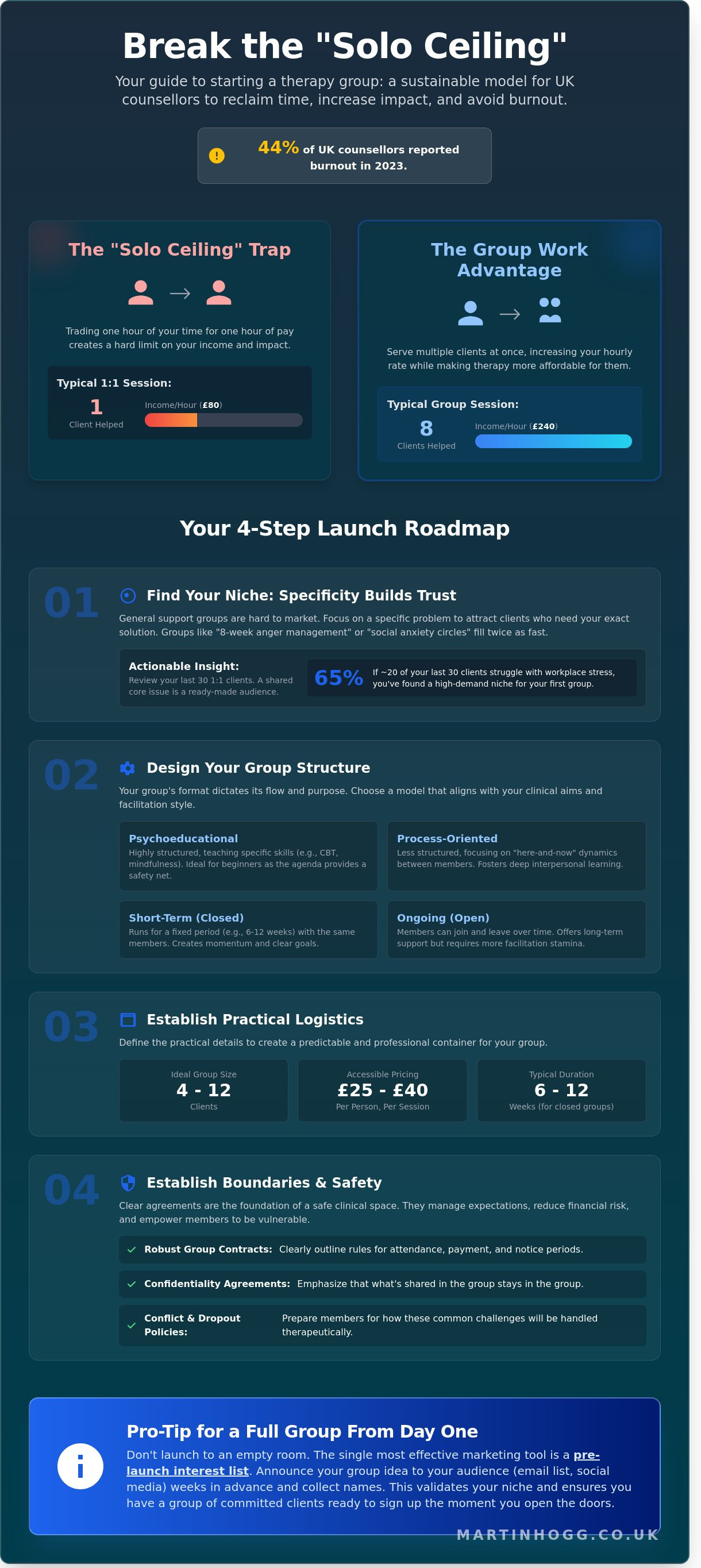
A therapy group is a facilitated space where 4 to 12 clients work through shared themes together. Most practitioners eventually hit a "Solo Ceiling" where trading one hour of time for one hour of pay limits their growth and their impact. Learning how to start a therapy group is often the most practical way to break through this barrier while maintaining your clinical integrity. Research indicates that 48% of therapists experience symptoms of burnout at some point in their careers. Moving into group work changes the dynamic from a constant one-to-one drain to a more sustainable, collective energy.
The financial side of this shift is equally compelling. If you charge £80 for a private hour, your income is capped by the number of hours you can physically sit in the chair. By hosting a group of eight people at £30 each, you increase your hourly rate to £240 while simultaneously making the service more affordable for every person in the room. The history and efficacy of Group psychotherapy show that the peer environment often creates breakthroughs that 1:1 work simply cannot match. It’s a win for your practice and a win for your clients.
Breaking the One-to-One Time Barrier
Burnout happens when your waiting list grows, but your diary stays full. Groups act as a vital relief valve for those long lists. Instead of making someone wait six months for a slot, you can offer them a place in a structured group within weeks. Group therapy is a high-impact, accessible alternative to individual sessions that lets you help more people without increasing your workload. This approach protects your own mental health, ensuring you stay sharp and empathetic for every client you see.
Improving Client Accessibility and Outcomes
One of the biggest hurdles for clients in the UK is the cost of private therapy. While a 1:1 session might cost £60 to £100, a group session can cost £25 to £40 per person. This lower price point opens your doors to a broader demographic who might otherwise go without support. You'll see the power of "universalisation" in action, where clients realise they aren't alone in their struggles. In this setting, your role shifts from being the primary source of change to becoming a facilitator. Understanding how to start a therapy group lets you step back and let peer support do the heavy lifting, fostering a community of recovery that extends beyond the therapy room.
Designing Your Group: Clinical Focus and Structure
When you're learning how to start a therapy group, the temptation is often to keep the doors wide open. You might think a "General Support Group" will attract the most people; however, the opposite is usually true. Specificity builds trust. In my experience, groups focused on a clear niche, such as 8-week anger management programmes or social anxiety circles, fill up twice as fast as general ones. People don't just want "counselling"; they want a solution to the specific weight they're carrying.
Before you launch, you must decide on the timeframe. Short-term groups typically run for 6 to 12 weeks and provide a sense of momentum. Ongoing groups offer deeper, long-term support but require more stamina from you as a facilitator. Whichever you choose, your clinical aim must be the anchor. This focus doesn't just guide your facilitation; it also informs your marketing and helps you stay aligned with the regulatory framework for psychological professionals in the UK. Setting firm boundaries around attendance and confidentiality from day one creates the safety your members need to be vulnerable.
Identifying Your Group’s Core Purpose
Start by looking at your own data. Review your last 20 or 30 1:1 clients. If 65% of them are struggling with the same core issue, like workplace stress or complex grief, you have a ready-made audience. General groups are harder to market because the "what's in it for me" factor is vague. If you're struggling to narrow your focus, this CPD for Counsellors UK guide offers excellent inspiration for finding a niche that matches your professional growth.
Choosing Between Psychoeducational and Process Groups
You need to decide how much "teaching" you intend to do. Psychoeducational groups are highly structured and involve teaching specific tools, such as CBT techniques or mindfulness. These are often easier for beginners because the agenda provides a safety net. Process groups are less structured; they focus on the "here and now" dynamics between members. These require more advanced facilitation skills to manage the live emotional energy in the room. If you want to refine your approach, exploring practical coaching tools can help you bridge the gap between these two models effectively.
Practical Logistics: Setting the Framework for Success
You have done the internal work and identified your niche. Now you need a structure that holds the space securely. When you are learning how to start a therapy group, the logistics you choose will either support the therapeutic work or become a constant distraction. I have found that clear, firm boundaries around how the group operates actually make clients feel safer. It shows them that you are in control of the environment so they can focus on their recovery.
Open vs. Closed Groups: Which Model Fits?
A closed group usually runs for a set period, such as 8 or 12 weeks. This model builds deep trust because the same faces show up every Tuesday night. The financial risk is higher here. If two members drop out in week three, your income for that block takes a hit. However, for your first group, I recommend this closed, time-limited approach. It allows you to contain the energy and focus on the process without the disruption of new members joining halfway through.
Open groups allow people to join at any time. While this provides a more consistent flow of income, often between £150 and £250 per session, depending on your numbers, it can shake the group's foundation. Every time a new person enters, the group's "personality" shifts. Understanding these shifts is vital. I suggest reading this essential guide to group dynamics to help you manage these complex interpersonal layers effectively.
Venue, Pricing, and Scheduling Considerations
Your choice of venue reflects your professionalism. In the UK, a decent private room in a community centre or a dedicated therapy hub usually costs between £15 and £25 per hour. Ensure the space is accessible and private. A room where people can hear a yoga class through the wall will not work. When pricing your group, aim for a balance. Charging £35 per person for a 90-minute session with eight members gives you a healthy return for your expertise while keeping it affordable for the client.
Automate your admin: Use practice management software uk to handle bookings and automated reminders.
Take payment upfront: Ask for the full block payment before the first session. This secures commitment and reduces the stress of chasing fees.
Consistency is key: Stick to the same day and time. If you start changing dates, you will see a 20% drop in attendance immediately.
Finally, remember that group work is more draining than one-to-one sessions. You are monitoring multiple relationships at once. You must have a clinical supervisor who is experienced in group work. They will help you navigate the "group think" or any projections that arise. This isn't just a box-ticking exercise; it's how you stay grounded and keep the group on track.
The Step-by-Step Process of Launching Your Group
Moving from the idea stage to a live session requires a structured approach. I've found that many counsellors rush the start, only to find themselves with empty chairs or a mismatched group dynamic. To learn how to start a therapy group successfully, you need to follow a clear timeline that builds momentum and safety simultaneously.
Step 1: Gauge demand. Before you book a room, create an "interest list." Send a simple email to your network or current clients. If you don't get at least 12 to 15 expressions of interest, you may need to rethink your topic or timing.
Step 2: Draft your group agreement. This is distinct from your 1:1 contract. It must explicitly cover "group-specific" rules like socialising outside of sessions and the absolute necessity of member-to-member confidentiality.
Step 3: Screen every participant. Never skip this. A 20 minute clinical screening ensures the group remains a therapeutic space rather than a chaotic one.
Step 4: Open the doors. Start your marketing 6 to 8 weeks before the first session. This gives people time to process the commitment and arrange their schedules.
Step 5: The final onboarding call. A week before you start, have a 10 minute check-in with each confirmed member. It settles their nerves and reduces "first-night" drop-outs by up to 25 percent.
Screening and Selecting the Right Members
Not everyone is ready for group work. If a client is in active crisis, experiencing psychosis, or has a history of high-conflict interpersonal relationships, they are likely better suited for 1:1 sessions. Your assessment session is your chance to set the tone. Use this time to explain that the group isn't just about "venting"; it's about mutual support and shared growth. I always look for a balance. You want to avoid a group filled entirely with "monopolizers" who dominate the space, or conversely, a group of eight people who are too withdrawn to speak. Aim for a mix of personalities to keep the energy moving.
Marketing Your Group to the Right People
Your existing 1:1 waiting list is your most valuable asset. These individuals already trust your professional authority. When you describe the group, focus on the transformation they will experience. Instead of listing the logistics like "90 minutes on a Tuesday," talk about the results. Use phrases like "gain the tools to manage your anxiety" or "find a community that finally understands your journey." For more broad strategies on building your presence, you can read my guide on how to get counselling clients uk. Remember, people don't buy a seat in a circle; they buy a path to feeling better.
If you're ready to transition from 1:1 work to a more scalable group model, I can help you navigate the practicalities. Book a consultation to discuss your group practice goals.
Managing Risks and Scaling Your Group Practice
Managing the practical risks of group work is just as important as the clinical delivery. When a member drops out, it creates an immediate financial and emotional shift. If you lose one person in an eight-week programme priced at £40 per session, you're looking at a £320 shortfall. Clinically, a sudden exit can trigger feelings of rejection or instability in the remaining members. I recommend having a clear "notice period" in your initial contract to allow for a proper "ending" session, which protects both your budget and the group's cohesion.
Conflict is another area that often worries counsellors learning how to start a therapy group. However, tension is often where the most profound growth happens. We call this "rupture and repair." When members disagree or feel hurt, your role is to facilitate a safe conversation rather than shut it down. Successfully navigating a conflict proves to the group that relationships can survive honesty. This builds a level of trust that individual therapy rarely replicates.
Handling Group Dynamics and Ethical Challenges
You are the guardian of the boundaries, not the solver of problems. It's tempting to jump in and fix things, but your job is to maintain the safety of the container. If a confidentiality breach occurs, you must address it directly within the group setting to restore the "contract" between members. Never carry these challenges alone. Regular peer-supervision for group facilitators is essential. It provides a space to decompress and ensures your own biases aren't clouding the group's progress.
Growing Beyond Your First Group
Once your first group is consistently full, you'll likely realise that your time is the only thing limiting your impact. Transitioning from a solo practitioner to a "group practice" model is a logical next step. If you have a waiting list of 5 or 6 people, it's a clear signal to expand. You might consider hiring an associate therapist to run additional cohorts using your proven framework. This allows you to scale your income while focusing on the parts of the business you enjoy most.
Building a successful group practice is a journey that's much easier with the right support. I've helped many UK therapists move from the "lone wolf" model to running thriving, multi-therapist practices. If you're ready to take that next step, check my calendar for upcoming group practice coaching sessions. Let's get your practice growing and your life back on track.
Take the Lead in Your Private Practice
Moving from one-to-one sessions to a group model is a significant step toward a more sustainable and impactful career. You now understand the clinical focus required and the practical logistics needed to set a firm foundation. By following a clear step-by-step process, you can manage risks and scale your impact without the common pitfalls of burnout. Mastering how to start a therapy group is the most effective way to transition from a solo counsellor to the CEO of a thriving practice.
I’ve helped over 500 UK practitioners navigate this transition through BACP-endorsed workshops and practical growth strategies. You don't need to guess the next steps or struggle with the paperwork in isolation. My blueprints provide a direct route to success, backed by a supportive community of peers who understand the unique landscape of UK private practice. It's about moving beyond the "time-for-money" trap and building a business that truly serves your life.
Join the Private Practice Success Membership and scale your practice with confidence. You have the skills to help people change their lives; now it's time to build the framework that lets you reach them. Your practice can grow, and I'm here to help you make it happen.
Frequently Asked Questions
Do I need a special qualification to start a therapy group in the UK?
You don't need a specific legal qualification beyond your core counselling diploma to start a therapy group. However, the BACP Ethical Framework 2018 requires you to work within your competence. I recommend completing a short CPD course in group dynamics, which usually takes 12 to 20 hours of study. This ensures you can manage the complex group process safely and effectively without feeling out of your depth.
What is the ideal number of members for a therapy group?
The ideal number for a therapy group is between 6 and 8 members. If you have fewer than 5 people, the group can feel exposed and may struggle to maintain momentum if someone is absent. If you go beyond 10 members, it's difficult for everyone to have enough time to speak in a standard 90 minute session. Aim for 8 sign ups to account for the 15% average attrition rate seen in community settings.
How much should I charge for a group therapy session compared to 1:1?
You should typically charge between £25 and £40 per session for a group member. This is roughly 40% of a standard £60 to £80 private 1:1 rate. This makes the support more accessible for the client while increasing your hourly income. If you have 8 members paying £30, you're earning £240 per session before room hire costs, which are often around £15 to £20 per hour in the West Midlands.
What happens if only two people sign up for my group?
If only two people sign up, you should delay the start date by 2 to 4 weeks to allow for more marketing. Running a group with just two people creates a dyad dynamic that lacks the diversity of perspective needed for a true group experience. It's better to be honest with the applicants and explain that you're waiting for a minimum of 4 members to ensure they get the best therapeutic results.
How do I handle a member who dominates the conversation?
You handle a dominating member by bringing the observation back to the whole group. You might say, "I've noticed John is doing a lot of the work today; I'm curious how others are feeling about the space." This keeps the focus on the process rather than being confrontational. It's a practical way to manage dynamics while teaching members how to take up space or set boundaries in their own lives.
Is it ethical to move my 1:1 clients into a group I am starting?
It's ethical to move 1:1 clients into a group, but you must carefully consider the impact on the existing therapeutic bond. Around 60% of group facilitators in private practice use their 1:1 caseload to seed new groups. You'll need to discuss how the change in dynamic feels for them. This is a key part of how to start a therapy group ethically while maintaining clear boundaries and avoiding a "special" relationship status.
Should I run my therapy group online or in person?
Choose in person if you want to capture the subtle non-verbal cues that make up 70% of communication. It's particularly effective for local community work where physical presence builds trust. Online groups are better if you're targeting a niche issue where you need to draw from a wider UK wide population. Online sessions also save you the £20 average hourly room rental fee, keeping your overheads low while you build your practice.


