
How to Work with EAP Providers: A Practical Guide for UK Counsellors

Article by
Martin Hogg
I help Private Practice counsellors in the UK set up and grow an ethical Private Practice they love, work with their ideal clients, and earn the income they deserve. All without guesswork and burnout. I have been a private practice counsellor myself for over 20 years, specialising in anger management. I set up a not-for-profit social enterprise, Citizen Coaching and Counselling, which delivers thousands of counselling sessions a year to adults and young people in Birmingham. I am a registered BACP Counsellor and the author of three books, My Anger Coach, My Anxiety Coach and My Relationship Coach. These are available on Amazon.
Working for an Employee Assistance Programme (EAP) shouldn't be your "forever home" as a therapist, but it's a brilliant way to keep the lights on while you learn how to get private clients for therapy uk wide. I know that sinking feeling of staring at an empty diary and wondering if you've made a massive mistake going solo. It's exhausting to balance your clinical work with the constant pressure of marketing, especially when you just want to help people. You shouldn't have to choose between your passion and your mortgage.
You likely agree that the "feast or famine" cycle is the most draining part of our profession. You want the clinical hours, but the admin and low-fee anxiety can feel like a heavy weight. I promise to show you how to use EAPs as a strategic fuel-stop to gain stability without losing your mind to endless forms or feeling undervalued. We can make these systems work for you, rather than the other way around.
We'll look at the practical steps for joining provider lists in 2026, including the impact of the now fully implemented SCoPEd framework and how to make these affiliate roles a bridge to your financial future. It's about finding a balance that lets you breathe while you build your dream practice.
Key Takeaways
- Understand how the affiliate model helps you maintain independence while receiving a steady stream of referrals from major UK employers.
- Identify the professional benchmarks, such as BACP accreditation and 450 post-qualifying hours, needed to join the most reliable provider lists.
- Master the "one-sentence offer" to pitch your niche effectively to big players like Health Assured, Bupa, and Optum.
- Use affiliate work as a tactical foundation for your business while you focus on how to get private clients for therapy uk through your own brand.
- Avoid the "EAP trap" by keeping your marketing consistent, so you aren't left with an empty diary if a provider's referral flow suddenly slows down.
What Exactly is an EAP and Why Should You Care?
Most therapists hear the term "EAP" and immediately think of low fees and endless spreadsheets. While that's part of the picture, it's helpful to understand the mechanics first. An Employee Assistance Programme is a confidential, employer-funded service designed to provide short-term counselling to staff members. Essentially, a company pays a provider to ensure their team has a safety net when life gets messy. If you are curious about the history or broader scope, What is an Employee Assistance Program? covers the foundational details well.
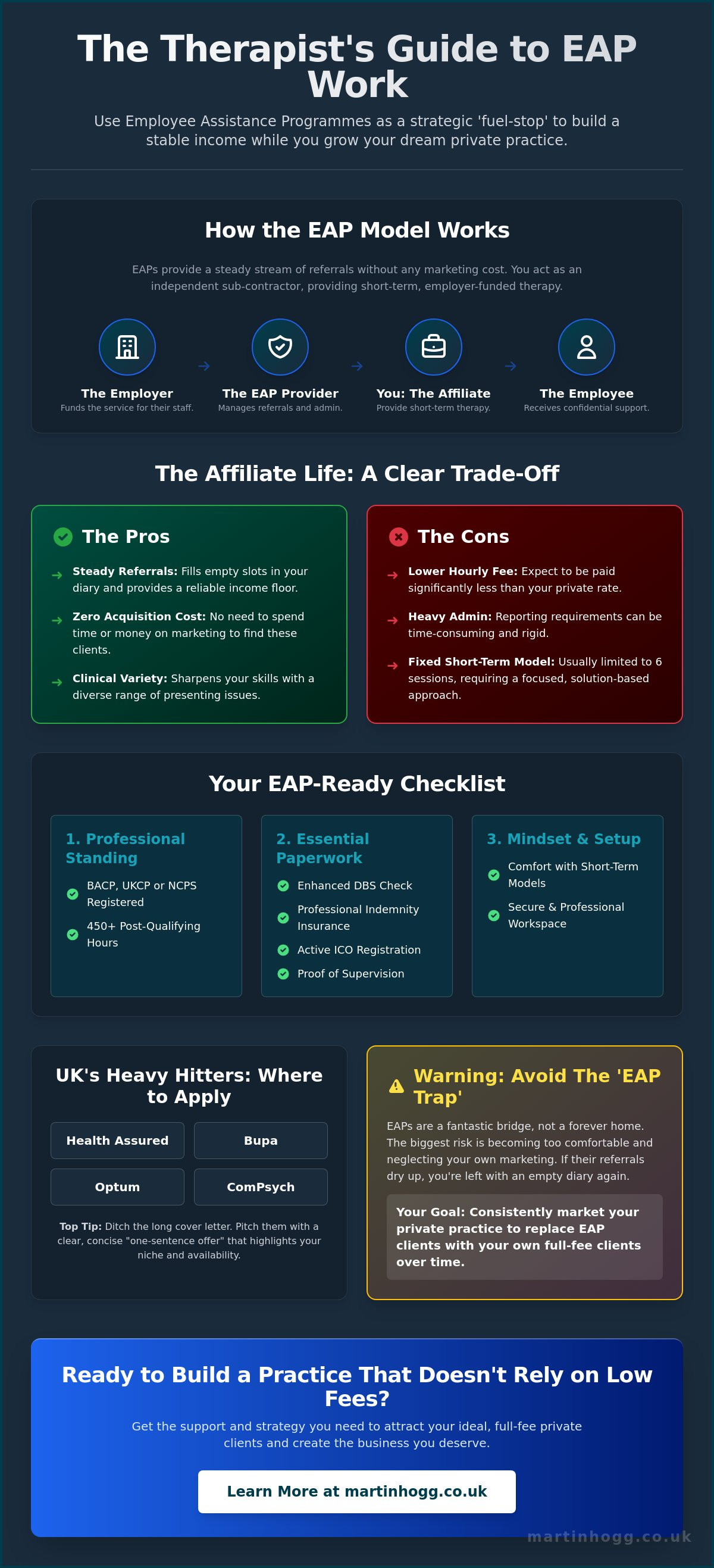
When you work with these providers, you join as an affiliate. This means you act as a sub-contractor rather than an employee. You keep your independence, your own therapy room, and your own professional indemnity insurance. The biggest draw is the "no-marketing" promise. You don't need to spend hours on Canva or mess around with Google Ads to find these clients. They simply arrive in your inbox. It's a smart way to gain experience while you're still mastering how to get private clients for therapy uk who pay your full professional rate.
The Pros and Cons of the Affiliate Life
The trade-off is straightforward. You accept a lower hourly fee, often significantly less than your private rate, in exchange for zero client acquisition costs. The pros are clear: you get steady referrals and a clinical variety that keeps your skills sharp. You don't have to "sell" yourself because the EAP has already done that legwork. However, the cons include heavy reporting requirements and a fixed short-term model, usually limited to six sessions. It requires a focused, solution-based way of working that doesn't suit every practitioner.
I always suggest using EAP work as a "fill-in" strategy. It's there to stabilise your income and keep your diary ticking over while your private brand grows. It's much easier to be brave with your marketing and wait for the right high-fee clients when your basic bills are already covered. If you want to move away from relying on these low-fee referrals, my Martin Hogg (Private Practice Success) can help you build that bridge to a more profitable, independent practice.
The Reality of Affiliate Work: Requirements and Expectations
Before you start sending off CVs, you need to make sure your professional house is in order. EAP providers act as gatekeepers. They protect their corporate clients by ensuring their affiliates are top-tier. Registration with the BACP, UKCP, or NCPS isn't just a recommendation; it's the absolute baseline. With the SCoPEd framework fully implemented as of January 2026, these standards are now more aligned across the board. Most major providers look for at least 450 post-qualifying hours. If you're a newly qualified therapist, this might feel like a hurdle, but it's about proving you can handle the intensity of short-term workplace issues.
Your tech stack matters too. Almost all EAPs now require you to be comfortable with secure online working. You'll need a private, professional room, even for video calls. They will also check your legal compliance. This means your ICO registration must be active. For a sole trader, this is usually £47 if you pay by direct debit. You also need professional indemnity insurance. Most basic policies start around £80 per year for a £1 million limit. For a deeper dive into these standards, I recommend checking the EAPA UK guide for counsellors.
Essential UK Paperwork Checklist
To speed up your applications, have these ready to go:
- Enhanced DBS check: Since January 2026, self-employed therapists can finally access enhanced checks. Being on the Update Service makes you much more attractive to providers.
- Proof of Supervision: You'll need to show your clinical supervision meets your professional body's requirements.
- The Short-term Mindset: You must be comfortable with Solution-Focused or CBT-lite models. EAP work isn't the place for a three-year deep dive into childhood history.
If the paperwork feels like a mountain, don't let it stop you. This admin is just the price of entry for a steadier income. Once you've cleared these hurdles, you can focus on the bigger picture of joining a community of successful therapists. Mastering these basics is a vital step in learning how to get private clients for therapy uk who value your professional standards as much as your clinical skill.
How to Get on EAP Lists (and Stay There)
Getting started doesn't require a complex marketing strategy. You just need to know where to look. Health Assured, Bupa, Optum, and ComPsych are the heavy hitters you should target first. Most of these organisations have a constant need for new affiliates, especially if you have a specific niche or work in a high-demand area. They aren't looking for your life story; they're looking for clinical safety and availability.
When you reach out, forget the long-winded introductions. Use a "one-sentence offer" to get their attention. Try something like: "I am a BACP accredited counsellor specialising in work-related anxiety with immediate Tuesday morning availability." This tells the provider exactly where you fit in their system. It's far more effective than a generic CV. While you're still figuring out how to get private clients for therapy uk wide, these quick wins keep your practice moving and your bank balance healthy.
I'm a big believer that "rough and ready" beats polished every time. Don't spend days perfecting one application. Set aside a morning, find ten provider portals, and get your details on their lists. In the affiliate world, responsiveness is your best friend. If a referral comes in and you wait until the next day to reply, that client will already be booked with someone else. Speed is often more important than a fancy website at this stage.
Managing the Admin Without the Burnout
The paperwork can feel like a full-time job if you let it. To stay sane, create templates for common reporting measures like CORE-10 or GAD-7. Having these ready to copy and paste will save you hours of unpaid admin time over a month. You also need firm boundaries. Decide exactly how many EAP slots you'll offer each week so you don't crowd out higher-paying private work. Use tools like Calendly to sync your availability across multiple providers automatically, which stops the dreaded double-booking.
If you're ready to stop guessing and start growing, come and join us in the Private Practice Success Membership where we turn these tactics into a clear, manageable plan.
EAP Work vs. Private Pay: Building a Sustainable Practice
I've seen too many brilliant therapists fall into the "EAP trap." It happens when you become so busy with affiliate referrals that you stop doing the very things that grow your business. You're working full-time hours, but because the fees are lower, you're actually struggling to pay the bills. This "busy but broke" cycle is exhausting. If you spend all your energy on short-term corporate work, you'll never have the headspace to figure out how to get private clients for therapy uk wide who pay your full professional fee.
The secret is to reframe how you view that affiliate income. Don't just let it disappear into your general expenses. Use a portion of it as a marketing budget to invest in your own brand. This might mean paying for your Counselling Directory profile, upgrading your Squarespace site, or joining the Practice Visibility Blueprint to sharpen your strategy. Think of the EAP as the sponsor of your private practice growth. It provides the financial floor that allows you to be picky about which private clients you take on.
You also need a clear exit strategy. As your private pay enquiries start to increase, you should slowly drop the EAP contracts that have the lowest rates or the most soul-crushing paperwork. You don't have to quit everything overnight. Just start by closing your diary to one provider and replacing those slots with your own direct bookings. It's about taking back control of your time and your income, one session at a time.
The Mixed Model Strategy
I usually recommend aiming for a 70/30 split. You want 70% of your diary filled with high-fee private clients and 30% kept for steady affiliate work. This balance gives you the best of both worlds: financial stability and higher profit margins. For a deeper look at the long-term fix for your diary, check out our guide on how to get counselling clients UK professionals can rely on.
Always remember that people connect with people. Even when you are working with EAP clients, your own website and presence should remain human and relatable. Don't hide behind a corporate mask. When you show up as your real, slightly "rough and ready" self, you'll naturally attract the kind of private clients who stay for the long term. This is how you build a practice that isn't just a job, but a sustainable, rewarding career.
Take Control of Your Practice Growth
EAP work is a fantastic tool for keeping your bank account healthy while you're still figuring out the best ways of how to get private clients for therapy uk. It takes the immediate pressure off and gives you the space to breathe. Remember to keep your admin "rough and ready" and your responsiveness high. By setting firm boundaries and using affiliate work as a tactical fuel-stop, you avoid the burnout that comes from being busy but broke. This stability is your foundation, not your final destination.
You don't have to figure out this transition alone. If you want a clear path to a fuller diary and a more visible brand, join the Private Practice Success Membership to balance your diary and grow your brand. You'll get access to my BACP-endorsed workshops, practical "skateboard model" website advice, and a supportive community of over 500 UK therapists who are doing exactly what you're doing right now. We focus on real-world steps that actually work.
Building a private practice is a marathon, not a sprint. Take the stability the EAPs offer, use it to fund your growth, and keep moving forward. You have the skills to help people; now it's just about making sure they can find you. You've got this.
Common Questions About EAP Work
Do I need a special qualification to work for an EAP?
No, you don't need a specific "EAP degree," but you do need to be a member of a recognised professional body like the BACP or UKCP. Most providers require accreditation as a minimum standard to ensure clinical safety. They generally want to see that you've completed your 450 post-qualifying clinical hours. It's more about demonstrating your professional standing and experience than having a specific workplace certificate.
How much do EAP providers typically pay per session in the UK?
EAP rates in the UK generally fall between £30 and £50 per session. While this is lower than the £50 to £150 you might charge your own clients, remember there are no marketing costs or room rental fees if you work remotely. It's a trade-off. You're trading a higher fee for the convenience of a full diary while you work on how to get private clients for therapy uk who pay your full rate.
Can I see EAP clients in my private practice room?
Yes, you can almost always see EAP clients in your existing private practice room. Providers aren't usually fussed about where the work happens, as long as the space is confidential, professional, and safe. If you're working online, they'll just want to ensure you're using a secure, GDPR-compliant platform and that your professional indemnity insurance covers remote work. Just make sure your room meets their basic accessibility and safety standards.
What happens if an EAP client wants to continue privately after their sessions end?
You must check your specific contract because most EAPs have a "non-compete" or "cooling-off" clause. This usually prevents you from taking an EAP client into your private practice for a set period, often three to six months after their funded sessions end. It's vital to respect these boundaries to keep your relationship with the provider healthy. It's one of the reasons learning how to get private clients for therapy uk directly is so important for your long-term growth.
How many EAP providers should I sign up with at once?
I recommend signing up with three to five providers to start with. If you join ten lists at once, the different admin portals and reporting requirements can quickly become overwhelming. It's better to get comfortable with the systems used by a few big players first. You can always add more later if you still have gaps in your diary that you're struggling to fill with your own direct marketing efforts.
Disclaimer
The information provided on this blog is for general informational purposes only and is not intended to be a substitute for professional medical or mental health advice, diagnosis, or treatment. Reading this content does not create a therapist-client relationship.


