
Increasing Therapy Fees: 2026 Guide for UK Counsellors

Article by
Martin Hogg
I help Private Practice counsellors in the UK set up and grow an ethical Private Practice they love, work with their ideal clients, and earn the income they deserve. All without guesswork and burnout. I have been a private practice counsellor myself for over 20 years, specialising in anger management. I set up a not-for-profit social enterprise, Citizen Coaching and Counselling, which delivers thousands of counselling sessions a year to adults and young people in Birmingham. I am a registered BACP Counsellor and the author of three books, My Anger Coach, My Anxiety Coach and My Relationship Coach. These are available on Amazon.
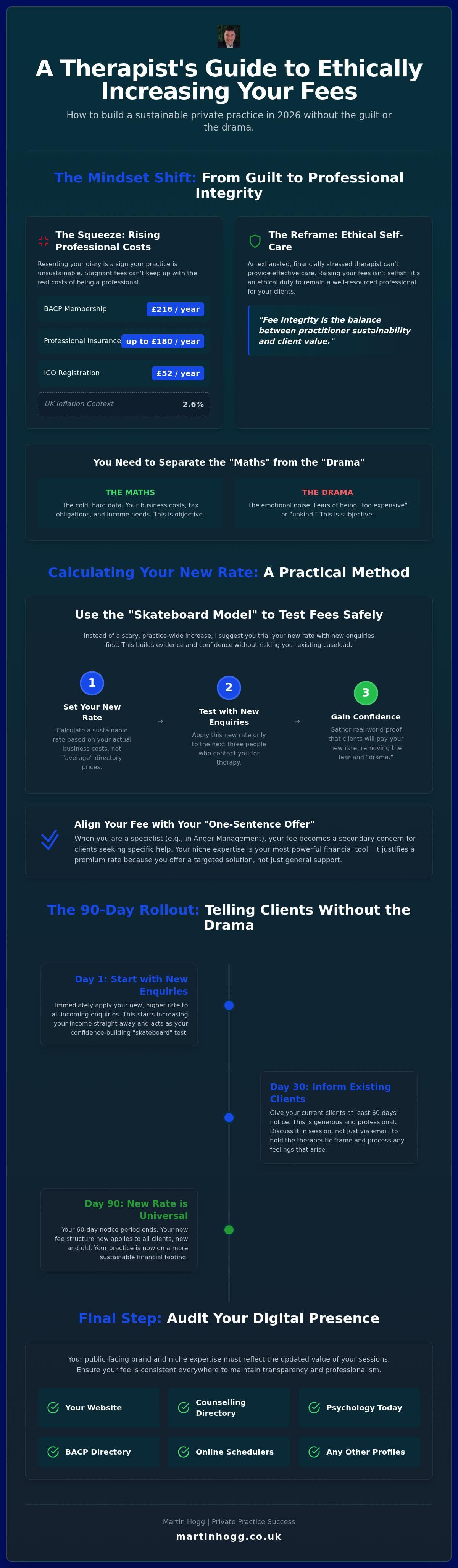
Resenting your diary is the first sign that your practice is no longer sustainable. It's a heavy feeling, isn't it? You love the work, but the rising costs of BACP membership at £216 and professional insurance reaching up to £180 mean your take-home pay is shrinking. You've likely spent hours wondering how to increase my therapy fees without feeling like you're abandoning the people who need you most. You worry that a price hike will lead to an empty room and a flurry of "goodbye" emails.
I understand that guilt because I've been there too. However, staying stagnant while UK inflation sits at 2.6% isn't just a financial risk; it's a recipe for burnout. This 2026 guide is here to help you navigate this transition ethically and professionally. You'll learn how to communicate changes to your clients with total transparency, align your rates with your specialist niche, and finally build a sustainable income that reflects your true value. We'll explore the practical steps to move from a stressed solo practitioner to a confident practice owner.
Key Takeaways
- Reframe fee increases as an act of professional integrity and ethical self-care, ensuring you remain a well-rested and effective therapist for your clients.
- Learn a practical, data-driven method for how to increase my therapy fees using the "Skateboard Model" to test new rates safely with new enquiries first.
- Master a stress-free 90-day rollout plan to communicate price changes transparently, allowing you to maintain strong therapeutic boundaries without the "drama."
- Audit your digital presence and directory profiles to ensure your public-facing brand and niche expertise accurately reflect the updated value of your sessions.
The Mindset Shift: Why Raising Your Therapy Fees is an Ethical Necessity
Feeling guilty about charging more is the most common hurdle for UK counsellors. This guilt often stems from a place of deep care, but it's misplaced. An exhausted therapist worried about their own tax bill or the cost of living cannot hold a safe, effective therapeutic relationship. Ethical care requires you to be well-resourced. When you're distracted by financial stress, your clinical presence suffers, and you risk providing a diluted version of the support your clients deserve.
To move forward, you need to separate "Maths" from "Drama." The maths consists of cold, hard data: your room hire, the £216 BACP membership, and your HMRC obligations. The drama is the emotional noise telling you that you're "too expensive" or "unkind." Your professional value is not a reflection of your personal worth. Understanding how to increase my therapy fees involves treating your practice as a separate entity that requires sufficient fuel to function effectively.
A sustainable practice in 2026 isn't just about survival. It's about thriving enough to afford the high-quality supervision and personal therapy that keeps your work safe. Your income must cover the rising costs of being a regulated professional while leaving room for your own well-being.
Fee Integrity is the balance between practitioner sustainability and client value.
Moving Beyond the Going Rate Trap
Relying on "average" rates from directory sites is a trap. If everyone copies stagnant prices, no one accounts for the 2.6% inflation rate or rising insurance costs. Your BACP accreditation and specialized niche building efforts are premium assets. When you research how to increase my therapy fees, remember that your expertise provides a level of transformation that "average" pricing simply doesn't reflect.
Calculating Your New Rate: Balancing Sustainability and Specialist Value
Determining your new rate isn't guesswork. It's about looking at your outgoings with clear eyes. You have to account for the "hidden" drains on your bank balance. These include your £216 BACP fee, the £52 ICO registration, and professional indemnity insurance, which can cost up to £180 in 2026. Don't forget the cost of your own supervision and personal therapy. If you're wondering how to increase my therapy fees, start by calculating the total cost of being in the room before you even see your first client.
I often suggest the "Skateboard Model" for fee testing. Instead of a blanket increase that triggers your anxiety, trial your new rate with the next three new enquiries. This is a practical way to learn how to increase my therapy fees without the fear of an empty diary. It builds the evidence you need to eventually move your legacy clients to a sustainable rate when you feel more prepared.
Aligning Fees with Your One-Sentence Offer
When you move from being a generalist to a specialist, your price becomes a secondary concern. A client looking for specific help with anger is less likely to haggle over £10 if they believe you have the exact tools they need. This is where niche building becomes your most powerful financial tool. By focusing on areas like Anger Management or Working with Men for your 2026 CPD goals, you position yourself as the expert rather than just another name on a list.
Efficiency is just as vital as your hourly rate. Using the Counsellor Efficiency Bundle helps you reclaim hours spent on admin, ensuring your billable time is truly profitable. If you want to dive deeper into these strategies, our Private Practice Success Membership offers a supportive community for this journey.
The Practical Rollout: How to Tell Your Clients Without the Drama
Implementing a change requires a steady hand and a clear timeline. If you're looking for how to increase my therapy fees, a 90-day rollout is often the safest path. Start by applying the new rate to all new enquiries immediately. This gives you a buffer period where your income begins to rise without impacting your current caseload. It's a practical way to build confidence in your new value before speaking to legacy clients.
For your existing clients, provide at least 60 days' notice. This allows space to process the change within the sessions rather than just via email. You might use a kind, direct script: "To ensure I can continue providing a high-quality, sustainable service, my fee will increase to £[Amount] starting on [Date]. I value our work together and wanted to give you plenty of notice." Transparency regarding fee changes doesn't just protect your business; it demonstrates the healthy boundaries and professional integrity that build deeper therapeutic trust.
If you offer a sliding scale, stay consistent. Limit these slots to a specific number to ensure your practice remains viable while staying accessible to those in need. This prevents your low-fee slots from overwhelming your diary and causing burnout.
Handling the Referral Dip and Objections
Sometimes, the phone stops ringing for a week or two after you implement your plan for how to increase my therapy fees. This is a common market adjustment, a temporary quiet period while your practice settles into its new positioning. This quiet spell is often just the universe making room for the clients who are ready to pay your new rate. If a client truly cannot afford the increase, offer a fair grace period of four to six weeks to conclude the work or help them transition to a lower-cost service. This preserves the integrity of your professional contract while honouring the relationship.
Updating Your Digital Presence and Scaling Your Practice
Once you've decided how to increase my therapy fees, your digital storefront needs to reflect that new reality. Start with your website's "above the fold" content. This is the text visible before anyone scrolls. If your messaging still feels like a generalist "catch-all" service, it won't support your updated rates. Your copy should speak directly to the specific outcomes you facilitate. "Rough and ready" updates are far better than waiting months for a complete rebrand. Change the numbers today; the perfect aesthetics can wait.
A systematic audit ensures no client finds conflicting information. Use this checklist to stay consistent:
- Psychology Today: Update your fee range and refresh your introductory paragraph to highlight your 2026 specialisms.
- Counselling Directory: Ensure your per-session cost is accurate and reflects any sliding scale limits you've set.
- Your Own Site: Update your "Fees and FAQ" page and any automated booking systems like Calendly or Stripe.
Automating your payment tools is a vital step in scaling a therapy practice. When your systems handle the billing at the new rate, it removes the emotional friction of manual invoicing. This shift from solo practitioner to practice CEO requires systems that support your growth rather than holding you back.
Finding Support in a Professional Community
Stepping into a higher fee bracket can feel lonely. You might find yourself checking local averages again or doubting your right to earn a sustainable living. This is where peer support is invaluable. Connecting with others who've successfully navigated how to increase my therapy fees provides the reassurance that you aren't being greedy; you're being professional. Our Private Practice Success Membership offers exactly this kind of grounded, expert-led community.
Remember, you're providing a life-changing service. Your expertise has a tangible impact on your clients' futures. By securing your own financial stability, you ensure that you can continue to offer that transformation for years to come.
Building a Sustainable Future for Your Practice
Raising your rates is more than a financial adjustment; it's a commitment to the longevity of your professional service. By separating the "maths" from the "drama," you've learned that sustainability is an ethical requirement for safe practice. Implementing a 90-day rollout and aligning your digital presence ensures that your brand reflects the specialized value you provide. You now have a clear framework for how to increase my therapy fees with clarity and confidence.
You don't have to navigate this transition alone. Within our community, you'll find the support of Martin Hogg and a network of UK therapists all using the Practice Visibility Blueprint to scale from solo practitioner to CEO. These proven strategies help you move past the guilt and into a future where your practice thrives. You are a professional providing life-changing support. You deserve a practice that supports you in return.
Frequently Asked Questions
How much notice should I give my therapy clients before a fee increase?
Give your clients at least 60 to 90 days of notice before any fee change takes effect. This generous window allows you to process the practical and emotional impact of the increase within your sessions. It ensures that the change is handled as a clinical boundary rather than a sudden financial shock. Clear, written communication alongside these verbal discussions helps maintain the transparency required by professional ethical guidelines.
Is it ethical for a counsellor to raise their prices during a cost-of-living crisis?
Yes, it's ethical to increase your rates because a financially struggling therapist cannot provide safe or effective care. Maintaining your practice's viability is a professional responsibility. If your costs for insurance and membership rise while your income remains stagnant, you risk burnout. Ethical practice involves balancing your own needs with client accessibility, ensuring you remain a stable presence in their lives for the long term.
Should I have different fees for new and existing therapy clients?
Many therapists successfully use a tiered structure by applying new rates to new enquiries first. This approach is a popular strategy when researching how to increase my therapy fees because it reduces the immediate risk of losing your entire caseload. You can then move existing clients to the new rate after a set notice period, ensuring your business growth remains steady and manageable without causing unnecessary distress.
What if a long-term client can no longer afford my new therapy rate?
If a client cannot afford the new rate, you can offer a time-limited grace period or a referral to a lower-cost service. It's helpful to keep a small number of sliding scale slots for such cases, but these must be strictly managed to protect your income. Providing a clear ending or transition plan ensures you honour the therapeutic work while maintaining your necessary business boundaries and professional integrity.
How often should I review and increase my private practice fees?
You should review your private practice fees annually to keep pace with UK inflation and rising professional costs. With the June 2026 inflation rate at 2.6%, a yearly audit ensures your income doesn't quietly erode over time. Regular reviews prevent the need for large, jarring price hikes later on, making the process of how to increase my therapy fees feel like a standard, professional part of your business routine.
Disclaimer
The information provided on this blog is for general informational purposes only. It is also not intended to be a substitute for professional medical or mental health advice, diagnosis, or treatment. Reading this content does not create a therapist-client relationship.


