Is Accreditation Worth It for UK Counsellors and Therapists in 2026?
If you have been staring at the BACP accreditation application and wondering if the stress is actually going to pay off, you are certainly not alone. Many therapists I talk to are asking if accreditation is worth it in UK private practice now that the SCoPEd transition period ended in January 2026. It is easy to feel like a second-class professional when you see yourself placed in a specific column, especially when you know the life-changing value of the work you do with your clients every single day.
I understand the pressure you might feel to tick every box just to keep your seat at the table for EAP or insurance work. In this guide, I will give you a straight-talking breakdown of the professional and financial reality of accreditation in this new era. We will look at the 13 new BACP routes, the actual impact on your income, and how to decide if this milestone is the right move for your practice or if your energy is better spent elsewhere.
Key Takeaways
- Understand how the 2026 SCoPEd framework alignment affects your membership level and your professional identity.
- Discover if accreditation is worth it in UK private practice by looking at the actual impact on client enquiries and insurance work.
- Break down the financial and time costs of the application process to see if the investment matches your personal goals.
- Learn why visibility and niche building are more powerful tools for growing your practice than any professional title.
Understanding Accreditation and the SCoPEd Framework in the UK
Accreditation is a voluntary process where you submit your work for a detailed peer review by a professional body like the BACP, UKCP, or NCPS. It is essentially a way of saying you have gone above and beyond your initial training. For many of us, the big question is whether this extra layer of scrutiny actually helps our work or if it is just another hurdle to clear. To put it simply; accreditation is a validation of clinical hours, supervision, and ethical commitment.
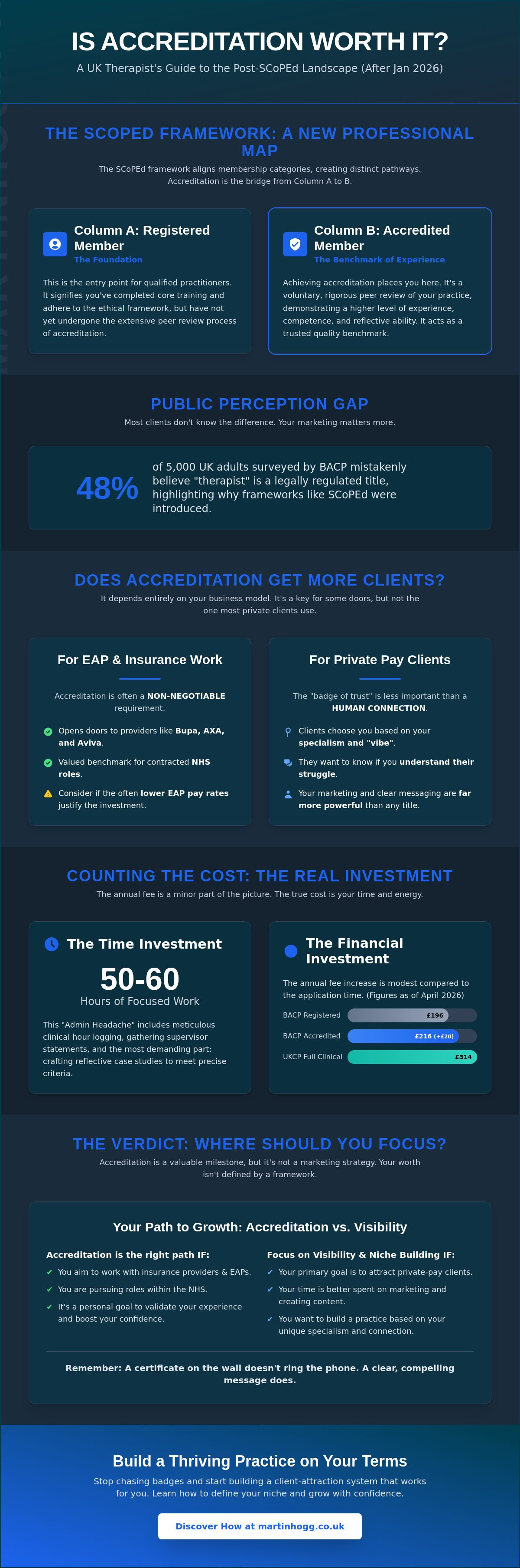
Because the regulation of counselling in the UK is not a legal requirement, the public often struggles to distinguish between a "qualified" therapist and an "accredited" one. A 2025 BACP survey of 5,000 adults found that 48% of people mistakenly believe "therapist" is a regulated title. This confusion is part of why the SCoPEd framework was introduced. It aims to standardise how our skills are seen by the public and employers alike.
The SCoPEd Impact: Columns, Competencies, and Confusion
In the new framework, practitioners are grouped into columns based on their training and experience. Column A generally covers registered members, while Column B is where accredited members sit. If you are currently in Column A, you might be asking yourself: is accreditation worth it in UK private practice? For many, accreditation acts as a bridge. It allows you to demonstrate that you have the specific competencies required for more complex roles or higher tiers of work without needing to start your training from scratch.
Why the 2026 Deadline Changed the Conversation
The SCoPEd transition period officially ended on Friday, 30 January 2026. Since then, the BACP and UKCP membership categories have fully aligned with these columns. This shift has created a real sense of urgency. I hear from many therapists who feel a deep anxiety about "being left behind" or being seen as less capable because they haven't moved into Column B or C yet. It is a heavy weight to carry, but it is important to remember that your worth as a therapist isn't defined solely by a framework deadline.
The Real-World Benefits: Does Accreditation Help You Get More Clients?
Let's talk about the bottom line. Does that "Accredited" badge on your website actually bring more people through the door? It is a question I hear all the time. When you are weighing up whether is accreditation worth it in UK private practice, you have to look at where your clients are actually coming from. For many, the answer depends entirely on your business model.
Opening Doors to EAPs and Insurance Referrals
If you want to work with health insurance providers or certain Employee Assistance Programmes (EAPs), accreditation is often a non-negotiable requirement. Organisations like Bupa, AXA Health, and Aviva typically insist on it before they will add you to their provider lists. When you look at the NHS requirements for counsellors, you will see a similar trend; they value these formal benchmarks for their contracted roles. However, you must consider if the often lower pay rates of EAP work justify the time and money spent on the application process. If your goal is a practice built on insurance referrals, then the path is clear. If not, the necessity starts to fade.
The "Badge of Trust" vs. Client Connection
For private pay clients, the reality is very different. Most people searching for a therapist don't understand the nuances of the SCoPEd columns or the technical difference between a registered and an accredited member. They are looking for a human connection. They want to know if you understand their pain and if you have the tools to help them get their life back on track. They choose you based on your "vibe," your specialism, and how well your profile speaks to their struggle.
While accreditation is a significant professional milestone, it is not a substitute for marketing. It validates your experience, but it doesn't find your clients. To truly grow, you need to focus on how to attract private pay therapy clients through clear communication and visibility. Achieving accreditation can certainly boost your internal confidence and help quiet those feelings of imposter syndrome. But remember, a certificate on the wall doesn't ring the phone; a clear message does.
If you're looking for a way to build that message without the overwhelm, you might find the support you need in our Private Practice Success membership.
Counting the Cost: Time, Money, and the Admin Headache
Deciding whether to apply for accreditation involves more than just a professional choice; it is a significant investment of your most precious resources. For many therapists, the financial aspect is the easiest part to calculate. As of April 2026, a BACP accredited membership costs £216 per year, which is only £20 more than the individual membership fee of £196. If you are with the UKCP, the full clinical membership fee is £314 per year. While these annual figures are manageable, they are only the tip of the iceberg.
The real challenge lies in the "Admin Headache." The application process typically requires at least 50 to 60 hours of focused work. This includes meticulous logging of clinical hours, gathering supervisor statements, and the most daunting task of all: reflective writing. Crafting case studies that meet the specific criteria of your professional body is a deep, academic exercise. You should carefully weigh this cost of entry against your long-term career goals before committing to the process.
Is the Return on Investment (ROI) There for You?
When you ask is accreditation worth it in UK terms, you must look at the opportunity cost. If you spend 50 hours on an application, those are 50 hours you are not spending on marketing your practice or seeing clients. If your average session rate is £60, that is £3,000 in potential gross income. You have to ask if the doors opened by accreditation, such as higher-paying insurance work or specific agency roles, will realistically recoup that investment within a year or two. For some, the maths works out perfectly. For others, it is a very expensive badge.
The Emotional Toll: Dealing with Perfectionism and Procrastination
We cannot ignore the emotional weight of this process. I see so many talented, experienced counsellors frozen by the fear that their work isn't "good enough" for the assessors. This perfectionism often leads to months, or even years, of procrastination. It is exhausting to have this "to-do" item hanging over your head. If you decide to go for it, my best advice is to break the application into manageable, weekly chunks. Set aside just two hours every Friday morning to focus on one specific competency. It makes the mountain feel like a series of small hills.
If you would rather spend your time building a practice that doesn't rely on external badges, you can find a supportive community to help you in our Private Practice Success membership.
Building a Successful Practice: Why Accreditation Is Not the Only Path
If you have decided that the application process isn't right for you at this stage, I want you to take a deep breath. You can absolutely run a thriving, full private practice while remaining as a registered member in Column A. Your ability to help people isn't diminished because you haven't completed a specific set of reflective essays. When asking yourself if is accreditation worth it in UK private practice, remember that your income is driven by how easily clients can find you, not by the letters after your name.
While accreditation is a valid professional milestone, it is often a long-term goal. If you need to increase your revenue right now, focusing on your "Practice Visibility" is a far more effective strategy. You could spend sixty hours on an application, or you could spend that same time building a presence that speaks directly to the people who need your help. One validates your past; the other builds your future.
Strategy First: Focus on What Clients Actually Search For
Clients rarely go to Google and search for "Column B accredited therapist." They search for solutions to their pain. They look for "help with social anxiety," "support for grieving," or "how to save my marriage." To stand out in a crowded market, you need to be the specialist they are looking for. I always suggest focusing on niche building for counsellors as your first priority. When you solve a specific problem for a specific group of people, your membership tier becomes secondary to your expertise.
Next Steps: Joining a Supportive Community
The journey of building a practice can feel isolating, especially when frameworks like SCoPEd make you feel like you are being ranked. Professional growth happens much faster when you have peer support and a clear roadmap. My goal is to help you grow your practice regardless of where you sit in the framework. If you are ready to move away from the "admin headache" and focus on practical growth, I invite you to join the Private Practice Success Membership. We focus on the marketing, SEO, and networking strategies that actually fill your diary with the clients you love to work with.
Deciding Your Next Step with Confidence
We have looked at the SCoPEd framework, the financial costs, and the reality of how clients actually find you. Ultimately, the question of whether is accreditation worth it in UK private practice depends on your personal vision. If you want to work with specific insurance panels, the path is clear. However, if you want a thriving practice filled with private clients who value your specific expertise, your energy might be better spent on visibility and connection.
I have spent over 20 years in UK private practice. Since founding our social enterprise in 2005, I have seen many therapists flourish without the accredited badge. My BACP-endorsed workshops are designed to give you the practical tools to grow; regardless of your membership column. You don't have to wait for a certificate to start helping people and building a sustainable business.
If you are ready to stop feeling overwhelmed by frameworks and start finding more clients, I invite you to join our Private Practice Success Membership. We focus on the real-world strategies that get your business moving forward today. You have already done the hard work of becoming a therapist. Now, it is time to build the practice you deserve.
Frequently Asked Questions
Do I have to be accredited to work as a counsellor in the UK?
No, you do not need to be accredited to work as a counsellor in the UK. Because the profession is not legally regulated, anyone can technically call themselves a counsellor. Most of us choose to join a professional body like the BACP or UKCP as a registered member to demonstrate our ethical commitment, but full accreditation remains a voluntary choice rather than a legal requirement.
Will being accredited allow me to charge higher fees in private practice?
Being accredited does not automatically mean you can charge more for your sessions. When considering is accreditation worth it in UK private practice, it is important to remember that clients pay for results and connection. If you have a clear niche and a strong reputation, you can charge premium fees regardless of your membership column. Accreditation might help with insurance work, but private pay is driven by your visibility.
How many clinical hours do I need for BACP accreditation?
The traditional route for BACP accreditation usually requires at least 450 hours of practice. However, as of February 2026, the BACP has introduced 13 new accreditation routes. These pathways are designed to be more flexible, recognising a wider variety of training and experience. You should check the specific requirements for the route that best matches your professional background and current skills.
Is accreditation the same as being a "qualified" therapist?
No, these are two different professional stages. Being "qualified" means you have successfully completed your core practitioner training and are eligible to practice. Accreditation is a later process of peer review that validates your experience and commitment to high standards. A 2025 BACP survey found that 48% of the public mistakenly believe "therapist" is a regulated title, so it is often up to us to explain our status to clients.
What happens if I decide not to pursue accreditation under SCoPEd?
If you decide not to pursue accreditation, you will simply stay in your current SCoPEd column, which is typically Column A for registered members. You can still practice, see private clients, and run a successful business. The main impact is that you might find it harder to join certain insurance provider lists or apply for specific agency roles that now require Column B or C status as a mandatory entry requirement.

Article by
Martin Hogg
I help Private Practice counsellors in the UK set up and grow an ethical Private Practice they love, work with their ideal clients, and earn the income they deserve. All without guesswork and burnout. I have been a private practice counsellor myself for over 20 years, specialising in anger management. I set up a not-for-profit social enterprise, Citizen Coaching and Counselling, which delivers thousands of counselling sessions a year to adults and young people in Birmingham. I am a registered BACP Counsellor and the author of three books, My Anger Coach, My Anxiety Coach and My Relationship Coach. These are available on Amazon.
Disclaimer
The information provided on this blog is for general informational purposes only and is not intended to be a substitute for professional medical or mental health advice, diagnosis, or treatment. Reading this content does not create a therapist-client relationship.


