
Is Counsellor Accreditation Worth It? Professional Guide

Article by
Martin Hogg
I help Private Practice counsellors in the UK set up and grow an ethical Private Practice they love, work with their ideal clients, and earn the income they deserve. All without guesswork and burnout. I have been a private practice counsellor myself for over 20 years, specialising in anger management. I set up a not-for-profit social enterprise, Citizen Coaching and Counselling, which delivers thousands of counselling sessions a year to adults and young people in Birmingham. I am a registered BACP Counsellor and the author of three books, My Anger Coach, My Anxiety Coach and My Relationship Coach. These are available on Amazon.
If you're wondering whether that expensive certificate is the magic key to a full diary, I've got some news that might save you a lot of late-night stress. I know the SCoPEd framework feels like a mountain of jargon, and the fear of academic writing is very real when you're already juggling clients and admin. You're likely asking yourself, "Should I become accredited as a counsellor?" while staring at your latest BACP membership bill and wondering if the return on investment is actually there.
I understand that feeling of being a "fake" without the title, but let's be honest about what actually brings people through your door. This guide is a plain-English look at whether accreditation actually helps your private practice or if it's just more expensive paperwork. We will clear up the SCoPEd Column B requirements and look at the realistic business benefits of those extra letters. By the end, you'll have a clear plan for whether to start your application now or wait until your practice is on firmer ground.
Key Takeaways
- Understand how the 2026 SCoPEd framework has redefined accreditation and what it means for your professional standing in the UK.
- Learn the truth about whether clients on sites like Counselling Directory actually look for accreditation or if they are looking for a human connection instead.
- Get a clear framework to help you decide "Should I become accredited as a counsellor?" by comparing the real costs against your private practice goals.
- Find a practical way to handle the application paperwork without letting perfectionism or a fear of academic writing stop you.
- Identify the specific business signs that suggest you should apply now or wait until your practice is more established.
What Does Accreditation Actually Mean in the Post-SCoPEd World?
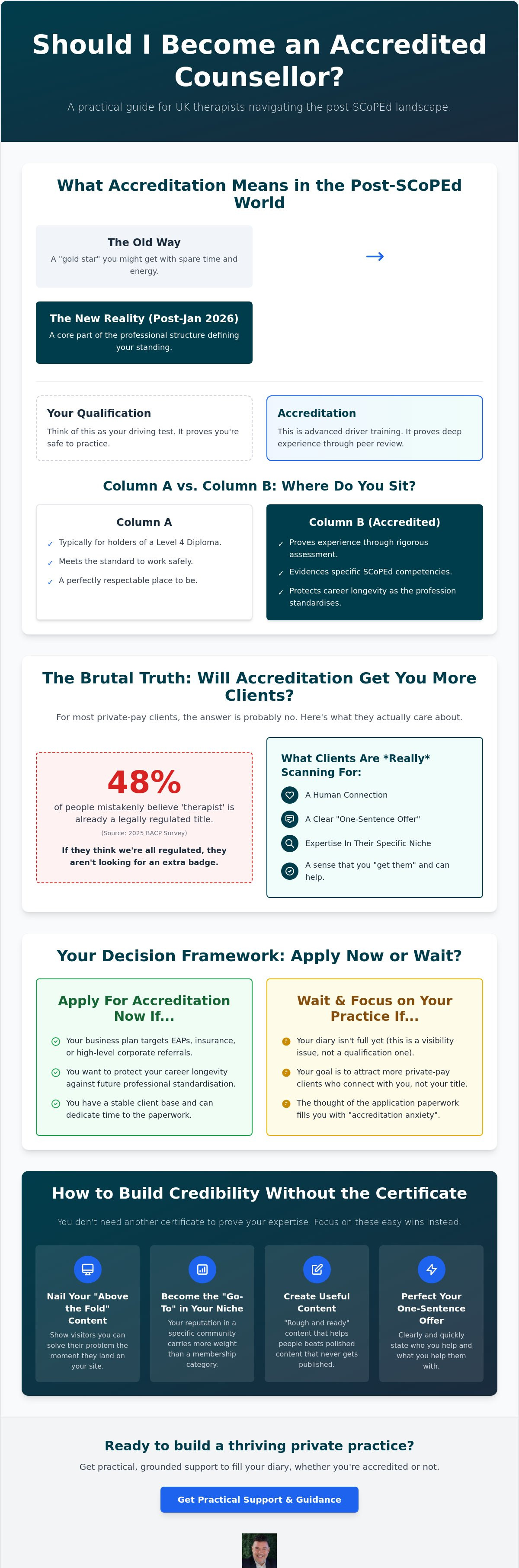
The January 2026 transition deadline wasn't just another date in the diary for UK therapists. It marked the moment the SCoPEd framework moved from a controversial idea to our daily reality. Before this, accreditation often felt like a gold star you might get if you had the spare time and energy. Now, it is the mechanism that defines your position within a specific professional column. It's a shift from "nice to have" to a core part of how our profession is structured.
Accreditation is a voluntary process of peer-reviewed professional standards. It is fundamentally different from your initial qualification. Think of your diploma as your driving test and accreditation as advanced driver training. If you are asking yourself, "Should I become accredited as a counsellor?" you are essentially asking where you want to stand in this new professional hierarchy. You are looking at what professional certification means for your long-term clinical standing rather than just your right to practice.
For most of us, being a Registered member means we've met the basic standards to work safely with clients. Being an Accredited member means you've proven your experience through a rigorous assessment of your clinical hours and reflective practice. With the BACP introducing 13 new routes to accreditation in February 2026, the path has become more flexible, but the standard remains high. It is no longer just about how many years you've been sitting in the chair; it's about evidencing the specific competencies laid out in the framework.
Column A vs. Column B: Where do you sit?
If you hold a Level 4 diploma, you likely find yourself in Column A. This is a perfectly respectable place to be, but many of my coaching clients worry about a potential "glass ceiling" in the future. Deciding "Should I become accredited as a counsellor?" usually comes down to whether you feel the need to move into Column B to protect your career longevity. Moving columns is about more than just a fancy new title. It is about ensuring that as the profession continues to standardise, you aren't left behind when organisations or EAPs look for specific accredited competencies. If you want to explore how this fits into your business growth, our Private Practice Success Membership offers a grounded way to stay informed without the overwhelm.
The Big Question: Will Accreditation Actually Get You More Clients?
Let's start with a reality check. If you're asking "Should I become accredited as a counsellor?" because you think it will make your phone ring off the hook, you might be disappointed. The brutal truth is that most people looking for help on Psychology Today or Counselling Directory don't actually know what BACP accreditation is. A 2025 BACP survey of 5,000 adults found that 48% of people already mistakenly believe that "therapist" is a legally regulated title. If they think we're all regulated anyway, they aren't scanning your profile for an extra badge. They are scanning for a human connection.
In the world of private practice, people connect with people. Your "one-sentence offer" on your website usually does more heavy lifting than your accreditation status. While there are many benefits of national certification in terms of professional pride and clinical standards, your average client just wants to know if you can help them stop feeling so anxious. They want to know you've "got them," not that you've written a 3,000-word case study for a panel of assessors.
When Accreditation is a Business Necessity
There are times when those letters are non-negotiable. If you want to work with EAPs, major insurance companies, or specific high-level charities, they will often demand accreditation as a baseline. If your business plan involves high-level corporate referrals, then yes, you need to be in that Column B. However, successful marketing for therapists uk style is built on rapport first. If you're struggling to fill your diary, the lack of accreditation is rarely the problem. It's usually a visibility issue that we can fix in our Private Practice Success Membership.
The Credibility Gap: Building Trust Without the Badge
You don't need a certificate to prove you're an expert in your niche. If you focus on your "above the fold" content, making sure the first thing a visitor sees on your site is a solution to their specific problem, you build immediate authority. Niche-building often trumps accreditation when it comes to attracting private-pay clients. If you're the go-to person for anger management or working with men, your reputation in that community will always carry more weight than a membership category. It's about being useful, not just being "qualified."
Dealing with "Accreditation Anxiety" and the Paperwork
Opening a blank Word document to start your accreditation case studies is often enough to make even the most seasoned therapist want to go and clean the oven instead. It feels like being back at university, staring at an assignment that seems designed to catch you out rather than celebrate your skills. This academic pressure can be incredibly off-putting, especially if your initial training was more about "being" than "writing." When you find yourself asking, "Should I become accredited as a counsellor?" the answer often depends on whether you can push through this initial wall of dread.
I always suggest a "rough and ready" approach to your first draft. Don't worry about the BACP's word counts or perfect grammar on day one. Just get your thoughts down. You can polish the prose later, but you can't edit a blank page. Remember that imposter syndrome is a common side effect of the application process; it usually hits hardest just as you're trying to prove how good you are. It doesn't mean you're a fake. It just means you're doing something that feels vulnerable.
Your clinical supervision is your secret weapon here. Instead of just using that time for client updates, use it to talk through your reflective practice. Your supervisor can help you find the "gold" in your work that needs to go into your case studies. It turns a lonely box-ticking exercise into a collaborative professional development project.
Practical Steps to Survive the Application
- Chunk it down: Don't try to write the whole thing in a weekend marathon. Aim for 500 words a week. It's much less intimidating.
- Focus on the "why": The assessors want to know why you did what you did, not just a transcript of the session.
- Find your tribe: Doing this in isolation is miserable. Having a supportive peer group to bounce ideas off makes a world of difference.
If the thought of tackling this paperwork alone is what's really holding you back, come and join a community of people who actually get it. You can find the support you need in our Private Practice Success Membership, where we keep things practical and grounded.
Making the Decision: Is Now the Right Time for You?
Before you dive into the paperwork, take a cold, hard look at your current client load. Are you already full? If you have a waiting list and you're charging a fee that makes your business sustainable, the pressure to ask "Should I become accredited as a counsellor?" might just be internal noise. If your "skateboard" is already getting you where you need to go, you don't necessarily need the Rolls Royce version of professional status just yet. Being a Registered member is a massive achievement; it proves you are safe, ethical, and qualified to help people change their lives.
Let's talk about the actual investment. The BACP accredited membership fee for 2026-2027 is £216. While a reduced rate of £108 is available for those who qualify, it is still an extra cost on top of your insurance, supervision, and room hire. You also have to factor in the cost of your time. If you spend forty hours on your application, that is forty hours you aren't seeing clients or working on your marketing. In the early stages of your career, that time might be better spent building your reputation in your local community.
Focusing on Practice Growth First
I've seen many therapists get stuck in a cycle of "qualification chasing" because they feel like a "fake" without more letters. The reality is that starting and growing a private practice usually requires visibility over more certificates. Clients want to know if you understand their pain, not which column of the SCoPEd framework you sit in. Focus on making yourself easy to find on Psychology Today first.
Setting a Review Date
If you decide that now isn't the right time, stop letting the "I should be doing it" thoughts haunt your Sunday nights. Set a "Review Date" in your calendar for six months from now. Until that date hits, give yourself full permission to ignore the accreditation forms. Focus on your clients, your niche, and your own well-being. If you want a clear path forward without the stress, you can always find us in the Private Practice Success Membership.
Your Practice, Your Rules
Deciding "Should I become accredited as a counsellor?" often feels like a heavy weight, but it's really just a business decision. While accreditation matters for SCoPEd alignment and specific insurance work, it isn't a magic wand for attracting private clients. Your niche, your "one-sentence offer," and the way you connect with people on your website will always do more heavy lifting than an extra badge on your profile. People buy from people, not from membership categories.
If you're already full or your current "skateboard" model is working, give yourself permission to breathe. You can set a review date for six months' time and focus on what actually pays the bills right now. If you want to build a sustainable business with a bit of help, you don't have to do it alone. You can stop overthinking the paperwork and start growing your practice inside the Private Practice Success community. You'll get access to our Practice Visibility Blueprint system, BACP-endorsed workshops, and a national UK community of therapists who are all in the same boat. You're already doing vital work. Keep going.
Frequently Asked Questions
Do I have to be accredited to work in private practice in the UK?
No, you do not need to be accredited to run a successful private practice. As long as you are a Registered member of a professional body like the BACP or NCPS, you are qualified to work with clients legally and ethically. Many therapists build full diaries while remaining in Column A of the SCoPEd framework. Clients rarely ask for your accreditation status; they care much more about whether you can help them feel better.
How many hours of practice do I need for BACP accreditation in 2026?
You currently need at least 450 hours of practice to apply for BACP accreditation. These hours must be supervised and usually need to be spread over a period of three to six years. It is a marathon, not a sprint. If you are asking yourself, "Should I become accredited as a counsellor?" before you've hit these numbers, focus on your clinical work and visibility first. The paperwork can wait until you've actually got the experience under your belt.
Is BACP accreditation the same as being on the BACP Register?
No, they are different levels of membership. The BACP Register is the baseline for all qualified members and shows you've met the minimum training standards to practice safely. Accreditation is a secondary, voluntary process where you prove your experience through case studies and reflective writing. Think of the Register as your basic license and Accreditation as a specialist badge of experience.
Can I charge higher fees once I am an accredited counsellor?
There is no rule that says you can't increase your fees after accreditation, but the market doesn't always reward the title alone. Most private pay clients won't pay more just for those letters. If you want to charge higher fees, you are usually better off building a strong niche or becoming the local expert in a specific area. Your value to the client is in the results you provide, not the certificates on your wall.
Will accreditation help me get on insurance provider panels like Bupa or AXA?
Yes, this is one of the most practical reasons to pursue the title. Many major insurance providers, including Bupa and AXA, often require therapists to be accredited before they will allow you onto their provider panels. If your business plan relies on insurance referrals rather than direct private pay clients, then accreditation becomes a much higher priority. It opens doors to certain corporate contracts that are otherwise closed to Registered members.
Disclaimer
The information provided on this blog is for general informational purposes only and is not intended to be a substitute for professional medical or mental health advice, diagnosis, or treatment. Reading this content does not create a therapist-client relationship.


