Is CPD Really Necessary for Therapists? A Practical UK Perspective for 2026
If you have ever stared at a £145 workshop invoice and wondered if you're paying for knowledge or just buying a certificate to keep your professional body happy, you aren't alone. With the BACP SCoPEd transition deadline of 30 January 2026 fast approaching, many of us are feeling the pressure to tick boxes. It leads to the uncomfortable question: is CPD really necessary for therapists, or has it simply become an expensive annual tax on our right to practise? Between the financial strain of courses and the time taken away from fee-paying clients, it's easy to view these requirements with a sense of dread.
I understand that frustration because I've been there myself. The fear of a random professional body audit or missing your 30-hour annual quota can make development feel like a burden rather than a benefit. In this guide, I'll show you how to choose training that actually builds your clinical confidence and helps you grow your practice. We'll look at the 2026 requirements and explore how to turn these mandatory hours into a tool that supports your business and your sanity.
Key Takeaways
- Learn how to shift your mindset from "ticking boxes" to intentional learning that prevents burnout and restores your energy for clinical work.
- Discover why choosing training based on your specific client gaps, rather than just what is on sale, helps you build a more sustainable and confident private practice.
- We address the question of whether is CPD really necessary for therapists by exploring how the right training acts as a safeguard against professional isolation.
- Get a practical 4-step plan to manage your 2026 professional requirements, ensuring you stay audit-ready without the usual end-of-year stress.
- Find out how to balance clinical skill-building with the "business of therapy" to ensure your professional development actually supports your practice growth.
Beyond the Box-Ticking: Why We Often Resent CPD
Let's be honest. Most of us have felt that sinking feeling when the annual renewal email lands in our inbox. You look at your diary, see the gaps where you could be seeing clients, and wonder is CPD really necessary for therapists when the costs are so high? For members of the BACP or NCPS, that 30-hour annual requirement can feel like a heavy weight, especially when you're juggling a busy private practice and a personal life. It's easy to see it as a regulatory tax rather than a growth opportunity.
Real Continuing Professional Development isn't about collecting certificates to file away in a dusty folder. It's a commitment to staying curious. The resentment we feel usually isn't about learning itself; it's about the time we've wasted on irrelevant workshops that don't help the person sitting in the chair opposite us on Monday morning. When training feels like a chore, it's usually because the content doesn't match the reality of our clinical work.
Regulatory Requirements vs. Professional Reality
Audits exist for a reason. They maintain public trust in our profession and ensure we aren't just making it up as we go along. However, the true value of these hours goes beyond satisfying a registrar. In private practice, the real danger is isolation. Without structured external input, we risk becoming an echo chamber for our own biases. Engaging with new ideas keeps our practice safe, grounded, and connected to the wider therapeutic community.
The Cost of Stagnation in a Changing World
The world our clients live in is changing fast. From the impact of new technology to evolving understandings of neurodiversity and gender, our initial qualification is only a starting point. Relying solely on training from a decade ago can lead to "ethical drift," where our methods slowly lose their edge. Staying current isn't just about being "modern"; it's about ensuring we remain effective and ethical practitioners in a world that doesn't stand still.
The Clinical Case for Ongoing Learning: Confidence and Safety
When we shift the focus away from the registrar's office and back into the therapy room, the question of whether is CPD really necessary for therapists takes on a different meaning. It's about how you feel when a client brings a challenge you haven't faced before. For instance, specific training in working with men in therapy doesn't just add a line to your CV. It gives you the specific tools and confidence to handle the unique ways men might engage with the therapeutic process, turning a moment of uncertainty into an opportunity for deep clinical work.
Learning something new is also a powerful antidote to therapist burnout. When we feel stuck with a long-term client or find ourselves repeating the same interventions session after session, our energy drains. A fresh perspective or a new framework can act as a circuit breaker. It reminds us why we started this work in the first place. Taking time for professional development is, in many ways, a high-level form of self-care. It protects your passion for the work and ensures you have something meaningful to offer every person who walks through your door.
If you are looking for a supportive environment to explore these ideas, our Private Practice Success Membership offers a space to grow alongside peers who understand the journey.
Tackling Imposter Syndrome Through Expertise
We all have moments where imposter syndrome whispers that we aren't quite enough for the complexity of our caseload. Deep-dive courses help build that "internal supervisor" voice. This is the quiet, confident part of you that knows what to do when a session becomes difficult. Stepping back into the role of a student also keeps us humble. It reminds us what it feels like to be vulnerable and uncertain, which directly feeds back into our empathy for the client experience.
Staying Ethical in Complex Situations
Beyond the clinical work, we have a duty to stay sharp on the practicalities. UK law and safeguarding protocols change, and staying aligned with current professional standards ensures you are up to date with GDPR and legal obligations. Reflective practice is the bridge between theory and ethical action.
Choosing CPD That Actually Serves Your Private Practice
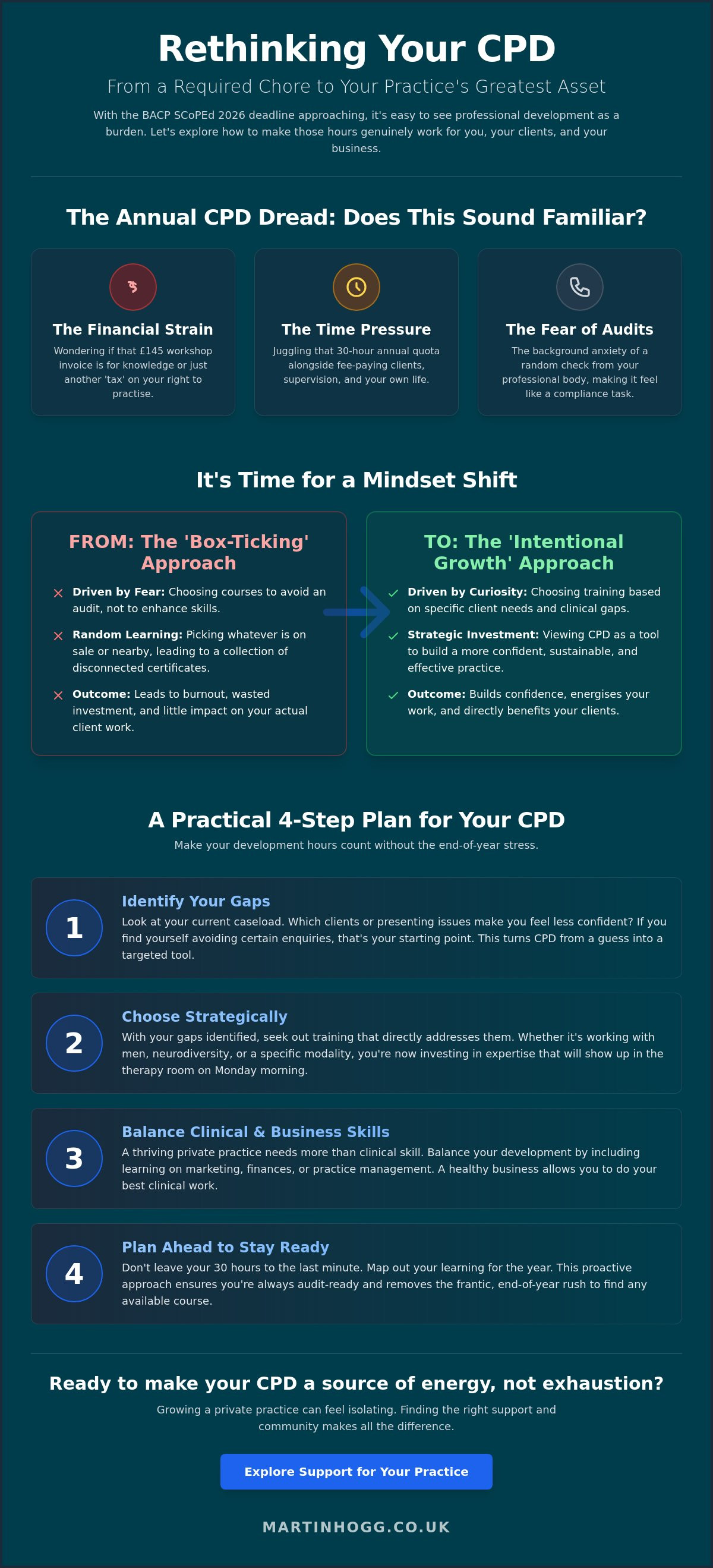
When you're looking at your budget for the year, it's tempting to just pick whatever course is on sale or closest to home. But if we want to answer the question, is CPD really necessary for therapists, we have to look at it through the lens of your specific caseload. Instead of gathering random certificates, try to identify the "gaps" in your current work. If you've had three enquiries this month about a topic that makes you feel slightly anxious, that's exactly where your next training should be focused. It turns a chore into a strategic investment.
A smart way to plan is by checking our CPD calendar for practical workshops that offer immediate clinical tools. When you align your learning with a specific niche, your marketing becomes much more effective. You stop being a "generalist" and start being the person clients specifically seek out. This approach follows the spirit of BACP's CPD guidance, which encourages us to reflect on how our learning actually benefits the people we serve.
Balancing Clinical Skills with Practice Growth
Many therapists don't realise that learning about marketing for therapists uk is a legitimate part of your professional development. You can't help clients if they can't find you. Becoming an expert in a niche, like Anger Management, allows you to build a reputation that naturally attracts more clients. If you want to stop worrying about where the next enquiry is coming from, join our Private Practice Success Membership to learn how to grow your business sustainably.
Evaluating the Quality of a Training Provider
Don't be swayed by fancy titles alone. Look for BACP endorsement, real-world trainer experience, and, most importantly, practical takeaways. Avoid courses that are 90% abstract theory. You need tools you can use in your Monday morning sessions. A good workshop should leave you feeling more capable, not just more tired. Your time is your most valuable asset; don't spend it on training that doesn't offer a clear path to better clinical outcomes or a healthier practice.
Making Your Professional Development Sustainable
If you've ever spent a frantic weekend in December trying to find fifteen hours of webinars to avoid an audit, you know that "panic learning" isn't learning at all. It's just stress. While we've explored why is CPD really necessary for therapists from a clinical perspective, making it sustainable requires a shift in how you manage your time and money. You don't have to let your professional requirements become a source of overwhelm. A little bit of planning at the start of the financial year goes a long way.
I recommend a simple four-step plan to keep things on track:
- Audit your caseload: Look at your current clients and identify where you feel least confident.
- Set a budget: CPD is typically tax-deductible for those in private practice. Decide what you can afford to invest back into your skills each year.
- Book in advance: Place your key workshops in your diary early so they don't clash with client sessions.
- Record as you go: Write your reflective notes the morning after a course while the ideas are still fresh.
Being part of a community makes this process much easier. Our Private Practice Success Membership provides a space where you can stay accountable and share the journey with others who understand the unique pressures of the UK therapy landscape.
Integrating Learning Into Your Practice Visibility
Your CPD shouldn't stay hidden in a folder. When you learn something new, share a simplified version of that insight with your audience. Writing a blog post or a social media update about a new technique shows potential clients that you're committed to the highest standards of care. It builds trust before they even book their first session. It turns your learning into a tool for growth.
The Power of Peer Learning
Solo reading is useful, but group-based learning often provides more depth. Hearing how other counsellors apply a theory to their work helps you see different perspectives you might have missed on your own. Finding a "learning buddy" or a peer group keeps you motivated. It transforms CPD from a lonely box-ticking exercise into a meaningful part of your professional life.
Moving from Compliance to Confidence
Professional development doesn't have to be a source of annual dread or a frantic search for hours at the end of the year. It's the primary tool we have to stay fresh, ethical, and effective in a demanding profession. By choosing courses that fill your specific clinical gaps and balancing those with the business skills needed to run a practice, you turn a mandatory requirement into a personal strategy. While the question of whether is CPD really necessary for therapists often starts with a focus on regulation, the real answer lies in the quality of the work you do and the longevity of your career.
You don't have to navigate these requirements alone. If you're ready to stop guessing and start growing, you can join the Private Practice Success Membership for accredited training and support. You'll get access to BACP-endorsed workshops and practical training delivered by me, Martin Hogg, designed specifically for the UK market. This community is already used by hundreds of UK counsellors who are committed to building better practices together. With the right plan and a supportive group behind you, your professional development can become the most rewarding part of your week.
Frequently Asked Questions
How many hours of CPD do I actually need for the BACP or UKCP?
Registered BACP members are expected to complete at least 30 hours of CPD every year. If you are registered with the UKCP, the requirement is slightly different, asking for 250 hours over a five-year period with a minimum of 20 hours in any given year. These hours should ideally be spread across different types of learning to show a broad commitment to your professional growth.
Does clinical supervision count towards my annual CPD hours?
No, clinical supervision is a separate mandatory requirement and does not count towards your 30 hours of CPD. Professional bodies view supervision as an essential part of your ongoing practice and client safety rather than "new" development. While you certainly learn a lot during your supervision sessions, you must record those hours in a separate log from your professional development activities.
Can I count reading therapy books or listening to podcasts as professional development?
Yes, personal study such as reading books or listening to relevant podcasts counts as unstructured CPD. When people ask is CPD really necessary for therapists, they often forget that these informal moments are just as valid as expensive workshops. The most important part is that you document what you learned and, more importantly, how that information has changed the way you work with your clients.
What happens if I fail a CPD audit from my professional body?
If your CPD record doesn't meet the requirements during a random audit, you'll usually be given a chance to put things right. Professional bodies typically provide feedback on what was missing and offer a specific timeframe for you to complete extra training or improve your reflective notes. It is a process meant to support your standards of practice, so there is no need to panic if you are asked for more detail.
Is business coaching for therapists considered valid CPD?
Yes, business coaching and learning about practice management are valid forms of professional development. Your professional body understands that running a safe, ethical, and sustainable practice is vital for providing a good service to your clients. Activities that help you manage your practice more effectively, such as learning about GDPR or marketing, contribute to your overall competence as a professional practitioner in the UK.

Article by
Martin Hogg
I help Private Practice counsellors in the UK set up and grow an ethical Private Practice they love, work with their ideal clients, and earn the income they deserve. All without guesswork and burnout. I have been a private practice counsellor myself for over 20 years, specialising in anger management. I set up a not-for-profit social enterprise, Citizen Coaching and Counselling, which delivers thousands of counselling sessions a year to adults and young people in Birmingham. I am a registered BACP Counsellor and the author of three books, My Anger Coach, My Anxiety Coach and My Relationship Coach. These are available on Amazon.
Disclaimer
The information provided on this blog is for general informational purposes only and is not intended to be a substitute for professional medical or mental health advice, diagnosis, or treatment. Reading this content does not create a therapist-client relationship.


