
Leaving Agency Work to Start a Therapy Practice: A Practical UK Guide
What if the "security" of your agency role is actually the biggest risk to your clinical passion? You likely chose this profession to help people, yet you might find yourself spending 40% of your week on administrative tasks rather than in the therapy room. It's a common struggle; a 2023 BACP survey highlighted that high workloads and "paperwork fatigue" are primary drivers for burnout among practitioners. Many counsellors stay because the steady paycheck feels like a safety net, but leaving agency work to start a therapy practice doesn't have to be a leap into the unknown.
I know the fear of inconsistent income is real, but you deserve a practice that reflects your clinical values. This guide provides a practical roadmap to help you transition from the constraints of agency life to the autonomy of your own business. We'll walk through everything from HMRC registration to setting fees that provide genuine financial stability. You'll learn how to build a manageable transition plan that gets your career back on track without the overwhelm.
Key Takeaways
- Understand the practical steps to move from the burnout of a heavy agency caseload to the calm autonomy of running your own room.
- Get your UK essentials in order with a straightforward guide to HMRC registration and securing the right professional indemnity insurance.
- Evaluate the best exit strategy for your finances, helping you decide between a clean break or a gradual transition when leaving agency work to start a therapy practice.
- Learn how to reframe marketing as "visibility," making it easy for the right clients to find you without needing to use pushy or "salesy" language.
- Move away from "hope-based marketing" by adopting a structured system that provides both financial stability and a supportive professional community.
The Reality of Transitioning from Agency to Private Practice
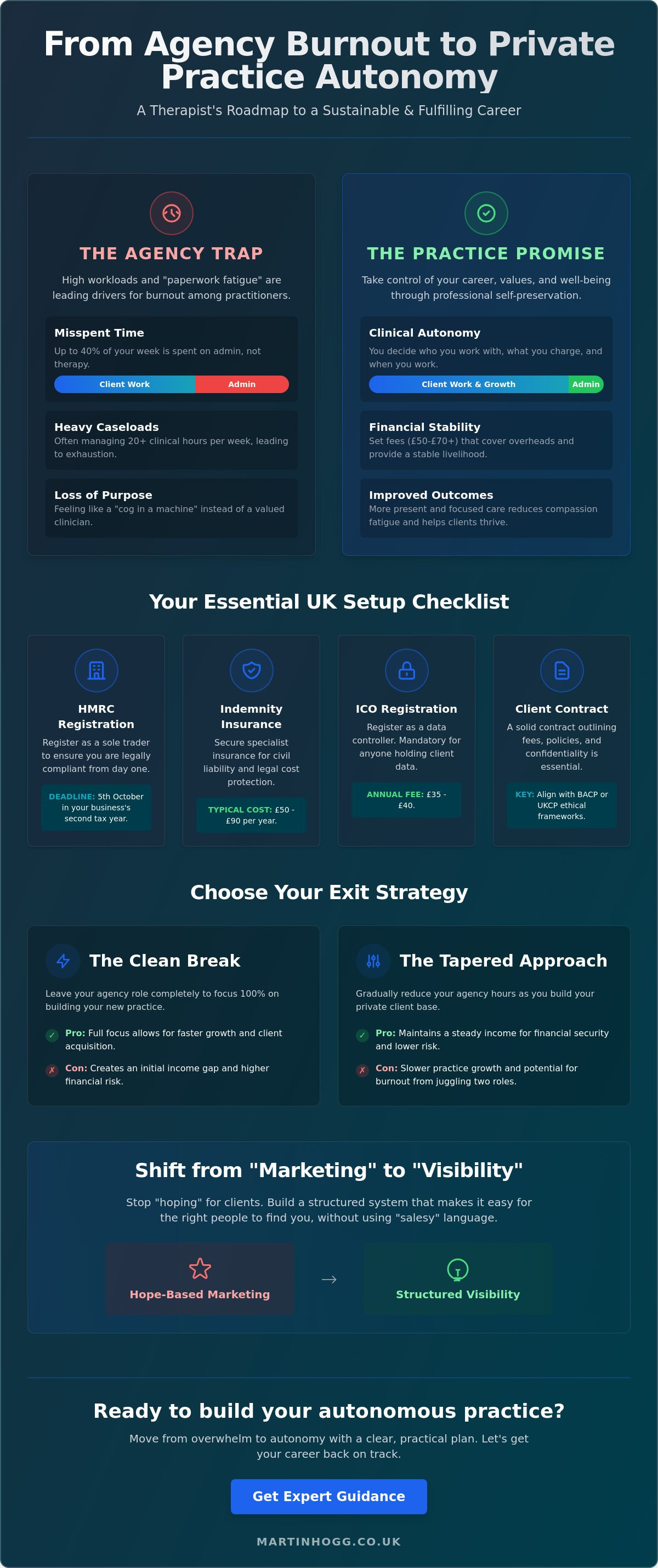
Leaving agency work to start a therapy practice is a significant professional milestone. It isn't just a change in your tax status. It's a move from the predictable safety of a monthly salary into a space where you hold all the responsibility. Many counsellors find themselves in a "no-man’s land" during this time. You might feel a mix of excitement and genuine fear. This is normal. You're likely exhausted from the heavy caseloads and administrative weight that come with agency or charity roles. In many UK charities, therapists are expected to manage 20 or more clinical hours a week. This often leads to burnout and a feeling that you're just a cog in a machine.
You might feel guilty about leaving your colleagues or the vulnerable clients the agency serves. I want you to remember that you can't pour from an empty cup. Moving to private practice is an act of professional self-preservation. It allows you to provide better care in the long run. The field of Psychotherapy is demanding. Doing it well requires you to be at your best. Framing this transition as a milestone rather than a simple career change helps you respect the work you've already done while looking forward to what's next.
The Mindset Shift: From Employee to Practitioner-Owner
In an agency, someone else provides the room, the referrals, and the insurance. You're an employee. Transitioning means you must accept that "business" is simply the container for your clinical work. It isn't a dirty word. If the business side doesn't work, the therapy can't happen. You'll likely face imposter syndrome when setting your first fees. Charging £50 or £70 an hour can feel wrong when you're used to a flat salary. However, these fees cover your overheads, supervision, and your own livelihood. Accepting this dual role as both a healer and a business owner is the first step toward a sustainable practice.
Defining Your Clinical Values in a Private Space
Autonomy changes everything. You get to decide who you work with. Perhaps you want to focus on specific client groups, like men's mental health or trauma recovery, rather than the "general list" an agency provides. You set the boundaries. If you only want to work three days a week to maintain your own mental health, you can. This control reduces the risk of compassion fatigue. When you aren't drained by rigid agency mandates, your clinical outcomes often improve because you're more present and focused. You are finally in charge of the therapeutic environment you create.
If you're feeling overwhelmed by the practical steps of this move, you can book a session on my calendar to talk through your specific situation.
Your Essential UK Private Practice Setup Checklist
Moving away from the structured environment of an agency is a significant step. While agency life provides a steady stream of clients, it often lacks the autonomy you need to work in a way that truly aligns with your values. When you are leaving agency work to start a therapy practice, your first task is to build a foundation that is legally sound and professionally robust. This isn't just about ticking boxes; it's about creating a safe container for your clients and peace of mind for yourself.
Your first port of call is HMRC. You must register as a sole trader, even if you are only seeing a few clients a week. You need to do this by 5th October in your business's second tax year. Keeping clear records from day one makes the annual Self Assessment much less daunting. As you begin this journey, I recommend looking at the official guidance on writing a business plan to help you map out your financial goals and service structure. It’s also vital to secure specialist professional indemnity insurance. Most UK policies for counsellors cost between £50 and £90 per year, providing essential cover for civil liability and legal costs. Finally, you must register with the Information Commissioner’s Office (ICO) as a data controller. The annual fee is usually £40, or £35 if you set up a direct debit, and it is a mandatory requirement for anyone holding client data under UK GDPR.
Legal and Regulatory Foundations
A solid therapeutic contract is your most important tool for managing expectations. It should clearly outline your fees, cancellation policy, and the limits of confidentiality. I always advise practitioners to align their contracts with the BACP or UKCP ethical frameworks to ensure they meet professional standards. Don't forget to appoint a professional executor for your clinical will. This is a trusted colleague who can contact your clients in the event of your sudden illness or death, ensuring they aren't left without support during a crisis.
Practical Logistics: Rooms and Technology
Deciding where to work is a balance of cost and comfort. Renting a room in a dedicated therapy centre often costs between £10 and £15 per hour in the West Midlands, though prices vary by region. If you choose to work from home, ensure the space is private and professional. For those working online, you'll need GDPR-compliant practice management software. Tools like WriteUpp or Bacpac help you store notes and process billing securely. I suggest setting up a dedicated business phone line and a professional email address, such as through Google Workspace, to keep your personal and professional lives distinct. If you feel overwhelmed by these choices, joining a community like our Private Practice Success group can provide the peer support you need to get these details right.
Choosing a supervisor who understands the specific pressures of private work is equally important. When you are leaving agency work to start a therapy practice, you no longer have a clinical lead down the hall. You need a supervisor who can help you manage the isolation and the business-related ethical dilemmas that don't always crop up in agency settings. This transition is about taking control of your career, and getting these basics right means you can focus on what you do best: helping your clients get their lives back on track.
Choosing Your Exit Strategy: The 'Clean Break' vs. The 'Tapered' Approach
Deciding exactly how you'll make the transition is a personal choice, but it must be grounded in your current financial reality. Before you hand in your notice, take a cold, hard look at your bank balance. I usually suggest having at least three to six months of essential living expenses tucked away in a separate account. If your monthly outgoings are £2,200, having a £6,600 "runway" provides the mental space you need to focus on your clients rather than worrying about the rent. You also need to dig out your original employment contract. Many UK agencies include notice periods of up to three months and "non-compete" clauses that might restrict you from seeing clients within a specific radius, such as five or ten miles, for a set period after you leave.
Leaving agency work to start a therapy practice requires a significant shift in your professional identity. You are moving from being an employee with a guaranteed caseload to a business owner responsible for your own referrals. When you tell your agency you're moving on, keep the conversation professional and warm. You don't need to justify your desire for independence; simply express gratitude for the clinical experience you've gained. The therapy community in the UK is smaller than you think, and maintaining those professional bridges can lead to valuable peer support and referrals in the future.
The 'Tapered' Transition: Slow and Steady
Many therapists find comfort in reducing their agency hours by one day a week as their private caseload grows. This "tapered" approach allows you to keep a steady salary while you test your marketing strategies and find your niche. It's a practical way to manage the risk of going solo. However, you must be honest about your energy levels. Working a "double shift," where you're an employee by day and an entrepreneur by night, can quickly lead to burnout. It's vital to set clear boundaries so your two professional roles don't bleed into each other, leaving you exhausted before you've even begun your private work.
The 'Clean Break': Starting Fresh
Sometimes, leaving the agency entirely before seeing your first private client is the right move for your mental health. This "clean break" offers a significant psychological benefit: you have 100% of your focus available for practice growth. Without the safety net of an agency salary, your motivation to succeed often sharpens. If you choose this path, ensure your financial safety net is robust. Having a clear plan for your first 90 days is essential to turn that initial momentum into a sustainable business. This approach is often best for those who feel their current role is draining the very empathy they need to serve their own clients effectively.
Overcoming the Fear of Marketing and Finding Your First Clients
Many therapists feel a genuine sense of discomfort when they hear the word "marketing". If you have spent your career in the NHS or a local charity, the idea of "selling" your services can feel clinical or even slightly unethical. I want you to look at this differently. Marketing is simply visibility. It is about making it easy for the right people to find the help they need. Practice visibility is the bridge between a therapist’s skill and a client’s need.
When leaving agency work to start a therapy practice, your first task is to stop using "salesy" language. You don't need to convince anyone to have a problem; they already have one. Your job is to describe that struggle in a way that makes them feel heard. Instead of listing your qualifications in the first paragraph, describe the weight of their anxiety or the exhaustion of their depression. When a potential client reads your words and thinks, "They actually get it," you have already built the first layer of trust.
In the early stages, directories are your most effective tool. Statistics from industry surveys in 2023 indicate that approximately 72% of private clients start their search on platforms like Psychology Today or the Counselling Directory. These sites do the heavy lifting for you. Pair this with a simple, human-centred website. You don't need a complex twenty-page site. A clear "About Me" page with a professional photo and a straightforward contact form is often enough to turn a visitor into an enquiry.
Building Visibility Without Sounding Like a Salesperson
To attract the right clients, your profile must speak directly to their internal experience. Use UK-specific SEO by including your town or borough in your headers. If you work in Birmingham, ensure "Counsellor in Birmingham" appears naturally on your page. This helps you appear in local search results when someone nearby is looking for support. Don't forget natural networking. Building a referral path with a local GP surgery or a nearby wellbeing organisation can provide a steady stream of clients without you ever feeling like a "salesperson".
Managing the "Feast or Famine" Cycle
In private practice, enquiries rarely arrive in a steady trickle; they often come in waves. You might see a spike in January or September as people look for a fresh start. It is vital to stay calm during the quiet weeks. Use these gaps to refine your admin or rest. If you find yourself oversubscribed, manage a waiting list ethically by giving clear timeframes. This prevents burnout and ensures you remain a stable, composed presence for those you do see.
If you want to join a community of peers who are also making this transition, you can access practical support and resources here.
Building a Sustainable Future with the Practice Visibility Blueprint
Leaving the security of an agency is a bold move. It is the shift from being a cog in a machine to becoming the architect of your own professional life. However, the biggest risk when leaving agency work to start a therapy practice is relying on what I call "hope-based marketing." This is the habit of building a directory profile, crossing your fingers, and hoping the phone rings. It rarely works long-term and often leads to the "struggling solo" cycle where you are constantly worried about next month's income.
A sustainable practice requires a structured system. You need a way to reach the people who need you most without feeling like a pushy salesperson. By following a clear blueprint, you move away from the anxiety of empty diary slots and into a position of professional authority. You aren't just a therapist for hire; you are a practice owner with a clear vision and a reliable way to connect with your community. This structure provides the stability that an agency once offered, but on your own terms.
The Power of the Private Practice Success Membership
One of the hardest parts of leaving an agency is losing the team around you. Private practice can be a lonely road if you try to walk it by yourself. That is why I created the Private Practice Success Membership. It is a space designed specifically for UK-based therapists who want to grow their business alongside peers who understand the unique challenges of our profession.
- Access live training sessions that focus on practical, ethical marketing techniques that actually work in the UK market.
- Connect with a network of practitioners who have already successfully made the move from agency work to independence.
- Utilise tools that help you move beyond survival mode so you can finally choose your own hours and your ideal client base.
This isn't about generic business advice. It is about grounded, human-to-human connection that helps you get your life back on track while you help your clients do the same. Having that support system means you have a sounding board when things get tough.
Next Steps: From Planning to Action
The research phase is important, but there comes a point where you have to stop planning and start doing. I encourage you to set a firm launch date. Having a specific date marked in your calendar changes your mindset from "maybe one day" to "this is happening." It gives your transition a sense of purpose and urgency that research alone cannot provide.
If you feel overwhelmed by the logistics of leaving agency work to start a therapy practice, let's talk. You can book a one-to-one practice growth coaching session with me. We will look at your specific situation and map out an exit strategy that feels safe, manageable, and realistic. You don't have to figure this out by trial and error. Professional independence is one of the most rewarding steps you can take in your career, and it is entirely within your reach.
Taking the first step toward your independence
Deciding on leaving agency work to start a therapy practice is a brave move that marks the beginning of a more balanced professional life. We've covered the practicalities, from choosing between a clean break or a tapered exit to ticking off your essential UK setup checklist. The transition is less about "selling" yourself and more about becoming visible to the clients who are already looking for your specific expertise. It's a shift from being an overstretched employee to a grounded, purposeful business owner.
I've spent over 20 years in UK private practice and work as a BACP-endorsed workshop provider. I understand the quiet anxiety of an empty diary, but I also know the freedom that comes with a well-run practice. Our community of 500+ therapists is proof that you don't have to do this alone. You have the clinical skills to change lives; you just need a reliable structure to support your own growth and sustainability.
Discover the Practice Visibility Blueprint and start your journey today.
You're more than ready to get your professional life back on track and build something that truly lasts. I look forward to seeing you thrive.
Frequently Asked Questions
Is it ethical to take agency clients with me to my new private practice?
You must prioritize your existing contract and the BACP or UKCP ethical framework before moving any clients. Most UK agencies include a "non-compete" clause that lasts for 6 to 12 months, which legally prevents you from soliciting their clients. While client autonomy is important, breaking a contract can lead to legal action and damage your professional reputation in the local community.
How much money should I save before leaving my agency job?
I recommend saving a "runway" of at least four to six months of your essential living expenses. Data from the 2023 BACP Private Practice survey shows that it often takes several months to build a consistent caseload. If your monthly outgoings are £1,800, having a safety net of at least £7,200 will help you stay calm and focused while you grow your new business.
Do I need to register with the ICO if I only keep paper notes?
Yes, you still need to register with the Information Commissioner's Office (ICO) in almost every case. Even if your clinical notes are on paper, you're likely using a mobile phone to store client numbers or a computer to send emails. These digital actions mean you're processing personal data. The annual data protection fee for most sole trader therapists is currently £40, or £35 if you pay by direct debit.
Can I run a private therapy practice from my own home in the UK?
You can certainly work from home, but you'll need to check your mortgage agreement, lease, and home insurance policy first. When you're leaving agency work to start a therapy practice, it's vital to consider the impact on your privacy and your neighbours. About 45% of UK therapists now work from home or offer online sessions, but you must ensure your space is confidential and has a professional entrance if you're seeing people in person.
What are the most common mistakes therapists make when leaving agency work?
The most frequent mistake is underestimating the time and energy needed for marketing and admin tasks. Many practitioners also suffer from isolation once they leave a busy team environment. Recent industry surveys suggest that 1 in 3 therapists feel overwhelmed by the business side of things in their first year. It's better to start slowly and build your confidence rather than trying to launch a perfect, high-cost website on day one.
How do I set my fees when I first start out in private practice?
Research the average rates in your specific part of the UK, as fees vary significantly between London and the Midlands. In 2024, many experienced therapists in Birmingham and surrounding areas charge between £50 and £75 per hour. Don't set your prices too low just because you're starting out. You've already gained valuable experience in your agency role, and your fee needs to cover your supervision, insurance, and pension contributions.
Do I need a separate business bank account as a sole trader therapist?
It's not a legal requirement for sole traders, but I strongly advise you to open one anyway. Keeping your therapy income separate from your personal grocery shopping makes your annual Self Assessment tax return much easier to manage. Many UK banks offer free business banking for the first 12 months, which gives you a clear view of your practice's financial health without any extra cost.

Article by
Martin Hogg
I help Private Practice counsellors in the UK set up and grow an ethical Private Practice they love, work with their ideal clients, and earn the income they deserve. All without guesswork and burnout. I have been a private practice counsellor myself for over 20 years, specialising in anger management. I set up a not-for-profit social enterprise, Citizen Coaching and Counselling, which delivers thousands of counselling sessions a year to adults and young people in Birmingham. I am a registered BACP Counsellor and the author of three books, My Anger Coach, My Anxiety Coach and My Relationship Coach. These are available on Amazon.
Disclaimer
The information provided on this blog is for general informational purposes only and is not intended to be a substitute for professional medical or mental health advice, diagnosis, or treatment. Reading this content does not create a therapist-client relationship.


