
Local Marketing for Therapists: How to Get Noticed Without Feeling Like a Salesperson

Article by
Martin Hogg
I help Private Practice counsellors in the UK set up and grow an ethical Private Practice they love, work with their ideal clients, and earn the income they deserve. All without guesswork and burnout. I have been a private practice counsellor myself for over 20 years, specialising in anger management. I set up a not-for-profit social enterprise, Citizen Coaching and Counselling, which delivers thousands of counselling sessions a year to adults and young people in Birmingham. I am a registered BACP Counsellor and the author of three books, My Anger Coach, My Anxiety Coach and My Relationship Coach. These are available on Amazon.
What if local marketing isn’t about persuading anyone, but helping the right person find you when they’re ready to look? That’s the heart of local seo for therapists. You don’t need to turn your practice into a sales pitch to become more visible.
I know marketing can feel uncomfortable when your work is built on trust, not persuasion. And when advice starts talking about algorithms, keywords and rankings, it’s easy to wonder where to begin. You’re not alone in that.
I’ll show you how to make your practice easier to find and understand. We’ll cover practical steps for your website, Google Business Profile and directory listings such as BACP and Counselling Directory. I’ll also explain the skateboard model: a simple one-page site you can build on over time. It doesn’t need corporate polish. Rough and ready content beats polished if it gives people the information they need.
Key Takeaways
- Make your online “shop window” clear, so people can quickly understand who you help and how to take the next step.
- Use a one-sentence offer to explain your work plainly, without feeling as though you’re giving a sales pitch.
- Build local seo for therapists with accurate directory profiles and a complete Google Business Profile that reflects how you work.
- Start with a simple one-page website, with the key information above the fold. You can improve it as you learn what visitors need.
What Local Marketing Actually Means for a UK Therapist
Local marketing isn’t about shouting louder than the therapist down the road. It’s about making your shop window clear for someone who may be anxious, tired and unsure where to start. I see it as the bridge between your clinical skill and the person looking for support. Local search engine optimisation (local SEO) helps people find relevant services nearby, but the human detail matters just as much as the technical signals.
A plain explanation of who you work with, what sessions involve and how to enquire can be more useful than glossy copy that could belong to any business. The difference between selling and being visible is simple: you’re not pressuring someone to book. You’re giving them enough clear information to decide whether to take the next step.
The Reality of UK Private Practice in 2026
Someone may search for a “counsellor near me” even if they’re open to working on Zoom. They could be looking for a therapist based nearby, a familiar local connection or simply a way to narrow down their options. Local seo for therapists helps make that information easier to find. Your task is to explain your work in language a potential client can understand, including whether you meet online, in person or both.
Why Your Community Needs to Find You
If your details are hard to find, someone may choose a result that looks clearer, not necessarily one that’s a better fit or more qualified. Make your experience, approach and professional memberships easy to understand. I wouldn’t describe visibility as a formal duty of care, but clear, accurate information can make support easier to access. Being findable gives people a fair chance to consider whether your practice suits them.
Overcoming the 'I'm Not a Marketer' Mental Block
If marketing feels a bit icky, that may be because you care about doing it responsibly. You don’t want to make promises you can’t keep or turn someone’s distress into a sales opportunity. Good. Ethical marketing isn’t about pressure. It’s about making accurate information easy to find, which is what local seo for therapists should help you do.
You don’t need to become a marketing expert. Start with one sentence that helps a potential client recognise whether your work might suit them. Think of it as a useful introduction, not an advert.
Make your offer clear and client-focused
Write for the person looking for support, not your clinical supervisor. For example: “I help adults who feel stuck in patterns of anger to understand what’s happening and find more useful ways forward.” Keep it honest and specific to your work. A person already making a difficult decision shouldn’t have to work hard to understand your website. The Local SEO for Therapists guide offers further practical context on improving your online presence.
Be clear without overclaiming
You can state your fees plainly and explain what a first session involves. The BACP says advertising should be accurate, avoid exaggerated claims and comply with the CAP Code. Clarity isn’t pushy; it lets people make an informed choice. You don’t have to be an expert in everything, either. Be clear about the people and concerns you’re equipped to work with. If self-doubt is getting in the way, I’ve written more about beating imposter syndrome as a therapist.
If you’d find it helpful to work through visibility alongside other practitioners, the Private Practice Success community offers a supportive network. You can take this one step at a time. Write your one-sentence offer, then make sure it sounds like you.
3 Practical Ways to Build Your Local Reach Today
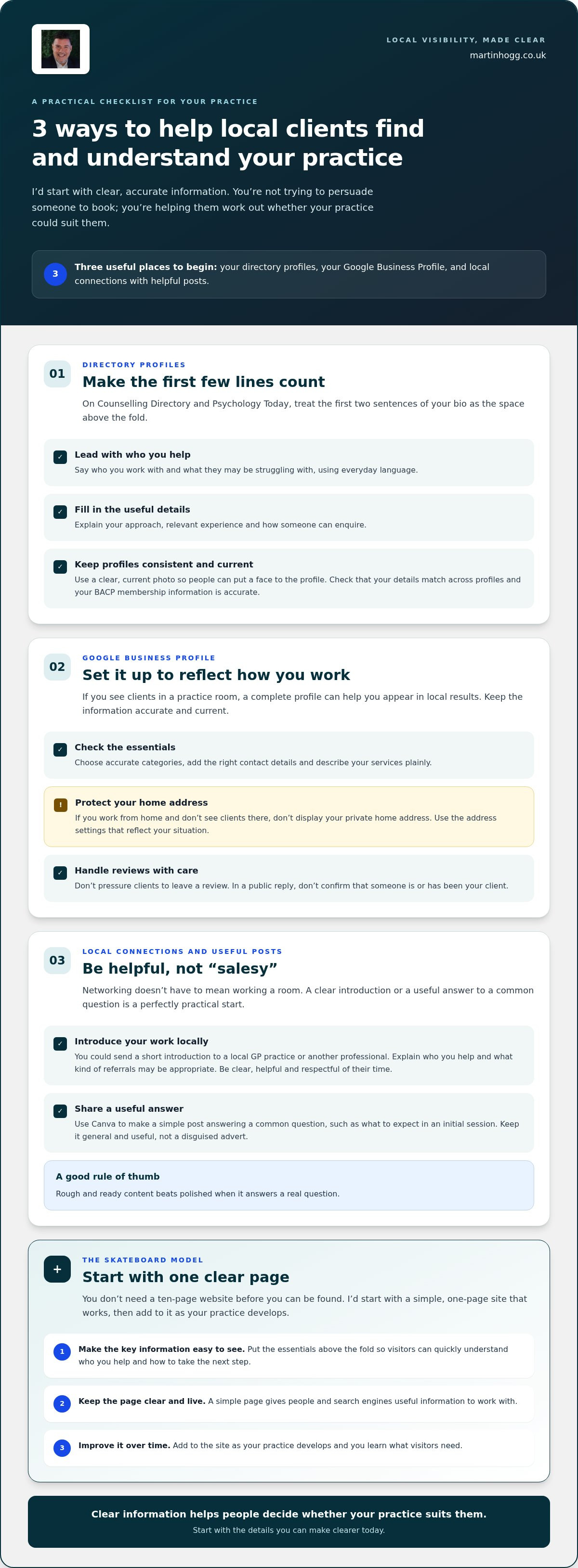
Local seo for therapists isn’t just keywords and website tweaks. Your directory profiles, local relationships and Google presence all help people understand whether your practice could suit them. Start with these three practical areas.
1. Make your directory profiles work harder
On Counselling Directory and Psychology Today, treat the first two sentences of your bio as the space above the fold. Say who you work with and what they may be struggling with, using everyday language. Then explain your approach, relevant experience and how to enquire. A clear, current photo helps people put a face to the profile before they reach your qualifications. Keep your details consistent across profiles, and make sure your BACP membership information is accurate.
2. Set up your Google Business Profile carefully
If you see clients in a practice room, a complete Google Business Profile can help you appear in local results. Choose accurate categories, add the right contact details and describe your services plainly. If you work from home and don’t see clients at that address, don’t put your private home address on display. Set up the profile to reflect how you work and use the address settings available for your situation. Keep the information current. Reviews need care in therapy: don’t pressure clients to provide one, and don’t confirm someone’s client status in a public reply.
3. Build local connections and share useful posts
Networking doesn’t have to mean working a room. You could send a short introduction to a local GP practice or another professional, explaining who you help and what kind of referrals may be appropriate. Be clear, helpful and respectful of their time. For online visibility, use Canva to make a simple post answering a common question, such as what to expect in an initial session. Keep it general and useful, not a disguised advert. Rough and ready content beats polished when it answers a real question.
From Visibility to Bookings: The Skateboard Model
You don’t need a ten-page website before you can be found. I use the skateboard model: start with a simple, one-page site that works, then add to it as your practice develops. A brilliant website still sitting in your drafts isn’t helping anyone. For local seo for therapists, a clear, live page gives people and search engines useful information to work with.
Build the useful version first
Squarespace, WordPress or a basic Canva site can all help you get started. Put your one-sentence offer in the main headline, where visitors can see it straight away. Then make the essentials easy to find: who you work with, the support you offer, where or how you work, your fees and how to enquire. Keep your contact details consistent with your directory profiles. If you’re shaping your focus, my guide to niche building for counsellors can help you get clearer about who you want to reach.
Give each page a title tag and description tag that accurately explain its content. For example, your homepage title could include your service and the area you work in. Write the description for a person deciding whether to click, not for a robot. Clear, relevant wording beats a string of search terms.
Make the next step straightforward
If you choose to offer a 15-minute introductory call, Calendly can let people book a suitable slot without a long email exchange. Explain what the call is for and what it isn’t, so expectations are sensible on both sides.
If you’re tired of guessing what to fix first, the Practice Visibility Blueprint gives you a structured path for improving your practice visibility. Start with the simple version and make it better as you go. People connect with people, not polished logos or clinical jargon. Your website just needs to help them see the person behind the practice.
Take the Next Step Towards a More Visible Practice
You don’t have to become a salesperson to help the right people find you. Clear directory profiles, useful local information and a simple website can make it easier for potential clients to understand who you help and how to get in touch. That’s the practical side of local seo for therapists: being visible while staying true to how you work.
Start small. Tidy one profile, write a plain-English sentence about your work, or publish a straightforward website rather than waiting for the perfect one. Rough and ready content beats polished content that never sees the light of day.
If you’d like more structure, the Practice Visibility Blueprint offers a practical path to improving your visibility, with structured growth plans and live training. The Private Practice Success Membership gives you a community of therapists working to grow their practices, so you’re not left figuring it all out on your own.
Your practice has something real to offer. Take the next small step, and let people find the person behind it.
Frequently Asked Questions
Is it ethical for a counsellor to use local marketing tactics?
Yes, local marketing can be ethical when it’s accurate, clear and free from pressure. The BACP says advertising should be truthful, avoid exaggerated claims and comply with the CAP Code. I see good marketing as useful signposting: explain who you work with, your approach and how someone can enquire. That helps people make an informed choice without turning your practice into a hard-sell operation.
Do I really need a website if I am already on the Counselling Directory?
A website isn’t essential to start, but it gives you a place you control to explain your work in more detail. A directory profile can help people discover you; your site can answer questions about your approach, fees and next steps. For local seo for therapists, a clear website also helps connect your services with the area or communities you serve. Start with one useful page rather than waiting for a perfect site.
How much should I spend on local marketing as a solo practitioner?
There isn’t one right amount, and you don’t need a large budget to begin. First make good use of the time you already have: improve your directory profile, check your website details and share useful information consistently. If you pay for listings or tools, decide what you can comfortably afford and review whether they lead to relevant enquiries. Avoid spending on several channels before you know which ones suit your practice.
What is the skateboard model for therapist websites?
The skateboard model means starting with a simple, working website instead of planning a large site that never gets published. Put your one-sentence offer, who you help, practical details and a clear way to enquire on one page. You can build on it later as your practice grows. The point is to get a useful version live, then improve it based on what visitors need.
How do I get my practice to show up on Google Maps without a public office?
Don’t publish your private home address just to appear on Maps. Google Business Profile eligibility and address-display options depend on how your practice operates, so use Google’s current guidance before setting up a listing. If you don’t have a public office, you can still build local visibility through accurate directory profiles and a website that clearly explains where and how you work. A Maps listing isn’t the only route to being found.
Disclaimer
The information provided on this blog is for general informational purposes only. It is also not intended to be a substitute for professional medical or mental health advice, diagnosis, or treatment. Reading this content does not create a therapist-client relationship.


