
Male Clients in Therapy: A Practical Guide for Counsellors

Article by
Martin Hogg
I help Private Practice counsellors in the UK set up and grow an ethical Private Practice they love, work with their ideal clients, and earn the income they deserve. All without guesswork and burnout. I have been a private practice counsellor myself for over 20 years, specialising in anger management. I set up a not-for-profit social enterprise, Citizen Coaching and Counselling, which delivers thousands of counselling sessions a year to adults and young people in Birmingham. I am a registered BACP Counsellor and the author of three books, My Anger Coach, My Anxiety Coach and My Relationship Coach. These are available on Amazon.
What if the most useful starting point for working with male clients in therapy is to set aside what you think you know about men? Social expectations can shape how someone talks about distress, asks for help or engages in sessions. But they don’t tell you what this particular client needs. If you try to fit him to a familiar pattern, you may miss what he is actually saying.
I’d focus on curiosity, collaboration and noticing what helps the person in front of you take part. That might mean inviting a conversation about emotions without insisting on a particular style, or making room for practical goals while staying open to what lies beneath them. There’s no single script, and that uncertainty is part of the work.
In this guide, I’ll share practical ways to build a thoughtful therapeutic relationship, respond flexibly to different communication preferences and reflect on your practice. I’ll also explain how focused CPD, including a Working with Men course, can support your development when it fits a question you want to explore.
Key Takeaways
- In working with male clients in therapy, distinguish each client’s own account from wider cultural ideas about masculinity.
- Let the client’s goals and preferences guide your approach rather than assuming gender calls for a particular method.
- Agree a focus together, use the client’s own language and check what feels useful as the work develops.
- Use confidential reflection and focused CPD to identify questions and practical next steps for your practice.
Working with Male Clients in Therapy Starts with the Individual
Gender can shape how someone experiences relationships, work, family life and help-seeking. But it doesn’t tell you what any one man thinks or feels. In working with male clients in therapy, I’d treat ideas about masculinity as possible context, not a ready-made explanation. The client’s concern, identity, relationships and circumstances all matter. Two men can use the same words and mean very different things.
Curiosity about the individual should lead your clinical understanding. Start with what the client tells you, then stay open to what you might not yet understand.
What might shape a male client’s decision to seek therapy?
Some clients may have learnt that they’re expected to cope alone, or that asking for support means letting someone down. For others, that idea may not fit at all. A client might come because of a relationship difficulty, a change at work, a recommendation or simply a sense that something needs attention. His hopes may be practical, exploratory or a mixture. Ask what brought this client in rather than assuming reluctance or a particular motivation.
How do you stay curious without making assumptions?
Use open questions such as, “What feels most important for us to understand?” or “What were you hoping might happen by coming here?” Then listen for the client’s own meanings. If you’re wondering about social expectations, keep your language tentative: “I might be getting this wrong, but does pressure to manage things alone feel relevant?” That gives him room to agree, disagree or take the conversation somewhere more useful.
You can invite correction without asking one client to speak for all men: “Have I understood that as you meant it?” or “What have I missed?” This matters across differences in sexuality, culture, age and personal identity. Gay-affirmative psychotherapy offers an example of attending to identity and self-acceptance without treating a person’s identity as a problem to solve. Let the client’s account guide how those themes matter in his life.
Does Working with Male Clients Require a Different Therapeutic Approach?
No. Gender alone doesn’t tell you which method will suit a client or what he wants from therapy. Flexibility matters, but it should respond to the person in front of you, not a stock idea of how men communicate. Some men may value a practical focus; others may want space to explore feelings, or move between the two. Responsive practice adapts to the client; a gender-based formula adapts the client to your expectations.
How can you adapt without turning gender into a clinical shortcut?
Ask how he’d like to approach a difficult subject. You might say, “Would it help to talk this through, or start with what you’d like to change?” Treat pace, language and goals as choices you can make together, not settings you decide in advance. If you notice yourself expecting a man to prefer action over reflection, pause and check whether that expectation comes from his words or a broader cultural story.
What if a client’s communication style differs from yours?
Difference isn’t automatically resistance. A client who gives brief answers may be thinking, unsure where to begin or simply communicating in a way that feels natural to him. Rather than label it, ask what’s useful: “Are my questions helping, or would you rather take this another way?” Direct questions, quiet pauses or a practical frame may each help at different moments. Check your understanding, then adjust if needed.
I’d review the approach together rather than assume one good session settles it. Ask what felt helpful, what felt awkward and what he’d like more or less of next time. Small course corrections are part of collaborative work, not evidence that you’ve got it wrong.
If you value the chance to reflect alongside other counsellors, the Private Practice Success Membership provides a professional community for connection and development.
Practical Ways to Build a Working Relationship with Male Clients
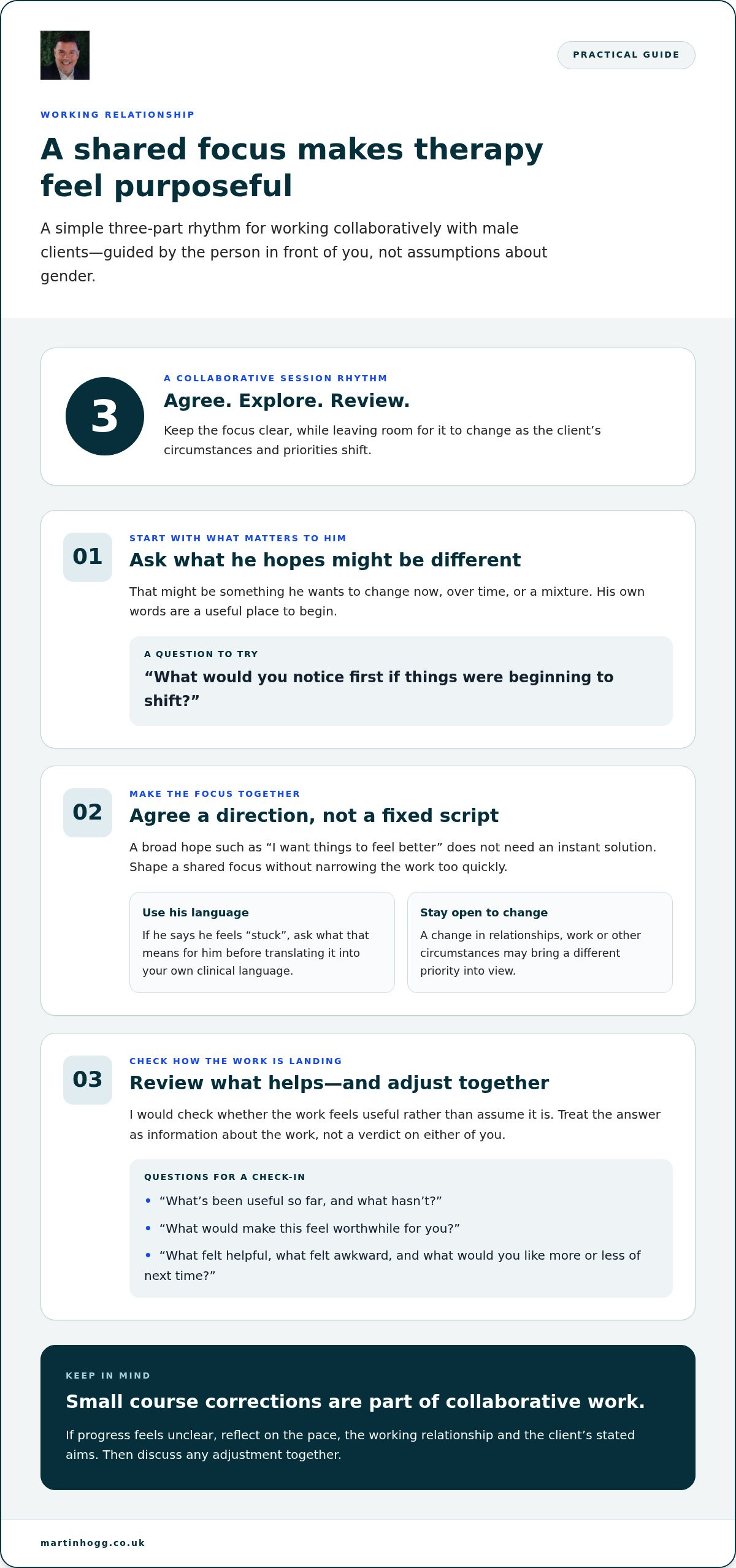
In working with male clients in therapy, a clear, shared focus can make sessions feel purposeful without turning them into a race to fix things. I’d keep the process simple: agree what to focus on, find out what the client wants from the sessions, then check whether the work feels useful. His own words are a good place to start. If he says he’s “stuck”, ask what that means for him before translating it into your own clinical language.
- Ask what he hopes might be different, now or over time.
- Agree a focus together, while leaving room for it to change.
- Review what feels helpful and what might need adjusting.
How can you agree a useful focus for sessions?
A broad hope such as “I want things to feel better” doesn’t need an instant solution. You might ask, “What would you notice first if things were beginning to shift?” That can help you shape a shared focus without narrowing the work too quickly. Keep checking that it still fits. A change in relationships, work or other circumstances may bring a different priority into view.
How do you respond when progress feels unclear?
Ask directly and sensitively: “What’s been useful so far, and what hasn’t?” or “What would make this feel worthwhile for you?” Check whether the work is helping rather than assuming it is. Treat the answer as information about the work, not a verdict on either of you. If progress feels unclear, reflect on the pace, the working relationship and the client’s stated aims, then discuss any adjustment together.
Ongoing professional connection can also give you space to reflect on your practice alongside other counsellors. The Private Practice Success Membership is one way to connect with a community of private practice owners.
Develop Your Confidence Through Reflection and Focused CPD
Continued learning isn’t evidence that you’re falling short. It’s one way to stay thoughtful about your work, especially when a client relationship leaves you uncertain or prompts questions you’d like to consider more carefully. In working with male clients in therapy, reflection can help you notice whether an idea about gender is shaping what you ask, what you hear or what you expect.
What can reflective practice help you notice?
After a session, you might note a broad, anonymised theme: perhaps you felt connected, were unsure how to respond or noticed a mismatch in pace. Ask yourself what the client said he needed, and whether your response stayed close to his perspective. If you discuss your learning with others, protect confidentiality by removing identifying details. Keep the focus on your practice, not the client’s private story.
When might focused CPD be useful?
If similar questions keep arising, targeted learning may give you a fresh framework to think with. Choose it to support a clear practice aim, not just to collect another certificate for the drawer. Martin Hogg’s Working with Men CPD course is for counsellors who want to explore this area in more depth. For broader development ideas, my CPD guide for counsellors can help you think about what learning fits your work.
I’d take one question from your reflection into your next learning step, then notice what you make of it in practice. You don’t need to have every answer before you begin. If you’d find it useful to reflect with other counsellors as you develop, the Private Practice Success Membership brings together a community of private practice owners.
Take Your Next Step with Curiosity
You don’t need a perfect formula for working with male clients in therapy. Choose one moment from your work that left you curious, then give yourself time to think about it. What did the client seem to need? What assumptions, if any, crept into your response? What might you ask differently next time? A few honest questions can be more useful than trying to solve the whole subject in one sitting.
Professional development can help you keep that reflection moving, and it doesn’t have to mean changing your whole way of working. Sometimes a fresh perspective, a thoughtful conversation with peers or focused learning is enough to help you return to the work with renewed attention. Take what fits, leave what doesn’t, and keep the client’s experience at the centre.
Good practice grows through curiosity, care and a willingness to keep learning. If you’d like a professional community to support your development, take a look at the Private Practice Success Membership.
Frequently Asked Questions
Is a male therapist better suited to working with male clients?
Not automatically. A client may have a preference about a therapist’s gender, and it’s worth asking what that preference means to him rather than treating it as a rule. He might feel more at ease discussing a particular experience, or the preference may come from a previous therapy relationship. Check how the working relationship feels as you go. The client’s needs and experience matter more than gender matching alone.
How can I work with a male client who attends because someone else encouraged him?
Start with his understanding of why he’s there. You could ask, “What have you been told about these sessions?” and “Is there anything you’d like to get from them?” Someone else may have prompted the appointment, but that doesn’t tell you how he feels about being there. Make clear that his own view matters, and give him room to decide what, if anything, he wants to explore.
Can humour be useful when working with male clients in therapy?
Yes, if it fits the relationship and the moment, but humour isn’t a technique to use simply because a client is a man. Notice whether it brings relief, helps him approach something difficult or seems to move the conversation away from it. If you’re unsure, you might say, “I noticed we laughed just then. What was happening for you?” Laughter doesn’t always mean someone feels comfortable.
How can I tell whether therapy is helping a male client?
Ask him directly. In working with male clients in therapy, don’t rely only on your sense that a session went well. Try, “Has anything shifted since we started?” or “What still feels difficult?” He may describe a small change in how he handles a conversation at home, or say the sessions aren’t addressing what matters. Use his answer to revisit the work together, not to score progress against a universal measure.
What training can help counsellors develop their work with male clients?
Choose learning that connects with a real question in your practice, such as how you respond when a client finds emotional language difficult. Focused CPD can give you a structured way to examine assumptions and consider your approach. Martin Hogg offers a Working with Men CPD course for professionals. I’d treat it as one possible development step, then reflect on how the learning relates to the individual clients you see.
Disclaimer
The information provided on this blog is for general informational purposes only. It is also not intended to be a substitute for professional medical or mental health advice, diagnosis, or treatment. Reading this content does not create a therapist-client relationship.


