
Managing a Group Therapy Practice: A Guide for UK Therapists

Article by
Martin Hogg
I help Private Practice counsellors in the UK set up and grow an ethical Private Practice they love, work with their ideal clients, and earn the income they deserve. All without guesswork and burnout. I have been a private practice counsellor myself for over 20 years, specialising in anger management. I set up a not-for-profit social enterprise, Citizen Coaching and Counselling, which delivers thousands of counselling sessions a year to adults and young people in Birmingham. I am a registered BACP Counsellor and the author of three books, My Anger Coach, My Anxiety Coach and My Relationship Coach. These are available on Amazon.
What if managing a group therapy practice well meant making fewer decisions yourself, rather than getting better at carrying them? As your team grows, everyday questions, admin and client coordination can keep landing on your desk. You want consistent standards, but you don’t want every therapist to work in exactly the same way. That’s a sensible tension, not a sign you’re getting it wrong.
I’d start by building clear, repeatable systems around the parts of the practice that need to work reliably, while leaving room for clinicians’ different styles. The aim is to support a consistent client experience and give your team confidence, without making you the answer to every small decision.
In this guide, I’ll look at how to clarify roles, agree practical ways of working and reduce the admin and coordination that pull you away from clinical work and business development. You’ll find ways to support your therapists, spot founder bottlenecks and make growth more manageable without turning your practice into a paperwork factory.
Key Takeaways
- See how your role changes as the practice grows, and identify which decisions need your attention and which can be shared.
- Set simple agreed workflows for enquiries, first contact, diary coordination and handovers, while leaving room for therapists’ professional judgement.
- Use a regular management rhythm to keep capacity, operational tasks and clinical casework from becoming one tangled to-do list.
- Managing a group therapy practice becomes more manageable when you decide whether to simplify, delegate or grow, rather than automatically taking on more.
Managing a Group Therapy Practice: How the Owner’s Role Changes
Moving from solo practice to a team changes the shape of your working day. You’re still a therapist, but now you’re also coordinating people, decisions and the systems that keep the practice running. You may continue seeing clients, but clinical work is no longer your only responsibility.
The owner-manager creates the conditions for reliable operations and good clinical work, without needing to make every decision personally. That’s the heart of managing a group therapy practice. It’s different from starting a therapy group: here, the focus is on running a practice with several clinicians, not setting up a group intervention for clients.
Good management supports care rather than replacing clinical judgement. If your practice offers group sessions as well as individual therapy, a grounding in Group therapy principles can help you distinguish the clinical work from the business systems that support it.
What changes when you move beyond solo practice?
In solo practice, you can often adjust your diary or respond to an enquiry as it arrives. With a team, one decision can affect colleagues and clients, so communication and delegation matter more. You might still hold a caseload while agreeing who responds to enquiries, who coordinates diary changes and how a handover is handled.
You don’t need to become a full-time administrator overnight. Start by noticing where coordination sits alongside your clinical work. Then give those responsibilities a clear place in your week, rather than squeezing them into every gap between appointments.
Which decisions should not depend on you alone?
Routine enquiries, diary coordination and agreed team processes are good places to start. If every booking question waits for your reply, or colleagues ask you the same procedural question repeatedly, that’s a bottleneck worth addressing. It doesn’t mean handing over clinical decisions. It means making routine operational choices easier to handle consistently.
For a week, keep a short note of interruptions and repeated decisions that land with you. Group them by topic, such as enquiries, scheduling or handovers. Choose one recurring issue to clarify with the team, and agree what colleagues can decide themselves and when something genuinely needs your input.
Build Shared Systems That Support Therapists and Clients
Shared processes make it easier for clients and clinicians to know what happens next. They don’t need to dictate how each therapist works in the room. I’d agree the essentials as a team, write them down in plain English and leave clinical choices to each practitioner’s professional judgement and standards.
How can you create consistency without over-managing?
Start with a few repeatable workflows. Agree who responds to an enquiry and how it’s passed on, what first contact should cover, how diary changes are communicated and what information a handover needs. For each process, name who owns the next step and what happens if that person is unavailable. Keep the instructions short enough to use on a busy Tuesday, not just admire in a folder.
Be clear about what’s shared and what’s individual. The team might agree how enquiries are acknowledged, while each therapist chooses language that feels natural. For clinical processes, work together around your professional standards and the needs of your practice. Managing a group therapy practice well means creating dependable foundations, not asking everyone to practise identically.
What belongs in a useful team meeting?
Give the conversation a job to do. An agenda might cover operational snags, diary capacity, workload, communication and actions carried forward from last time. Bring a specific example where possible: for instance, an enquiry that was passed between people without anyone knowing who would reply. End by noting who will do what and when you’ll revisit it. Otherwise, a meeting can become a pleasant chat followed by the same unresolved problem next week.
Keep management discussions distinct from clinical case discussion. A team meeting isn’t a substitute for appropriate professional arrangements for discussing clinical work. Agree the boundary together, so everyone understands what belongs in each setting.
I’d also keep a simple record of decisions and review it when a process stops fitting the way the practice works. A short, practical plan can help the team see how everyday tasks support the practice’s aims, without turning routine work into a pile of paperwork. The Private Practice Success Membership brings private practice owners together for structured growth plans and peer conversations.
Create a Practical Weekly and Monthly Management Rhythm
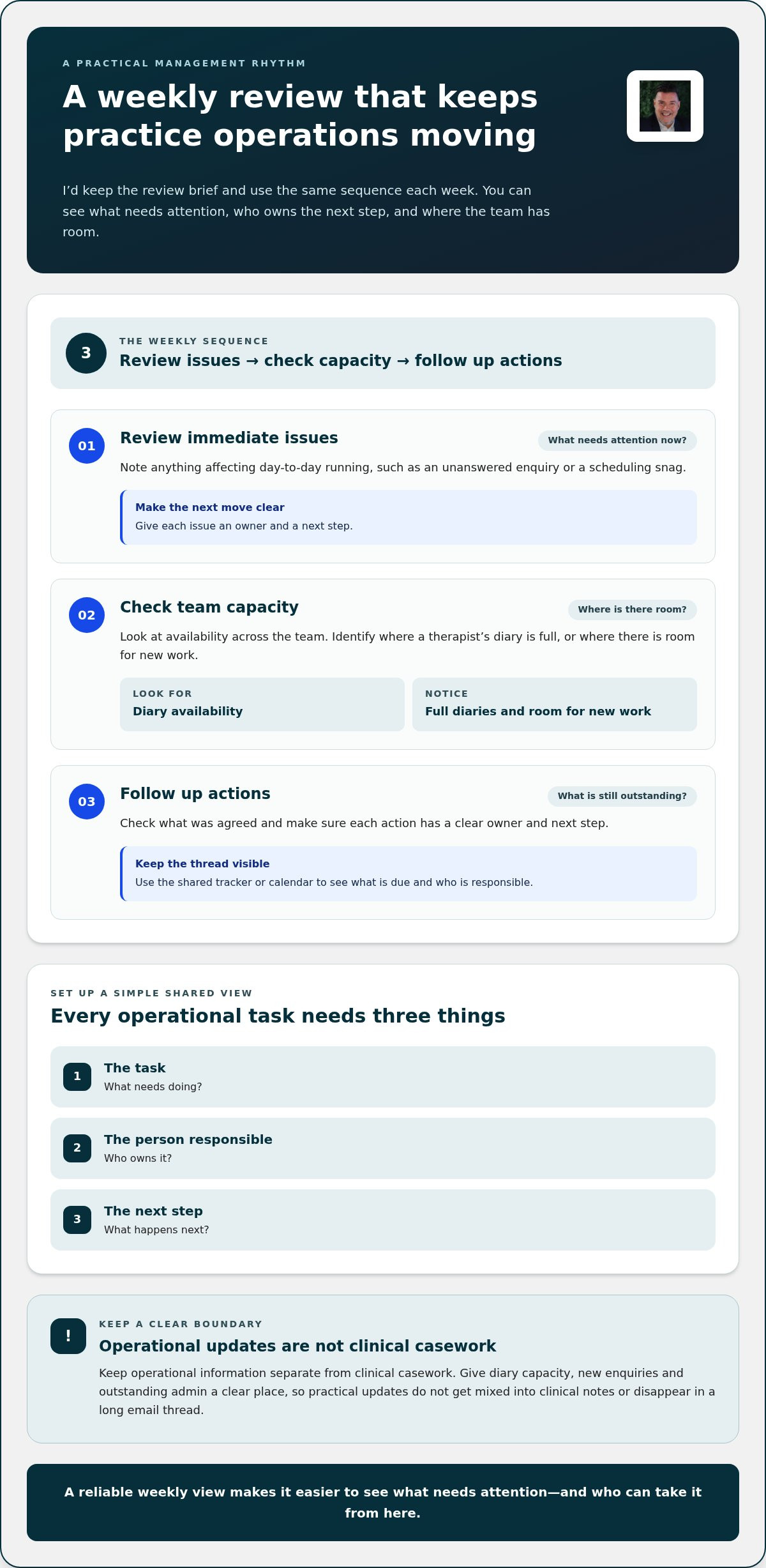
A regular review helps you spot small operational snags before they become the thing that fills your inbox. I’d keep it brief and use the same sequence each week. Managing a group therapy practice doesn’t require another complicated system; it needs a reliable way to see what needs attention and who owns the next step.
What should you check each week?
Use a shared tracker or calendar that shows the task, the person responsible and the next step. Keep operational information separate from clinical casework. Diary capacity, new enquiries and outstanding admin each need a clear place, so practical updates don’t get mixed into clinical notes or disappear in a long email thread.
- Review immediate issues. Note anything affecting the day-to-day running of the practice, such as an unanswered enquiry or a scheduling snag. Give each issue an owner and a next step.
- Check capacity. Look at availability across the team and identify where a therapist’s diary is full or has room for new work.
- Follow up actions. Check what was agreed previously, who is responsible and whether anything is waiting on your decision.
- Review patterns. Notice repeat problems, rather than treating the same interruption as a fresh surprise every week.
That third step matters. If a routine decision keeps drifting back to you, agree who can own it next time and make that visible in the tracker. A task without a named owner tends to find its way back to the person who started it.
What is worth reviewing each month?
Look across the weeks for recurring friction: enquiries that sit unanswered, diary changes that cause confusion, communication gaps or an uneven workload. Ask the team what takes longer than it should. Then choose one process to simplify, clarify or stop doing. You don’t need a new app for every admin irritation. A shared calendar and a tidy tracker may be quite enough.
If recurring admin is eating into your working day, you can also explore the Counsellor Efficiency Bundle. I’d review the routine itself as well: if a check isn’t helping anyone make a decision, remove it.
Grow a Group Therapy Practice Without Becoming Its Bottleneck
Growth can look like the obvious next step when enquiries are coming in. But adding clinicians or clients won’t fix a practice that relies on you to approve every diary change and answer every routine question. I’d treat growth as a choice, not a target you have to chase. Sometimes the right move is to make the current practice easier to run.
How do you know when the practice is ready to grow?
Before you add more work, take an honest look at three things: the team’s workload, how reliably your shared processes work and how many decisions still wait for you. If enquiries are handled consistently, diaries are coordinated without repeated confusion, and routine tasks have clear owners, you may have a steadier base for growth. If not, simplify first.
Ask yourself what you want growth to make possible. More client choice? A stronger team? More time for your own clinical work? Sustainable visibility and client attraction should match the capacity you can support. There’s little value in bringing in more enquiries if the team can’t respond smoothly. For a broader look at planning the next stage, use the guide to Scaling a Therapy Practice alongside this capacity check.
Where can a practice owner get practical support?
You don’t have to carry every business decision alone. A conversation with other practice owners can help you test an idea, notice a blind spot or decide whether to delegate, simplify or expand. The Private Practice Success Membership offers structured growth plans, live training and a community of private practice owners. It’s business support alongside, not instead of, the clinical arrangements your team needs.
The Private Practice Success Membership is one option for structured growth planning and peer learning as your practice develops.
Make Your Next Practice Decision Deliberately
You don’t have to solve every operational challenge at once. Choose one decision that keeps landing back on your desk, then make a clear plan for what happens next. That small shift can give you more room to focus on the work only you can do.
Managing a group therapy practice is an ongoing process, not a test you either pass or fail. Your team and your needs will change, so give yourself permission to review what’s working and adjust without treating every change as a major overhaul.
Build the practice in a way that supports your clients, your team and you. You’re allowed to grow at a pace that feels workable.
If you’d value structured growth planning, live training and peer support, explore the Private Practice Success Membership.
Frequently Asked Questions
How do you manage a group therapy practice effectively?
Managing a group therapy practice effectively means being clear about what a well-run practice looks like for your team and clients. I’d choose a few useful signs to review, such as whether clients understand the next step after making an enquiry and whether clinicians can raise practical concerns early. These give you a clearer basis for decisions than relying on the feeling that you ought to be doing more. Keep the review practical: note what’s working, where a handoff gets stuck and who will take the next step.
What is the difference between starting and managing a group therapy practice?
Starting asks you to make initial choices; managing asks whether those choices still work in practice. Once the team is established, you can learn from what happens day to day. For example, a service may attract the right clients but create an awkward handover between initial contact and the first appointment. That kind of real-world feedback helps you refine the practice rather than keep treating it as a launch project.
How can I manage a therapy team without micromanaging?
Agree the result a shared task needs to achieve, then give the person responsible room to decide how to get there. For instance, you might want a client to receive clear information before an appointment, without prescribing the exact wording every therapist must use. Discuss exceptions in advance, too. People are less likely to seek approval for every small choice when they know what falls within their remit and what needs to be brought back to you.
What should a group therapy practice owner review regularly?
Alongside operational matters, review whether the practice is attracting the work it is set up to offer. You could look at broad referral patterns and ask whether enquiries reflect the clients or areas of work the team wants to support. Keep the discussion at a useful, non-identifying level. This can help you decide whether a change is needed in your communication, service mix or planning.
Can a group therapy practice grow without the owner doing everything?
Yes. Growth doesn’t have to mean adding more clinicians or taking on more clients. It might mean making the current service easier to access, improving how the team works together or giving yourself time for a different priority. Before choosing, consider what you want the practice to make possible for clients and for you. That purpose gives growth a direction, rather than making expansion the default.
Disclaimer
The information provided on this blog is for general informational purposes only. It is also not intended to be a substitute for professional medical or mental health advice, diagnosis, or treatment. Reading this content does not create a therapist-client relationship.


