
Managing Client Expectations in Private Practice: A Practical UK Guide

Article by
Martin Hogg
I help Private Practice counsellors in the UK set up and grow an ethical Private Practice they love, work with their ideal clients, and earn the income they deserve. All without guesswork and burnout. I have been a private practice counsellor myself for over 20 years, specialising in anger management. I set up a not-for-profit social enterprise, Citizen Coaching and Counselling, which delivers thousands of counselling sessions a year to adults and young people in Birmingham. I am a registered BACP Counsellor and the author of three books, My Anger Coach, My Anxiety Coach and My Relationship Coach. These are available on Amazon.
Have you ever found yourself hovering over your phone at 10:30 PM, wondering if you should reply to a client’s non-urgent text just to prove you care? It is a common trap. We go into this profession because we are helpers, but that deep empathy often makes us feel like "bad" therapists for simply having rules. You might feel a pang of anxiety about charging for a late cancellation or worry that sticking to your guns on a contract will drive people away.
The truth is that managing client expectations in private practice isn't about being cold. It is actually the most compassionate thing you can do for your clients and yourself. When your boundaries are clear, you stop being a 24/7 crisis service and start being a professional with a sustainable career. In this guide, I will show you how to set firm, kind boundaries that protect your peace and ensure your practice thrives without the burnout. We will look at how to build confidence in your contract, handle those awkward money talks, and finally reclaim your weekends.
Key Takeaways
- Understand why "Nice Person Syndrome" leads to resentment and how a firm therapeutic frame creates a safer space for both you and your clients.
- Discover how to handle the "Four Pillars" of practice management, including navigating annual fee increases and the dreaded "I forgot my wallet" scenario.
- Learn practical methods for managing client expectations in private practice regarding digital boundaries and late-night messaging.
- Find out how to stay visible on directories like Psychology Today without sacrificing your personal privacy or feeling like an "open book."
- Identify the early warning signs of boundary erosion so you can use your clinical supervision to protect your peace and prevent burnout.
Why Managing Client Expectations in Private Practice Feels So Awkward
Most of us trained to be therapists because we care about people. We want to be helpful, kind, and supportive. But when you start managing client expectations in private practice, that same "helper" instinct can actually trip us up. You might feel a sudden wave of guilt when a client asks for a discount you can't afford. You might find yourself apologising for charging a late cancellation fee. This is what I call "Nice Person Syndrome." It is the urge to over-deliver and bend the rules to avoid conflict, but it almost always leads to resentment.
Think of your boundaries as the therapeutic frame. This frame is the essential structure that keeps both you and your client safe. It is the foundation of a healthy therapeutic relationship; without it, the work becomes messy and unpredictable. When you don't set clear expectations from the start, you aren't being "extra nice." You are actually creating a confusing environment for the person sitting across from you. Clear communication is the secret to managing client expectations in private practice without feeling like a corporate robot. Poor boundaries are the fastest route to therapist burnout. You simply cannot be a good practitioner if you are perpetually exhausted, underpaid, and dreading your next session.
The Difference Between Clinical and Business Boundaries
It helps to separate your rules into two buckets. Clinical boundaries are about protecting the client's safety and the psychological space of the work. Business boundaries are about protecting your time, your income, and your family life. If you confuse the two, you end up with "sliding scale exhaustion" and doing admin at 11 PM. Professionalism isn't the opposite of empathy. It is the container that makes empathy sustainable. If you wouldn't let a client talk over your lunch break in a clinic, don't let them do it in your own business.
The Four Pillars of a Solid Therapeutic Frame
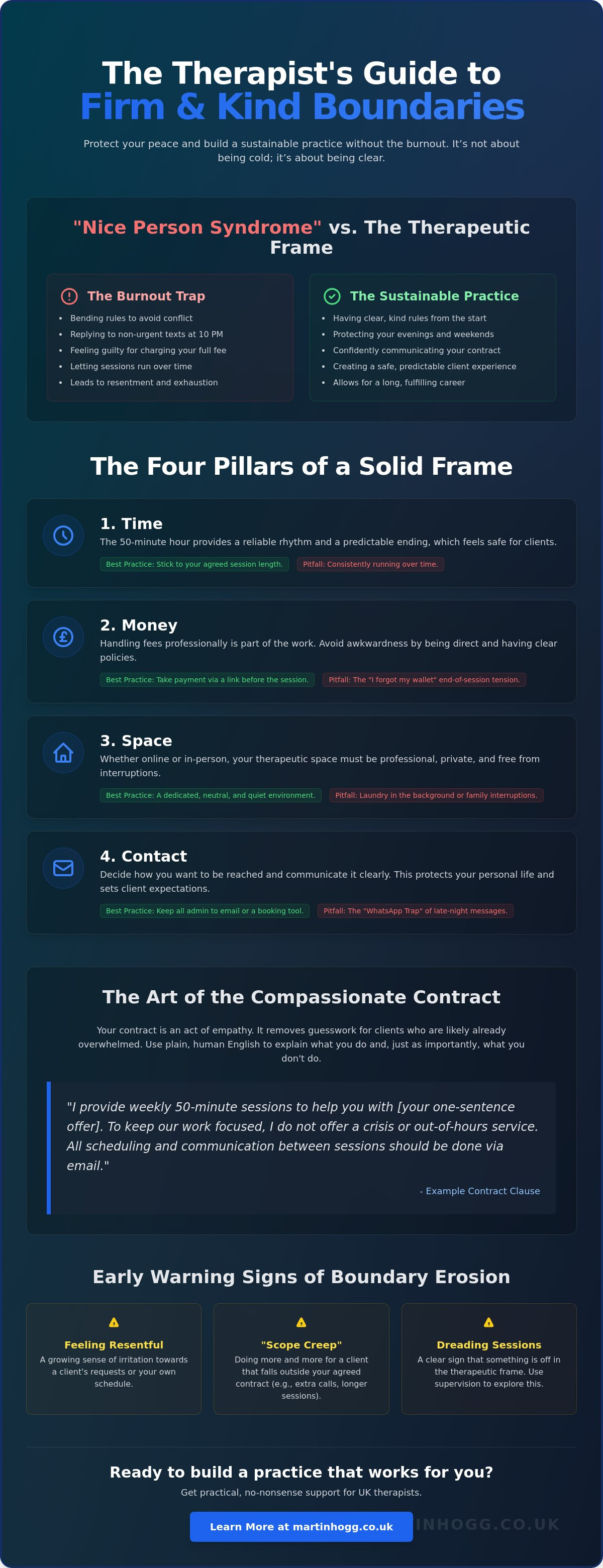
Building a frame isn't about building a wall. It is about creating a predictable, safe container where the actual work happens. When managing client expectations in private practice, you need to be crystal clear on four specific areas. If these pillars are wobbly, the therapy often follows suit. It is much easier to set these markers at the start than to try and fix them three months into a messy relationship.
- Time: The 50-minute hour is a standard for a reason. Sticking to it provides a reliable rhythm. If you consistently let sessions run over, you aren't being "extra helpful." You are actually making the ending unpredictable, which can feel unsettling for the client.
- Money: Be direct about your fees. Whether it is an annual increase or the awkward "I forgot my wallet" moment, handling money professionally is part of the process. I always suggest taking payments via a link before the session to avoid that end-of-hour tension.
- Space: Whether you are in a rented room or on a Zoom screen, the environment must be professional. No laundry in the background and no interruptions from family members.
- Contact: Decide how you want to be reached. If you don't want 11 PM texts, tell them. I recommend keeping all admin to email or a dedicated booking tool like Calendly to keep your personal life private.
The Art of the Compassionate Contract
Your contract shouldn't read like a terms and conditions page for a software update. It needs to be in plain, human English. I find that using your "one-sentence offer" mindset helps here. Tell them exactly what you provide and, just as importantly, what you don't. For example, "I provide weekly 50-minute sessions but I do not offer a crisis or out-of-hours service."
Clarity in contracting is actually an act of deep empathy because it removes the guesswork for a person who is likely already feeling overwhelmed. This approach aligns with the BACP's Ethical Framework, which emphasises being trustworthy and acting in the client's best interest. If you want to get more confident with these business basics, you might find my Private Practice Success Membership a helpful place to find practical templates and peer support.
Managing the Modern Boundary Blur in a Digital World
The digital world has made managing client expectations in private practice a bit more complex. Gone are the days when therapy simply ended at the office door. Now, we have the "WhatsApp Trap." I strongly recommend keeping client communication off your personal messaging apps. If a client sees you are "online" at 11 PM, they might naturally assume you are available to chat. It's far better to use email or a dedicated business line to keep your private life separate.
Visibility is vital for growth, but it shouldn't cost you your privacy. You can have a professional, engaging presence on Psychology Today without sharing your entire life story. Automation tools like Calendly are also a godsend. They stop that exhausting back and forth scheduling dance and set a firm boundary before the first session even begins. If a client "Googles" you and finds out more about your weekend than you planned, don't panic. It happens. The key is how you handle it when it comes up in the room.
Dealing with Boundary Crossings Without Shaming
When a boundary is nudged, it often feels like a small "ouch" moment. Don't ignore that feeling. Instead, bring it into the session as clinical material. You might say, "I noticed you sent a few texts over the weekend. I wanted to revisit our agreement about contact between sessions to make sure our time together remains the focus." This isn't about telling them off. It is about re-stating the frame with kindness and firmness using simple, direct scripts.
The Social Media Policy: A Private Practice Essential
Every counselling private practice needs a clear, written social media policy. This document should explain that you don't accept friend requests from current or former clients to protect their confidentiality and the integrity of the work. It is much easier to point to a pre-existing policy than to make a rejection feel personal in the moment.
If you are feeling overwhelmed by the tech side of things, my Private Practice Success Membership offers specific templates and scripts to help you get these digital boundaries right from day one.
Building a Practice That Protects Your Wellbeing
People connect with people. It is a core belief of mine and the heart of any successful therapy business. But let's be clear: being relatable does not mean you have to be an open book. You can be a warm, genuine human being without sharing your life story or your bank balance. In fact, managing client expectations in private practice is much easier when you are seen as a grounded professional rather than a friend who happens to do therapy.
Your marketing plays a huge role in this. If your website or directory profile is vague, you will naturally attract people who don't know where the lines are. My Practice Visibility Blueprint is designed to help you attract the right clients from the very first click. It ensures they respect your frame before they even book that initial consultation. When your message is clear, the boundaries almost set themselves.
Don't forget the role of your clinical supervisor in all of this. They are your early warning system. They can often spot boundary erosion or "creeping empathy" long before it turns into a full-blown crisis. Use that space to be honest about the times you feel tempted to bend your rules. It isn't a sign of weakness; it is a sign of professional maturity.
Self-Care as a Professional Requirement
Setting boundaries isn't just a business tactic. It is the ultimate form of self-care for counsellors. You need to be able to shut the office door, both physically and mentally, at the end of the day. If you are still thinking about a client's late-night text while you are trying to eat your dinner, the boundary has failed. You deserve a life outside of your work.
It can be lonely doing this on your own, especially when you are worried about being "too strict." That is why I created the Private Practice Success Membership. It's a community where you can discuss these hurdles with peers who actually get it. Sometimes, just hearing that another therapist also struggles with charging for a missed session makes the whole thing feel a lot less heavy.
Final thought: a sustainable practice is built on the foundation of clear, lived-out boundaries. By managing client expectations in private practice from day one, you aren't just being a "good business person." You are ensuring you can stay in this profession for the long haul. You protect your ability to help others by first protecting yourself.
Reclaiming Your Time and Peace of Mind
Building a practice that lasts is about more than just clinical skill. It is about the quiet confidence that comes from knowing your worth and sticking to your rules. We have looked at how a solid therapeutic frame protects you from burnout and why digital boundaries are essential for your sanity. Remember, managing client expectations in private practice isn't a hurdle to overcome; it is the very thing that allows you to do your best work without feeling resentful or exhausted at the end of the day.
You don't have to figure this out by trial and error. I have spent over 20 years in UK private practice, and I have seen how much easier it gets when you have the right templates and support. Whether it is through my BACP-endorsed workshops or our thriving group of over 500 therapists, you can find the tools to grow without the overwhelm.
Ready to build a practice that works for you? Join the Private Practice Success community today. You have already done the hard part by becoming a therapist. Now, let's make sure your business is as healthy and sustainable as the support you offer your clients.
Frequently Asked Questions
How do I handle a client who constantly sends long emails between sessions?
I would suggest acknowledging the email briefly but making it clear that you will discuss the contents during your next appointment. Long emails are often a way for the client to "start" the session early. By saving the processing for the room, you protect your own time and keep the therapeutic work contained within the 50-minute hour. It helps to state in your initial contract that emails are for admin purposes only.
Is it okay to be friends with a client on Facebook or Instagram?
No, it is best to keep your personal social media profiles private and separate from your professional life. Accepting friend requests creates a dual relationship that can complicate the clinical work and compromise the client's confidentiality. If you want to be visible online, use a professional page where the boundaries are clear. This is a vital part of managing client expectations in private practice from the very beginning.
What should I do if a client asks me a deeply personal question?
You should respond by exploring why the client is asking and what the answer would mean to them. While a small amount of human relatability is fine, deeply personal questions usually require a boundary. You can kindly say, "I'm curious about what prompted that question," which keeps the focus on their process. It's about being a guide rather than an open book.
How do I enforce my cancellation policy without feeling guilty?
You enforce it by remembering that your cancellation fee is a business rule; not a personal judgment on the client. Consistency is a gift you give to your clients because it makes the relationship feel stable and predictable. When you stick to your policy, you are managing client expectations in private practice in a way that respects both your time and the therapeutic frame.
Can I ever transition a client relationship into a friendship after therapy ends?
The short answer is no. The power imbalance inherent in the therapeutic relationship doesn't simply vanish because the sessions have stopped. Most ethical bodies advise against this because it can be harmful to the client's long-term progress. It is far better to leave the door open for them to return to therapy in the future; should they ever need your professional support again.
Disclaimer
The information provided on this blog is for general informational purposes only and is not intended to be a substitute for professional medical or mental health advice, diagnosis, or treatment. Reading this content does not create a therapist-client relationship.


