
Marketing CPD for Therapists: Growing Your Practice Without Losing Your Soul

Article by
Martin Hogg
I help Private Practice counsellors in the UK set up and grow an ethical Private Practice they love, work with their ideal clients, and earn the income they deserve. All without guesswork and burnout. I have been a private practice counsellor myself for over 20 years, specialising in anger management. I set up a not-for-profit social enterprise, Citizen Coaching and Counselling, which delivers thousands of counselling sessions a year to adults and young people in Birmingham. I am a registered BACP Counsellor and the author of three books, My Anger Coach, My Anxiety Coach and My Relationship Coach. These are available on Amazon.
Marketing isn't a betrayal of your clinical ethics; it's the bridge that lets the right people find you. I know the word alone makes many UK counsellors want to hide under their desks. You spent years training to help people, not to become a tech wizard or a social media influencer. But when you're looking for marketing CPD for therapists, you don't need corporate jargon or "hustle" culture. You need a way to be visible that feels as honest as the work you do in the chair.
I agree that the pressure to "sell" yourself feels completely wrong for our profession. It's frustrating to spend your hard-earned money on workshops that leave you feeling more overwhelmed than when you started. That's why I'm going to show you how to find professional development that actually works for your private practice without making you feel like a salesperson. We'll explore how a simple "skateboard" website and a clear one-sentence offer can fill your diary with private-pay clients, all while staying firmly rooted in your values.
Key Takeaways
- Reframe marketing as an ethical way to be found by those who need you, rather than a corporate exercise in "selling."
- Learn how to choose marketing CPD for therapists that prioritises practical results like a full diary over academic theory.
- Master the "one-sentence offer" to explain what you do clearly, without the usual ten-minute preamble that confuses potential clients.
- Realise why "rough and ready" content usually beats polished corporate videos when it comes to building real trust.
- Move from the isolation of the "solo struggle" to a sustainable practice using the Practice Visibility Blueprint.
Why Traditional Marketing CPD Often Feels Wrong for UK Counsellors
I see marketing as a vital part of your Continuing Professional Development. To me, marketing cpd for therapists isn't about learning how to manipulate people into buying something they don't need. It's the ongoing study of how to communicate your value ethically and effectively so that someone in pain can find you. If you've spent years honing your clinical skills, it's only right that you learn how to put those skills in front of the people who are currently searching for them.
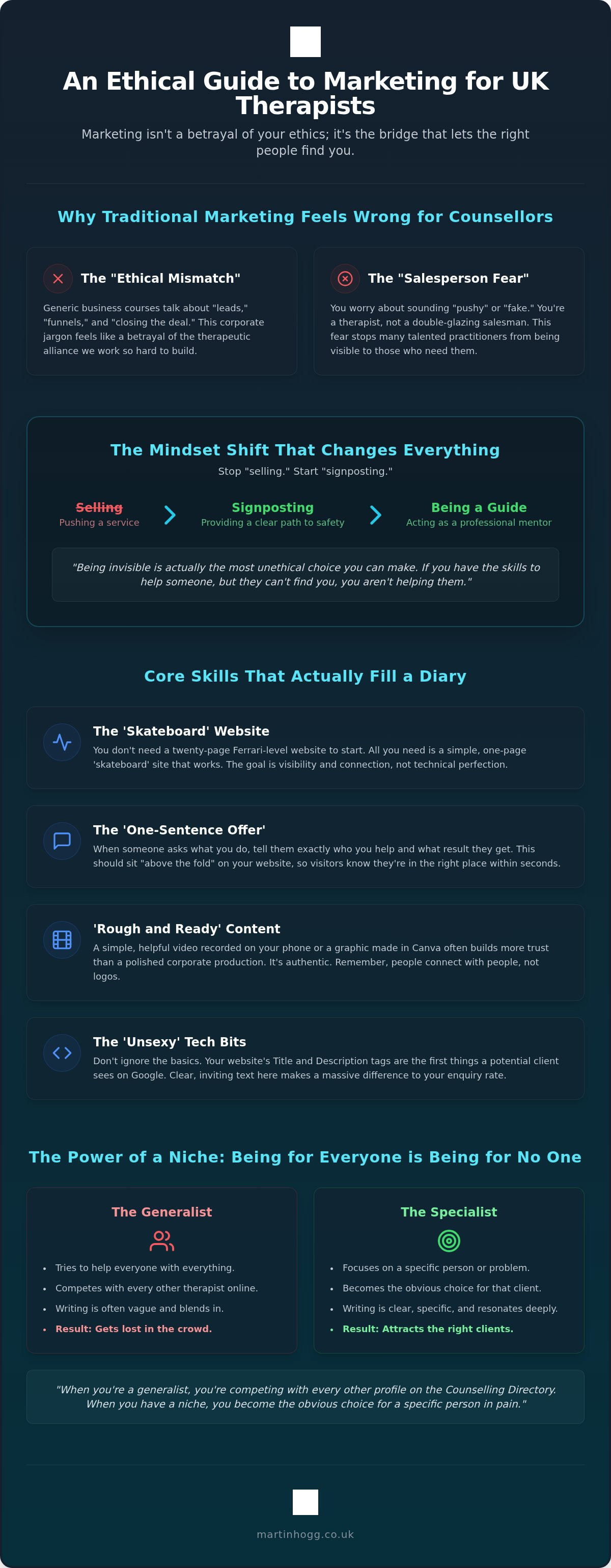
The problem is that most generic business courses treat therapy like a retail product. They talk about "leads," "funnels," and "closing the deal." It feels like a betrayal of the therapeutic alliance. If you've ever sat through a workshop feeling like you're being taught to be a double-glazing salesman, you're not alone. This "Ethical Mismatch" happens because those trainers don't understand the nuance of our work. They don't realise that for us, the relationship begins the moment someone reads our profile on the Counselling Directory.
I hold a fairly firm view on this. Being invisible is actually the most unethical choice you can make as a practitioner. If you have the skills to help someone struggling with anxiety or grief, but they can't find you because your website is hidden on page ten of Google, you aren't helping them. You're leaving them to find someone less qualified who just happens to be better at tech. Good marketing cpd for therapists helps you bridge that gap without losing your integrity.
The Salesperson Fear vs. The Professional Mentor
Many counsellors I work with worry about sounding "pushy" or "fake" in their writing. You don't want to be a salesperson; you want to be a professional mentor. I encourage you to shift your mindset from "selling" to "signposting." You're simply providing a clear, honest path for someone in distress to reach safety. When you write from a place of service rather than ego, the fear of being "salesy" usually disappears. It's about being a guide, not a shark.
BACP and UKCP Guidelines: Staying Safe and Visible
The BACP and UKCP have clear rules about advertising, but they aren't there to stop you from being seen. They want you to be honest and accurate. Practical marketing doesn't require you to make exaggerated claims or use clickbait. In fact, most clients aren't looking for a list of twenty letters after your name anyway. They are looking for a human being who understands their specific struggle. If you can communicate that you understand their pain, you're already ahead of most generalists. You can learn more about finding your specific focus through niche building secrets that align with professional standards.
The Core Marketing Skills That Actually Fill a Therapy Diary
I believe that effective marketing cpd for therapists should leave you with a list of things to do, not just things to think about. I often talk about the "skateboard model." You don't need a Ferrari-level website with twenty pages and complex booking systems to start. You just need a one-page site that works. It's about getting from A to B as quickly as possible so you can start helping people. The goal is visibility, not perfection.
One of the most important skills you can learn is the "one-sentence offer." When someone asks what you do, don't give them a five-minute lecture on your training. Tell them exactly who you help and what result they get. This is what should sit "above the fold" on your website so visitors know they're in the right place within seconds. I also advocate for "rough and ready" content. A simple video recorded on your phone or a helpful graphic made in Canva often builds more trust than a polished corporate production. People connect with people, not logos.
Don't ignore the unsexy technical bits either. Title and description tags are the first things a potential client sees on Google. If these aren't clear and inviting, people simply won't click through to your site. It's a small detail that makes a massive difference to your enquiry rate. If you're tired of trying to figure these bits out alone, you're always welcome to join our community in the Private Practice Success Membership.
Niche Building: Why Being for Everyone Means Being for No One
I know the fear of "missing out" on clients is real. You worry that if you specialise in working with men or anger management, you'll turn everyone else away. The truth is quite the opposite. When you're a generalist, you're competing with every other profile on the Counselling Directory. When you have a niche, you become the obvious choice for a specific person in pain. You can explore how to find your focus in my guide to Niche Building Secrets.
Writing for the Client, Not Your Supervisor
Stop writing for your peers. Your clients don't know what "modalities," "integrative," or "person-centred" mean. They just know they can't sleep or they're snapping at their partner. While staying grounded in APA's Ethical Principles to ensure your advertising is honest and never misleading, you must speak to the client's internal struggle. Use the language they use. If you speak to their pain, they'll know you're the one who can help them find the way out.
Implementing Your Learning: Tools for the Modern Private Practice
Once you've started your journey into marketing cpd for therapists, the next hurdle is usually the tech. I talk to many counsellors who feel paralysed by the sheer volume of tools available. My advice is always to choose the path of least resistance. For your website, I usually recommend Squarespace over WordPress. WordPress is powerful, but it often requires a level of maintenance that takes you away from your actual work. Squarespace is more of a "set it and forget it" solution that looks professional right out of the box.
For creating worksheets or social posts, Canva is your best friend. You don't need a design degree to make something that looks clean and trustworthy. I also suggest setting up Calendly to handle your initial enquiries. It reduces the back-and-forth emails that often lead to potential clients losing momentum. If they can see your availability and book a discovery call immediately, you've removed a massive piece of friction from their journey to the therapy room.
Don't forget your directory profiles. Most therapists treat their Counselling Directory or Psychology Today pages like a clinical CV. That's a mistake. These profiles are often the first thing a client sees. They need to speak directly to the person looking for help, not to your former tutors. Make sure your photo is clear and approachable. Your first paragraph should address their pain immediately, showing them that you understand exactly what they're going through.
The "Above the Fold" Rule for Therapist Websites
When someone lands on your site, you have about three seconds to convince them they're in the right place. Everything they see before they have to scroll down is called "above the fold." This space should contain your one-sentence offer and a clear button to "Book a Consultation" or "Get in Touch." Don't make them go on a treasure hunt to find out how to work with you. A clear, simple call to action is helpful, not pushy.
Social Media: Do You Really Need It?
I'll be honest. I think a solid SEO for therapists strategy is far more valuable than shouting into the Instagram void every day. People search Google when they are in crisis; they browse social media when they are bored. However, if you do use social platforms, focus on "rough and ready" video. A sixty-second clip of you talking about a common struggle builds more trust than a thousand perfectly filtered photos. It lets them hear your voice and see your face before the first session.
Moving from One-Off Workshops to the Practice Visibility Blueprint
I've seen so many colleagues attend a one-off Saturday workshop, take pages of notes, and then do absolutely nothing with them on Monday morning. It's not because they're lazy. It's because a single day of learning doesn't provide the long-term support needed to change habits. When you're looking for marketing cpd for therapists, you need more than a burst of inspiration; you need a system that sticks. Private practice can be a lonely business, but it shouldn't be a solo sport where you're forced to figure out every technical glitch by yourself.
This is why I created the Practice Visibility Blueprint. It's a structured path that moves you away from the "hit and miss" approach to getting clients. By following a proven system, you stop wasting time on things that don't work and focus on the small, high-impact changes that actually fill your diary. If you're feeling bogged down by the administrative side of things, I also recommend using the Counsellor Efficiency Bundle to reclaim your time so you can focus on your clinical work.
Scaling from Solo to CEO
There comes a point where you need to stop thinking like a freelancer and start thinking like a business owner. This doesn't mean becoming corporate or cold. It means valuing your time and protecting your energy so you can serve more people without burning out. If you're ready to look at the bigger picture, you might find my guide on Scaling a Therapy Practice helpful for planning your next move.
Your Next Steps: Action Over Analysis
I want you to stop overthinking and start doing. Here is a simple 30-day "Visibility Challenge" to get you moving:
- Days 1-10: Update your Counselling Directory photo and write your one-sentence offer.
- Days 11-20: Tweak your website's "above the fold" content and check your title tags.
- Days 21-30: Record one "rough and ready" video explaining how you help with a specific struggle.
You don't have to do this alone. Effective marketing cpd for therapists is about finding a community that understands your values. I'd love to see you in the Private Practice Success Membership, where we turn these practical steps into a sustainable, soul-friendly practice.
Build a Practice That Serves You and Your Clients
You now have a clear path to move from being invisible to being the obvious choice for the people who need you most. We've looked at how reframing marketing as ethical signposting takes the "salesperson" pressure off your shoulders. By focusing on a simple skateboard website and a clear one-sentence offer, you can fill your diary without ever needing to sound corporate or fake.
Investing in practical marketing cpd for therapists is about more than just getting new enquiries; it's about reclaiming your time and energy. I've spent over 20 years in the UK private practice environment, and as a BACP Professional Development partner, I know that success is much easier to achieve when you aren't doing it alone.
You deserve a full diary and a supportive community of hundreds of UK counsellors who understand exactly what you're going through. Stop the solo struggle and start taking the small, consistent steps that lead to a thriving practice. Your future clients are out there right now, and I'd love to help them find you.
Frequently Asked Questions
Is marketing CPD tax-deductible for UK therapists?
Yes, training that helps you maintain or improve the skills you need for your existing practice is generally a tax-deductible business expense in the UK. I always suggest checking with your accountant, but since marketing is a core requirement for running a private practice, the cost of the course can usually be offset against your profits. It's a sensible way to reinvest in your professional growth while reducing your tax bill.
Do I need to be "tech-savvy" to do marketing CPD?
You don't need to be a computer whiz to benefit from marketing cpd for therapists. Most modern tools like Canva or Squarespace are designed for people who would rather be in the therapy room than looking at code. I focus on the "path of least resistance," teaching you only the essential bits of tech you need to be visible. If you can send an email, you can learn to manage a basic website.
Will marketing my practice make me look "unprofessional" to my peers?
Ethical marketing actually enhances your professionalism because it shows you care about making your services accessible to those in need. There's a big difference between "hypey" sales tactics and clear signposting. Your peers are likely struggling with the same visibility fears. When you lead with honesty and clear communication, you aren't just getting clients; you're setting a standard for how modern private practice should look in the UK.
How much time should I realistically spend on marketing each week?
I recommend setting aside two to three hours a week when you're first building your visibility. Once your systems like the "skateboard" website and directory profiles are running, this often drops to just an hour of "maintenance" a week. The goal of good marketing cpd for therapists is to make your growth sustainable. You want a full diary, not a second full-time job as a digital marketer.
Can I get BACP-endorsed CPD for business and marketing skills?
Yes, the BACP recognises that running a practice requires a specific set of professional skills beyond your clinical training. I've delivered BACP-endorsed workshops for years because they understand that a therapist who can't find clients can't help anyone. Choosing endorsed training ensures the content meets high professional standards and respects the ethical boundaries of our profession. It counts toward your annual 30-hour CPD requirement too.
Disclaimer
The information provided on this blog is for general informational purposes only. It is also not intended to be a substitute for professional medical or mental health advice, diagnosis, or treatment. Reading this content does not create a therapist-client relationship.


