
Marketing for Anxiety Therapists: A Practical UK Guide

Article by
Martin Hogg
I help Private Practice counsellors in the UK set up and grow an ethical Private Practice they love, work with their ideal clients, and earn the income they deserve. All without guesswork and burnout. I have been a private practice counsellor myself for over 20 years, specialising in anger management. I set up a not-for-profit social enterprise, Citizen Coaching and Counselling, which delivers thousands of counselling sessions a year to adults and young people in Birmingham. I am a registered BACP Counsellor and the author of three books, My Anger Coach, My Anxiety Coach and My Relationship Coach. These are available on Amazon.
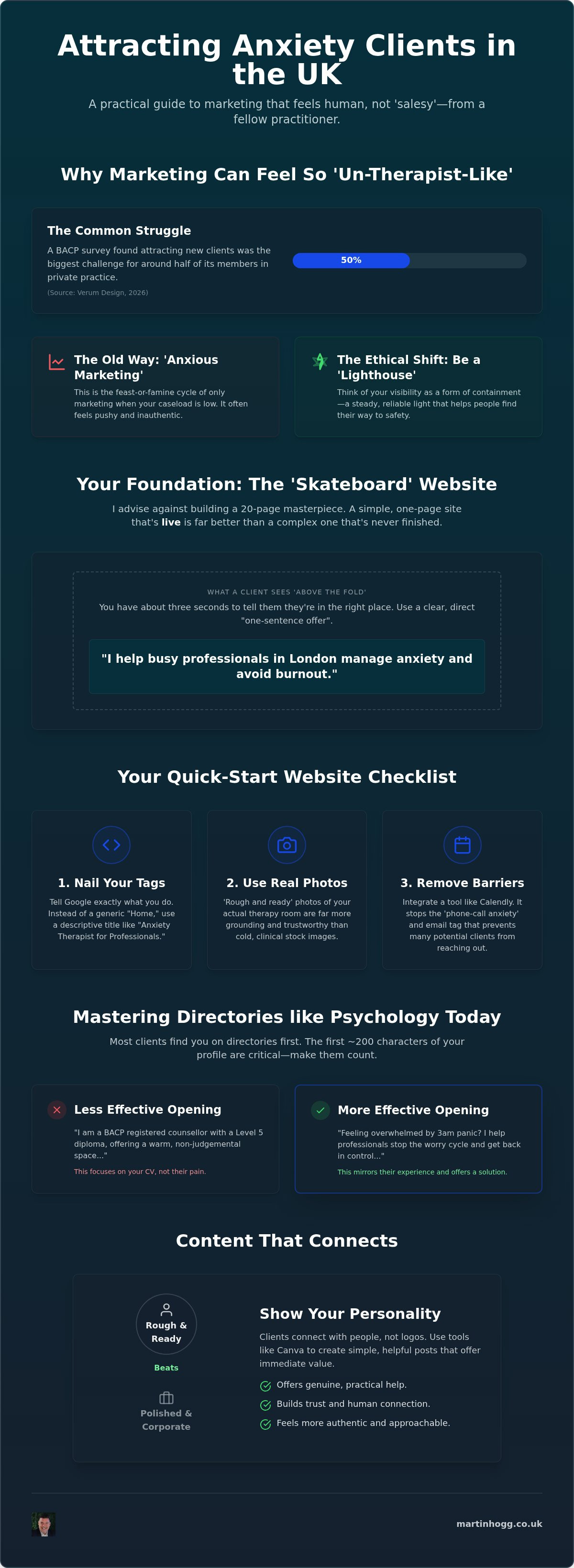
A BACP survey found that attracting new clients was the biggest challenge for around half of its members in private practice (Source: Verum Design, 2026). I know how that feels. You probably didn't spend years training as a clinician just to worry about marketing for anxiety therapists or spend your weekends baffled by technical jargon. It often feels a bit "un-therapist-like" to promote yourself, especially when you're already managing the weight of your clients' experiences and a sparse caseload.
I agree that the "hard-sell" approach has no place in our profession. You want a steady stream of private-pay clients, but you want to find them through trust rather than pushy tactics. This guide is my practical, British-focused roadmap to help you attract more anxiety clients using ethical strategies that feel human. I'll show you how to build a website that works while you sleep and how to talk about your work with genuine confidence.
We'll look at the "skateboard model" for your site, how to use directories like Psychology Today effectively, and why "rough and ready" content usually beats a polished corporate image.
Key Takeaways
- Stop seeing marketing as "salesy" and start viewing it as a way to help people who are currently struggling to find your support.
- Use the "skateboard model" to launch a simple, one-page website that focuses on what clients see "above the fold" before they even scroll.
- Master marketing for anxiety therapists by hooking readers in the first 200 characters of your Psychology Today or Counselling Directory profiles.
- Swap polished, corporate posts for "rough and ready" content on Canva that shows your personality and offers immediate, practical value to anxious clients.
Why Marketing Feels Like an Anxiety Trigger (And How to Flip the Script)
Many of us in the BACP and the wider UK counselling community feel a bit grubby about the word "marketing." We worry it sounds like we're hawking double glazing rather than offering a therapeutic alliance. But if we look at the global mental health landscape, it's clear that the need for support is massive, yet people often struggle to find the specific person they need. Marketing for anxiety therapists isn't about manipulation; it's about being the lighthouse for someone lost at sea.
I often see what I call "anxious marketing." This is when you only post on the Counselling Directory or update your profile when three clients finish at once and your bank balance looks a bit thin. This creates a feast-or-famine cycle that isn't good for your nerves or your practice. Instead, think of your visibility as a form of containment. By being consistently present, you're telling a potential client that you're stable and reliable. You're showing them you can handle what they're carrying before they've even booked a session.
The Ethical Shift: From Selling to Solving
You don't need to shout about your 10 years of experience or your list of post-grads. An anxious person doesn't usually care about your Level 5 diploma when they're in the middle of a panic attack. They care that you understand their specific flavour of dread. Shift your message from "I am an expert" to "I help you stop the 3am panic." This is the core of niche building secrets. It's about finding that one-sentence offer that makes a client feel truly heard. When you specialise in anxiety, your marketing becomes a series of helpful, grounding signals rather than a desperate sales pitch.
Building Your 'Skateboard' Website: The Foundation of Visibility
I often see therapists get stuck for months trying to build a 20-page masterpiece. They want everything perfect before they launch. I suggest the "skateboard model" instead. A skateboard isn't a car, but it gets you moving. For effective marketing for anxiety therapists, a one-page site that works is better than a complex one that's never finished.
The most important part is what's "above the fold." This is the space a person sees before they scroll down. You have about three seconds to tell them they're in the right place. Use a "one-sentence offer" here. Something like: "I help busy professionals regain control of their lives through practical anxiety therapy." It's direct, human, and tells them exactly what to expect.
Choosing your tech shouldn't be a hurdle. I usually recommend Squarespace for its simplicity. WordPress is powerful but can be a headache if you aren't tech-savvy. Your Call to Action (CTA) must be obvious. Don't make people hunt for a "Book Now" button. While NHS mental health campaigns focus on broad public awareness, your website needs to focus on the individual sitting behind their screen right now, looking for a way out of their distress.
The 3-Step Website Checklist for Anxiety Specialists
Start with these three essentials to make your site functional and welcoming:
- Nail your tags: Use your title and description tags to tell Google exactly what you do. Don't just put "Home." Put "Anxiety Therapist."
- Use real photos: "Rough and ready" photos of your actual therapy room are much more grounding than clinical stock images. People want to see where they'll be sitting.
- Remove barriers: Integrate Calendly. It stops the "phone-call anxiety" that prevents many people from reaching out.
If you're feeling overwhelmed by the tech, you might find the Private Practice Success Membership helpful for getting these foundations right without the stress.
Where Anxious Clients Look: Directories and SEO for Specialists
Most clients won't find your site through a random Google search initially. They go to the big directories. Psychology Today and the Counselling Directory are your digital shop windows. If you want to master marketing for anxiety therapists, you need to understand the "First Paragraph Rule." On these platforms, only the first 200 characters usually show up in search results. If you waste that space talking about your BACP membership or your "warm, non-judgemental space," you've lost them.
An anxious person is looking for relief, not a CV. I recommend using those first few words to mirror their experience. Instead of a list of credentials, try something that prompts immediate engagement. As a Guardian article suggests, we need to be moving beyond awareness to action. Your profile should invite them to take that first step, like booking a brief chat to see if you're the right fit.
Ranking for "anxiety therapist" on Google doesn't require a computer science degree. It's mostly about consistency and using the right title tags on your "skateboard" site. Keep it local and specific. This is a core part of marketing for anxiety therapists that actually works, and I cover this in detail within the Practice Visibility Blueprint.
Optimising Your UK Directory Profiles
Avoid the usual therapist clichés. Everyone says they're "passionate" or "caring." Be specific about anxiety outcomes. Do you help people get back on the Tube? Do you help new mums manage intrusive thoughts? A "rough and ready" video intro can build more trust in thirty seconds than three pages of text. To get clearer on your specific message, take a look at my niche building secrets.
Content that Connects: Using Canva and Social Media Without Losing Your Soul
I've always believed that people connect with people. In the world of marketing for anxiety therapists, your personality is your most effective tool. You don't need to act like a corporate entity or a polished influencer. In fact, being a bit "rough and ready" usually builds more trust with someone who is currently feeling overwhelmed. A quick voice note or an unpolished post feels like a real human reaching out. It's far more grounding than a high-production video that looks like it was made by a slick agency.
You can use Canva to create simple, helpful graphics that offer immediate support. Think about the grounding tips you give every day for managing panic or worry. Turn those into a single, clear slide. It provides value before a client even books a session. This approach to marketing for anxiety therapists allows you to be visible without being "salesy." Just remember to set firm boundaries. You don't want marketing your practice to become a second full-time job that leaves you too drained for your actual clinical work. Pick one platform where your clients hang out and ignore the rest.
Practical Content Ideas for Anxiety Therapists
If you're stuck for what to say, use the "FAQ" strategy. Think about the questions your clients actually ask in session. "Will I always feel like this?" or "What happens if I can't find the words?" Answering these publicly shows you understand their internal struggle. It positions you as a guide who has been there before. For more broad advice on the marketing for therapists uk landscape, it's worth looking at how you can streamline your entire process.
To keep your focus on this kind of helpful outreach rather than getting buried in paperwork, I suggest using the Counsellor Efficiency Bundle. It's designed to save you time on the boring admin bits. When your systems are efficient, you have the mental space to create content that actually connects with the people who need you most.
Finding Your Calm and Consistent Visibility
Effective marketing for anxiety therapists doesn't have to be a source of dread. By moving away from "anxious marketing" and embracing a "rough and ready" approach, you can build a practice that feels authentic and sustainable. We've covered how to launch your one-page skateboard site, how to use title tags that actually work, and why ditching the clichés on your directory profiles is essential. Your visibility is a form of containment for the client who is currently searching for a way out of their panic.
I've helped hundreds of therapists through my BACP-endorsed workshops and practical, UK-focused mentorship. You don't need to be a tech wizard to have a website that works while you sleep. You just need the proven Visibility Blueprint system that respects your ethics and your time. It's about being the steady signal in a very noisy world.
You've already done the hard work of becoming a skilled clinician. Now it's just about making sure the right people can find your door. I'm here to help you bridge that gap with confidence.
Common Questions About Marketing Your Practice
Is it ethical for a UK counsellor to use marketing to find clients?
Yes, it's entirely ethical as long as you follow ASA guidelines and professional standards. I see marketing as a form of "Ethical Outreach." If you're a skilled therapist but people can't find you, they might end up with someone less qualified or helpful. Being visible is simply a way to help those who are already looking for the specific support you provide in your private practice.
How much should I spend on marketing for my private practice?
You don't need a massive budget to get started. Basic tools like Squarespace cost around £12 to £17 monthly, while directory listings generally range from £20 to £25 per month. I suggest focusing on these essentials before spending money on expensive ads. Consistency is far more effective than "anxious marketing," where you only spend money when your caseload drops and you feel panicked.
Do I really need a website, or is a directory profile enough?
A directory profile is a brilliant starting point, but a website is your own digital home. It allows you to control the narrative and showcase your personality. While directories are vital for validation, a simple site helps with SEO for marketing for anxiety therapists. It gives potential clients a chance to feel your "vibe" before they reach out, which makes them much more likely to book.
What is the 'skateboard model' for therapist websites?
The skateboard model is a one-page MVP site that gets you moving immediately. Instead of waiting months for a complex, 20-page masterpiece, you build something simple that works. It focuses on the essentials: who you help, how you help them, and a clear "Book Now" button using Calendly. It's about being functional and visible right now rather than waiting for a perfection that might never arrive.
How can I market my practice if I have imposter syndrome?
Focus on the client's struggle rather than your own credentials. When you talk about the 3am panic or the dread of the morning commute, you're showing empathy, not showing off. I've found that "rough and ready" content on Canva feels more human and approachable anyway. If you're struggling with visibility, the Private Practice Success Membership is a safe, supportive place to build that confidence alongside your peers.
Disclaimer
The information provided on this blog is for general informational purposes only. It is also not intended to be a substitute for professional medical or mental health advice, diagnosis, or treatment. Reading this content does not create a therapist-client relationship.


