
Marketing for CBT Therapists: Growing Your UK Practice

Article by
Martin Hogg
I help Private Practice counsellors in the UK set up and grow an ethical Private Practice they love, work with their ideal clients, and earn the income they deserve. All without guesswork and burnout. I have been a private practice counsellor myself for over 20 years, specialising in anger management. I set up a not-for-profit social enterprise, Citizen Coaching and Counselling, which delivers thousands of counselling sessions a year to adults and young people in Birmingham. I am a registered BACP Counsellor and the author of three books, My Anger Coach, My Anxiety Coach and My Relationship Coach. These are available on Amazon.
What if I told you that marketing for cbt therapists doesn't have to feel like you're selling your soul or shouting from the rooftops? Most of us trained to help people, not to become digital marketing experts. It's completely natural to feel that "selling" your services is a bit brash or even unethical. You might be staring at your Squarespace site or a half-finished Counselling Directory profile, wondering why the phone isn't ringing despite your expertise. I know how frustrating it is to feel like you're wasting money on a fancy website that doesn't actually convert visitors into clients.
I will show you how to attract more CBT clients using a structured, ethical, and distinctly British approach that avoids the "salesy" fluff. We will explore how to use the "skateboard model" to get visible quickly; we'll also discuss how to make directories like Psychology Today work for you rather than against you. By the end, you'll have a simple, repeatable system to build a professional online presence that reflects your clinical skills and brings in a steady stream of private-pay work.
Key Takeaways
- Learn why marketing for cbt therapists is actually an extension of your duty of care, helping you move past the fear of sounding "salesy" so you can reach those in distress.
- Discover how to use the "skateboard model" to build a simple, professional one-page website using Canva or Squarespace that starts bringing in clients immediately.
- Optimise your presence on UK directories like Psychology Today and Counselling Directory by focusing on local search visibility and clear, human-focused descriptions.
- Create a repeatable system for turning enquiries into clients through structured 15-minute consultations that protect your time while building trust.
Why Most CBT Therapists Struggle with Marketing (and the CBT-Friendly Fix)
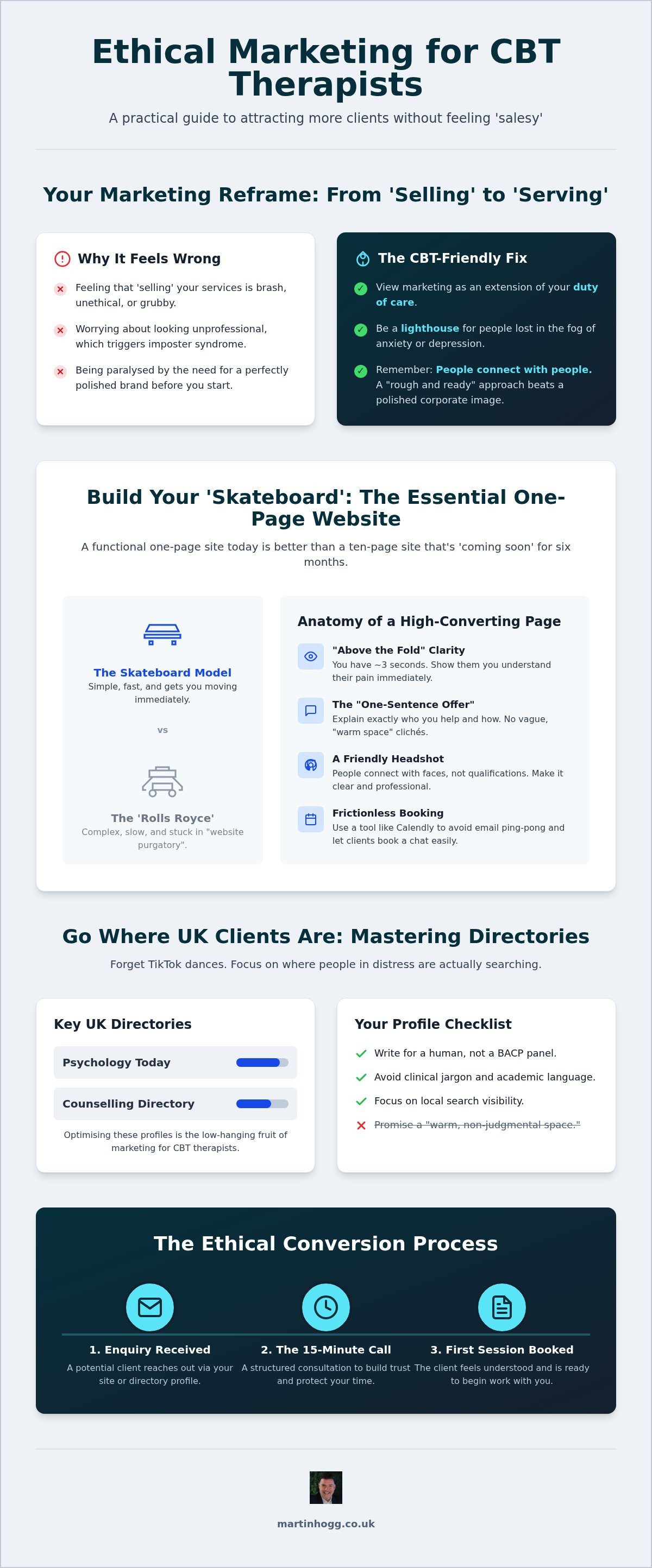
I've sat with many practitioners who feel that marketing is a bit, well, grubby. It feels like you're trying to trick people into buying something they don't need. But let's reframe that. If you are qualified in Cognitive Behavioral Therapy (CBT), you have a set of tools that can literally change lives. Marketing for cbt therapists is simply the act of making that clinical expertise visible to those in distress. It isn't about being a salesman. It's about being a lighthouse for people lost in the fog of anxiety or depression.
I often see therapists paralysed by the "salesy" stigma. They worry about looking brash or unprofessional. This often triggers a wave of imposter syndrome. You might think you need a perfectly polished brand before you can even start. Here's a secret: a "rough and ready" approach beats a polished, corporate image every single time in the UK market. People connect with people. They don't want a clinical robot; they want a human who understands their struggle. I want you to view marketing for cbt therapists as an essential extension of your duty of care.
The Ethical Dilemma: Marketing vs. Professionalism
You can stay strictly within BACP ethical frameworks while still being proactive about growing your practice. The key is moving away from tired therapist clichés. We've all seen the profiles promising a "warm, non-judgmental space." While that's a lovely sentiment, it's incredibly vague to a client in crisis. UK clients are looking for practical solutions. Instead of generic fluff, try a specific, evidence-based offer. Tell them exactly how your CBT approach helps with their specific problem, like social anxiety or panic attacks. This isn't "hard-selling"; it's providing clear information so a client can make an informed choice.
Building Your Skateboard: The Essential CBT Therapist Website
I meet so many therapists stuck in "website purgatory." You want everything to be perfect before you go live, so you spend months tweaking colours and writing endless pages. Instead, I suggest the skateboard model. A skateboard is a simple, one-page site that gets you moving while others are still trying to build a Rolls Royce. It's much better to have a functional one-page site today than a ten-page site that's "coming soon" for six months. Marketing for cbt therapists is about clarity, not complexity.
You don't need a tech-head headache to do this. Squarespace is brilliant for hosting, and Canva makes your branding look professional for very little cost. Focus on the "above the fold" area. This is what people see before they scroll. You have about three seconds to show them you understand their pain. Write a clear "one-sentence offer" that explains exactly how your approach helps. Even the massive NHS Talking Therapies campaign relies on this kind of direct, accessible messaging to reach those in need.
The Anatomy of a High-Converting Therapy Page
Your photo matters more than your qualifications for building initial trust. People don't connect with certificates; they connect with faces. Make sure it's a clear, friendly headshot. To keep things moving, I'd integrate Calendly. It removes the friction of email ping-pong and lets clients book a chat immediately. If you want to sharpen your back-office systems, the counsellor efficiency bundle is a great place to start. Marketing for cbt therapists becomes much easier when your tech isn't fighting you. If you're tired of winging it, you might find my Private Practice Success community helpful for more practical tips.
Where UK Clients Actually Look for CBT: Directories and SEO
While some experts might tell you to start dancing on TikTok, I'd rather you focus on where the clients actually are. In the UK, that means the big directories. Optimising your Psychology Today and Counselling Directory profiles is the low-hanging fruit of marketing for cbt therapists. When someone is in distress, they aren't usually scrolling social media for a therapist. They are searching Google with a specific problem in mind.
Writing your bio is where most people trip up. You aren't writing for a clinical supervisor or a BACP panel; you're writing for a person who is currently struggling. Avoid clinical jargon. A bio that sounds like a human rather than an academic textbook builds immediate trust. You can find more digital marketing strategies for therapists that focus on this patient-centric approach. Don't forget your local SEO either. Even if you work nationally online, having correct title and description tags for your local area helps you show up in those vital "near me" searches. Effective marketing for cbt therapists often starts with these simple local search settings. Read more on how to get counselling clients UK wide if you want to explore these search basics further.
Winning at Directories
Your headline is your first and only chance to stop the scroll. A generic headline like "Qualified CBT Therapist" is a wasted opportunity because everyone else is saying the same thing. You need to be specific. Use your CBT niche to stand out from the crowd. If you specialise in social anxiety or OCD, lead with that. Being a specialist in a sea of generalists makes you the obvious choice for someone dealing with that specific pain. Learn about niche building secrets to refine your message so it actually lands with your ideal client.
Turning Enquiries into Clients: The Ethical Conversion Process
Getting an enquiry is a win, but it is also where the real work begins. Handling that first contact with confidence is a vital part of marketing for cbt therapists. When a potential client reaches out, they are often at a vulnerable point. They don't need a clinical dissertation; they simply need to know you've heard them. I suggest keeping your initial reply warm, brief, and focused on the next step. Responding to an enquiry is a skill in itself.
I strongly recommend a structured 15-minute consultation. This chemistry call is an assessment of fit, not "free therapy." You must be firm about that boundary. It allows you to check if their needs align with your CBT expertise and if you actually want to work with them. By setting this dynamic early, you establish a professional relationship. It stops you from giving away your time while building the trust necessary for a paid booking. Effective marketing for cbt therapists relies on these clear, professional boundaries.
From Inquiry to First Session
Use simple follow-up templates that don't feel pushy. If you haven't heard back in two days, a gentle "just checking you got my last email" is perfectly fine. It shows you care. You should also track what works by asking every client: "How did you find me?" This is the only way to know if your Counselling Directory profile or your Squarespace site is doing the heavy lifting.
If you're tired of the feast-and-famine cycle, my Practice Visibility Blueprint helps you create a repeatable system. You shouldn't have to constantly chase the next lead. For ongoing support from a community who really gets the UK private practice environment, join us. It makes the journey much less lonely when you have peers to talk to.
Taking the Next Step Toward a Busy Practice
Marketing for cbt therapists shouldn't be a source of stress or a distraction from your clinical work. I've shown you how to swap the "salesy" dread for a practical, ethical system that actually works in the UK market. Remember that a simple "skateboard" website is better than a perfect one that never launches. By focusing on where clients actually look and using a structured consultation process, you can build a practice that feels sustainable and professional.
I've spent over 20 years in UK private practice and running social enterprises, so I know that the hardest part is often just starting. My BACP-endorsed workshops are built on these exact principles of visibility and trust. You already have the skills to help people; now you just need to make sure they can find you.
You don't have to figure this out alone. Take one small action today, even if it's just updating your directory headline, and watch the momentum build. I'm rooting for you.
Common Questions About Growing Your Practice
Is social media necessary for CBT therapists in the UK?
You don't need to be an Instagram influencer to have a full diary. While social media can help with brand awareness, most clients looking for CBT start with a Google search or a directory. I'd rather you spend your energy on your "skateboard" website or your Psychology Today profile. If you enjoy social media, use it; if it feels like a chore, focus on intent-based marketing for cbt therapists instead.
How much should I spend on marketing my private practice?
Start with the basics before throwing money at ads. Your main costs will likely be directory subscriptions, like Counselling Directory or Psychology Today, which usually range from £20 to £25 per month. Add in your ICO fee and basic website hosting, and you can run a very effective practice for under £50 a month. I recommend keeping costs low until you have a steady stream of clients paying your full fee.
What is the best directory for CBT therapists in the UK?
Psychology Today and Counselling Directory are the primary starting points for most UK therapists. While they shouldn't be your only marketing tool, they offer high visibility because they rank so well on Google. I suggest starting with one, optimising your profile with a clear headline, and tracking your enquiries for three months. If it brings in clients, keep it; if not, you might need to adjust your message or try another platform.
How do I market my CBT practice without sounding like a salesperson?
Marketing for cbt therapists is about being helpful, not pushy. Instead of trying to "sell" your services, focus on explaining how you can help with a specific struggle, like health anxiety or panic attacks. When you position yourself as a solution to a problem, it feels like a professional consultation rather than a sales pitch. Use human language that reflects your clinical warmth rather than corporate jargon or clinical textbooks.
Do I need a blog on my therapy website?
You only need a blog if you have something useful to say and the time to say it. A blog with two posts from 2021 looks worse than no blog at all. If you do write, focus on answering common questions your clients ask during sessions. This "rough and ready" content helps build trust and shows your expertise. However, if writing feels like a burden, stick to a solid one-page MVP site.
Disclaimer
The information provided on this blog is for general informational purposes only. It is also not intended to be a substitute for professional medical or mental health advice, diagnosis, or treatment. Reading this content does not create a therapist-client relationship.


