
Marketing for Internal Family Systems Therapists: A Self-Led Approach to Practice Growth

Article by
Martin Hogg
I help Private Practice counsellors in the UK set up and grow an ethical Private Practice they love, work with their ideal clients, and earn the income they deserve. All without guesswork and burnout. I have been a private practice counsellor myself for over 20 years, specialising in anger management. I set up a not-for-profit social enterprise, Citizen Coaching and Counselling, which delivers thousands of counselling sessions a year to adults and young people in Birmingham. I am a registered BACP Counsellor and the author of three books, My Anger Coach, My Anxiety Coach and My Relationship Coach. These are available on Amazon.
Your marketing shouldn't feel like a pushy Manager part that's constantly clashing with your clinical values. I know that for many of you, marketing for internal family systems therapists feels like a bit of a chore. You've spent years mastering the nuances of parts work, yet trying to explain it on a Psychology Today profile or your own website often feels clunky and overwhelming. You want to reach the people who need you most, but the technical side of SEO and directories feels worlds away from the quiet, healing space of the therapy room.
I've seen so many talented practitioners struggle to bridge this gap. This guide is here to help you translate those complex IFS concepts into a clear, compassionate strategy that feels like a natural extension of your Self-led work. We'll explore how to use the skateboard model to get your message online quickly and how to niche down effectively. You'll learn how to build a practice that attracts a steady stream of clients who are specifically looking for the deep, transformative work you offer.
Key Takeaways
- Learn how to identify the "Protector Parts" that make marketing feel "salesy" so you can approach your business growth with calm, Self-led confidence.
- Use my "One-Sentence Offer" framework to stop trying to be the therapist for everyone and start attracting the specific clients you are best equipped to help.
- Discover how the "skateboard model" simplifies marketing for internal family systems therapists by focusing on a clear, one-page website that actually gets launched.
- Get a practical overview of the Practice Visibility Blueprint to help you maintain a steady stream of enquiries without getting bogged down in technical overwhelm.
Why Marketing Often Clashes with Your IFS Parts
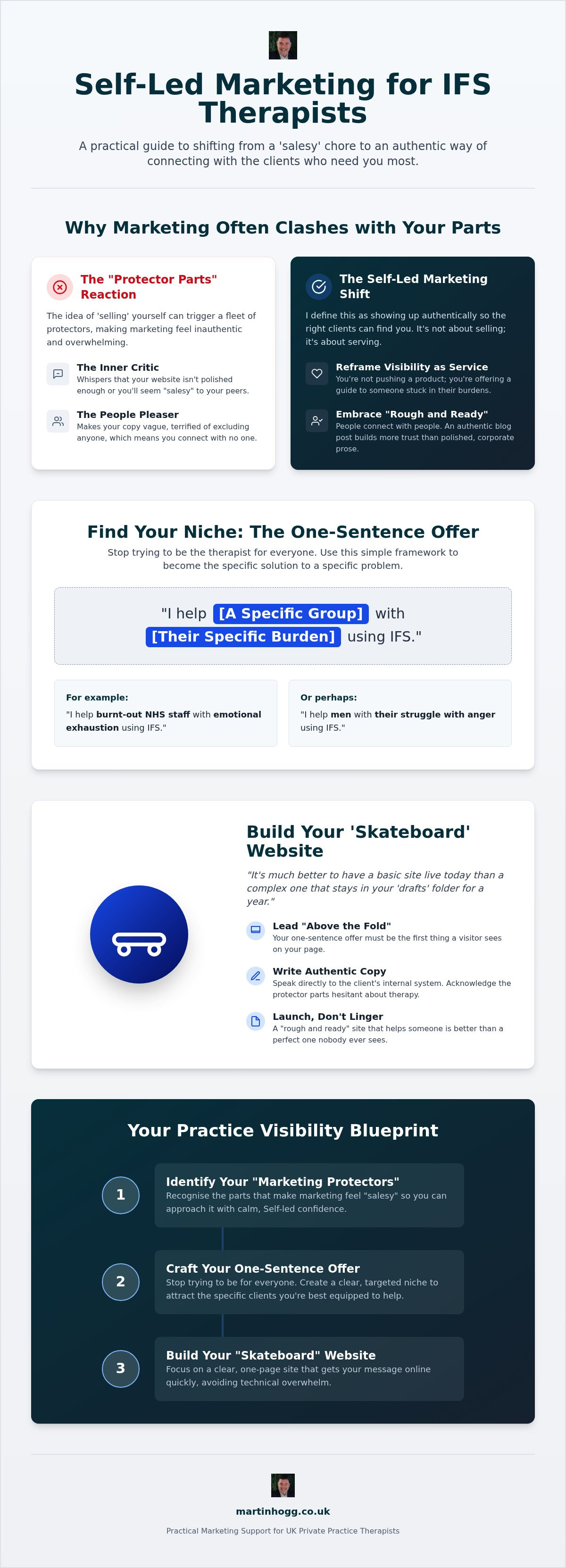
Marketing for internal family systems therapists often feels like a direct conflict of interest. While your clinical work is about unburdening and connection, the idea of "selling" yourself can trigger a fleet of Protector parts. I define Self-Led Marketing as the process of showing up authentically so the right clients can find the help they need. This isn't a lack of business skill; it's usually a Manager part trying to protect you from being judged.
Identifying Your "Marketing Protectors"
Recognising your Inner Critic is the first step. It's often the loudest voice, whispering that your Squarespace site isn't polished enough or that you'll look "salesy" to your peers. Then there's the People Pleaser. This part makes your copy vague because it's terrified that if you niche down, you'll leave someone out. The result is a website that sounds like everyone else and says very little to the clients who actually need you.
The Shift from Selling to Serving
This shift is about moving away from that controlling Manager energy and into a space of authentic connection. When you understand the Internal Family Systems (IFS) model, you know that the Self is calm and compassionate. Reframing visibility as an act of service changes everything. You aren't "selling" a product; you're making sure a person stuck in their burdens can find a guide who understands them.
I always tell my coaching clients that rough and ready content beats polished corporate prose every time. People connect with people. A slightly imperfect video or a heartfelt blog post builds more trust than a glossy, distant website. It shows your future clients that you are a real human being, ready to meet them in their complexity. Approaching marketing for internal family systems therapists this way makes the whole process feel much more like the work you already love.
Finding Your Niche: The IFS One-Sentence Offer
A common mistake I see is therapists trying to be "the IFS therapist for everyone." It sounds safe, but it actually makes you invisible. Effective marketing for internal family systems therapists relies on being the specific solution to a specific problem. If your website tries to speak to everyone, it ends up speaking to no one. You want your ideal client to land on your page and think, "Finally, someone who understands exactly what I'm going through."
I use a simple tool called the "One-Sentence Offer" to fix this. It goes: "I help [Specific People] with [Specific Burden] using IFS." It's clear. It's direct. It tells a potential client exactly what you do without them needing a degree in psychology. If you can't explain your work in one sentence, your "Manager part" might be overcomplicating things to avoid being seen. You can learn how to build your niche using this framework to ensure your message actually lands.
Translating IFS Jargon for Potential Clients
When someone lands on your site, they're usually in distress. They don't want to hear about "Exiles" or "Unblending" right away. They want to know why they feel stuck in old patterns or how to quiet a relentless inner critic. While research confirms the evidence-based efficacy of IFS therapy, your homepage should focus on the experience of transformation. Describe the shift from being overwhelmed by parts to living with more Self-leadership in plain, human English.
The Power of a Narrow Focus
Think about niches like IFS for burnt-out NHS staff or IFS for men struggling with anger. By narrowing your focus, your SEO becomes much easier. You aren't competing with every counsellor in the UK; you're the go-to person for a specific group. This makes marketing for internal family systems therapists feel less like a battle for attention and more like a targeted invitation. If you're ready to grow, our private practice success membership offers the support you need to refine this focus.
Building Your IFS 'Skateboard' Website and Presence
I often see therapists get stuck in "analysis paralysis" regarding their websites. I've found that marketing for internal family systems therapists works best when you keep things simple. Don't wait months to launch a perfect, multi-page Squarespace site that never quite feels finished. I recommend the skateboard model instead. This is a simple, one-page site that gets you moving immediately. It's much better to have a basic site live today than a complex one that stays in your "drafts" folder for a year.
Writing Copy that Speaks to "Parts"
Your "above the fold" content must lead with the one-sentence offer we discussed. When writing your bio, try to speak directly to the client's internal system. Acknowledge the Protector parts that might be feeling hesitant about therapy. By inviting these parts into a safe, calm space, you build immediate trust. Make the next step effortless by using a tool like Calendly for bookings. It reduces the friction for a part that's already feeling overwhelmed.
Basic SEO for IFS Therapists
Effective marketing for internal family systems therapists requires being specific with your keywords. Instead of just calling yourself a "counsellor," use title and description tags that highlight your modality. A phrase like "IFS therapist for anxiety" is far more powerful for search engines than a generic term. This specificity helps you stand out on the Counselling Directory and Psychology Today. When you're updating your profiles, keep these points in mind:
- Use modality-specific keywords in your headline to attract the right enquiries.
- Check the BACP directory search filters to ensure you're categorised correctly under IFS.
- Ensure your profile photo reflects a calm, Self-led presence.
You can even use Canva to create simple, Self-led visuals that reflect the grounded energy of your practice without needing a professional designer. These small, practical steps build a professional presence that feels authentic to your work.
The Practice Visibility Blueprint: Scaling with Self-Leadership
Marketing for internal family systems therapists isn't about a one-off burst of energy. I've seen many practitioners start with a flurry of posts only to disappear because they've burnt out. Consistency always beats intensity. My Practice Visibility Blueprint is designed to help you build a repeatable system that moves you from being a solo practitioner to running a sustainable business. It's about showing up regularly in a way that feels authentic to your Self-led values rather than a desperate push for numbers.
Email marketing is a brilliant way to scale this connection. Not every visitor to your site is ready to dive into parts work today. By offering a simple newsletter, you can nurture these potential clients over time. It keeps you in their mind as a trusted guide until they feel ready to book. This approach feels much more like a gentle invitation than a hard sell, which is exactly how your future clients want to be met.
Building a Sustainable Visibility Habit
You need clear boundaries around your marketing time so it doesn't bleed into your clinical work. I suggest blocking out a specific hour each week for your visibility tasks. This is where my "rough and ready" philosophy is vital. A quick, helpful blog post or a short video is far more effective than a perfect one that stays in your drafts forever. Remember, perfectionism is often just a protector part trying to keep you safe from being seen. Explore the Private Practice Success Membership to learn how to manage these parts while growing your practice.
Next Steps for Your Practice
When you hit a growth plateau, it might be time to consider one-to-one coaching to break through the specific blocks in your business. We can look at your niche and your pricing to ensure your practice truly supports your life. For broader advice on visibility, you can read my guide on how to get counselling clients in the UK. It's a practical, grounded resource for any therapist ready to take the next step.
Taking the Next Step in Your Self-Led Practice
Growing an IFS practice doesn't have to be a battle between your clinical heart and your business head. We've looked at how to quiet the protectors that make visibility feel scary and how to use a simple skateboard website to get moving. By focusing on a clear one-sentence offer, you stop being invisible and start being found by the people who truly need your specific approach. Marketing for internal family systems therapists is simply about creating a clear bridge from their burden to your Self-led presence.
I've spent over 20 years in UK private practice, and I've seen that the most successful therapists are the ones who keep things simple and human. Whether it's through my BACP-endorsed workshops or the Practice Visibility Blueprint, my goal is always to strip away the technical overwhelm. You don't need a polished corporate image; you just need to show up as you are. You have everything you need to build a practice that feels as authentic as your clinical work.
It's time to let your ideal clients know you're here. I'm looking forward to seeing your practice thrive.
Frequently Asked Questions
How do I explain IFS "Parts Work" on my website without confusing people?
I would focus on the client's lived experience rather than clinical theory. Instead of using jargon like "unblending" or "exiles," talk about the "inner critic" or feeling "pulled in two directions." People understand what it feels like to have a part of them that wants to change and another that's terrified of it. This makes marketing for internal family systems therapists much more accessible to someone in distress.
Is it better to use my name or a brand name for my IFS practice?
For most solo practitioners, I recommend using your own name. People connect with people, especially in a modality as personal as IFS. A brand name can sometimes feel a bit distant or corporate, which might trigger a client's protector parts. If you plan to grow into a multi-therapist clinic later, a brand name makes sense, but starting with your name builds immediate, human trust.
Which UK therapy directories are best for IFS practitioners?
Psychology Today and the Counselling Directory are the heavy hitters in the UK. Both allow you to filter for IFS, which is vital because more clients are searching for this specific modality now. Don't forget your BACP directory listing if you're a member. Make sure your "one-sentence offer" is clear in your profile headline so you stand out when someone scrolls through the search results.
How much should I spend on marketing my private practice each month?
You don't need a huge budget to start. Most therapists spend between £50 and £100 a month on directory subscriptions and basic website hosting. I suggest focusing on these essentials before considering paid ads. If you follow the skateboard model, your costs stay low while you build your visibility. It's better to invest your time in creating "rough and ready" content than spending a fortune on polished advertising.
Can I market myself as an IFS therapist before I am fully certified?
Yes, but you must be transparent about your training level. If you've completed Level 1 but aren't yet certified, I would describe yourself as "IFS-trained" or "offering IFS-informed therapy." This maintains your integrity and follows BACP ethical guidelines. Effective marketing for internal family systems therapists is built on trust, so being clear about where you are on your training journey actually helps you connect with the right clients.
Disclaimer
The information provided on this blog is for general informational purposes only. It is also not intended to be a substitute for professional medical or mental health advice, diagnosis, or treatment. Reading this content does not create a therapist-client relationship.


