
Marketing for Trauma Therapists: How to Build a Visible, Ethical UK Practice

Article by
Martin Hogg
I help Private Practice counsellors in the UK set up and grow an ethical Private Practice they love, work with their ideal clients, and earn the income they deserve. All without guesswork and burnout. I have been a private practice counsellor myself for over 20 years, specialising in anger management. I set up a not-for-profit social enterprise, Citizen Coaching and Counselling, which delivers thousands of counselling sessions a year to adults and young people in Birmingham. I am a registered BACP Counsellor and the author of three books, My Anger Coach, My Anxiety Coach and My Relationship Coach. These are available on Amazon.
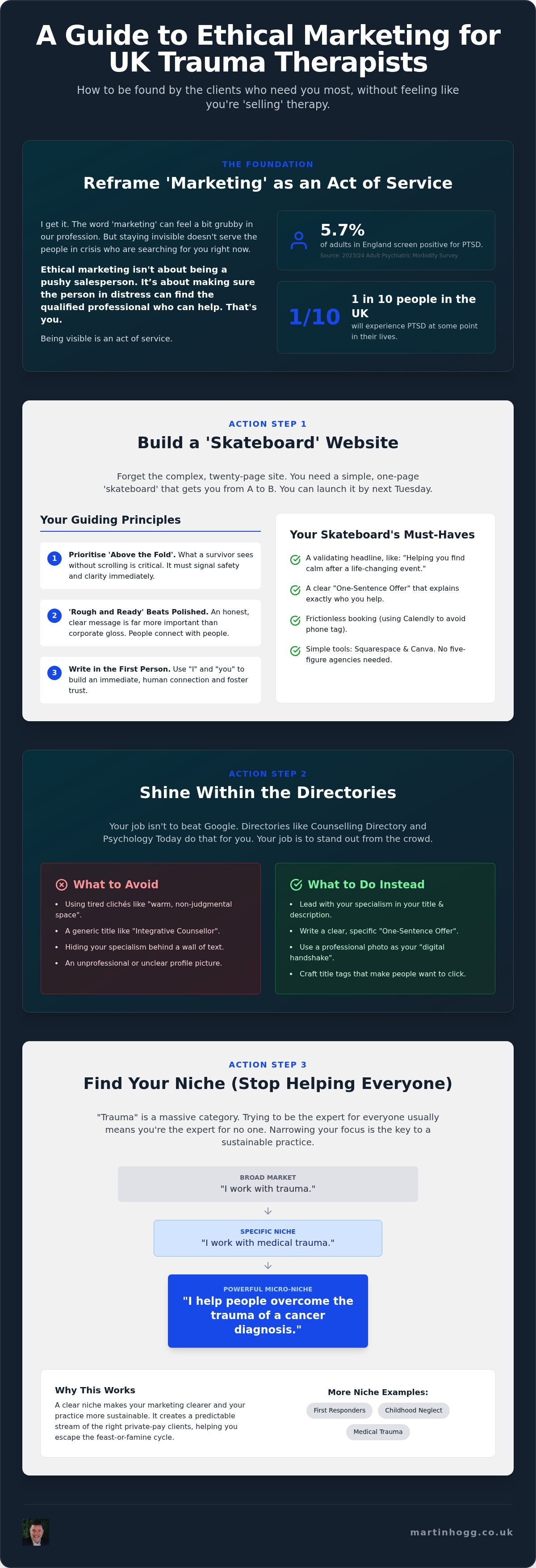
Being the best trauma therapist in the UK doesn't matter if the people who need you most can't find you. I know the word marketing for trauma therapists often feels a bit grubby in our profession. You've spent years training to hold space for deep pain, not to become a digital salesperson. It's easy to worry that putting yourself out there looks unprofessional or, worse, exploitative. But standing on the sidelines while 5.7% of adults in England screen positive for PTSD, according to the 2023/24 Adult Psychiatric Morbidity Survey, isn't helping anyone.
I'm here to show you that visibility can be an act of service, not a sales pitch. You'll learn how to attract the right clients for your practice without feeling like a pushy shark. I'll walk you through building a simple skateboard website that signals safety, fixing your directory profiles, and using clear SEO to reach people in need. It's about being visible so those in distress can find the help they deserve.
Key Takeaways
- Reframe marketing for trauma therapists as an ethical act of visibility that helps survivors find the safety and professional support they need.
- Stop over-complicating your tech and build a "skateboard model" website that prioritises clear, trustworthy content above the fold.
- Learn how to write title and description tags that make your directory profiles on Psychology Today and Counselling Directory actually get clicked.
- Discover how niche building through the Practice Visibility Blueprint creates a predictable stream of private-pay clients without the constant feast-or-famine stress.
Why Marketing Trauma Therapy Feels Different (and Why It Is Necessary)
I get it. The word "marketing" makes most UK therapists want to hide under their desks. You've spent years learning how to hold space for people, not how to write catchy headlines. You worry that being visible looks unprofessional or, worse, like you're trying to profit from someone's pain. But here's the truth: marketing for trauma therapists isn't about being a pushy salesperson. It's about making sure the person in crisis can find the person who can help. That's you.
In our profession, we're rightly careful about ethical frameworks like those from the BACP or UKCP. However, staying invisible doesn't protect clients; it just makes it harder for them to find qualified support. When you consider that approximately 1 in 10 people in the UK will experience PTSD at some point, hiding your expertise starts to look less like humility and more like a missed opportunity to serve. Effective marketing for trauma therapists is actually an act of service.
The Ethics of Being Found
We need to move past the "warm, non-judgmental space" clichés. While true, they don't help a survivor distinguish you from the thousands of other profiles on the Counselling Directory. Survivors of Psychological trauma are looking for signals of safety and competence. I recommend using a clear "one-sentence offer" that tells them exactly what you do. Instead of saying you "work with trauma," try: "I help survivors of childhood neglect find the confidence to set healthy boundaries." It's direct, honest, and immediately reassuring.
Niche Building for Trauma Specialists
Trying to help everyone usually ends in helping no one. "Trauma" is a massive category. To stand out on Psychology Today, you need to narrow your focus. Are you the go-to person for medical trauma, or perhaps you work specifically with first responders? Narrowing your niche makes your marketing clearer and your practice more sustainable. If you're struggling to pick a path, check out my niche building secrets for a bit of practical guidance.
The Skateboard Model: Building Your Trauma-Informed Website
Most therapists spend months overthinking their website. I call this analysis paralysis. You don't need a complex, twenty-page site to start marketing for trauma therapists effectively. You need a skateboard. In product design, a skateboard is the simplest version of a tool that still gets you from A to B. It's a functional, one-page site that you can launch by next Tuesday.
Forget the five-figure agency fees. Use Squarespace for your layout and Canva for your graphics. What actually matters is your "above the fold" content; the section people see before they even scroll. A trauma survivor is often in a state of high alert. If they land on a page cluttered with clinical jargon or a confusing menu, they'll bounce. My "rough and ready" philosophy means prioritising a clear, honest message over corporate polish.
Essential Website Elements for Trauma Practitioners
Your headline should validate the reader’s experience immediately. Instead of a generic title, try something like: "Helping you find calm after a life-changing event." Follow this with a clear way to book. I recommend using Calendly to remove the exhausting friction of "phone tag." Just make sure your digital setup aligns with current ICO guidance on digital marketing to keep your practice compliant.
Copywriting for Safety and Trust
Write in the first person. Use "I" and "you" to build an immediate connection. Avoid clickbait or exaggerated claims. Keep your language grounded, calm, and reassuring. When you approach marketing for trauma therapists with this sense of calm authority, you build trust before the first session even starts. If you want a structured path to getting your site right, joining our Private Practice Success membership is a great way to start building that professional foundation.
SEO and Directory Strategies for UK Practitioners
In the UK, directories like Counselling Directory and Psychology Today do the heavy lifting for you. They have huge budgets to stay at the top of Google, so your job isn't to beat them, but to shine within them. Most profiles are a sea of "Integrative Counsellors" using the same tired phrases. To make marketing for trauma therapists work, you have to lead with your specialism. If you want a broader look at the basics, I have written a guide on marketing for therapists uk that covers the wider ground.
Your profile picture is your digital handshake. It is the first thing a distressed person sees. It needs to look professional, grounded, and kind. A blurry crop from a wedding photo won't cut it. You want to signal that you are a stable, composed presence before they even read a single word of your copy.
Optimising Your Directory Presence
Use your "one-sentence offer" right in the snippet. Don't waste those first 150 characters on your qualifications or BACP membership level. Tell them who you help and how. If someone is searching for "childhood trauma support," and your snippet says "I help adults move past the shadow of childhood neglect," you have already won the click.
Simple SEO Wins
SEO sounds scary, but it is just about matching the words people type into Google at 2 AM. Think about their pain points. They aren't searching for "clinical interventions"; they're typing "why can't I sleep after an accident?" When you understand the basics of marketing for trauma therapists, you realise that SEO is just about being the right answer to a difficult question.
For trauma specialists working online, local SEO is less of a priority. You aren't just looking for people in your postcode; you're looking for your ideal client anywhere in the UK. Focus on the specific problem you solve rather than just the place where you sit.
Scaling Your Practice with the Visibility Blueprint
Most trauma therapists I work with are stuck in a cycle of "feast or famine." One month you're overbooked and exhausted; the next, you're staring at an empty diary. This usually happens because we tend to stop marketing the moment we get busy. To break this, you need a predictable system that works in the background. The Practice Visibility Blueprint is designed to keep your practice visible even when you're in the therapy room, ensuring a steady stream of private-pay clients who actually fit your niche.
I've seen too many brilliant clinicians give up on private practice because the business side felt too heavy. It doesn't have to be that way. When you have a structured growth path, marketing for trauma therapists becomes a routine part of your week rather than a source of panic. It's about building a sustainable future where you can focus on the clinical work you love.
From Solo Practitioner to Practice Leader
Scaling isn't just about making more money; it's about increasing your impact without burning yourself out. When you have a clear system for marketing for trauma therapists, you move from reactive survival to proactive leadership. If you're just beginning this journey, I recommend reading my guide on starting and growing a private practice to get your fundamentals in order.
Your 90-Day Visibility Plan
Don't try to do everything at once. Focus on these three steps over the next three months:
- Step 1: Launch your Skateboard website. The Skateboard model reduces the cost of entry for new practitioners by focusing on a functional, one-page site that signals safety immediately.
- Step 2: Optimise one directory. Pick Psychology Today or Counselling Directory and apply your one-sentence offer.
- Step 3: Create consistent, human content. Share one "rough and ready" insight a week that helps your specific niche.
You don't have to do this alone. Isolation is the biggest threat to a private practice. In our Private Practice Success Membership, you'll find a community of UK therapists who are all working through these same hurdles together. We share what works, what doesn't, and we keep each other moving forward.
Your Path to a Sustainable Trauma Practice
Marketing for trauma therapists is ultimately about making a connection with someone who is currently struggling to find a way forward. We've looked at how a simple skateboard website and a focused directory profile can signal the safety and competence survivors need. It's time to stop letting the fear of being "salesy" keep your expertise hidden from the people who need it most.
I've spent over 20 years in UK private practice, and as a BACP Professional Development partner, I know that the best results come from a blend of clinical excellence and practical visibility. You don't have to figure out the tech or the strategy on your own. Join our supportive community of UK-based therapists and let's get your practice to a place where it can truly thrive.
You have the skills to change lives. Now, let's make sure the right people can find you.
Frequently Asked Questions
Is it ethical for a trauma therapist to use marketing?
Yes, it's absolutely ethical. I see marketing for trauma therapists as an act of service that helps people in pain find the right support. If you hide your skills, you're making it harder for survivors to find a safe, professional space. As long as you stay within BACP guidelines and avoid making exaggerated claims, visibility is about helping people, not just getting more bums on seats.
How much should I spend on marketing my trauma practice?
You don't need a massive budget to get started. A listing on Psychology Today costs £19.95 per month, and they often offer a six-month free trial. Add an ICO fee of £47 if you pay by Direct Debit and a simple Squarespace site, and you're up and running. The goal is to be visible without putting yourself under financial pressure while you build your private practice.
Which directory is best for trauma therapists in the UK?
There isn't a single best one, but Counselling Directory and Psychology Today are the heavy hitters. The BACP directory is also vital for building trust. I usually suggest starting with Psychology Today because that six-month trial is a gift for new practitioners. Pick one, write a clear one-sentence offer, and track your enquiries before you start paying for multiple listings. It's about being smart with your overheads.
Do I really need a website if I am on Psychology Today?
Yes, you do. A directory profile is a great start, but a website is your digital home where you control the narrative. A simple skateboard model site allows you to build deeper trust and signal safety more effectively than a standard template. It also gives you a professional place to link your Calendly so clients can book their first session without the exhausting stress of playing phone tag.
How do I explain my trauma niche without using too much clinical jargon?
Focus on the transformation rather than the clinical technique. Instead of talking about stabilisation phases, try explaining how you help people sleep better or feel less jumpy in crowds. Use the language your clients use when they're talking to a friend. When you focus on the daily struggles they face, your marketing for trauma therapists will feel much more human and accessible to someone in distress.
Disclaimer
The information provided on this blog is for general informational purposes only. It is also not intended to be a substitute for professional medical or mental health advice, diagnosis, or treatment. Reading this content does not create a therapist-client relationship.


