
Marketing for UK Therapists: Ethical Practice Growth

Article by
Martin Hogg
I help Private Practice counsellors in the UK set up and grow an ethical Private Practice they love, work with their ideal clients, and earn the income they deserve. All without guesswork and burnout. I have been a private practice counsellor myself for over 20 years, specialising in anger management. I set up a not-for-profit social enterprise, Citizen Coaching and Counselling, which delivers thousands of counselling sessions a year to adults and young people in Birmingham. I am a registered BACP Counsellor and the author of three books, My Anger Coach, My Anxiety Coach and My Relationship Coach. These are available on Amazon.
Why does it feel like your directory profile is just a digital version of a bargain bucket? It’s a bit soul-destroying when you’ve spent years training to help people, yet you’re stuck staring at a quiet diary. When you think about marketing for therapists uk, it often feels like a race to the bottom on price rather than a reflection of your actual skill. I know how exhausting that is.
Most of us didn't sign up for this profession to become experts in technical jargon like SEO or Meta Tags. I’m going to show you how to build a visible, ethical, and thriving private practice without the "salesy" ick. You can be findable for the people who need you most without compromising your professional integrity or feeling like a cut-price commodity.
We’ll explore how to move past the directory scramble and create a simple marketing system that runs itself. You’ll learn how to gain confidence in your professional visibility and finally fill your diary with the clients you’re best equipped to help.
Key Takeaways
- Stop being a "blank slate" and start seeing visibility as an ethical duty to the clients who are currently struggling to find you.
- Adopt the "skateboard model" for your website to get moving immediately. Pair it with a fluff-free one-sentence offer that lands with your audience.
- Learn how to use directories and "rough and ready" content to master marketing for therapists uk without ever feeling like a pushy salesperson.
- Plan your move from solo practitioner to practice CEO by using niche CPD, such as working with men, to stand out and scale your income.
Why Your Clinical Training Didn’t Prepare You for the Business of Therapy
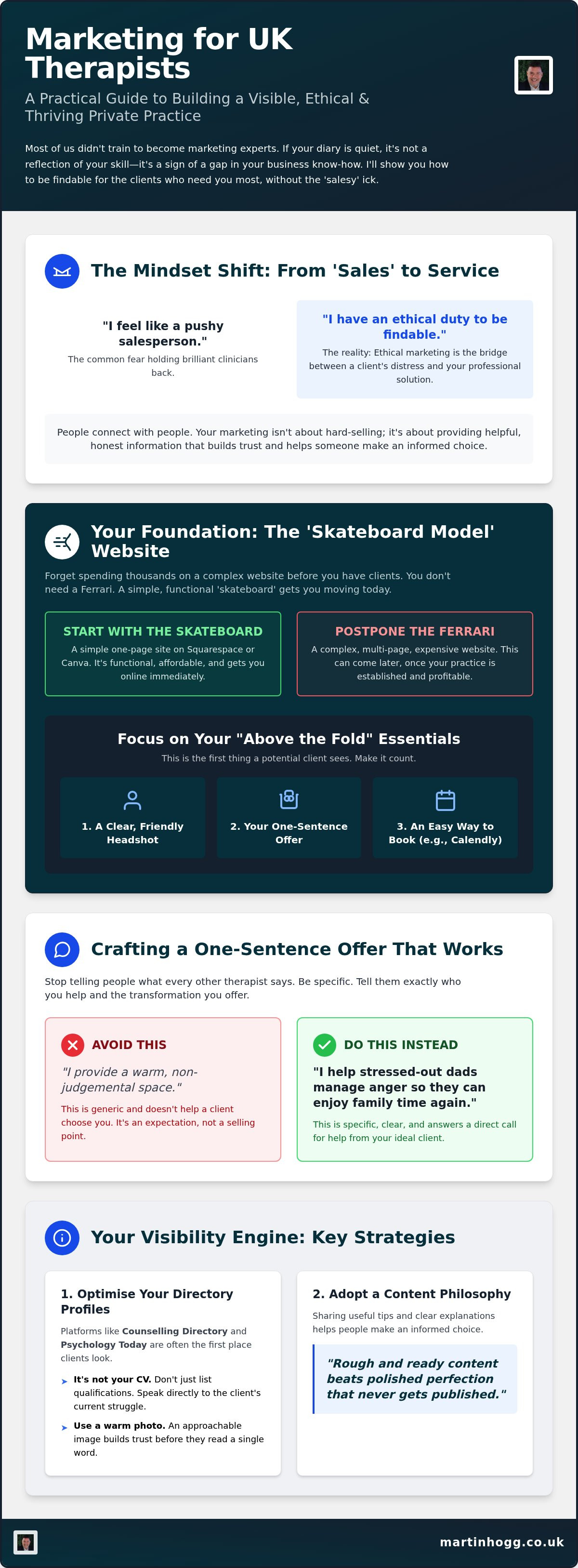
I’ve seen it a thousand times. Brilliant clinicians with empty diaries because they were taught to be "blank slates," not business owners. Your training focused on the work inside the room. It likely ignored the reality of how to get people into that room in the first place. This gap creates a lot of self-doubt. You might feel that promoting yourself is somehow "un-therapeutic" or even slightly manipulative.
Actually, I believe visibility is an ethical duty. If a client is in distress and searching for help, but they can’t find you, you aren’t serving them. We should look at marketing ethics as a framework for clear, honest communication. Ethical marketing is the bridge between a client’s distress and your professional solution.
The "Salesy" Stigma and How to Break It
Most of us cringe at the word "sales." We think of pushy car dealers or flashy adverts. But marketing for therapists uk is really just about "being findable." There is a massive difference between hard-selling and providing helpful information that builds trust. When you share a useful tip or a clear explanation of your process, you are helping someone make an informed choice. People connect with people; they don't connect with a cold, clinical list of qualifications.
The Role of Professional Bodies like the BACP
Remaining ethically grounded is easier when you use your professional body’s standards as a compass. Whether you are with the BACP or another accredited register, your membership is a cornerstone of your message. It tells the public you are safe and qualified. Use that badge with pride. It isn't bragging; it’s providing the reassurance a vulnerable person needs. If you are feeling overwhelmed, joining a community like the Private Practice Success Membership can help you see that you aren’t alone in this struggle. This supportive environment helps you grow without losing your professional soul.
Building Your Foundations: The Skateboard Model and Your One-Sentence Offer
Don't get bogged down in technical perfection. I’ve seen too many practitioners spend thousands on complex websites before they even have their first five clients. I prefer the "skateboard model." It’s a simple, functional site that gets you moving today. You don't need a Ferrari when a skateboard will get you down the road just fine. It's about being functional, not perfect.
The Skateboard Model for Therapist Websites
Forget twenty pages of academic theory. A one-page site on Squarespace or even Canva is often all you need to start. Focus your energy on the "above the fold" content. This is the part people see before they scroll. It’s your most valuable digital real estate. You need three things here: a clear, friendly headshot; your one-sentence offer; and a direct link to your Calendly. This setup makes booking a consultation effortless for the client while keeping your costs low.
Crafting a One-Sentence Offer That Actually Works
Stop telling people you provide a "warm, non-judgemental space." Every therapist says that. It doesn't help a client choose you. Instead, tell them exactly how you help. For example, "I help stressed-out dads manage anger so they can enjoy family time again." This kind of clarity makes your marketing for therapists uk much easier. When you have a specific niche, you aren't shouting into the void; you are answering a specific person’s call for help. If you're struggling to pin this down, my Niche Building Secrets guide can help you refine your message.
Building these basics alone can feel a bit isolating. If you want some company while you get set up, you might find the Private Practice Success Membership a helpful place to find support from others on the same path.
The Visibility Engine: Directories, SEO, and "Rough and Ready" Content
Directories like Counselling Directory and Psychology Today are often the first place people look. I see many therapists treat these like a CV. That's a mistake. You want your profile to speak directly to the person in distress. If you know how to write for them, these platforms become your biggest allies in the UK market.
Optimising Your Directory Profiles
The secret to standing out is simple: it’s not about you, it’s about the client. Most profiles are a dry list of qualifications and BACP codes. Yours should describe the specific struggle the client is facing right now. Your directory photo needs to look like a real person, not a corporate robot. A warm, approachable image builds trust before they’ve even read a word. Avoid the "blank slate" look here; show them a human being who can help.
Practical SEO for the Non-Techy Therapist
You don't need to be a tech wizard to master marketing for therapists uk. Start with your title and description tags. These are the short snippets that appear in Google search results. Instead of just listing your name, use these tags to speak to pain points. If someone is searching for help with relationship issues, seeing that in your title is much more powerful than a list of letters after your name. Ensure your contact buttons are "above the fold" on your site so clients don't have to hunt for a way to reach you.
I always say that "rough and ready content beats polished." Don't wait for perfection before posting a helpful blog or a quick video. People connect with authenticity, not high-end production. Use tools like Canva to create simple graphics that offer value. To save yourself from getting bogged down in the admin of it all, you can use the Counsellor Efficiency Bundle to streamline the process.
Scaling Your Practice: Moving Beyond the Solo Slog
Once your diary is full, the game changes. You stop worrying about where the next client is coming from and start wondering how to keep this up without burning out. This is the moment you move from "Solo Practitioner" to "Practice CEO." It sounds a bit corporate, but it’s really just about taking control of your time and your value. Marketing isn't a one-off event; it's a rhythm that supports your clinical excellence.
Leveraging CPD for Practice Growth
Specialised CPD is one of the quickest ways to increase your visibility and your rates. When you become an expert in a specific niche, such as Anger Management or Working with Men, you stop being "just another counsellor." You become the go-to person for referrals. This specific focus makes your marketing for therapists uk significantly easier because you’re speaking to a very specific need. Professional development should connect directly to your marketing strategy; if you've got the skills, make sure people know about them.
The Practice Visibility Blueprint
The Practice Visibility Blueprint is my step-by-step system for maintaining a full diary year-round. It’s designed to take the guesswork out of being found. If you want to fast-track your results, one-to-one practice growth coaching can help you skip the trial and error. Private practice can be a lonely old slog, but it doesn't have to be. Joining a community like the Private Practice Success Membership is the best way to stay motivated and supported. Remember, your practice exists to serve your clients, but it also needs to serve you.
Take the Next Step Toward a Thriving Practice
Building a full diary doesn't mean losing your clinical soul. You’ve seen how visibility is actually an ethical duty to your future clients and why a simple "skateboard" website beats a complex one that never launches. By focusing on a clear one-sentence offer and using "rough and ready" content, you can master marketing for therapists uk without the technical headache.
I’ve helped hundreds of UK counsellors move from a quiet room to a sustainable business. My approach is rooted in over 20 years of experience and includes BACP-endorsed workshops to keep your professional development on track. It’s a no-nonsense, no-contract way to get the support you deserve. You don't have to figure this out in isolation.
You have the skills to change lives; now it’s just about making sure the right people can find you. I’m here to help you bridge that gap and get your practice moving forward. It is time to step out of the shadows and let your ideal clients know you are ready to help.
Frequently Asked Questions
Is marketing my therapy practice ethical according to the BACP?
Yes, it is perfectly ethical as long as your communication is honest and doesn't make misleading claims. The BACP Ethical Framework values integrity and being trustworthy. I see marketing for therapists uk as an act of service. If you have the skills to help someone in distress, you have a duty to ensure they can find you easily. It's about clear communication, not manipulative sales tactics.
How much time should I realistically spend on marketing each week?
I suggest setting aside two to four hours each week when you are first building your foundations. This time should be spent on high-impact tasks like refining your one-sentence offer or updating your directory profiles. Once your systems are in place and your diary is full, you can usually scale this back to about an hour a week. Consistency is much more important than doing a massive marketing burst once a month.
Do I really need a website if I am already on the Counselling Directory?
You definitely need your own site. Think of a directory like Psychology Today as a shared marketplace, while your website is your own private practice space. A simple "skateboard model" website on Squarespace or Canva allows you to control the narrative and show your personality. It provides the "above the fold" clarity that directories lack, helping prospective clients feel safe enough to take that final step and book a session.
What is the most effective way to get more counselling clients in the UK?
The most effective strategy is combining a clear professional niche with high visibility on search engines. When you specialise through CPD, like my Working with Men course, you become the obvious choice for specific enquiries. This makes your marketing for therapists uk much more targeted. Instead of competing with everyone, you are speaking directly to a client's specific pain points, which naturally leads to a much higher booking rate.
Can I grow my practice without using social media?
You can absolutely build a successful practice without using social media at all. In fact, for many counsellors, social media is an unnecessary distraction that leads to burnout. Focus on your "Visibility Engine" by optimising your directory listings and your website's SEO. Being findable on Google when a client is actively searching for help is far more effective than trying to "go viral" on platforms like Instagram or TikTok.
Disclaimer
The information provided on this blog is for general informational purposes only. It is also not intended to be a substitute for professional medical or mental health advice, diagnosis, or treatment. Reading this content does not create a therapist-client relationship.


