Marketing Your Private Practice: Common Business Advice and Why You Shouldn’t Always Follow It
What if the loud, aggressive business advice you see online is actually the biggest hurdle to your success as a therapist? Over the last 15 years, I've spoken with hundreds of counsellors across the UK who feel completely drained by the pressure to act like a "hustler" just to fill their diary. You've likely heard that you need to be on every social media platform at once, but we are going to look at that common advice and why you shouldn't always follow it if you want a practice that actually lasts. It's exhausting to feel like you're compromising your professional ethics just to get noticed, especially when you'd rather be focusing on your clients.
You probably agree that most marketing strategies feel cold or just plain pushy, leaving you feeling more overwhelmed than inspired. This article will show you how to build a visible, ethical practice that feels right for you without the "salesy" gimmicks. We'll explore how to attract a steady stream of the right clients while keeping your reputation built on genuine trust. I'll share practical, grounded ways to grow your practice that respect your boundaries and your energy, ensuring you avoid burnout while helping those who need it most.
Key Takeaways
- Learn how to set healthy boundaries by rejecting the "always available" hustle culture and why you shouldn't feel guilty for building a practice that respects your own well-being.
- Discover how to grow your visibility without compromising your ethical standards, ensuring your marketing remains honest and respectful of your professional code.
- Find out why choosing a niche is a practical way to attract the right clients and how being a specialist allows you to provide deeper, more focused support.
- Realise the importance of peer connection in overcoming the "lonely therapist" syndrome and making more confident, practical business choices.
The "Always Available" Trap in Private Practice and Why You Shouldn’t Say Yes to Everyone
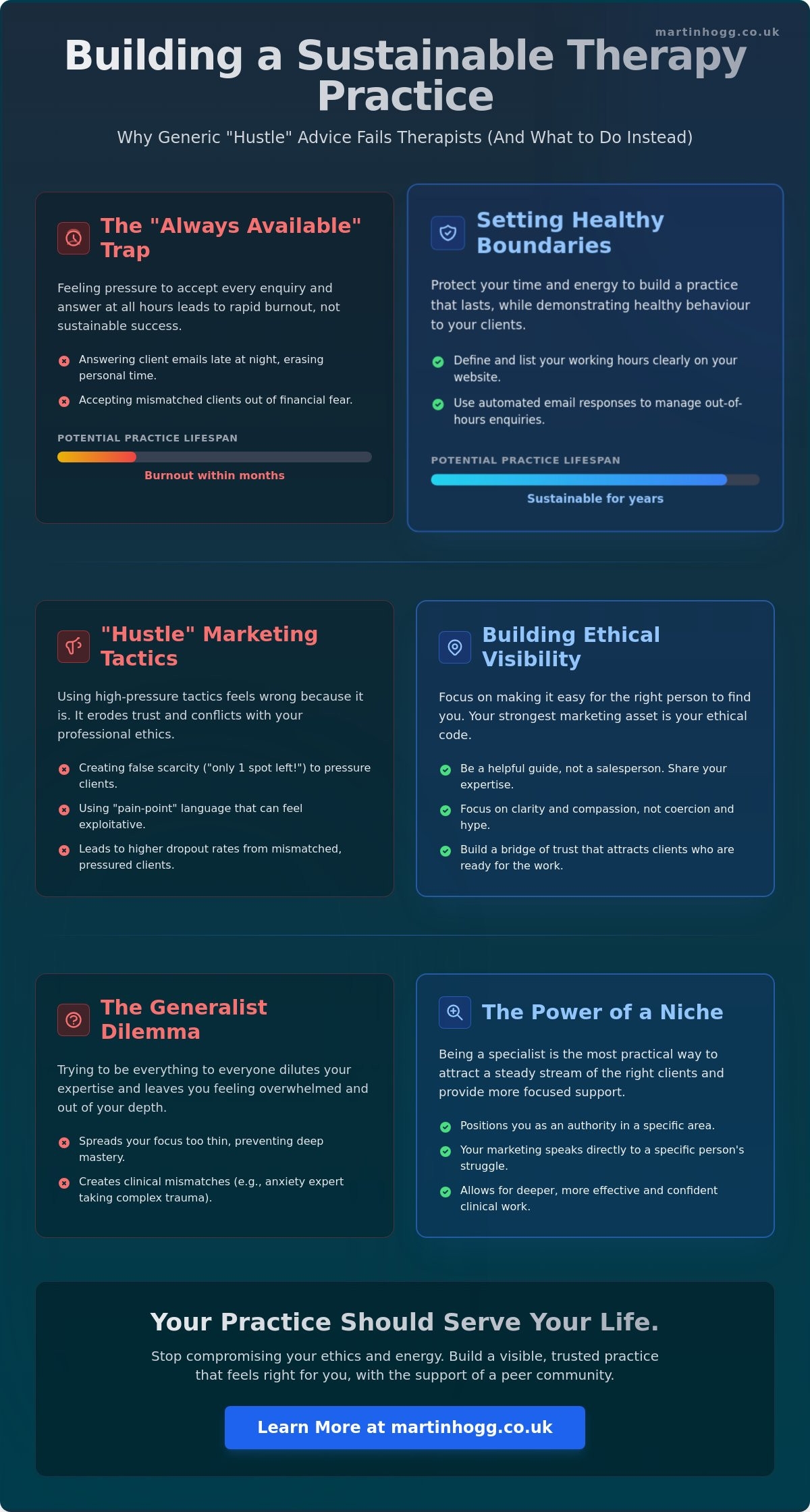
Starting a private practice often brings a heavy sense of pressure. You might feel that every enquiry is a lifeline, and turning someone away feels like you're sabotaging your own success. It’s a common fear, but the "hustle" mentality that works for selling products doesn't work for therapy. Sustainable growth in our profession means building a practice that lasts for years, not one that burns you out in six months.
Your practice should serve your life, not the other way around. When you try to be everything to everyone, you dilute your expertise and drain your emotional reserves. Following standard business advice often means ignoring ethical marketing principles that prioritise the client's best interest over a quick sale. There are specific reasons to be selective, and why you shouldn't feel guilty about protectng your time.
The Myth of Constant Availability
An empty diary can feel like a personal failure, but it’s actually an opportunity to wait for the right fit. Accepting a client purely for financial necessity often leads to a mismatch in clinical suitability. If you specialise in anxiety but take on a complex trauma case because you need the fee, you aren't being fair to the client or yourself. In the UK, professional bodies like the BACP emphasise working within your competence. A quiet week is better than a week filled with cases that leave you feeling out of your depth.
Setting Boundaries from Day One
You aren't a 24/7 emergency service. Defining your working hours is the first step toward professional authority. If you answer emails at 11 pm, you teach clients that you have no boundaries. This can actually decrease their trust in your ability to hold a safe, contained space. Clear limits show that you are a professional who values their own mental health, which is a powerful model for your clients. There are practical ways to manage this, and why you shouldn't hesitate to implement them immediately:
- Decide your "on-duty" hours and list them clearly on your contact page.
- Use an automated email response for any out-of-hours enquiries to manage expectations.
- Stick to your session finish times, even when it feels difficult to stop.
If you're looking for a supportive community to help you navigate these business challenges without losing your mind, you might find our Private Practice Success group helpful. It's a place where we focus on building a business that supports your wellbeing as much as your bank balance.
Following Generic Marketing Rules and Why You Shouldn’t Ignore Your Ethical Code
Business gurus often tell you to create "scarcity" or use high-pressure sales tactics to close deals. They suggest using countdown timers on your website or claiming you only have one spot left to force a decision. While these methods might work for selling software, they feel wrong in a therapeutic context. I believe your ethical code is your strongest marketing asset, not a hurdle to clear. There are many reasons why you might feel pressured to follow the crowd, and why you shouldn't let fear dictate your business decisions.
The BACP Ethical Framework (2018) focuses on client autonomy and doing no harm. If your marketing uses exaggerated claims or "hypey" language, you create a trust deficit before the first session even begins. A client who feels pressured into booking is less likely to engage fully in the work. You might see a short-term gain in your diary, but it often leads to higher dropout rates. This is a primary reason why you should look at standard business advice through a critical lens and why you shouldn't compromise your professional integrity for a quick win.
The Problem with "Hustle" Marketing for Therapists
Many traditional marketers push "pain-point marketing," which involves digging into a customer's misery to sell a solution. For a counsellor, this can feel exploitative. We want to acknowledge the struggle without making the person feel worse. I define ethical marketing as making it easy for the right person to find the right help. It's about clarity, not coercion. By developing a successful niche, you can speak directly to a specific struggle with compassion rather than using "hustle" tactics to grab attention.
Building Trust Through Visibility
You don't need to be a "celebrity therapist" to have a full practice. You just need to be visible. Share your expertise by explaining how you work or what a client can expect in a session. This builds a bridge of trust. If you want a deeper look at how to do this properly, my guide on Marketing for Therapists in the UK covers these practical steps. Focus on being a helpful guide rather than a salesperson. If you're looking for a supportive space to grow your practice alongside others, you might find our community for private practice success a good fit for your next steps.
The "Generalist" Counsellor Approach and Why You Shouldn’t Fear Finding a Niche
Many therapists worry that narrowing their focus will leave them with an empty diary. You might think that by offering support for every possible issue, you are casting a wider net to catch more clients. This is a common piece of business advice, but I want to explain the specialist premium and why you shouldn't fear narrowing your focus. When a person is in the middle of a life-altering crisis, they don't look for a generalist. They look for an expert who understands their specific pain.
Think about your own health. If you had a complex heart condition, you wouldn't just see any doctor; you would seek out the best cardiologist you could find. Private practice works the same way. Being a specialist allows you to charge a premium because your value is higher to the person seeking help. It also makes your own life easier. When you have a niche, your marketing becomes a direct conversation with one person, and your path for professional development becomes clear and focused.
My own experience with "Working with Men" through Citizen Coaching is a practical example of this. By focusing on a group that often feels misunderstood by traditional services, I didn't limit my practice. Instead, I became the go-to person in Birmingham for that specific need. This clarity allowed me to build a reputation quickly. It also ensured I stayed within my professional boundaries, as suggested by the Ethical Principles of Psychologists and Code of Conduct, which highlights the importance of honesty in how we represent our expertise to the public.
Why Being a Generalist is a Harder Path
If you look at a directory like the BACP or Psychology Today, you will see page after page of counsellors who list thirty different specialisms. It is hard to stand out in a crowded digital room when you sound like everyone else. A niche allows you to speak directly to one person’s struggle. Instead of a generic "I can help with anxiety," you can say, "I help parents manage the specific anxiety of returning to work after maternity leave." That level of specificity builds immediate trust.
Finding Your Authentic Niche
Identifying your niche shouldn't feel like a chore. It should come from the work that already energises you. Ask yourself these questions to find your focus:
- Which clients do I look forward to seeing the most each week?
- What specific problems do I find myself reading about in my spare time?
- What lived experience do I have that gives me a unique perspective on a struggle?
Once you identify that spark, your marketing stops feeling like "selling" and starts feeling like reaching out to help. For more inspiration on how to build your expertise, you can read this guide on CPD for Counsellors UK.
If you are ready to stop being a generalist and start building a practice that reflects your true expertise, come and join our Private Practice Success community.
Building Your Practice in Isolation and Why You Shouldn’t Go It Alone
It's easy to fall into the trap of thinking you can manage every aspect of your business from your therapy room. Many practitioners in the UK believe that total self-reliance is a badge of honour, but this often leads to "lonely therapist syndrome." When you are the only person making decisions about your marketing, pricing, or admin, your perspective naturally narrows. You might find yourself stuck in a cycle of overthinking, and why you shouldn't stay in that loop is simple: isolation breeds indecision and burnout. According to a 2022 survey by the BACP, a significant number of private practitioners reported that professional isolation was a primary factor in their work-related stress.
Peer support is a business necessity, not just a clinical one. While clinical supervision ensures your work with clients is safe and ethical, it rarely addresses the practicalities of running a profitable practice. A business coach or mentor provides the strategic oversight that a clinical supervisor isn't trained to give. You need someone to look at your growth strategy, not just your case notes. Programs like the Practice Visibility Blueprint provide a structured way to bridge this gap, offering practical steps to ensure your service is seen by the people who need it most.
The Value of a Supportive Community
Being part of a group helps you realise that your struggles with imposter syndrome aren't unique. When you see a colleague in a similar town successfully grow their practice, it makes your own goals feel achievable. Shared resources, such as proven templates for client enquiries or marketing materials, can save you dozens of hours of trial and error. This collective knowledge speeds up your growth and prevents you from making the same expensive mistakes others have already solved.
Next Steps for Your Practice
If you're tired of making every business decision in a vacuum, it's time to find your tribe. You can check the training calendar for upcoming workshops that focus on practical, real-world skills. To move away from isolation for good and join a group of like-minded professionals, I encourage you to join the Private Practice Success Membership. Taking this step means you can focus on your clients while having a supportive community behind you to help with the business side of things.
Building a Practice That Truly Works for You
Building a successful private practice in the UK doesn't mean you have to follow every loud piece of business advice you find online. It's about finding a balance that respects your clinical ethics and your personal well-being. You've seen how trying to be a generalist can dilute your impact, and why you shouldn't ignore the specific niche that truly resonates with your clinical experience. Marketing doesn't have to feel like a compromise of your values; it's simply about letting the right people know you're there to help.
I've spent over 20 years in the UK therapy sector. I know that the most resilient practices are built on community and sound, ethical foundations. Our social enterprise-led professional training and BACP-endorsed workshops are designed to give you practical tools that work in the real world. You don't have to struggle with isolation or the pressure to be "always on" for every enquiry that comes your way. There's a better way to grow that keeps your passion for helping people at the very centre.
Join the Private Practice Success community and start your visibility journey today
You've got the skills to change lives. Now, let's make sure you have the right support to get your practice back on track and thriving.
Frequently Asked Questions
Is it ethical to market a therapy practice in the UK?
It's entirely ethical to market your counselling practice as long as you follow the BACP Ethical Framework for Good Practice. This framework requires all your communications to be honest, accurate, and not misleading. Marketing isn't about being pushy or using "salesy" tactics. It's simply the process of making sure people in your community who are struggling with anxiety or trauma know that your support is available to them.
How much time should I spend on marketing my private practice each week?
I suggest you spend about 5 hours a week on your marketing when you're first building your caseload. A 2021 study by Tide found that many UK small business owners spend roughly 19 percent of their work week on promotion and business development. You don't need to spend every waking hour on it. Consistency matters much more than intensity, so find a small block of time each day to focus on your visibility.
Can I grow a successful therapy practice without using social media?
You can definitely grow a successful practice without using social media at all. Many therapists believe they must be on Instagram or TikTok to find clients, but this is often just noise and why you shouldn't feel forced into it. Focusing on your local search presence or professional directories can be far more effective. If you find social media draining, your energy is better spent elsewhere.
Why do most therapist websites fail to attract the right clients?
Most websites fail because they focus on the therapist's qualifications rather than the client's immediate pain. Research from the Nielsen Norman Group shows that users often decide whether to stay on a site within 10 to 20 seconds. If your homepage is just a list of your diplomas and training dates, people will likely leave. You need to show them you understand their specific struggle with clear, compassionate language.
When is the right time to join a professional practice membership?
The best time to join a membership is when you have 2 or 3 clients and want to build a sustainable foundation for the future. The 2022 BACP Private Practice survey found that 45 percent of therapists feel isolated in their work. Joining a community provides the practical tools you need to avoid burnout. This is common business advice and why you shouldn't ignore the need for professional connection while building your practice.

Article by
Martin Hogg
I help Private Practice counsellors in the UK set up and grow an ethical Private Practice they love, work with their ideal clients, and earn the income they deserve. All without guesswork and burnout. I have been a private practice counsellor myself for over 20 years, specialising in anger management. I set up a not-for-profit social enterprise, Citizen Coaching and Counselling, which delivers thousands of counselling sessions a year to adults and young people in Birmingham. I am a registered BACP Counsellor and the author of three books, My Anger Coach, My Anxiety Coach and My Relationship Coach. These are available on Amazon.
Disclaimer
The information provided on this blog is for general informational purposes only and is not intended to be a substitute for professional medical or mental health advice, diagnosis, or treatment. Reading this content does not create a therapist-client relationship.


