
Mentorship for New Counsellors: Benefits and Boundaries

Article by
Martin Hogg
I help Private Practice counsellors in the UK set up and grow an ethical Private Practice they love, work with their ideal clients, and earn the income they deserve. All without guesswork and burnout. I have been a private practice counsellor myself for over 20 years, specialising in anger management. I set up a not-for-profit social enterprise, Citizen Coaching and Counselling, which delivers thousands of counselling sessions a year to adults and young people in Birmingham. I am a registered BACP Counsellor and the author of three books, My Anger Coach, My Anxiety Coach and My Relationship Coach. These are available on Amazon.
Good mentoring offers support, not supervision by another name. Mentorship for new counsellors is a developmental relationship in which an experienced practitioner helps you build knowledge, confidence and a clearer sense of your professional approach. It can provide guidance and perspective, but it does not replace clinical supervision or make someone else responsible for your client work.
It’s understandable to want a trusted person to talk things through with, especially when the early years of practice bring questions a textbook cannot answer. Look for a relationship that gives you space to reflect, receive constructive feedback and set goals, with confidentiality and clear boundaries at its centre.
This guide explains what mentoring can offer, how it differs from clinical supervision, and what to agree at the outset to keep the relationship useful. It also shows how to use feedback as part of your development, without expecting a mentor to have every answer.
Key Takeaways
- Agree the purpose, boundaries and confidentiality of a mentoring relationship at the outset, so you both know what the conversations are for.
- Use mentoring for professional development and perspective; keep clinical supervision focused on your client work and clinical responsibilities.
- Set a few learning goals with your mentor and revisit them as your confidence and practice develop.
- Ask for specific, constructive feedback that helps you recognise your strengths and consider a different approach.
Confidential developmental relationships between mentors and mentees
Mentorship for new counsellors is a learning relationship that supports career development by building knowledge, skills and professional understanding. It can help you move from training into practice, whether you’re shaping your approach to client work or deciding how to start a private practice. The Community Tool Box describes mentoring as a structured way to share useful knowledge, skills, experience and connections.
Keep the purpose clear. A mentor might help you plan a first website, identify a learning goal or reflect on a difficult professional decision. To keep your knowledge current, bring a recent BACP resource or professional reading to a meeting and discuss how it relates to your work. Mentoring can be formal or informal, but agreed goals give each conversation direction. Bring one question or learning aim to get a useful discussion started.
Discuss confidentiality explicitly rather than relying on assumptions. Agree what stays within the relationship, how you’ll handle sensitive examples and what the limits are before sharing details. Use anonymised situations, never identifying client information. Mentoring can support clinical skills and competence through reflection, but it is not a substitute for clinical supervision or a place to make decisions about client safety.
There’s no single route to finding a suitable mentor. Ask your training provider about alumni connections, then use professional networks or counsellor groups to meet potential mentors. Peer support can be a starting point without a formal paid programme. Before joining an organised scheme, find out what its fee covers. Look for someone whose experience fits your next step, such as setting up a practice or developing a particular area of work.
In an initial conversation, ask about their counselling experience, current professional learning, mentoring approach and boundaries. Choose someone who listens, challenges your assumptions and respects differences in background or practice. Avoid a relationship where an existing close working connection makes honest discussion difficult. Agree when to review the arrangement, and revisit your goals as your career develops.
Difference between mentoring and clinical supervision
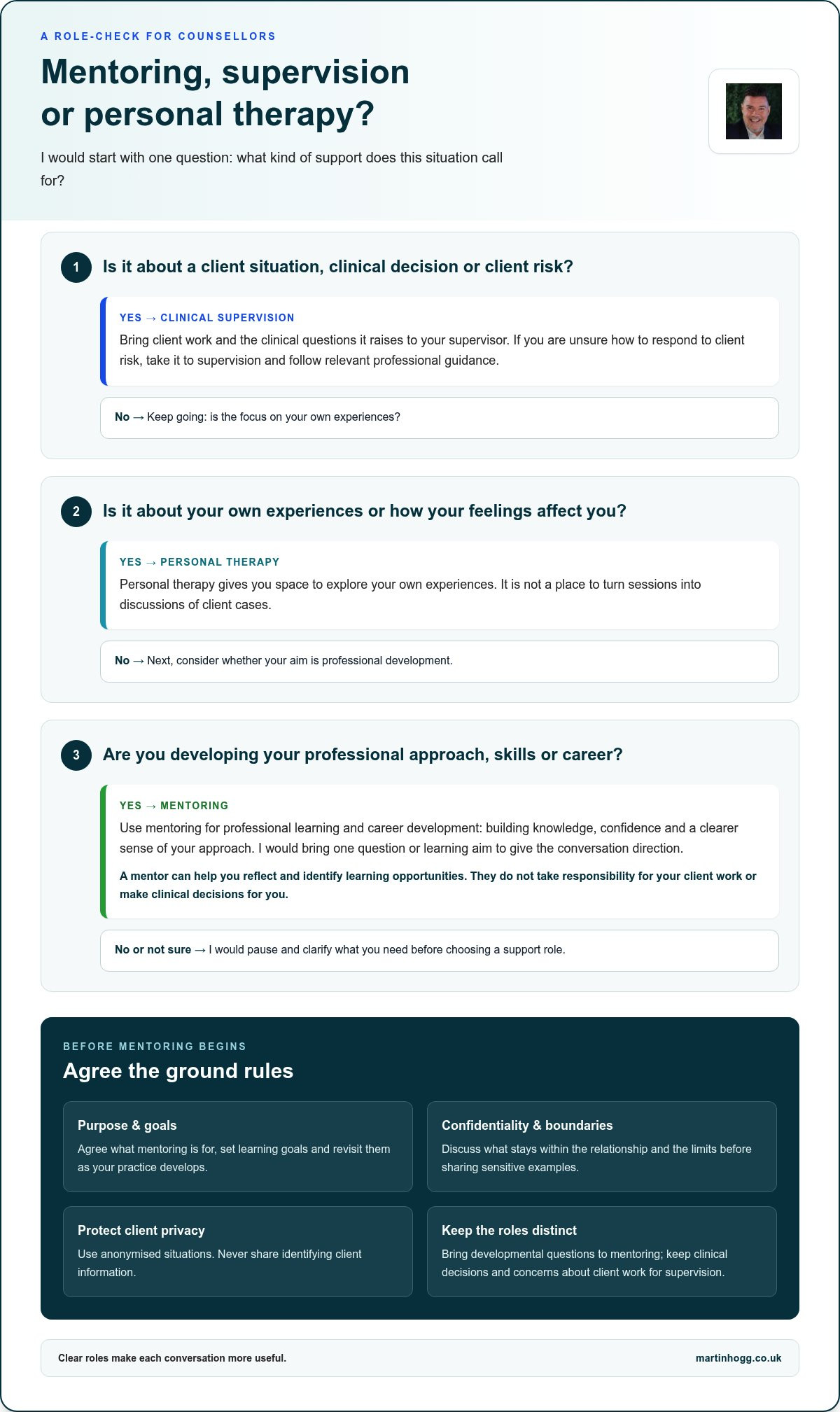
Mentoring, clinical supervision and personal therapy have different purposes. Mentoring supports professional learning and career development. Supervision focuses on your clinical work and the decisions arising from it. Personal therapy gives you space to explore your own experiences, rather than your role as a mentee or client.
In supervision, you might discuss a client situation, your response and the clinical questions it raises. Clinical supervision can take place individually or in a group. Peer mentoring can offer additional support alongside supervision, but it does not replace it. A mentor may help you consider a training goal or a challenge in your practice, without taking responsibility for your clinical work.
That distinction matters. If you’re unsure how to respond to a client’s risk, take the question to your supervisor and follow relevant professional guidance. If you want to build confidence in a particular area, a mentor might help you identify learning opportunities and reflect on your progress. Personal therapy is different again: it can help you understand how your own feelings or experiences affect you, without turning sessions into discussions of client cases.
UK mentoring and supervision costs vary according to the format, session length and practitioner’s experience. The price depends on the case and is given after a quote request, so compare what the fee covers before agreeing to work together.
I would keep the roles clear from the outset. Agree what you’ll bring to mentoring, what belongs in supervision, and how you’ll protect client confidentiality in both conversations. If a discussion raises a clinical concern, take it to supervision rather than asking a mentor to make that decision for you. For practical peer learning about developing a private practice, the Private Practice Success community offers a separate place to focus on business questions.
Peer mentoring can give counsellors additional support and learning alongside clinical supervision. Keep the two roles distinct in practice: bring developmental questions to mentoring, while clinical decisions and concerns about client work remain for supervision. This keeps each conversation focused on its purpose and avoids asking a mentor to take on supervisory responsibility.
Benefits of mentoring
The first 5-10 years of practice can bring new challenges as you find your feet. A mentor can help you build confidence, strengthen your professional identity and think through the kind of therapist you want to become. That support can make a difference when a difficult session leaves you questioning your approach or your place in the profession.
Mentoring can turn broad learning into practical next steps. For example, you might discuss how to respond when a client repeatedly arrives late, then identify what you want to explore in supervision. Or you could ask an experienced psychotherapist how they keep their clinical skills current. Use these conversations to consider your options, rather than copying someone else’s style.
A mentor can also help you expand your professional network. They may introduce you to useful networks, relevant workshops or training resources for developing a particular interest. If you’re building a private practice, a conversation about referral relationships or how to describe your work can help you identify practical opportunities. These connections can be especially useful when working alone makes it harder to hear how others approach similar challenges.
There’s a mental benefit, too. A thoughtful mentor can help you notice when self-doubt is clouding a decision, while still taking your concerns seriously. They might ask what went well in a challenging session before discussing what you’d change next time. That balance helps you recognise strengths, learn from mistakes and avoid treating one difficult situation as proof that you’re unsuited to counselling.
Bring a focus to each conversation to make mentoring useful. Choose a skill to develop, a practice question to explore or a career decision to weigh. Then agree on a manageable action and return to it at your next meeting. You might research a training workshop, revise your professional profile or reflect on how you want to achieve your next goal.
Mentoring can help leaders develop leadership skills, emotional intelligence and problem-solving abilities. For new counsellors, it can support professional development through networking, resources and access to relevant workshops or training.
Commitment to growth and feedback
Useful feedback is specific, balanced and linked to a goal. A mentor might say, “You explained the boundary clearly,” then ask what felt difficult during that conversation. This recognises a strength while making room to explore an area for development. It’s more useful than a vague “good job”, which gives you little to act on.
As the mentee, bring an example and explain what you want feedback on. You could describe how you introduced a cancellation policy, then ask whether your wording felt clear and respectful. Listen before defending your choice. You don’t have to adopt every suggestion, but you can weigh it against your values, training and professional guidance.
How often should a new counsellor meet with a mentor or supervisor? Agree a regular mentoring schedule that fits your goals and availability, then review it as your practice changes. Keep supervision on its own agreed schedule, so clinical questions have a clear place.
It can help to agree the purpose, focus, format and timing of meetings with your mentor. Include how you’ll handle confidentiality, feedback, cancellations, costs and ending the arrangement. Be clear about what belongs in supervision instead, particularly when a client situation raises a clinical concern. A brief written agreement avoids relying on assumptions or memory.
Review your progress together against clear, specific goals. For example, if you want to feel more confident discussing endings, note what you’ve tried and what you want to practise next. Ask your mentor for feedback on specific examples, not a general verdict on whether you’re “good enough”. This keeps learning practical and supports your wellbeing without turning every conversation into an assessment.
Growth also means making room for another perspective. A mentor should encourage questions and new ideas, including when your background or experience differs. If feedback repeatedly feels personal, dismissive or outside the agreed purpose, raise the issue directly and reconsider whether the relationship is still useful.
Martin Hogg Private Practice Success: Practice Visibility Blueprint
Martin Hogg Private Practice Success offers the Practice Visibility Blueprint to help counsellors become easier for potential clients to find. Mentoring supports professional development, while practice visibility work focuses on how potential clients discover and understand your services.
Consider the Blueprint when you’re ready to build or strengthen your private practice but aren’t sure what to prioritise. You might need to clarify who you work with, explain your services simply or improve how your practice appears online. The Practice Visibility Blueprint offers a focused next step for those business questions, rather than clinical supervision or clinical mentoring.
If your next challenge is visibility, explore the Practice Visibility Blueprint and see whether it fits what you’re working towards. You’re welcome to contact Martin Hogg Private Practice Success or visit the website to find out more.
Take your next step with purpose
Your development doesn’t need a grand plan. Choose the next question that matters most, whether it’s strengthening your professional confidence, developing a special interest or making your practice more visible. Mentorship for new counsellors can be one part of that progress, alongside focused learning and practical business support.
For support with the business side, the Private Practice Success Membership offers a place to work on your practice. For focused professional learning, Anger Management CPD for Professionals may suit your next development step. The right choice depends on what you want to work on now, not what you think you should already have sorted.
You can take this at your own pace. Choose one useful next step, give it proper attention and let your professional path develop from there.
You’ve already begun by asking thoughtful questions about your growth. Keep going, one considered step at a time.
Frequently Asked Questions
What is mentoring?
Mentoring is an ongoing professional conversation in which an experienced person shares perspective to help you think through your development. You might bring a question about finding relevant training or explaining your approach to prospective clients. A mentor can offer ideas drawn from their experience, but you remain responsible for deciding what fits your values, competence and professional responsibilities.
What qualifications and experience should a counselling mentor have?
Look for a mentor whose experience fits your next step. Ask about their counselling experience, current professional learning, mentoring approach and boundaries. Choose someone who listens, offers constructive feedback and challenges your assumptions.
Disclaimer
The information provided on this blog is for general informational purposes only. It is also not intended to be a substitute for professional medical or mental health advice, diagnosis, or treatment. Reading this content does not create a therapist-client relationship.


