
Money Saving Tips for Counsellors: Building a Lean, Sustainable UK Practice
What if the secret to a thriving private practice isn't seeing more clients, but keeping more of what you already earn? It's a question many of us avoid because we're trained to focus on clinical outcomes rather than balance sheets. I know how it feels to look at your bank statement and see your hard work swallowed up by £180 professional membership fees, rising room rentals, and those sneaky software subscriptions that seem to multiply every month. You want to provide the best care possible, but the financial strain can quickly lead to the very burnout we help our clients avoid.
I understand that the business side of therapy can feel cold or even intimidating. However, implementing practical money saving tips for counsellors is about more than just pennies; it's about building a sustainable foundation so you can stay in this profession for the long haul. You deserve to have a practice that supports your life rather than draining it. In this guide, I'll show you exactly how to reduce your monthly overheads and reclaim your financial peace of mind.
We'll walk through a clear list of UK-specific deductible expenses you might be missing and explore how to simplify your business model. My goal is to help you get your practice back on track so you can focus on the work that truly matters. Let's look at how to make your money work as hard as you do.
Key Takeaways
- Audit your current software and insurance policies to ensure you aren't paying for "ghost" subscriptions or unnecessary features that don't add value to your work.
- Learn how to calculate the true cost of room hire, including travel and "dead time," to decide if an online or hybrid model is better for your bottom line.
- Get to grips with HMRC requirements and identify which everyday practice expenses are actually tax-deductible, keeping more of your hard-earned pounds in your pocket.
- Implement practical money saving tips for counsellors that reduce your monthly overheads without sacrificing your clinical excellence or personal well-being.
- Discover why trying to do everything yourself is often the most expensive way to run a practice and how collective resources can save you both time and money.
The Financial Reality of Private Practice in the UK
I often talk to therapists who feel a deep sense of discomfort when the topic of money comes up. We're trained to focus on empathy and clinical outcomes, yet we're often left feeling guilty for wanting a stable income. This money taboo is a quiet burden that hurts our profession. If you're constantly worried about your bank balance, you can't show up fully for your clients. Realising that money saving tips for counsellors are actually a form of self-care is the first step toward a sustainable career. It's about preventing the kind of burnout that happens when your passion for helping others isn't matched by your financial security.
Setting a realistic budget for 2026 means looking at the hard numbers. There's a massive difference between your gross income and what you actually take home. If you charge £60 per session, you might only see half of that after you've paid for supervision, insurance, and professional memberships. By understanding the fundamentals of psychotherapy and the business structures that support it, you can build a practice that lasts. I've seen too many talented people leave the profession because they didn't account for the 20% to 30% of their income that needs to be set aside for tax and National Insurance.
Understanding Your Practice Overheads
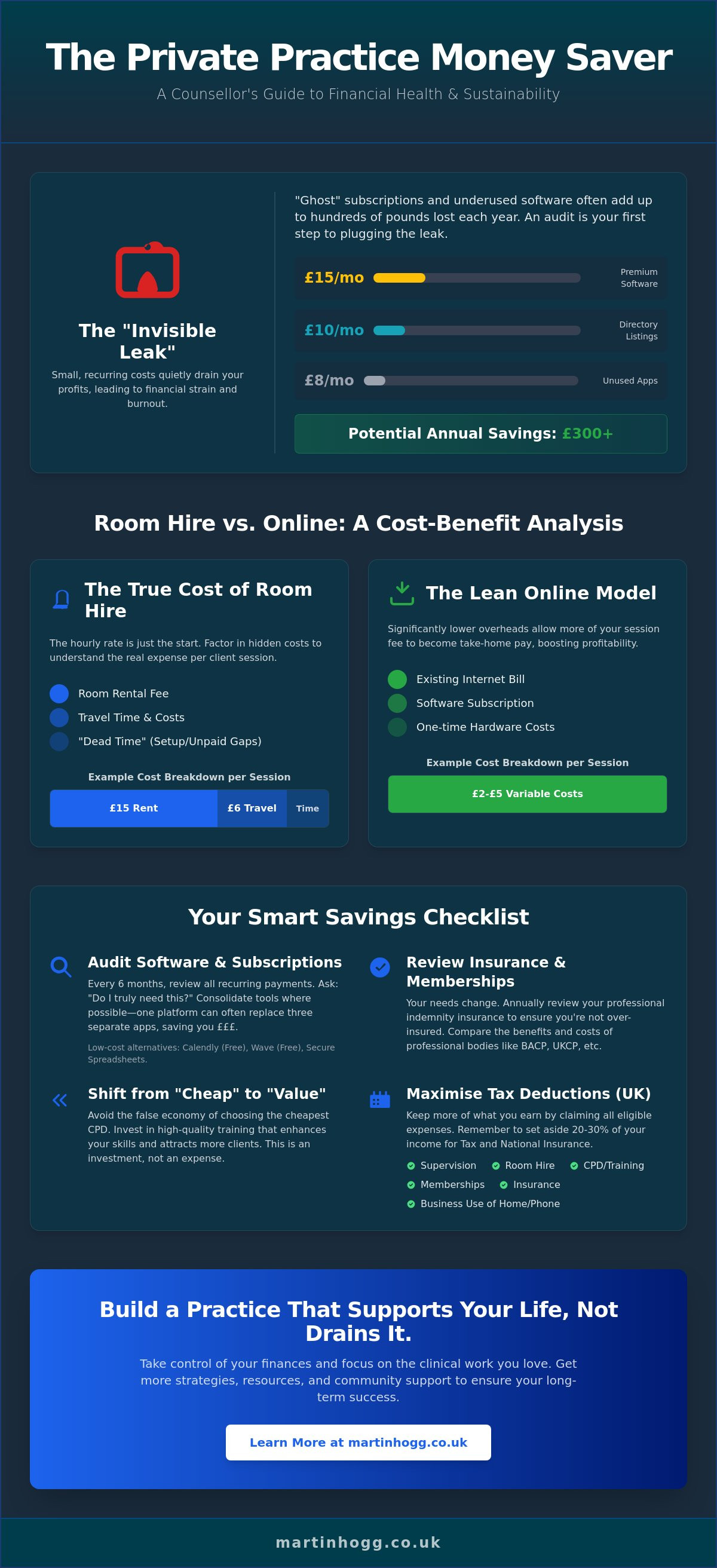
Your costs fall into two camps. Fixed costs, like your ICO registration and professional indemnity insurance, stay the same regardless of how many clients you see. Variable costs, such as room hire or marketing, change with your workload. I see many practitioners suffering from the "Invisible Leak," where small £10 or £15 monthly subscriptions for software or directories add up to hundreds of pounds annually. To stay lean, you must establish a baseline. Calculate exactly what it costs you to see a single client before you even consider your profit. This clarity helps you make better decisions about which expenses are truly necessary.
The Psychology of Pricing and Profit
It's easy to fall into a scarcity mindset. You might find yourself bargain hunting for the cheapest CPD just to tick a box, but this is often a false economy. If a training course doesn't help you deliver better results or attract more clients, it's a drain on your resources, not an investment. Moving to a professional business mindset means valuing your time and expertise. If you want to grow your confidence in this area, you might find my Private Practice Success community a helpful place to start. Practical money saving tips for counsellors aren't about being "cheap"; they're about being intentional with every pound so you can keep doing the work you love without the constant stress of financial instability.
Trimming the Fat: Software, Insurance, and Professional Fees
Running a private practice often feels like death by a thousand papercuts. Small monthly subscriptions for apps you barely use or insurance policies you haven't reviewed in years quietly eat into your profit. One of the most effective money saving tips for counsellors is to conduct a "subscription audit" every six months. I've seen practitioners paying for premium Zoom accounts, separate booking software, and a full practice management suite simultaneously. Often, one tool can do the work of three, saving you upwards of £300 a year.
Low-Cost Practice Management Solutions
You don't always need high-end, all-in-one software when you're starting out or keeping things lean. While platforms like Power Diary or WriteUpp are excellent, they come with monthly fees that add up. Many therapists successfully use a combination of secure, encrypted spreadsheets and free tools like the basic tier of Calendly for scheduling. If you go the manual route, you must stay on top of your obligations. GDPR compliance means you're taking legal responsibility to handle client information with the same care and privacy you'd want for your own most sensitive data. For invoicing, consider using the free versions of Wave or even the built-in tools in your Monzo Business or Starling bank account to avoid extra costs.
Professional Memberships and Insurance
Professional body fees are a significant but necessary outgoing. While the BACP is the most common choice, it's worth comparing the annual costs and benefits of the NCPS (National Counselling & Psychotherapy Society). If your specific niche doesn't require a certain affiliation, switching could save you over £80 annually. When it comes to insurance, don't just hit "renew" on your current policy. Shop around for combined Professional Indemnity and Public Liability cover. Specialist providers like Towergate or Howden often offer competitive rates for therapists. Remember that these professional fees and insurance premiums are fully tax-deductible. You can find more details on what you can claim back in the official HMRC guidance on Self Assessment.
The cost of CPD is another area where a bit of foresight goes a long way. Last-minute, "panic-buying" courses to meet your annual hours is expensive. By planning your learning year in advance, you can take advantage of "early bird" discounts or free webinars offered by your professional body. If you want a structured way to grow without the heavy price tag, have a look at this guide on CPD for Counsellors UK for practical advice on meaningful growth. Managing these costs effectively isn't about being "cheap"; it's about being a good steward of your resources so you can stay in the chair for the long haul. If you're feeling overwhelmed by the business side of things, joining a community of like-minded practitioners can provide the clarity and support you need to build a sustainable practice.
Room Hire vs. Online Therapy: A Cost-Benefit Analysis
Deciding where you sit to do your work is one of the biggest financial choices you'll make in your practice. It is easy to look at a room rate of £15 per hour and think that is your only expense. It isn't. When I talk to practitioners about money saving tips for counsellors, I always start with the "leakage" that happens outside the therapy room. If you drive 20 minutes each way to a clinic, that is 40 minutes of your life you aren't being paid for. Add in the HMRC mileage rate of 45p per mile and a £3 parking fee, and that "cheap" room suddenly costs you much more than you realised.
By applying expert financial management tips, you can better track these invisible drains on your profit. Online therapy removes the commute and the parking, but it brings its own overheads. You need a rock-solid fibre connection, which in the UK typically costs between £30 and £50 per month for business-grade speeds. You also need to consider the cost of professional lighting and a secure, GDPR-compliant platform. Most of my colleagues find a hybrid model works best, perhaps seeing face-to-face clients on two specific days to keep travel costs down while working from home the rest of the week.
The Real Cost of a Physical Session
I suggest you calculate your "true hourly rate" by including your travel time. If you charge £60 but spend two hours on travel and admin for that one session, your actual earnings drop to £20 per hour before tax. Pay-as-you-go rooms offer flexibility, but block-booking a four-hour slot often secures a 15% to 20% discount. Don't limit yourself to dedicated therapy centres. I have found that local community spaces, Quaker Meeting Houses, or even library meeting rooms often charge half the price of a private clinic. You can often negotiate these rates further if you offer to bring your own tea and coffee supplies.
Making Online Work More Profitable
To make your digital practice sustainable, invest in quality equipment once. A £60 external webcam and a £40 ring light will last years and prevent the technical glitches that lead to cancelled sessions. You don't always need a paid subscription for everything. Platforms like the healthcare-compliant version of Google Meet or the free tier of Zoom for one-to-one sessions are perfectly secure and cost nothing. A dedicated home office space is highly tax-efficient because it allows you to claim a proportion of your household running costs, including council tax and electricity, against your business income. If you want to dive deeper into building a lean business, you can find more resources at Private Practice Success.
HMRC and Tax Efficiency for UK Therapists
Registering as a sole trader is usually the most practical path for your practice. It's simple to set up and keeps your administrative tasks manageable. You need to let HMRC know you're self-employed once your gross income from counselling exceeds £1,000 in a tax year. While some people talk about limited companies, the extra accountancy fees and filing requirements often don't make sense until your profit is consistently above £40,000. Keeping things simple in the beginning is one of the most effective money saving tips for counsellors.
Claiming Your Professional Expenses
You shouldn't pay tax on money you've already spent to keep your practice running. HMRC allows you to deduct "wholly and exclusively" business-related costs from your income before calculating your tax bill. This includes a variety of costs that are specific to our profession:
- Clinical supervision and mandatory personal therapy for CPD
- Professional indemnity insurance and BACP or UKCP membership fees
- Books, journals, and attendance fees for training workshops
- Room hire costs or a portion of your home office bills
Don't forget the 45p per mile rule. If you travel to see clients at their homes or drive to a training venue, you can claim 45p for every mile for the first 10,000 miles. It's much simpler than tracking petrol receipts and wear and tear on your car. If you're just starting out and want to see how these costs fit into a larger plan, I've written more about starting and growing a private practice to help you find your feet.
Simplified Accounting for Therapists
I always suggest opening a separate bank account for your practice. It doesn't need to be a complex business account; a basic second account works well to keep your therapy income separate from your personal grocery shopping. This makes your bookkeeping much cleaner and saves you hours of stress when January 31st approaches. I recommend setting aside 25% of your monthly income into a separate savings account. This ensures you have the funds ready for your Income Tax and National Insurance payments without feeling the pinch.
While paying for an accountant might feel like an extra expense, they often save you more than they cost. A specialist accountant understands the nuances of the "Home Office" deduction, where you can claim a fair percentage of your rent, council tax, and electricity based on the rooms and hours you use for therapy. They also ensure you avoid the £100 automatic fine for late filing. If you want to learn how to manage your practice finances alongside other successful therapists, join our Private Practice Success community for practical support and guidance.
Scaling Smart: Collective Resources and Community Support
Trying to build a private practice in total isolation is a recipe for high costs and early burnout. In the UK, many therapists start their journey as "lone wolves," believing they have to figure out every marketing strategy and administrative hurdle by themselves. This approach is expensive. You pay a "trial and error tax" every time you spend money on a directory that doesn't work or software you don't need. When you're looking for money saving tips for counsellors, the most overlooked strategy is often community. Sharing the burden of business development reduces the financial pressure on your shoulders.
The ROI of the Private Practice Success Membership
Time is your most valuable commodity. Every hour you spend struggling to design a flyer or write a social media post is an hour you aren't seeing a client. The Private Practice Success Membership offers a practical solution to this drain on your resources. Instead of hiring expensive consultants or buying multiple standalone courses, you get access to "done-for-you" marketing templates and business resources designed specifically for the UK market.
The membership functions as a collective. By moving away from high-cost individual coaching and into a group format, you benefit from shared learning at a fraction of the price. You can troubleshoot business problems with peers who have already solved them, saving you from making costly mistakes. It's about working smarter, not harder, and keeping your overheads low while your confidence grows.
Investing in Visibility, Not Just Overhead
It's easy to get caught up in the "admin" of therapy, spending money on fancy stationery or premium office suites that don't actually bring people through the door. Effective money saving tips for counsellors aren't just about cutting costs; they're about making sure every pound spent works hard for you. I encourage you to shift your financial focus from "maintenance" to "attraction." If a spend doesn't directly help a client find you, question whether it's necessary right now.
Focusing on your visibility is the best long-term saving you can make. When you have a steady stream of enquiries, you don't have to panic-spend on desperate marketing tactics. You can learn these essential skills in a supportive environment by checking the Martin Hogg Calendar for upcoming workshops. These sessions are designed to give you the tools to manage your own growth without relying on expensive agencies.
Building a sustainable practice means being honest about where your money goes. Focus your budget on what actually brings in clients and helps them get their lives back on track. You don't have to do this alone, and you certainly don't have to overspend to be successful. Be lean, be focused, and stay connected to your community.
Start Building Your Sustainable Practice Today
Running a private practice shouldn't feel like a constant financial uphill struggle. By reviewing your recurring software subscriptions and making intentional choices about room hire, you can lower your monthly outgoings. We've covered how understanding HMRC rules on tax-deductible expenses ensures you aren't overpaying. These practical money saving tips for counsellors help you create a lean business that supports your life rather than draining it.
I draw on over 20 years of UK practice experience to provide no-nonsense business coaching that actually works in the real world. You don't need to be a financial expert to have a profitable practice; you just need a clear plan and a bit of community support. Through my BACP-endorsed workshops, I've helped therapists move away from overwhelm and towards a more grounded, successful way of working. It's about making small, smart changes that add up to long-term stability.
Ready to build a more profitable practice? Join the Private Practice Success Membership and get the support you need. It's time to take the pressure off and get your practice back on track.
Frequently Asked Questions
What business expenses can I legally claim back as a UK counsellor?
You can legally claim for any costs incurred "wholly and exclusively" for your business. This includes professional supervision, indemnity insurance, and clinical stationery. I always suggest keeping digital receipts for small items like notebooks or pens. If you use a room in your house, you can also claim a proportion of your utility bills based on the hours you work.
Is it cheaper to work from home or rent a therapy room in 2026?
Working from home remains the most affordable option for most practitioners in 2026. While a rented room in a city centre might cost £15 per hour, working from home eliminates travel time and additional rent. You just need a private, secure space. Many therapists now use a hybrid model, seeing 70% of clients online to keep overheads low while renting a room for the remaining 30% who prefer face-to-face sessions.
Do I need an expensive accountant for a small solo private practice?
You don't need an expensive accountant for a solo practice, especially if your turnover is below the £90,000 VAT threshold. Many of my colleagues use simple cloud-based software that costs around £12 a month. If your books are tidy, a local bookkeeper can check your self-assessment for a one-off fee of £250 to £400, which is much cheaper than a full-service firm.
How much should I set aside for tax and National Insurance each month?
I recommend setting aside 30% of your total earnings every month to cover your tax and National Insurance. While the basic tax rate is 20%, you also need to account for Class 4 NI contributions and your "payment on account" for the following year. Putting this money in a separate high-interest savings account ensures you aren't caught short when the January 31st deadline arrives.
Can I claim my own personal therapy as a business expense?
You usually cannot claim personal therapy as a business expense because HMRC views it as having a "duality of purpose." Even though it supports your work, it also provides a personal benefit to your well-being. The only exception is often for students where therapy is a mandatory, documented requirement of their training. For qualified counsellors, it's safer to pay for this from your post-tax income.
What is the most cost-effective way to get new counselling clients in the UK?
The most cost-effective way to get new clients is by optimising your Google Business Profile for local searches. This is a free tool that helps you appear when people search for "counsellors near me" in your specific town. Combining this with one well-chosen directory listing is one of the best money saving tips for counsellors who want to avoid expensive paid advertising.
Are professional membership fees like BACP or UKCP tax-deductible?
Yes, your annual membership fees for professional bodies like the BACP or UKCP are fully tax-deductible. HMRC maintains a list of approved professional organisations, often called List 3. As long as your membership is necessary for you to practice, you can include the full cost in your self-assessment. This also applies to the cost of your annual Enhanced DBS check.
How can I reduce the cost of my annual CPD requirements?
You can reduce CPD costs by joining online learning platforms that offer unlimited access for a flat annual fee. Many reputable providers offer over 50 hours of training for less than £150 a year. Don't forget that peer-led study groups and reading relevant journals also count towards your hours. These activities are often free and provide excellent networking opportunities with other local practitioners.

Article by
Martin Hogg
I help Private Practice counsellors in the UK set up and grow an ethical Private Practice they love, work with their ideal clients, and earn the income they deserve. All without guesswork and burnout. I have been a private practice counsellor myself for over 20 years, specialising in anger management. I set up a not-for-profit social enterprise, Citizen Coaching and Counselling, which delivers thousands of counselling sessions a year to adults and young people in Birmingham. I am a registered BACP Counsellor and the author of three books, My Anger Coach, My Anxiety Coach and My Relationship Coach. These are available on Amazon.
Disclaimer
The information provided on this blog is for general informational purposes only and is not intended to be a substitute for professional medical or mental health advice, diagnosis, or treatment. Reading this content does not create a therapist-client relationship.


