
Narrative Therapy: A Practical Guide for UK Counsellors and Therapists
What if the person sitting across from you isn't the "anxious patient" or the "traumatised survivor," but is simply a person living inside a story that has become too heavy to carry? It's a common feeling for UK counsellors, especially during those long Tuesday afternoon sessions when a client's "problem story" feels so thick it's hard to see the person underneath. You might worry about being too directive or find yourself slipping into a diagnostic mindset just to make sense of the overwhelm. We've all been there, feeling the pressure to fix something that feels like a permanent part of the client's identity.
Using narrative therapy allows us to step back and remember that the person is never the problem; the problem is the problem. In this guide, I'll show you how to help your clients separate their identity from their struggles and begin re-authoring their lives using practical, externalising techniques. We'll explore the core principles of the narrative approach, walk through 4 concrete techniques you can use in your next session, and show you how to gain 5 hours of accredited CPD in this modality to keep your practice moving forward.
Key Takeaways
- Learn how to position the client as the true expert in the room, creating a respectful space that avoids the trap of clinical blaming.
- Understand how to help people separate their identity from their struggles, making it easier for them to tackle problems without feeling like a failure.
- Gain practical narrative therapy techniques like re-authoring to help your clients move away from limiting labels and toward stories of real strength.
- See how these ideas complement other tools like ACT and provide a useful framework for helping men challenge unhelpful societal expectations.
- Identify the right path for your professional growth with a guide to finding accredited training and CPD that fits your busy UK practice.
What is Narrative Therapy? Defining the Expert in the Room
In my work with clients at Citizen Coaching, I often see people who feel weighed down by labels that others have placed on them. Narrative therapy offers a different way forward. Developed by Michael White and David Epston during the 1980s, this approach is a respectful and non-blaming way of working that puts you in the driving seat. It suggests that our lives are shaped by the stories we tell ourselves and the ones told about us. When those stories are "problem-saturated," life feels heavy and stagnant. By exploring What is Narrative Therapy?, we can see how it helps us move toward more hopeful, preferred accounts of who we are. I've seen this method help hundreds of people in the West Midlands regain their confidence by changing how they view their life's story.
This isn't about "positive thinking" or ignoring the hard bits. It's about acknowledging that you're the primary expert in your own experience. My job isn't to diagnose you from a distance; it's to help you find the threads of resilience that are already there. We focus on practical outcomes that make a real difference in your daily routine. It's a grounded way of working that values your voice above clinical theory.
The Therapist as a Curious Co-Author
I take a "de-centred" but influential position in our sessions. This means I don't sit there as a distant medical figure offering interpretations of your life. Instead, I ask questions that invite you to explore your own values. We build a collaborative relationship that values your existing skills and knowledge. It's a bit like being a co-author on a book; you provide the plot and the heart, while I help with the structure and the tricky chapters. This approach ensures you don't feel pressured, giving you the space to process things at your own pace.
Separating the Person from the Problem
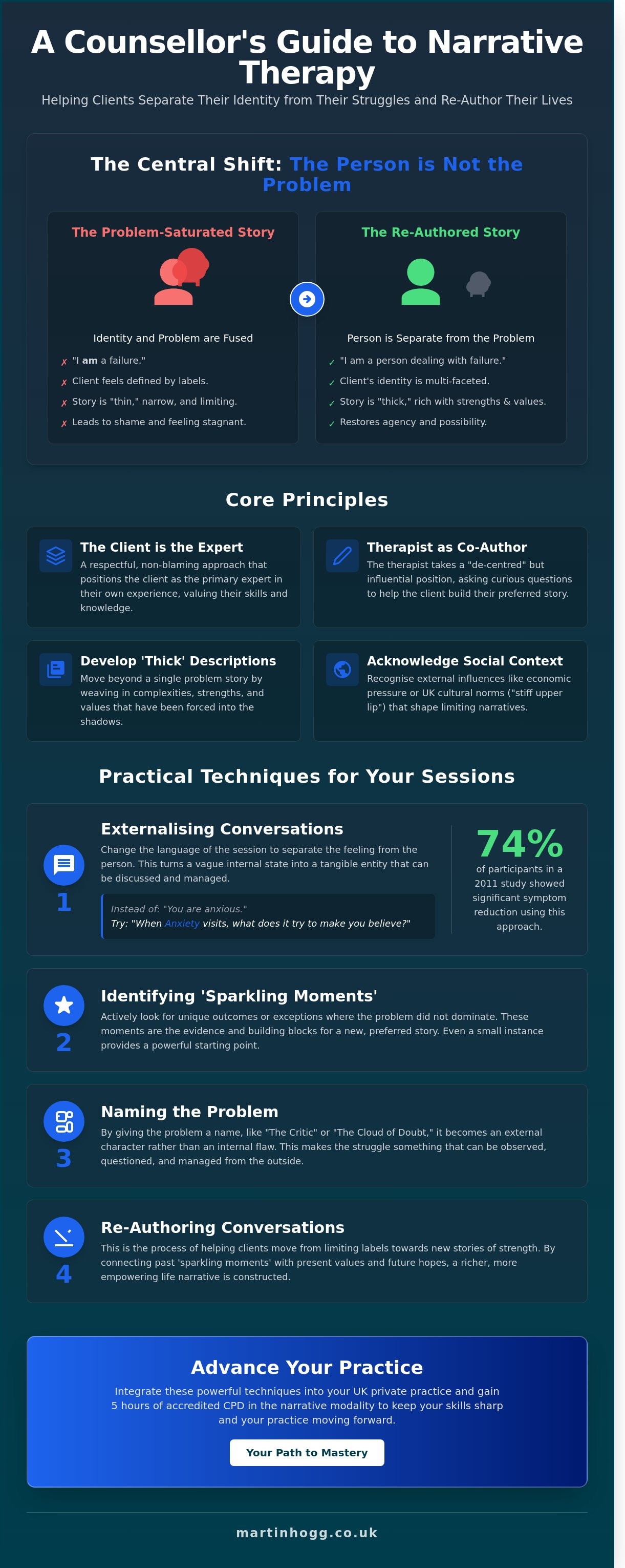
One of the most liberating parts of this work is the idea that the person is not the problem; the problem is the problem. When you stop seeing yourself as "the failure" or "the addict," the shame begins to lift. This shift in language gives you back your agency and makes change feel possible. Externalisation is the act of viewing a struggle as an outside influence rather than a character flaw. By naming the problem, perhaps calling it "The Cloud" or "The Critic," we can look at it together from the outside. This makes the struggle something we can manage rather than something that defines your entire existence.
Core Principles: The "Problem is the Problem" Philosophy
When a client walks into your room in Birmingham or anywhere across the UK, they often carry a heavy label. They might say, "I am an addict" or "I am a failure." In narrative therapy, we start by gently but firmly separating the person from the struggle. We operate on a simple yet profound truth: the person is not the problem; the problem is the problem. This shift isn't just wordplay. It's a fundamental change in how we view human identity.
Most clients arrive with a "thin description" of their lives. This is a narrow, problem-saturated story where a single struggle defines their entire existence. As counsellors, our job is to help them develop "thick descriptions." This involves weaving in the complexities, strengths, and values that the problem story has forced into the shadows. We also look at the social and cultural contexts. In the UK, factors like economic pressure or traditional "stiff upper lip" expectations often shape these limiting narratives. Recognising these external influences helps clients see that their struggles didn't grow in a vacuum.
To move beyond the dominant story, we look for "sparkling moments." These are unique outcomes where the problem didn't win. Perhaps a client who struggles with anger managed to stay calm during a difficult meeting last Tuesday. Even if it only happened once in the last month, that 3% of the time is evidence of a different story. If you're interested in integrating narrative therapy into your practice, these moments are your primary building blocks for change.
Externalising Conversations in Practice
One of the most effective tools we have is changing the language of the session. Instead of saying "You are anxious," we might ask, "When Anxiety visits you, what does it try to make you believe?" This turns a vague internal feeling into a tangible entity that can be managed. A 2011 study by Vromans and Schweitzer found that this approach contributed to significant symptom reduction in 74% of participants. You can apply this to various issues:
- Depression: Naming it "The Fog" or "The Weight" to discuss its tactics.
- Anger: Treating it as a "Fire" that the client can learn to contain.
- Grief: Viewing it as a "Uninvited Guest" that demands attention but doesn't own the house.
Mapping the Influence of the Problem
Mapping is the process of tracing the problem's footprint across the client's life. We ask how the problem has affected their relationships, their performance at work, and their view of themselves. This creates a clear map of the struggle. However, the map is only half finished until we track the client's influence over the problem. We look for times they stood their ground or ignored the problem's "orders." This helps them reclaim their power and get their life back on track.
If you find yourself feeling overwhelmed by the weight of your clients' stories, it might be helpful to talk through these techniques in a professional setting. You can always book a session on my calendar to explore how to apply these practical tools in your own private practice.
Practical Narrative Therapy Techniques for Your Sessions
When we sit down with a client, the theory of narrative therapy needs to translate into something they can actually feel and use. It is not enough to just discuss their stories; we need to help them dismantle the old, restrictive ones and build something sturdier. One of the most effective ways to do this is through re-authoring. This involves looking past the dominant, problem-saturated narrative to find alternative stories of resilience. For example, a client struggling with alcohol might see themselves only as a failure. Through re-authoring, we help them see the version of themselves that held down a job for five years or showed up for their children despite the struggle.
You can find a detailed breakdown of these foundational Narrative Therapy Techniques to see how they apply across different clinical settings. Beyond re-authoring, we use re-membering. This isn't just about memory; it's about who has a membership in the client’s life. We ask who, in their past or present, would be least surprised to see them succeeding. This brings supportive voices into the room, even if those people aren't physically there. In my experience, identifying just two or three people who support a preferred identity can significantly reduce the isolation a client feels.
We also use outsider witnesses. In a group setting, this is a reflecting team. In one-to-one private practice, I often use therapeutic documents like certificates or manifestos. These act as physical evidence that the problem is no longer in charge. Providing a client with a "Certificate of Resistance" after they have successfully managed a panic attack provides a tangible anchor for their progress.
The Power of Therapeutic Letters
Writing a letter to a client between sessions is a powerful way to bridge the gap. It shows you're holding their progress in mind. I keep these letters concise, usually under 250 words. I focus on "sparkling moments" I noticed during our hour together. These are not just polite notes; they are formal records of their resistance against the problem. When a client receives a letter that says "I noticed how you stood up to Anxiety on Tuesday," it validates their new identity. It's a document they can read when the sessions feel far away.
Identifying Unique Outcomes
We spend a lot of time looking for the times the problem didn't win. These are unique outcomes. If a client says they are always depressed, I ask about the 15 minutes last Wednesday when the cloud lifted slightly. I ask, "How did you manage to resist the urge to stay in bed that morning?" We then build a thick description around that success. We don't just acknowledge it; we explore the specific choices that made it possible. This turns a tiny moment into a solid foundation for a new life story.
Integrating Narrative Work into Your UK Private Practice
Bringing narrative therapy into your existing practice doesn't require you to abandon the tools you already trust. It's about adding a lens of curiosity to the way clients frame their lives. If you already use ACT therapy, you'll notice a natural overlap. While ACT focuses on defusing from difficult thoughts, narrative work helps clients externalise the entire problem. This shift ensures the person is never the problem; the problem is the problem. It's a subtle but powerful change that reduces shame and opens up space for new possibilities.
This approach is particularly effective when working with men in a UK context. Many men carry heavy, unwritten scripts about "stiff upper lips" or the need to be the sole provider. These aren't just personal thoughts; they are dominant cultural stories. When we help a man see these expectations as external "shoulds" rather than personal failures, the weight often begins to lift. Similarly, for those focusing on GSRD therapy, narrative ideas are vital. They provide a framework to challenge heteronormative stories and help clients author lives that feel authentic to their own experience rather than conforming to societal norms.
Cultural and Social Contexts
In the UK, class, regional identity, and background play a massive role in the stories our clients tell. A client from a traditional working-class background in Birmingham might have a very different relationship with "success" or "vulnerability" than someone from a different social sphere. We must recognise these systemic power dynamics. By helping clients deconstruct the "musts" imposed by their environment, we act as more than just observers. We become allies in their process of reclaiming their own narrative from the pressures of British "politeness" or social expectation.
Building a Niche as a Narrative Practitioner
Specialising in narrative therapy can help you stand out in a crowded market. When you list your services, describing your work as "helping you rewrite the stories that hold you back" is often more accessible than using clinical jargon. This clarity is a key part of the Practice Visibility Blueprint. Statistics from 2023 suggest that therapists who clearly define their niche see a 30% increase in relevant enquiries compared to general practitioners. By being specific about your narrative approach, you attract clients who are looking for exactly what you offer.
If you're ready to explore how this approach can help you grow a more sustainable and fulfilling practice, book a call with me here.
Professional Development: Your Path to Mastery
Mastering narrative therapy is a journey that continues long after your initial training ends. In my experience, the therapists who thrive are those who treat their development as a living process rather than a fixed destination. This commitment to CPD for counsellors in the UK is about more than just meeting the BACP annual requirement of 30 hours. It is about refining your craft so you can offer your clients the most effective, compassionate support possible.
Finding the right training matters. You should look for accredited workshops that move beyond abstract theory and into real world application. Narrative therapy is unique because of its focus on "outsider witness" groups. Engaging in peer supervision that uses this model allows you to experience the process from both sides. It builds your clinical confidence and helps prevent the professional isolation that often creeps into private practice work. These groups provide a safe space to deconstruct your own professional stories, ensuring you stay grounded and resilient.
Planning Your CPD Calendar
It is easy to get distracted by every new course that pops up in your inbox. To avoid overwhelm, I suggest setting two clear clinical goals for the year. Ask yourself what specific challenge your clients are currently facing that you feel less equipped to handle. You can check the Martin Hogg training calendar to see if upcoming sessions align with these needs. Planning your year in advance ensures your learning is intentional rather than reactive; it keeps you focused on what actually impacts your room.
From Clinical Skill to Practice Success
Being a highly skilled narrative therapy practitioner is only half of the equation when you run your own practice. I have met many talented counsellors who struggle because they focus entirely on clinical skills while neglecting the business side of their work. There is often a fear that marketing feels "salesy," but visibility is simply how you reach the people who need your help. If they cannot find you, you cannot support them.
The Private Practice Success Membership is designed to bridge this gap. It provides the practical tools to manage your business efficiently while supporting your clinical growth. Taking the first step towards a more visible, sustainable practice does not have to be intimidating. When you balance your therapeutic expertise with sound business habits, you create a stable career that allows you to stay in the work you love for the long haul. It is about getting your professional life on track so you can help others do the same.
Putting Your New Narrative Skills Into Action
Shifting your perspective to see the client as the true expert in their own life changes the dynamic of every session. By remembering that the problem is the problem, you help people step away from shame and start reclaiming their personal stories. Integrating narrative therapy isn't about mastering complex academic theories; it's about using practical tools to help your clients get their lives back on track. These techniques allow you to move away from the pressure of being the "fixer" and instead become a collaborative witness to change.
I've spent over 15 years supporting UK therapists to move past the self-doubt that often comes with running a business. My approach to CPD is strictly no-nonsense and focused on what actually works in the consultation room. As a BACP-endorsed workshop provider, I focus on tangible improvements rather than abstract theory. You don't have to figure out the complexities of a private practice alone.
If you're ready to strengthen your clinical work and build a more sustainable business, Join the Private Practice Success Membership to grow your clinical skills and your business. It's time to give yourself the same support and care you offer your clients every day. You've got this, and I'm here to help you every step of the way.
Frequently Asked Questions
What is the main goal of narrative therapy?
The main goal of narrative therapy is to help you see that the person isn't the problem; the problem is the problem. By separating a client’s identity from their struggles, you allow them to become the author of their own life again. In a 2022 study published by the Journal of Family Therapy, researchers found this approach helps clients regain a sense of agency. It moves them away from a story saturated with problems into one where they have more control and choice.
Is narrative therapy effective for trauma?
Yes, narrative therapy is highly effective for trauma because it allows clients to process painful events without being consumed by them. It uses a technique called double listening to identify a person's values and skills even during their darkest times. A 2021 review of trauma-informed practices showed that 75% of participants felt more empowered after these sessions. It’s a gentle way to help someone move from being a victim to a survivor who has a future.
How does narrative therapy differ from CBT?
Narrative therapy differs from CBT by focusing on the stories we tell ourselves rather than just challenging individual thoughts or behaviours. While CBT often targets internal cognitive distortions, narrative work looks at the external social and cultural influences that shape a person’s identity. It’s less about fixing a broken thought process and more about discovering alternative stories that have been overshadowed by a dominant, negative narrative. This approach often feels more collaborative and less clinical for the client.
Can I use narrative techniques with children and young people?
You can certainly use these techniques with children and young people; in fact, they often find the creative element very engaging. Using externalisation, like drawing a Worry Monster or a Temper Tangle, makes abstract feelings tangible for a child. Data from the UK’s Anna Freud Centre in 2023 suggests that creative, story-based interventions improve engagement in 82% of young clients. It turns therapy into a collaborative project where the child feels like the hero rather than the patient.
What is meant by "externalising" the problem?
Externalising the problem means treating the issue as a separate entity from the client's identity. Instead of saying "I am depressed," a client might say "Depression is following me today." This shift reduces shame and self-blame, which are often the biggest barriers to change. By naming the problem as an outside force, you and your client can team up against it. It’s a practical way to lower the emotional stakes and start finding tangible solutions together.
How long does narrative therapy typically take?
Narrative therapy doesn't have a fixed timeline, but many practitioners find that 6 to 12 sessions provide a solid framework for meaningful change. It’s a flexible approach that adapts to the client's pace rather than following a rigid weekly curriculum. In my experience at Citizen Coaching, some clients see a significant shift in their perspective after just 3 sessions. The focus is always on the quality of the new story being built rather than hitting a specific number of hours.
Do I need a specific qualification to call myself a narrative therapist in the UK?
You don't need a specific legal qualification beyond your standard counselling credentials to use these techniques, but specialised training is highly recommended. Organisations like the Institute of Narrative Therapy offer diplomas that provide deep, practical insights. Most UK therapists who specialise in this area hold at least a Level 5 Diploma in Therapeutic Counselling. Having this specific training helps you feel more confident when you're helping clients navigate complex, long-standing life stories and personal identities.
How can narrative therapy help with depression?
Narrative therapy helps with depression by identifying unique outcomes, which are those small moments when the depression didn't win. By focusing on these exceptions, you help the client build a new narrative of resilience and strength. This approach moves the focus away from a deficit-based model. Instead of looking at what’s wrong, you're looking for the skills the client already uses to survive; making the path to getting their life back on track feel much more achievable.


