
Networking for Therapists: A Practical Checklist to Build Your UK Referral Base
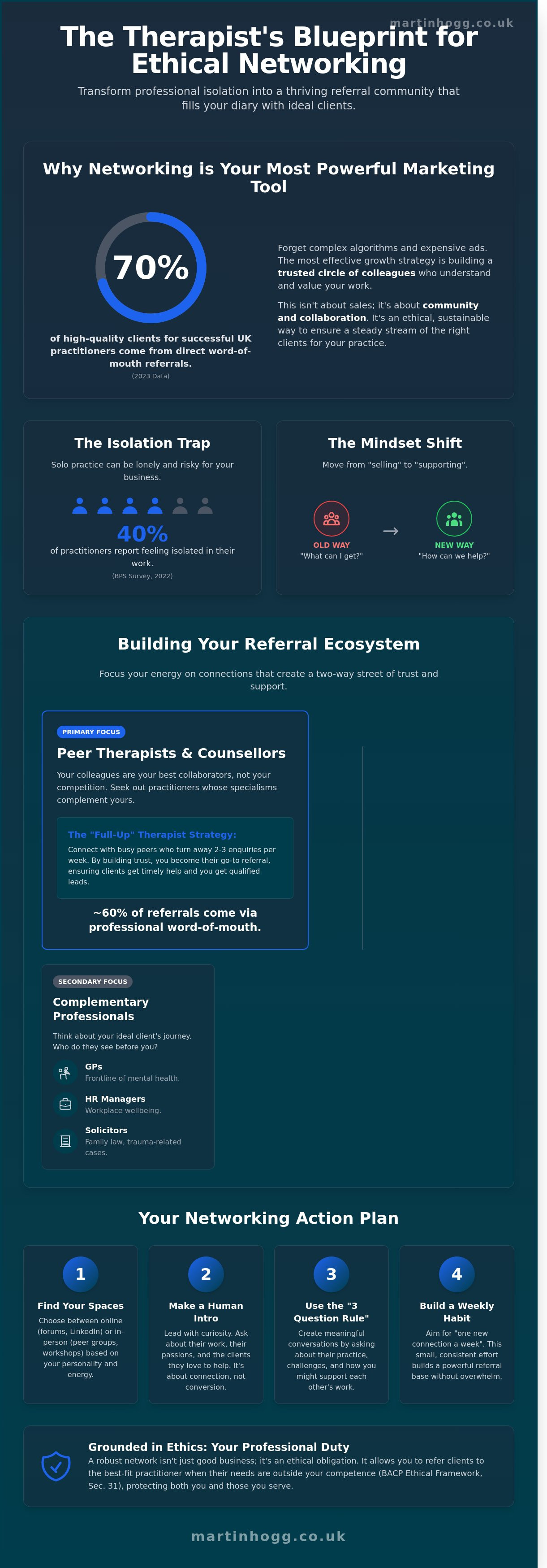
What if the most effective way to grow your practice had nothing to do with social media algorithms or expensive directory listings? Recent data from 2023 suggests that up to 70% of successful UK practitioners receive their highest quality clients through direct word-of-mouth. Effective networking for therapists isn't about awkward business breakfasts or pushy sales pitches. It's about building a quiet, trusted circle of colleagues who understand your specific way of working and feel confident sending people your way when their own diaries are full.
You probably entered this profession to help people, not to spend your evenings worrying about marketing. It's completely normal to feel isolated in solo practice or to dread the idea of "selling" your services. I've been there, and I know that most counsellors value integrity over ego. In this article, you'll learn how to build a referral base that feels entirely ethical and grounded in your values. I'll share a practical, repeatable checklist to help you find your professional community and ensure a steady stream of the right clients for your practice.
Key Takeaways
- Move past the isolation of solo practice by building a professional circle based on genuine trust rather than awkward sales pitches.
- Identify the most effective referral partners for your niche and learn why connecting with busy, "full-up" peers is a smart move for your business.
- Use our practical checklist to make networking for therapists feel manageable, featuring a "human" introduction and the "Three Question Rule" for meaningful connection.
- Learn how to choose between online and in-person spaces based on your personality to ensure your time and energy are spent effectively.
- Establish a sustainable "one connection a week" habit to build your referral base steadily without feeling overwhelmed or "salesy."
Why Networking for Therapists is Essential (and Not as Scary as You Think)
When you first started your private practice, you probably didn't envision yourself as a "networker." For many of us, that word brings up images of cold rooms, stiff suits, and forced small talk. But in our world, networking for therapists is something entirely different. It's the process of building a web of professional trust. It's about knowing exactly who is at the other end of the phone when you need to refer a client whose needs fall outside your expertise.
Solo practice can quickly lead to what I call the "Isolation Trap." A 2022 survey by the British Psychological Society highlighted that nearly 40% of practitioners feel isolated in their work. This isn't just bad for your mental health; it's risky for your business. Without external connections, you lose the perspective that keeps your practice healthy and your clinical skills sharp. You need a community to lean on when the work gets heavy. It's hard to stay grounded when you're only ever talking to your own four walls.
I see networking for therapists as an ethical duty rather than a marketing chore. We aren't all things to all people. If a client comes to me with a specific issue like complex trauma and my current caseload is full, I have a responsibility to guide them toward the best-fit practitioner. Having a robust network ensures that no one falls through the cracks. It's about providing the best possible care for the person sitting in front of you, even if that care isn't provided by you.
Overcoming the Salesperson Mental Block
You might worry about sounding like a salesperson, but you're already naturally gifted at this. Networking is just listening, empathy, and curiosity. It's moving from "What can I get?" to "How can we support each other?" You aren't pushing a product; you're making your professional visibility clear so that the right clients find their way to you. It's about being known for your specific skills, not shouting the loudest. Genuine connection always beats marketing hype.
The Ethical Side of Professional Connections
The BACP Ethical Framework is clear about our duty to work within our competence. Section 31 reminds us that referrals must be made in the client's best interests. A strong network protects your clinical boundaries by allowing you to say "no" to a client you aren't suited for, while still providing them with a path forward. It's a safety net for both you and those you serve. If you're feeling overwhelmed by the business side of things, you can always check my calendar to see when we can chat about building your practice.
Building Your Referral Network: Who Should You Be Talking To?
Networking for therapists isn't about collecting a stack of business cards you'll never look at again. It's about mapping out an ecosystem where you and your peers support one another. Many counsellors make the mistake of only talking to people who do exactly what they do. While that provides great emotional support, it doesn't always fill your diary. You need to look at the wider circle of people your ideal client interacts with before they ever reach out to you.
One of the most effective strategies involves connecting with the "full-up" therapist. These are practitioners who have reached their capacity and often have to turn away 2 or 3 enquiries every week. By building a genuine relationship with these busy peers, you become the trusted name they provide when they can't take on someone new. It isn't about being a second choice. It's about being part of a professional safety net that ensures clients get the help they need without delay. It works because it solves a problem for the busy therapist who wants their enquiries to be in safe hands.
Clinical Referrals: Connecting with Fellow Counsellors
Your "competitors" are actually your best collaborators. If you specialise in anxiety but don't work with children, you should know at least three local therapists who do. Peer supervision groups are a goldmine for this. Data from 2023 suggests that 60% of private practice referrals in the UK still come through professional word-of-mouth. When you approach a peer, focus on how your specialisms complement each other rather than how they overlap. It's about creating a two-way street of trust. If you're feeling stuck on how to start these conversations, you might find it helpful to book a brief chat to discuss your practice goals.
Complementary Professionals: GPs, HR Managers, and Solicitors
Think about the journey your client takes. If someone is struggling with a high-conflict divorce, they are likely speaking to a solicitor long before they consider therapy. If an employee is facing burnout, the HR manager is often the first to notice. Building links with these professionals requires a soft touch. Don't go in with a hard sell. Instead, offer yourself as a resource. You could provide a local GP surgery with a simple, clear leaflet about your bereavement support or offer a 20-minute talk to a local business about stress management. These professionals are often relieved to find a reliable, local expert they can confidently recommend to their clients or staff.
Choosing the Right Spaces: Online vs. In-Person Networking
Finding your rhythm with networking for therapists starts with an honest look at your own energy levels. You don't need to be everywhere at once. If you're someone who feels recharged by quiet reflection, a massive national conference might feel like a chore rather than an opportunity. Conversely, if you thrive on face-to-face interaction, sticking solely to screen-based groups will leave you feeling isolated. A 2023 survey by the Psychotherapy Excellence network found that 72% of private practitioners felt more confident in their practice once they established a local peer group.
In-person meetups in your local town or city allow for a depth of connection that Zoom simply cannot replicate. You get to know the person behind the professional profile. However, digital groups offer a wider reach without the travel time. For most UK practices, a hybrid approach works best. I suggest attending one local event every month and spending thirty minutes a week engaging in a high-quality online group. This balance helps you avoid the networking burnout that happens when you try to please everyone but end up exhausted. It's about being selective so you can show up fully for your clients.
Making the Most of BACP and Professional Body Events
CPD workshops are often overlooked as a way to build your referral base. These events aren't just about ticking a box for your annual requirements; they're fertile ground for meeting like-minded professionals. During the tea break, try to speak with at least two people you haven't met before. Ask them about their niche. If you find a therapist who works with a client group you don't see, that's a perfect referral partner. A quick follow-up email the next day can turn a brief chat into a long-term professional friendship.
Navigating Digital Communities and Social Media Groups
Social media can be a double-edged sword. Facebook groups for counsellors are great for quick advice, but they can sometimes become echo chambers. LinkedIn is often more productive for finding non-clinical partners. If you want to work with local businesses, connect with HR managers or legal professionals who handle stressful cases. Don't start by asking for referrals. Instead, share a helpful tip or a short article you've written. If you're looking for more structured support on how to present yourself, you can always check my calendar for upcoming training sessions. Providing value first builds the trust necessary for a referral relationship to grow naturally.
The Ultimate Therapist Networking Checklist: A Step-by-Step Guide
Networking for therapists often feels like a chore because we try to approach it like a corporate sales event. It doesn't have to be that way. In my experience, 70% of the most reliable referrals come from relationships built over at least three separate interactions. It's about building a community of peers you can trust, rather than just handing out cards to strangers. If you feel a bit of "visibility anxiety" creeping in, having a clear, practical plan helps to settle those nerves and keeps you focused on the human connection.
Preparation: Your Introduction Without the Cringe
Before you step into a room or join a Zoom call, you need to know what you’re going to say when someone asks what you do. Avoid the clinical jargon that makes people's eyes glaze over. Instead of saying you use "integrative modalities to address maladaptive schemas," try a single sentence that focuses on the result you provide. For example: "I help men struggling with work stress so they can enjoy their weekends again." It’s clear, it’s human, and it makes it easy for others to remember you.
- Set a small, realistic goal: Aim to meet just two new people per event. This takes the pressure off and allows for deeper conversation.
- Refresh your contact info: Whether it's a physical card or a QR code on your phone, make sure your contact details are up to date and easy to share.
- Check your mindset: Remind yourself that you aren't there to "sell" yourself; you are there to see how you might support others.
Execution: Meaningful Conversations over Business Cards
When you’re in the middle of a conversation, focus entirely on the other person's practice first. This isn't just polite; it's strategic. Use the "Three Question Rule" to keep the flow natural: ask how they started their practice, what they find most rewarding, and then the most important one: "What kind of clients are you looking for right now?" This "Referral Question" signals that you are interested in being a source of help, not just a seeker of it.
If the conversation has run its course, you don't need to feel awkward. A simple "It’s been lovely chatting; I’m going to say hello to a few more people before the break" is professional and kind. Effective networking for therapists is about quality, not quantity. You don't need to speak to everyone in the room to have a successful afternoon.
The Follow-Up: Turning a Chat into a Relationship
The real work happens after the event. I recommend a 48-hour follow-up window. Send a personalised message on LinkedIn or a quick email. Mention something specific you discussed, such as a book recommendation or a shared interest in a particular therapeutic approach. This shows you were actually listening.
Suggest a "Virtual Coffee" for 20 minutes to talk more about your clinical work. To stay organised, keep a simple spreadsheet with the person's name, their area of expertise, and when you last spoke. This prevents that awkward moment six months later when you’ve forgotten who told you they specialise in postnatal depression. Keeping these relationships warm doesn't require constant contact; a quick check-in every few months is often enough to keep you at the top of their mind for referrals.
If you're ready to grow your practice and want some direct, practical support to get your business on track, you can book a time to chat with me here.
Integrating Networking into Your Practice Visibility Strategy
Networking isn't a separate chore to tick off your list; it's a fundamental part of how to get counselling clients UK wide. I view it as one of the three main pillars of a healthy practice, sitting right alongside your digital presence and your clinical reputation. If you only rely on a website or a directory listing, you're missing the human element that often seals the deal for a high-quality referral.
I recommend adopting a "One Connection a Week" habit. This simple routine means that by the end of the year, you've built 52 professional relationships. You don't need to spend hours at awkward breakfast meetings or corporate mixers. A 20 minute coffee or a brief Zoom call with a local GP, a school lead, or another therapist is enough. Over time, your role changes. You stop being a "seeker" looking for work and become a "connector" who provides genuine value to others. When you're the person who knows the best local specialist for ADHD or the right bereavement group, you become an essential part of the local mental health ecosystem.
Measuring networking for therapists requires a bit of patience. It's rarely about getting a booking the same afternoon. Instead, track your "referral lag." I've found that a connection made in January often bears fruit by July or August. Success looks like a 15% to 20% increase in word-of-mouth enquiries over a twelve month period. It also shows up as a decrease in your marketing anxiety, because you know people are finally talking about your work in the right circles.
Consistency Over Intensity: Planning Your Networking Calendar
Burnout happens when you try to do everything at once. You can map out your networking activity using the Private Practice Success Calendar to ensure you aren't overcommitting. I suggest dedicating just three hours a week to visibility tasks. This includes your networking calls and your email marketing for therapists. When these systems work together, you'll notice your network starts working for you, even when you're busy in the therapy room.
How Private Practice Success Can Support Your Growth
The transition from a struggling solo practitioner to a thriving business owner can feel lonely. Within the Private Practice Success Membership, we focus on moving away from that solo struggle towards collective growth. You get to learn from others who have already walked this path and built sustainable practices. Remember, you don't have to do this alone. There's a whole community ready to support you as you get your practice, and your life, back on track.
Moving Toward a Thriving Referral Network
Building a referral base is about making human connections, not collecting business cards. It's about finding those three or four key people who understand your work and feel confident sending clients your way. I've been working in the UK therapy sector for more than 20 years, and I've seen how a simple, practical approach to networking for therapists can transform a quiet diary into a sustainable practice. You don't need to be an extrovert to succeed. You just need the right tools, like my Practice Visibility Blueprint, to help you show up with confidence.
Whether you attend one of my BACP-endorsed workshops or start small with local coffee mornings, the goal is to get your practice visible so you can focus on the work you love. If you'd like a bit of guidance and a group of peers who truly get it, I'd love to welcome you into our community. We focus on what actually works in the current UK market, moving past the theory and into real results.
You've got the skills to help people. Now, let's make sure they can find you.
Frequently Asked Questions
Is networking for therapists actually ethical according to the BACP?
Yes, networking for therapists is entirely ethical and encouraged by the BACP Ethical Framework. Section 32 of the 2018 Ethical Framework highlights the importance of working collaboratively with other professionals to provide the best service for clients. It isn't about selling in a cold, commercial sense; it's about building a trusted circle so you can refer a client to a specialist if their needs fall outside your competency. This ensures your clients receive the most appropriate care available.
How do I introduce myself as a therapist without sounding like I am selling a service?
Focus on the specific problem you solve rather than your job title or a rehearsed pitch. Instead of saying "I am a CBT therapist," try saying "I help people manage anxiety so they can get back to work." This feels human and helpful because you're offering a solution to a struggle, which is exactly what we do in our rooms every day. It shifts the energy from a sales pitch to a professional offer of support that people can easily understand.
Where can I find local networking groups for counsellors in the UK?
You can find local groups through the BACP regional networks or the Counselling Directory events page. Sites like Meetup.com often host "Therapists in Private Practice" groups that meet monthly across the UK. I've found that 70% of my best connections come from smaller, informal peer supervision groups rather than large, formal business breakfasts. Look for local hubs where 5 to 10 practitioners meet for coffee to discuss their work and challenges.
What should I do if I am an introvert and find networking events exhausting?
Networking for therapists doesn't have to mean standing in a crowded room with a drink in your hand. Stick to one-to-one coffee chats instead, as it's much less overwhelming to meet one person for 30 minutes than to face a crowd of 50. Set a realistic limit of two meetings per month to protect your energy levels. Remember that 60% of counsellors identify as introverts, so the person you're meeting likely feels exactly the same way you do.
How many referral partners does a private practice realistically need?
A healthy private practice realistically needs 3 to 5 reliable referral partners to stay consistent. These should be people in complementary fields, such as GPs, yoga teachers, or HR managers in local firms. If each partner sends you just one client every two months, you'll maintain a steady flow without needing a massive marketing budget. It's always about the quality of the connection and mutual trust rather than the quantity of business cards you hand out.
Should I pay for membership in professional networking groups?
Only pay for a membership if the group is specific to your niche or your local geographical area. Spending £200 to £500 a year on a high-quality local business group can be worth it if it puts you in front of the right people. However, avoid expensive national groups that don't offer local face-to-face contact or a sense of community. Your money is often better spent on a local community hub where you can actually build real relationships over time.
What is the best way to follow up with a professional contact I just met?
Send a short, personal email or LinkedIn message within 48 hours of your meeting. Mention something specific you discussed so they know you were genuinely listening to them. You might say, "It was great to hear about your work with teenagers." Suggest a low-pressure next step, such as a 15-minute Zoom call or a quick coffee next month. This keeps the connection warm and professional without making it feel like you're chasing them for work.


