Networking for Therapists to Get Clients: A Practical UK Guide
What if the most effective way to fill your diary didn't involve a single "sales pitch" or a single moment of feeling like a fraud? Most of us entered this profession because we care about people, not because we want to be marketing experts. It's completely natural to feel a knot in your stomach at the thought of "putting yourself out there," or to worry that networking for therapists to get clients feels a bit too much like corporate ladder-climbing. You are certainly not alone in this feeling; a BACP survey confirmed that about half of its members find attracting new clients to be their biggest challenge in private practice.
I understand that anxiety deeply. Whether you are an introvert who dreads small talk or you are simply confused about how referral building fits with the BACP Ethical Framework, there is a way forward that feels grounded and right. This guide will show you how to build a sustainable referral network that feels as authentic as your clinical work, without the overwhelm or the "salesy" aftertaste that many of us fear.
We will explore a practical plan for who to contact, what to say to them, and how to create professional connections that actually support your well-being. By the end of this article, you will have a clear strategy to turn quiet weeks into a steady stream of high-quality referrals, allowing you to focus on the work you were trained to do.
Key Takeaways
- Reframe networking from "selling" to building a professional support system that actually improves clinical outcomes for your clients.
- Identify the specific local professionals and peer partners who are already in contact with the people you are best equipped to help.
- Discover a low-pressure, human-to-human method of networking for therapists to get clients without ever feeling pushy or "salesy."
- Learn how to maintain your professional connections through a simple gratitude loop that keeps referrals flowing over the long term.
Why Networking for Therapists is About Connection, Not Selling
Many of us feel a bit uneasy when we hear the word "networking." It often conjures up images of awkward business breakfasts or pushy sales tactics that feel entirely at odds with our role as counsellors. In reality, effective networking for therapists to get clients is simply about building a professional support system. It isn't business hunting; it's about ensuring that when a person needs help, they find the right practitioner for their specific needs. Professional networking is the act of being helpful to other practitioners so they feel confident recommending you.
There is a practical reason why word-of-mouth referrals are so valuable. These connections often lead to better clinical outcomes because the therapeutic alliance begins with a foundation of trust. When a client is referred by a professional they already respect, they usually arrive with a higher level of commitment. You will likely notice fewer "no-shows" and a more engaged starting point for the work ahead. While general business networking principles focus on mutual growth, in our field, the primary benefit is the peace of mind that comes from knowing a client is in safe, competent hands.
In the UK, the ethical landscape is quite clear. Reciprocal referrals based on clinical suitability, rather than referral fees or financial kickbacks, are the gold standard. This approach keeps our practice clean and ensures our focus remains entirely on client welfare. It allows us to build a community of peers where we can support one another without the pressure of "making a sale."
Overcoming the 'Salesy' Dread
It is common to feel that marketing contradicts your "helper" identity. If you find yourself hesitating, try reframing your outreach as an act of service. When you reach out to a colleague, you aren't asking for a favour; you are offering them a solution for a client they might not be able to see. Perhaps their diary is full, or the client’s issue sits outside their niche. By being visible, you help that colleague provide a better service. Focus on the client’s needs rather than your own diary. This simple shift makes networking for therapists to get clients feel like a natural extension of your clinical care.
Building Your UK Referral Network: Who Should You Connect With?
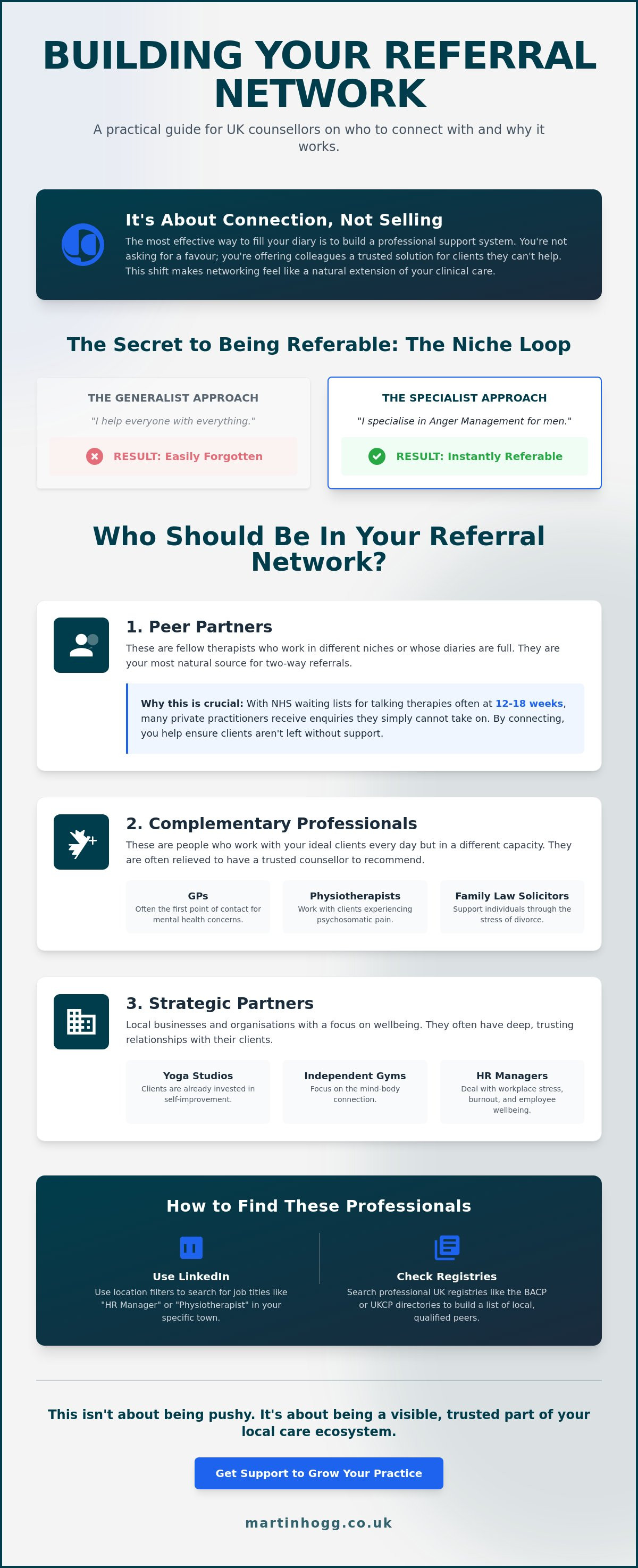
When you start thinking about networking for therapists to get clients, it is easy to assume you only need to talk to other counsellors. While your peers are a vital part of your circle, the most robust referral networks are built on a diverse range of professional relationships. Think of your network as a local ecosystem of care where different professionals support the same person at different stages of their journey.
Your first port of call should be "Peer Partners." These are fellow therapists who work in different niches or whose diaries are currently full. With NHS waiting lists for talking therapies typically sitting between 12 and 18 weeks, many private practitioners are overwhelmed with enquiries they cannot take on. By connecting with a peer who specialises in an area you don't cover, you create a natural two way street for referrals that ensures clients aren't left without support.
Beyond our own profession, you should look toward "Complementary Professionals." These are people who see your ideal clients every day. GPs are the obvious choice, but they are often time-pressed. Consider reaching out to physiotherapists who deal with psychosomatic pain, or family law solicitors who work with individuals going through the emotional upheaval of divorce. These professionals are often relieved to have a trusted counsellor they can recommend to their clients.
The secret to being "referable" is what I call the Niche Loop. If you tell a contact that you "help everyone with everything," they will likely forget you by the time they finish their coffee. However, if they know you specialise in a specific area, such as Anger Management, you become the immediate answer to a specific problem. If you're looking for a structured way to define your place in the market, our Private Practice Success Membership offers the community support to help you get clear on your niche.
Beyond Other Therapists: Strategic Partners
Don't overlook local wellbeing businesses like yoga studios or independent gyms. These business owners often have deep, trusting relationships with their clients who are already invested in self-improvement. Similarly, HR managers in local firms are frequently dealing with workplace stress and burnout. If you have a specific focus, like "Working with Men," an HR department can be a brilliant partner, as they are often looking for practical ways to support male employees who might otherwise avoid traditional support routes.
You can find these partners nationally by using LinkedIn filters to search for "HR Manager" or "Physiotherapist" in your specific town. Combining this with a search of professional UK registries like the BACP or UKCP directories allows you to build a list of local allies who are just as committed to client welfare as you are.
The Low-Pressure Approach: How to Reach Out Without Feeling Pushy
If you've ever felt that marketing is a bit like forcing your way into a conversation where you weren't invited, you'll find this step-by-step approach much more comfortable. Networking for therapists to get clients doesn't have to be loud or aggressive. It's actually far more effective when it's quiet, consistent, and genuinely curious about others. I've found that breaking this down into small, manageable steps helps to lower the pressure and keep the focus on professional connection.
- Step 1: Research. Identify just five people this week who already serve your ideal client. This might be a local GP practice manager, a fellow therapist in a neighbouring town, or a specialist solicitor.
- Step 2: The 'Human-to-Human' Message. Reach out with a brief, appreciative note. Mention something specific you admire about their work and ask if they’d be open to a brief chat.
- Step 3: The Professional Coffee. Whether virtual or in-person, make this meeting about them. Ask about the challenges they face when trying to find support for their clients. Being a good listener is your greatest professional asset here.
- Step 4: The Follow-Up. A few days later, send a helpful resource or an article related to something you discussed. It shows you were listening and keeps you at the front of their mind without you having to ask for anything.
Digital Networking: Using LinkedIn and Skool
LinkedIn is a brilliant tool for finding UK-based professionals, provided you use it to build relationships rather than just collecting names. Avoid the "pitch-slap" where you send a connection request followed immediately by a sales message. Instead, use it to share helpful insights and comment on the work of others in your local community.
Online communities also provide a safe space to find peer support and referral partners. In our Private Practice Success community, we focus on building these connections in a way that feels supportive rather than competitive. If you're looking for a place to practice your outreach or find like-minded peers, you can join our Private Practice Success Membership to get started today.
When you do reach out on LinkedIn, keep your connection request simple and focused on mutual support. Here is a sample you can adapt:
"Hi [Name], I’m a local counsellor specialising in [Niche] and I’ve heard great things about your work with [Client group]. I’d love to connect here and learn more about your practice so I can keep you in mind for future referrals."
By approaching networking for therapists to get clients as a way to be helpful, the "salesy" dread begins to disappear. You are simply becoming a known resource for the people who are already talking to your ideal clients.
Nurturing Your Network for a Sustainable Private Practice
Building a list of contacts is a great start, but nurturing those relationships is how you stop the "feast or famine" cycle for good. You don't need a complex or expensive system to stay organised. A simple "Referral CRM" can be as basic as a spreadsheet or a dedicated notebook where you track who you've spoken to and when. This ensures that networking for therapists to get clients remains a structured part of your week rather than a sporadic afterthought when your diary feels too quiet.
One of the most effective habits you can develop is the "Gratitude Loop." When a colleague or local professional sends a client your way, send a brief note of thanks. You must never share client details or break confidentiality, but acknowledging the professional trust they’ve placed in you is vital. It’s a small, kind gesture that makes your contacts feel appreciated and far more likely to think of you again when the next enquiry lands on their desk.
Staying visible doesn't have to be a full-time job that drains your energy. I recommend a simple 15-minute weekly check-in. Use this time to send one "thinking of you" email to a peer or comment on a local partner's professional update. For a broader look at how these connections fit into your overall business strategy, you might find my Marketing for Therapists UK guide helpful for extra context.
Using the Practice Visibility Blueprint
Consistency beats intensity every single time. It is far better to reach out to one person a week for a year than to contact fifty people in a single, panicked afternoon when you're feeling anxious about an empty diary. My Practice Visibility Blueprint is designed to help you build these small, sustainable habits so they become second nature. If you find the idea of doing this alone a bit daunting, I encourage you to join our supportive community. It's a safe space to share your networking successes and work through the hurdles with people who truly understand the unique journey of UK private practice.
Your Path to a Connected Practice
Building a referral network isn't about changing who you are; it's about extending the same care you show your clients to your professional community. By reframing networking for therapists to get clients as an act of service, you remove the pressure to "sell" and replace it with the goal of being a reliable resource. Whether you are reaching out to a local GP or connecting with a peer in a different niche, you are simply making it easier for the right people to find the support they need.
You don't have to navigate these professional hurdles alone. With over 20 years of experience helping UK practitioners grow through BACP-endorsed workshops and accredited CPD, I've seen how much easier it is to succeed when you have a supportive group behind you. It’s the small, consistent steps, like your 15-minute weekly check-in, that lead to a sustainable and fulfilling career.
Join the Private Practice Success community and start building your network today to share your journey with a supportive community of peer practitioners. You have the tools and the plan; now it's time to take that first gentle step toward a more visible and connected practice.
Frequently Asked Questions
Is it ethical for UK therapists to pay for referrals?
Paying for referrals is generally considered unethical within the UK counselling profession. Professional bodies like the BACP prioritise the client's best interests, which means referrals should always be based on clinical suitability rather than financial gain. Instead of paying a commission, you should focus on building reciprocal relationships where you recommend others based on their expertise and they do the same for you because they trust your work.
How do I network if I'm a total introvert and hate small talk?
You don't need to attend loud events or master the art of small talk to succeed. Many effective introverted counsellors find that networking for therapists to get clients works best through quiet, one-to-one professional "coffees" or thoughtful digital outreach. Focus on deep, meaningful conversations about clinical work rather than trying to "work a room"; your natural listening skills are actually a significant advantage in building professional trust.
What should I say when I reach out to a GP for the first time?
When contacting a GP, keep your message brief and focus entirely on how you can ease their workload. Mention your specific niche and explain that you have immediate availability for private referrals. A simple letter or email acknowledging that NHS waiting lists for talking therapies are typically 12 to 18 weeks and offering yourself as a local, qualified alternative is often very well received by busy practice managers.
How many referral partners do I actually need to fill my practice?
You don't need a massive list of contacts; usually, three to five high-quality referral partners are enough to keep a private practice full. If each partner sends you just one client every few months, your diary will stay consistently busy without you needing to spend hours on marketing every week. It is much better to have five deep professional relationships than fifty superficial ones that never lead to a clinical enquiry.
Can I network effectively if I only work online?
Networking is just as effective for online therapists, though the geographic focus shifts toward shared specialisms rather than local towns. You can use LinkedIn to connect with professionals across the UK who serve your specific niche or join online peer groups. Digital networking for therapists to get clients allows you to build a national referral base from the comfort of your own home, provided you remain visible in the right professional circles.

Article by
Martin Hogg
I help Private Practice counsellors in the UK set up and grow an ethical Private Practice they love, work with their ideal clients, and earn the income they deserve. All without guesswork and burnout. I have been a private practice counsellor myself for over 20 years, specialising in anger management. I set up a not-for-profit social enterprise, Citizen Coaching and Counselling, which delivers thousands of counselling sessions a year to adults and young people in Birmingham. I am a registered BACP Counsellor and the author of three books, My Anger Coach, My Anxiety Coach and My Relationship Coach. These are available on Amazon.
Disclaimer
The information provided on this blog is for general informational purposes only and is not intended to be a substitute for professional medical or mental health advice, diagnosis, or treatment. Reading this content does not create a therapist-client relationship.


