Online Counselling Best Practice: Professional Guidelines

Article by
Martin Hogg
I help Private Practice counsellors in the UK set up and grow an ethical Private Practice they love, work with their ideal clients, and earn the income they deserve. All without guesswork and burnout. I have been a private practice counsellor myself for over 20 years, specialising in anger management. I set up a not-for-profit social enterprise, Citizen Coaching and Counselling, which delivers thousands of counselling sessions a year to adults and young people in Birmingham. I am a registered BACP Counsellor and the author of three books, My Anger Coach, My Anxiety Coach and My Relationship Coach. These are available on Amazon.
The biggest lie we've been told about digital therapy is that it’s a second-rate substitute for the 'real thing' in person. If you've ever sat there staring at a frozen screen or felt a wave of GDPR-induced panic while trying to pick a platform, you've likely wondered if you're doing this right. Following the best practise for counselling online isn't just about ticking technical boxes; it’s about creating a space where the screen disappears and the human connection remains front and centre. I know that shift from the physical room to the digital one can feel clunky, especially when you're worried about losing that subtle rapport we all rely on.
I’m here to help you master the clinical, technical, and business essentials of a virtual practice that actually works for you and your clients. We'll look at the tools that make life easier, from BACP-aligned standards to streamlining your admin with Calendly or Squarespace. By the end of this guide, you'll have a professional setup you're proud of and the confidence to build deep rapport without the tech getting in the way. It’s time to move past the 'lite' version of therapy and build a practice that feels grounded, professional, and entirely your own.
Key Takeaways
- Create a professional, contained digital environment that builds trust without relying on messy virtual backgrounds or working from your sofa.
- Master the 'eye contact' illusion to ensure your clients feel connected and seen, moving past the awkwardness of being a 'head in a box'.
- Stop the 'email ping-pong' and reclaim your time by setting up a practical workflow with tools like Calendly and Squarespace.
- Implement the best practise for counselling online by focusing on a simple, 'skateboard model' website that gets you in front of the right people.
- Look ahead to scaling your practice, using your online setup to move beyond one to one work and into workshops or groups.
Setting Your Digital Stage: Ethics, Tech, and Environment
Setting up your digital practice is about more than just sending a link. It is about creating a 'contained' space that feels just as safe as a physical room. When you follow the best practise for counselling online, you aren't just checking boxes. You are building a foundation of trust. For a broader look at the field, you can read this Overview of Online Counseling, which covers the history and ethical considerations of this way of working.
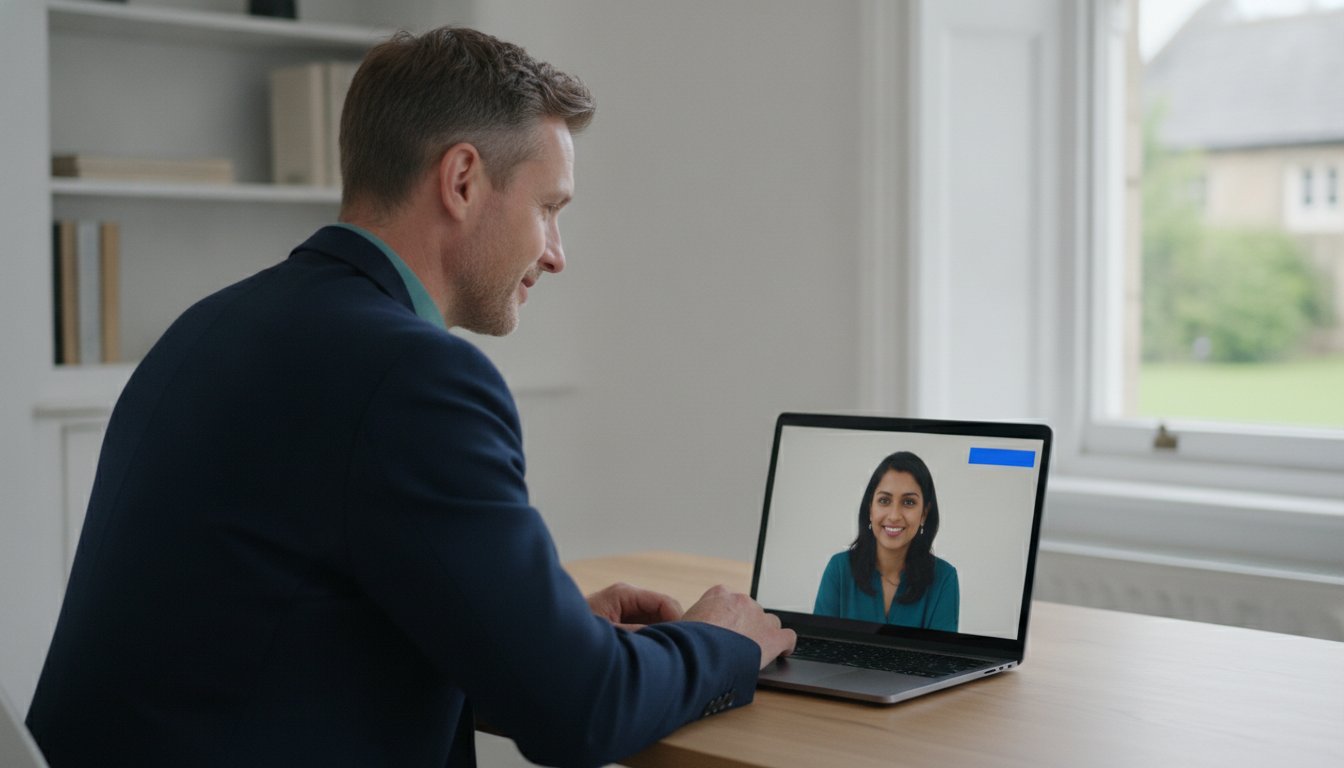
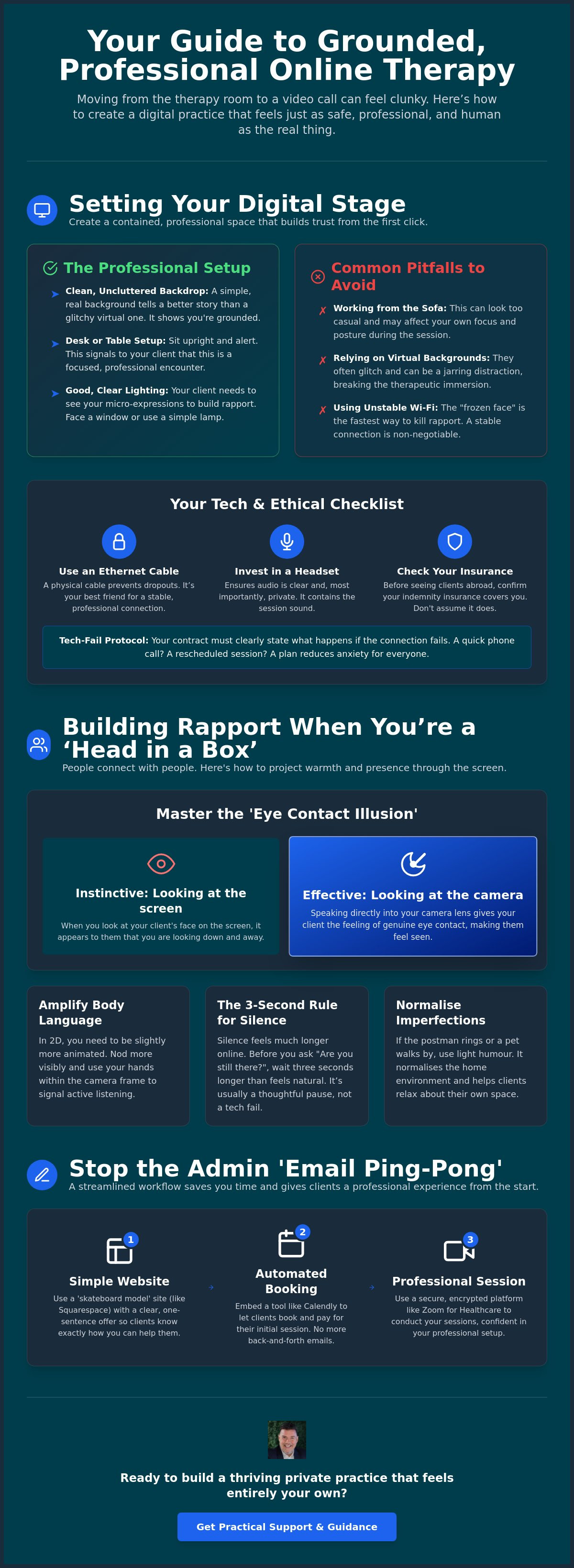
Your backdrop tells a story. I always suggest a clean, uncluttered space over those distracting virtual blurs. Virtual backgrounds often glitch when you move, which can be jarring for a client. It breaks the immersion. And please, stay off the sofa. You want to sit at a desk or table where you can remain alert and professional. Your environment should signal that this is a serious, focused encounter.
Let's talk tech. WiFi is convenient, but ethernet is your friend. A physical cable prevents the 'frozen face' syndrome that kills rapport. You also need a decent headset to keep the audio private and clear. Good lighting isn't about vanity; it's about safety. If a client cannot see your micro-expressions, they might feel disconnected. The BACP framework reminds us that our digital presence must be as carefully managed as our physical one.
GDPR and Platform Security for Therapists
Standard Skype often fails the professional test. You need platforms that offer end-to-end encryption and proper security, like Zoom for Healthcare. It is also vital to have a 'tech fail' protocol in your contract. Tell your clients exactly what happens if the screen goes black. Will you call them? Switch to audio? Having a plan lowers anxiety for everyone. It shows you are in control of the digital space.
Insurance and Jurisdiction
Before you take on that client in another country, check your professional indemnity insurance. Many policies are specific to the UK. Working within your competence is a core requirement for any ethical therapist. If you feel out of your depth with the digital side of things, it is worth looking into CPD for counsellors UK to sharpen your skills. Following the best practise for counselling online means knowing exactly where your legal and clinical boundaries sit.
Building Rapport When You're a 'Head in a Box'
The biggest worry I hear from therapists moving online is that the connection will feel thin. We are used to the energy of a shared room. When you're just a head in a box, you have to work a bit harder to show you're a real human. My philosophy is simple: people connect with people. You don't need a clinical mask. In fact, being a bit more yourself helps bridge that digital gap. Following the best practise for counselling online means being intentional about how you project that warmth through a lens.
One of the best tricks is mastering the eye contact illusion. It feels natural to look at the client's eyes on your screen, but to them, it looks like you're looking down. Try looking directly into the camera lens when you're speaking. It makes the client feel truly seen. You should also be aware of the online disinhibition effect. Clients often feel a false sense of safety behind a screen and might share traumatic details too quickly. Part of your role is to gently hold those boundaries, ensuring they don't leave the session feeling over-exposed. For more on the clinical framework of this work, the APA Telepsychology Guidelines offer excellent grounding on maintaining professional standards in a virtual space.
Body language in 2D requires you to be slightly more animated. Nodding and using your hands within the camera frame are small but vital parts of the best practise for counselling online. It signals active listening in a way that a still image cannot. These tiny adjustments make the difference between a cold video call and a deep therapeutic encounter.
Handling Silence and Technical Glitches
Silence feels longer online. In a room, it's a pregnant pause. On Zoom, it feels like the Wi-Fi has died. I use the three-second rule: wait three seconds longer than you think you should before checking the connection. If the postman rings or a cat wanders across your desk, don't panic. A bit of light humour normalises the situation and actually helps the client feel more relaxed about their own home environment.
Presence and 'Above the Fold' Connection
Your presence starts before the camera even turns on. Ensure your one-sentence offer is clear on your site so the client arrives knowing exactly how you help. Once the session starts, use simple checking-in questions to bridge the physical gap, such as asking if the lighting or sound feels comfortable for them today. If you want to dive deeper into building a practice that feels this connected, you might find my Private Practice Success community helpful for practical support.
The Practical Workflow: From First Click to Final Invoice
Running a practice shouldn't feel like a part-time job in admin. If you're still stuck in the endless cycle of 'Email Ping-Pong' to book a single session, you're wasting energy that belongs to your clients. A core part of the best practise for counselling online is building a workflow that runs while you sleep. I always recommend tools like Calendly. It lets clients see your availability and book directly into your digital diary. No fuss, no back-and-forth, just a notification in your calendar.
Your website follows the same logic. Don't get bogged down in a twenty-page masterpiece. Use the 'Skateboard Model'. A simple, one-page site on Squarespace that tells people who you are and how to book is far better than a complex site that is never finished. You can even automate your intake forms and GDPR consents using Google Forms or Canva. It’s about making the 'boring bits' invisible. For payments, use Stripe or GoCardless. Asking for money at the end of a deep session can feel clunky, so getting paid upfront is a win for everyone.
Your Online Visibility: Being Found by the Right People
To get found by the right people, make sure your Counselling Directory and Psychology Today profiles are sharp. Use keywords that specifically mention your online availability. People want to see a human, so a 'rough and ready' video on your profile builds way more trust than a stiff, corporate headshot. Understanding how to present yourself is a huge part of how to get counselling clients UK wide. This approach is the best practise for counselling online because it prioritises connection over perfection.
Managing Your Digital Energy
Working from home makes it easy to fall into the 'Back-to-Back' trap. You need at least 15 minutes between sessions to stretch and look at something that isn't a screen. This isn't a luxury; it's how you avoid therapist burnout. Set firm digital boundaries too. Just because you're online doesn't mean you have to answer WhatsApp messages at 10 PM. If you want to refine these systems with a supportive group, come and join us in the Private Practice Success Membership.
Scaling Your Online Practice and Professional Growth
Once you've nailed the basics, the real magic of a digital practice starts to show. You're no longer tethered to a physical room or a local postcode. Moving beyond the 1:1 hour becomes much easier when you don't have to worry about renting a hall or finding a space that fits twelve chairs. Following the best practise for counselling online allows you to start groups or workshops from your own home office. It’s a way to help more people without burning yourself out in the process.
This is where you shift from a 'Solo' mindset to a 'CEO' mindset. Your online foundation is the perfect springboard for eventually hiring associates or even creating your own membership model. When you specialise online, you aren't just the therapist down the road. You can become the UK expert in a specific niche, like Anger Management or working with men. Geography doesn't limit you anymore. You can attract clients from Cornwall to Caithness who are looking for your exact expertise, not just whoever is closest to them.
Doing this alone is tough. It can feel isolating when you're staring at a screen all day. That is why I’m such a big believer in joining a community of like-minded professionals who get the struggle. It keeps you grounded and gives you a place to celebrate the wins. Adopting the best practise for counselling online isn't just about the tech; it's about the growth of the person behind the screen.
Niche Building for the Virtual World
In the virtual world, your 'one-sentence offer' needs to be razor-sharp. You want to attract private pay clients who value your specific skill set. Instead of being a generalist, you want to be the person they've been searching for. Refining your message for a national audience is an easy win that sets you apart from the 'general' listings on the Counselling Directory or Psychology Today. It’s about being seen as the specialist you already are.
Next Steps for Your Practice
If you're ready to take this further, I'd love for you to join the Private Practice Success community. It is a place for ongoing support, practical advice, and real human connection. Remember, you don't need to be perfect to start. You just need to be professional, present, and willing to take that next step. You've got the tools; now it's time to build something you're truly proud of.
Take the Next Step in Your Private Practice
Moving your work online isn't about becoming a tech expert or losing the human touch. It’s about being a professional who knows how to hold a safe, contained space through a screen. We’ve looked at how a simple Squarespace site and a solid Calendly link can save you hours of admin, and why looking into the camera lens is the simplest way to build deep rapport. Following the best practise for counselling online is ultimately about removing the friction so you can focus on the work you were trained to do.
I’ve spent over 20 years helping therapists grow, and as a BACP-endorsed workshop provider, I’ve supported over 500 therapists in the UK to find their feet in this digital landscape. You don't have to figure this out on your own. If you want to build a practice that feels grounded and professional, Join the Private Practice Success Membership and scale your online practice today. You already have the skills and the heart for this work; now you have the roadmap to make it sustainable and successful.
Common Questions About Digital Practice
Is online counselling as effective as face-to-face therapy?
Research generally shows that online therapy is just as effective as in-person work for most common mental health issues. It is not a 'lite' version of support. The success of the work depends far more on the quality of the relationship you build than the physical room you sit in. Once you get used to the tech, you will find that the screen quickly fades into the background as the human connection takes over.
What is the best platform for UK counsellors to use for online sessions?
The best platform is one that offers end-to-end encryption and prioritises privacy over convenience. While standard Skype or FaceTime might be fine for a chat with friends, professional tools like Zoom for Healthcare or Doxy.me are built for our industry. They provide the security your clients expect. Choosing a professional tool is a key part of the best practise for counselling online because it gives both you and your client peace of mind.
How do I handle a crisis situation with a client during an online session?
You handle a crisis by being prepared before the session even starts. Always confirm the client's exact physical location at the beginning of the call and keep their local emergency contact details in your notes. If a crisis occurs, stay on the line with them while you follow your pre-agreed safety protocol. Being calm and having a plan is what keeps both you and your client safe when things get difficult.
Do I need a special contract for online counselling clients?
Yes, you need a contract that specifically addresses the unique nature of digital work. Your agreement should cover what happens during a technical failure, your expectations for their privacy at home, and how you manage their data under GDPR. It is a cornerstone of best practise for counselling online. A clear contract sets the boundaries from day one, so everyone knows the 'rules of the room' before the work begins.
How do I stop 'Zoom fatigue' as a full-time online therapist?
Stop 'Zoom fatigue' by being ruthless with your diary and your physical setup. Make sure your camera is at eye level so you aren't straining your neck and take a proper 15 minute break between every single session. You need to get up, move your body, and look at something that isn't a screen. Your brain needs that sensory reset to stay sharp and present for the next person who clicks your link.
Disclaimer
The information provided on this blog is for general informational purposes only and is not intended to be a substitute for professional medical or mental health advice, diagnosis, or treatment. Reading this content does not create a therapist-client relationship.


