
Overcoming Fear of Marketing: A Practical Guide for UK Therapists

Article by
Martin Hogg
I help Private Practice counsellors in the UK set up and grow an ethical Private Practice they love, work with their ideal clients, and earn the income they deserve. All without guesswork and burnout. I have been a private practice counsellor myself for over 20 years, specialising in anger management. I set up a not-for-profit social enterprise, Citizen Coaching and Counselling, which delivers thousands of counselling sessions a year to adults and young people in Birmingham. I am a registered BACP Counsellor and the author of three books, My Anger Coach, My Anxiety Coach and My Relationship Coach. These are available on Amazon.
Posting on social media shouldn't feel like you're selling your soul in a cheap suit, yet for many of us, the "cringe" is very real. You didn't train for years just to spend your afternoons wrestling with Instagram algorithms or worrying that your peers will judge you for being "too commercial." It's completely normal to feel like a bit of a fraud when you're trying to describe your services online. You're likely here because overcoming fear of marketing as a therapist feels like a bigger hurdle than the clinical work itself.
I understand that the thought of being "too commercial" makes you want to hide. But marketing is just a bridge. I promise that you can build a visible, ethical practice that feels completely authentic. You can have a full diary of private-pay clients without becoming a tech expert or a polished influencer. Marketing isn't about "selling" at all; it's about making it easy for a person in distress to find the help they need.
In this guide, we'll look at how to move past the technical jargon and build a simple, "rough and ready" routine. We will explore practical ways to get your message in front of the right people while remembering that people connect with people, not with polished corporate facades.
Key Takeaways
- Reframe marketing as an act of service, moving away from the "pushy salesperson" stereotype toward a focus on being found by those who need your help.
- Learn how overcoming fear of marketing as a therapist starts with a "one-sentence offer" that feels authentic rather than like a scripted sales pitch.
- Use the "skateboard model" to create a simple, one-page website that gets results without needing a degree in web design or expensive software.
- Optimise your presence on platforms like the Counselling Directory and Psychology Today to ensure your profile stands out to the right people.
- Establish a sustainable marketing routine that only takes two hours a week, focusing on "rough and ready" content that builds real human connection.
Why Therapists Dread Marketing (And Why That Is Okay)
Let's be honest. Most of us became therapists because we want to help people, not because we want to be the next big thing on TikTok. The word "marketing" often feels like a dirty word in our circles. We associate it with being pushy, insincere, or somehow "less than" our clinical standards. This discomfort is actually a good sign. It shows you care about your integrity and the sanctity of the therapeutic relationship. But overcoming fear of marketing as a therapist isn't about becoming a different person; it's about changing how you view the process.
Ethical marketing is simply the act of being findable. If a person in your local community is struggling with anxiety at 2 a.m., they are looking for a lifeline. If you aren't visible, they cannot find you. That isn't just a business problem; it's a service problem. We often get stuck in the "Professional Mirror," worrying about what our supervisors or peers will think of our LinkedIn posts. This is where Impostor syndrome often takes root, making us feel like frauds for wanting a successful business. In reality, your clinical training makes you a natural at this. You understand human needs better than any corporate marketing executive ever could. You are already an expert in empathy, and that is the core of great communication.
The Ethical Dilemma of Self-Promotion
The BACP Ethical Framework doesn't forbid you from talking about your work. In fact, it encourages clear, honest communication so clients can make informed choices. Staying hidden doesn't protect your clients. It just leaves them to find less-qualified or even dangerous "gurus" who aren't afraid to shout about their services. Being visible is a professional responsibility. If you feel isolated in this struggle, joining a community like the Private Practice Success Membership can help you realise you're not alone in these fears.
Marketing vs. Clinical Jargon
We often hide behind phrases like "warm, non-judgmental space" or "person-centred approach." While these mean something to us, they mean very little to a person in crisis. They want to know if you can help them sleep better or stop the panic attacks. Translating your skills into "human-speak" is the first step in overcoming fear of marketing as a therapist. It's about speaking to the person, not the textbook. When you stop trying to sound like a clinician and start sounding like a human, the "cringe" starts to disappear.
Reframing Visibility: From "Selling" to "Serving"
We often get stuck in our own heads, worrying about looking unprofessional or, even worse, desperate. This self-consciousness is the biggest barrier to overcoming fear of marketing as a therapist. When you're worried about looking silly, you're accidentally making the process about you. But marketing isn't about you. It's about the person who is currently scrolling through a directory, feeling hopeless. If you shift your focus from "What will people think of me?" to "What if this person never finds the help they need?", the fear starts to lose its grip.
The "People Connect with People" philosophy is vital here. Potential clients aren't looking for a corporate logo or a stock photo of a pebble. They are looking for a face they can trust and a voice that resonates with their pain. This is why "rough and ready" content, like a quick video or an honest post about a common struggle, is so much more effective than polished corporate-speak. It feels human. It feels real. It signals that you are a real person who understands them. Polished adverts often get ignored, but a genuine message from a person who cares will always stand out.
Building Your One-Sentence Offer
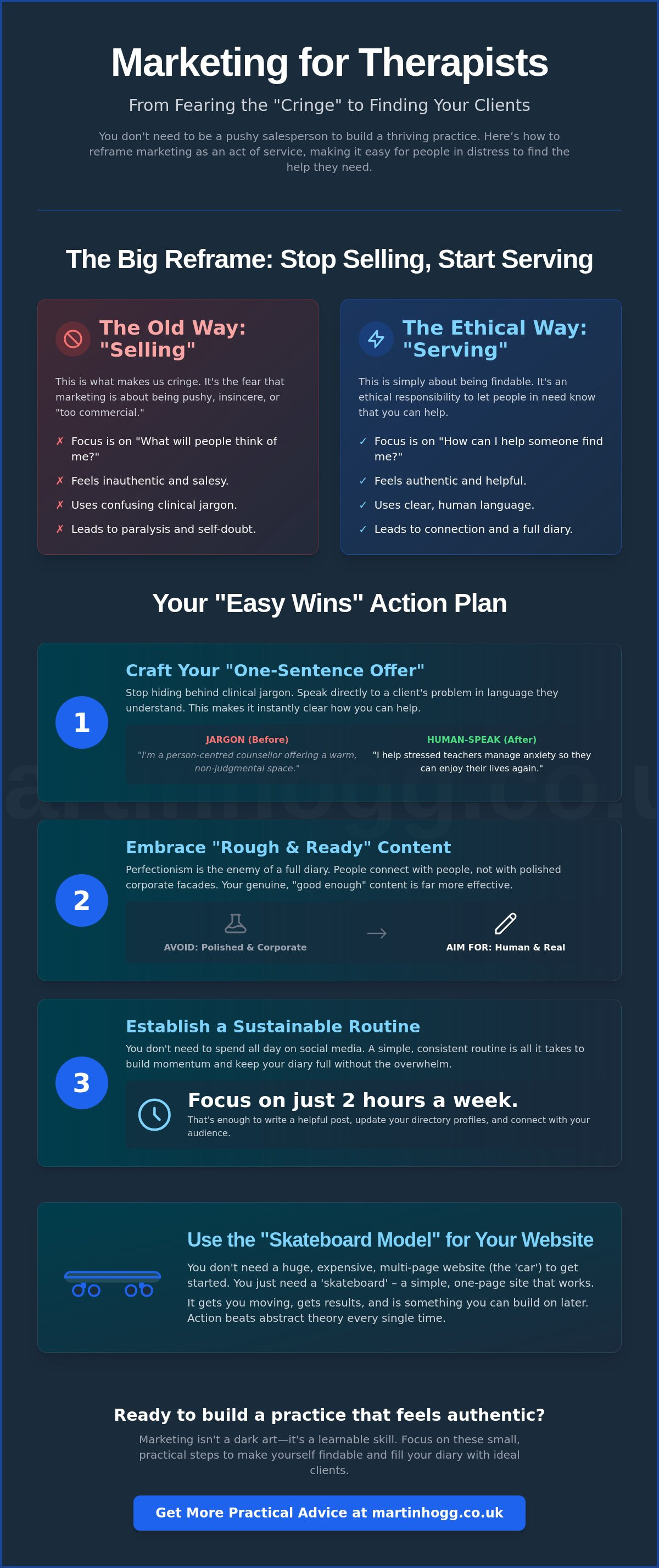
One of the best ways to stop feeling like a fraud is to have a clear, simple way to describe what you do. I call this the "One-Sentence Offer." Instead of saying "I'm a person-centred counsellor," which is clinical jargon, try something like "I help stressed teachers manage anxiety so they can enjoy their lives again." This identifies a specific problem and a specific solution. It makes it easy for the right person to say, "That's exactly what I need." For more on this, you can read my guide on Starting and Growing a Private Practice.
The Power of "Good Enough" Content
Perfectionism is the enemy of a full diary. You don't need a design degree to look professional. Tools like Canva allow you to create simple, clean images in minutes without any fuss. Your content doesn't need to be a masterpiece; it just needs to be useful and consistent. If you find yourself stuck in the perfectionism trap, joining a supportive community can help you get moving and grow your practice with confidence. Action beats abstract theory every single time.
Practical "Easy Wins" for UK Private Practice
You don't need a massive advertising budget or a complex strategy to start seeing results. In fact, overcoming fear of marketing as a therapist is much easier when you focus on small, manageable tasks that yield immediate rewards. I like to call these "easy wins." These are the low-hanging fruit of private practice growth that most practitioners overlook because they are too busy worrying about the big, scary stuff like "going viral."
The first place to look is your directory presence. In the UK, platforms like the Counselling Directory and Psychology Today are the heavy lifters. Most potential clients will find you there before they ever see your website. You should also set up a Google Business Profile. It is free, takes ten minutes to configure, and helps you appear in local search results when someone nearby types "counsellor near me" into their phone. It is a simple way to capture local interest without spending a penny on ads.
The 15-Minute Directory Audit
Open your directory profile and look at the "above the fold" content. This is the text a person sees before they have to scroll down. Does it immediately address the client’s pain, or does it list your qualifications first? To be effective, your opening paragraph must mirror the reader's struggle. If you want a deeper dive into making these platforms work for you, check out my guide on How to Get Counselling Clients UK.
Simple Tech for Non-Techies
I am a huge fan of the "skateboard model." You don't need a twenty-page WordPress site that costs a fortune to maintain. A simple, one-page site on Squarespace or Carrd is often more than enough to get enquiries. Use clear title and description tags so Google knows who you help. Finally, add a Calendly link. Reducing the "back-and-forth" email dance makes it much more likely that a person in distress will actually book that first session. If you want to stop overthinking and start doing, come and join us in the Private Practice Success Membership to get your visibility moving.
Building a Sustainable Visibility Routine
Marketing shouldn't feel like a second full-time job. If you are already balancing a clinical caseload and a personal life, adding a complex digital strategy is a recipe for burnout. I advocate for the "Minimum Effective Dose." This means doing just enough to keep the engine running without it becoming a source of stress. Overcoming fear of marketing as a therapist is much easier when you realise you only need about two hours a week to maintain a healthy presence.
In those two hours, you can update your directory profiles, share one honest post on your chosen platform, and ensure your Calendly links are working. It is about consistency over intensity. As your practice scales, you will need to shift from solo overwhelm to a "CEO mindset." This doesn't mean becoming a corporate shark. It just means treating your practice with the professional respect it deserves. You are a therapist first, but you are a business owner second. Embracing that second role is what allows you to keep doing the first one sustainably.
Creating Your Marketing "Skateboard"
Don't try to be everywhere at once. Pick one platform where your potential clients actually hang out and do it well. If you enjoy writing, start a blog. If you prefer professional networking, focus on LinkedIn. This focused approach is part of a larger strategy for Marketing for Therapists in the UK. By keeping it simple, you avoid the perfectionism that leads to procrastination. You can always add more later, but start with the basics.
Next Steps for Practice Growth
Sometimes, the blocks are deeper than just not knowing which button to click. If you find yourself struggling with specific fears around money or being seen, one-to-one coaching can provide the tailored support you need to move forward. For many, the best cure for imposter syndrome is being part of a group that understands the unique pressures of our profession. I invite you to join the Private Practice Success Membership. It is a safe, practical space where we value action and tangible improvement over abstract theory, helping you build a practice that serves both you and your clients.
Your Path to a Visible and Ethical Practice
Building a full private practice doesn't require you to become a different person. It just requires you to be found. By reframing marketing as an act of service and focusing on "easy wins" like directory audits and the "skateboard model" website, you can attract the right clients without the "cringe." Remember that "rough and ready" content usually beats polished corporate-speak because people connect with real people. Overcoming fear of marketing as a therapist is a process of small, consistent steps rather than a giant leap into the unknown.
I have spent over 20 years in the UK therapy landscape helping practitioners just like you. As a BACP-endorsed workshop provider and creator of the Practice Visibility Blueprint, I know exactly what works in our unique environment. You don't have to figure this out alone in a dark room. You can Join the Private Practice Success Membership and build your visibility today alongside a supportive community of peers. Your future clients are already out there looking for you; it's time to make it easy for them to find your door. You've got this.
Frequently Asked Questions
Is it ethical for a therapist to market their services?
Yes, marketing is entirely ethical as long as you remain honest and avoid making unsubstantiated claims. The BACP Ethical Framework actually encourages clear communication so that potential clients can make informed choices about their care. Think of your marketing as a signpost rather than a sales pitch. You aren't "selling" a product; you're simply letting people in distress know that professional help is available to them.
How much should a UK therapist spend on marketing each month?
There is no fixed amount, but most solo practitioners start with basic directory fees. A listing on the Counselling Directory or Psychology Today usually costs between £20 and £30 a month. If you eventually decide to use Google Ads, a starting budget of £300 to £800 per month is common for those looking to scale quickly. However, many successful practices grow perfectly well using only low-cost directories and organic visibility.
What is the best social media platform for counsellors?
The best platform is the one you will actually use consistently. LinkedIn is excellent if you work with professionals or corporate stress, while Instagram or Facebook can work well for the general public. Don't feel pressured to be everywhere at once. Overcoming fear of marketing as a therapist is much easier if you master one platform that feels natural to you rather than spreading yourself too thin across several.
Do I really need a website to get private therapy clients?
You don't strictly need a website to get your first few clients, but it certainly helps build trust. Many therapists start with just a strong, well-written profile on a reputable directory. Once you are ready, a simple "skateboard model" one-page site is often enough to show you are a professional. It acts as a digital business card where people can check your credentials and "vibe" before they decide to book a session.
How do I handle the fear of being judged by my clinical peers?
Peer judgment is a common worry, but your peers aren't the ones seeking your help or paying your bills. Focus on the person in pain who is currently searching for a way out of their struggle. When you speak directly to a client's needs, you aren't being "too commercial," you are being accessible. Most of the time, the judgment we fear is just our own imposter syndrome reflecting back at us.
Disclaimer
The information provided on this blog is for general informational purposes only and is not intended to be a substitute for professional medical or mental health advice, diagnosis, or treatment. Reading this content does not create a therapist-client relationship.


