
Panic Attack and Anxiety Disorder Symptoms: A Practical Guide to Reclaiming Calm
Last Tuesday, a client sat in my office and described the sheer terror of a moment on the M6 when his heart hammered so hard against his ribs he was certain his life was ending. It's a story I hear often; in fact, data from the Mental Health Foundation suggests that around 13% of people in the UK will experience a panic attack at some point in their lives. When you're dealing with panic attack anxiety disorder symptoms, it can feel like your body has turned against you, leaving you with a bone-deep exhaustion that lasts for days. It's incredibly frustrating when friends or family suggest you just 'take a deep breath,' as if you haven't already tried everything to make the shaking stop.
I want you to know that these physical sensations, while frightening, are manageable when you understand what's actually happening. In this guide, we'll recognise the specific signs that are keeping you on edge and explain the 'fear of fear' cycle that traps so many of us. I'll share three practical, evidence-based tools we use at Citizen Coaching to help you ground yourself in the moment. We're going to look at why your body reacts this way and provide a clear path to help you start getting your life back on track.
Key Takeaways
- Recognise the physical and cognitive signals of a "false alarm" and learn the vital differences between a panic episode and a heart attack.
- Understand the "fear of fear" cycle and why experiencing a one-off attack does not necessarily mean you are living with a long-term disorder.
- Identify the most common panic attack anxiety disorder symptoms so you can label what is happening and reduce the power these sensations hold over you.
- Master the "Acceptance" method and a simple breathing exercise designed to settle your nervous system quickly when you feel overwhelmed.
- Discover how the Citizen Coaching approach helps you re-train your brain for safety, giving you the practical tools to get your life back on track.
Understanding the Experience of Panic and Anxiety
When you are sitting in your living room or driving down the M6 and suddenly your heart starts racing, it is absolutely terrifying. You might feel like you are having a heart attack or losing your mind entirely. I have heard this story hundreds of times in my counselling room. A panic attack is a sudden surge of overwhelming fear and physical distress that hits without warning. It is often described as a "False Alarm" because your body reacts as if you are in mortal danger, even when you are just doing the weekly shop or watching television.
I want you to know that while it feels like your world is ending, your body is actually doing what it was designed to do. It has simply chosen a very inconvenient moment to do it. About 13% of people in the UK will experience at least one panic attack during their lifetime, according to data from various mental health surveys. The sheer terror of that first experience often leads people to A&E, convinced they have a physical health crisis. Recognising these panic attack anxiety disorder symptoms is the first step toward getting your life back on track and moving away from the constant "what if" cycle.
For those looking for a clinical breakdown of these events, Understanding Panic Attacks provides a comprehensive overview of the diagnostic criteria used by professionals. However, knowing the facts on a page doesn't always stop the fear when it hits. If you find that these experiences are becoming a recurring pattern, we begin to look at what we call Panic Disorder. This is essentially the "fear of the fear," where you start to worry about when the next attack will happen, often changing your daily routine to avoid potential triggers.
The Sudden Onset: Why Panic Feels So Powerful
The intensity of a panic attack usually peaks within 10 minutes. In those 600 seconds, time seems to stretch and warp. You might feel completely trapped or disconnected from your surroundings, a sensation we call derealisation. Many of my clients describe it as feeling like they are watching their life through a thick pane of glass. These attacks often arrive "out of the blue," without an obvious external trigger, which is why they feel so unpredictable and powerful. Identifying the specific panic attack anxiety disorder symptoms during these peaks helps us label the experience, which is a vital tool in reducing its power over you.
The Purpose of the Fight-or-Flight Response
Your adrenal glands pump out adrenaline and cortisol during an attack. This is your body's survival kit, preparing you to either fight a predator or run for your life. In 2023, NHS Digital reported that 1 in 6 people in England experienced a common mental health problem in any given week, and many of these involve this overactive survival mechanism. Your heart beats faster to get blood to your muscles, and your breathing quickens to take in more oxygen. This physiological response is actually a sign that your body is working perfectly; it is just responding to a non-existent threat. Through Citizen Coaching, I help people realise that their body is not their enemy. It is simply a highly efficient system that needs a bit of help to recalibrate and understand that it is currently safe.
Recognising Panic Attack and Anxiety Disorder Symptoms
Understanding what’s happening in your body is the first step toward taking back control. When you're in the middle of a surge, the experience feels overwhelming. It isn't just "in your head"; it's a full-body response that can be terrifying if you don't know what's happening. When we look at panic attack anxiety disorder symptoms, we have to look at the three distinct ways they manifest: physically, emotionally, and cognitively. Each person’s experience is unique, but the patterns are often remarkably similar.
One of the most distressing aspects is how closely these symptoms mimic a heart attack. In the UK, it’s estimated that roughly 1 in 10 people will experience a panic attack at some point. Many end up in A&E, convinced their heart is failing. A 2014 study found that up to 25% of patients presenting with chest pain were actually experiencing a panic response. The distinction often lies in the nature of the pain. Cardiac pain is usually a crushing pressure that radiates to the arms or jaw, while panic-induced chest tightness often feels sharp or localised to one spot. It's also helpful to understand the difference between a one-off event and a recurring pattern, often referred to as Panic Attack vs. Panic Disorder, as the approach to management can vary.
Sensory changes are also common. Your brain enters survival mode, which can cause tunnel vision as your eyes focus only on perceived threats. Sounds might become painfully loud, a condition known as hyperacusis. Once the adrenaline levels finally drop, you might feel like you've run a marathon. This "post-panic hangover" can cause intense fatigue that lasts for hours or even a full day. If you're finding these symptoms are starting to dictate your daily routine, you might find it helpful to look at some of the practical tools for anxiety management I've developed for my clients.
The Physical Toll: What Your Body Goes Through
Your body’s "fight or flight" system is designed to protect you, but it's a blunt instrument. When it misfires, your heart rate skyrockets, leading to palpitations that feel like your heart is skipping beats. You might find yourself over-breathing, which lowers the carbon dioxide levels in your blood. This leads to paresthesia, that strange "pins and needles" sensation in your hands, feet, or face. Your digestive system also reacts quickly. Blood is shunted away from your stomach to your muscles, which often results in a churning feeling or sudden nausea.
The Mental Shift: Fear of Dying or Losing Control
The cognitive impact of panic attack anxiety disorder symptoms can be just as draining as the physical ones. Many people describe "derealisation," a sense that the world around them has become foggy, distant, or somehow "fake." This is often accompanied by an intense fear of impending doom or a terrifying thought that you are losing your mind. In this state, your "thinking brain" goes offline. Simple decisions, like which key to use or what to say next, become incredibly difficult. It's a temporary cognitive struggle, but it feels permanent when you're in the thick of it.
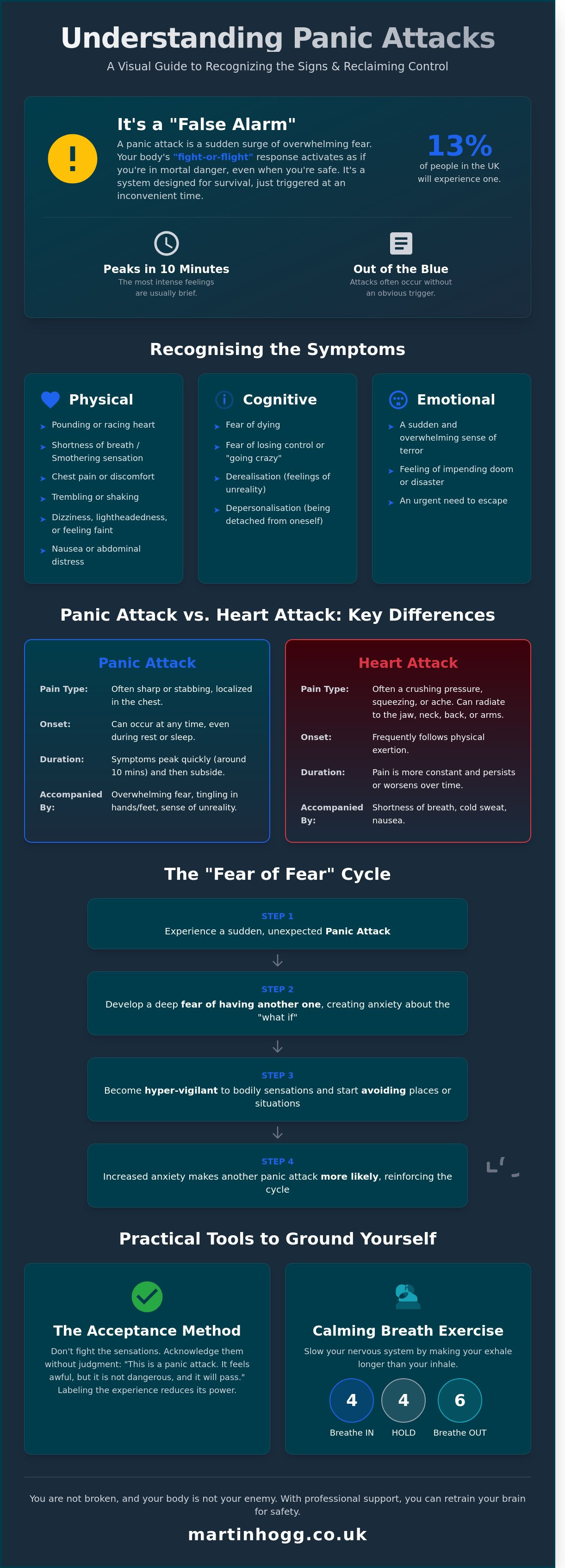
Panic Attack vs. Panic Disorder: The Fear of Fear
I often talk to people who believe that having one terrifying episode means they are stuck with a lifelong condition. It's vital to remember that having a panic attack does not automatically mean you have a disorder. In my experience, a panic attack is often a one-off response to an overwhelming period of stress or a specific trauma. It is a physical alarm system going off at the wrong time. Panic disorder, however, is a different beast altogether. It is less about the physical event and more about the relationship you develop with the fear itself.
When you live with panic disorder, you aren't just dealing with the symptoms; you are living in a state of constant vigilance. You begin to monitor your heart rate, your breathing, and your surroundings with an intensity that is exhausting. Identifying these panic attack anxiety disorder symptoms early allows us to separate a physical reaction from a psychological pattern. According to the Adult Psychiatric Morbidity Survey, about 1.2% of adults in England meet the criteria for panic disorder in any given year. For these individuals, the fear of the next attack becomes more debilitating than the attack itself, often leading to a significant withdrawal from professional and social responsibilities.
Breaking the Cycle: Identifying Safety Behaviours
I see many clients who have inadvertently "shrunk" their lives to avoid a repeat of a past crisis. If you had an attack in a local Tesco or during a board meeting, your brain might tell you that the supermarket or the office is the enemy. You start using safety behaviours. These might include only going out with a specific person, sitting near the exit in every room, or avoiding certain routes home. While these actions feel like they keep you safe, they actually fuel the anxiety by confirming to your brain that you are in constant danger. This creates a heavy layer of anticipatory anxiety that builds up between attacks, making the next one feel almost inevitable.
When a client presents with recurring panic attack anxiety disorder symptoms, the focus shifts from managing the moment to reclaiming their freedom. We have to look at how these behaviours stop you from seeing that you can actually handle the discomfort. Recognising Panic Attack Symptoms for what they are, harmless but intense physical sensations, is the first step in stopping the cycle. Panic disorder is the persistent expectation of a future crisis.
When to Seek Professional Support
It is time to seek help when your world starts getting smaller. If you are turning down promotions because they involve travel, or if you've stopped seeing friends because you're worried about "making a scene," the disorder is in the driving seat. Early intervention is the most effective way to prevent these patterns from hardening into agoraphobia. I believe in a pragmatic approach to recovery that focuses on getting your life back on track rather than just talking about the problem.
In the professional community, many counsellors use the Practice Visibility Blueprint principles to help clients find the right support by ensuring their services are accessible and clearly explained. This helps bridge the gap between someone suffering in silence and the practical, evidence-based help they need. Whether it is through CBT, exposure therapy, or simple grounding techniques, the goal is to show you that you are stronger than your fear. You don't have to be a spectator in your own life; with the right tools, you can move from a place of survival back into a place of growth.
Practical Strategies for Managing an Attack
When you feel the first surge of adrenaline, your natural instinct is to fight it. You might try to push the feelings away or tell yourself to "stop it" with a sense of desperation. I’ve seen many clients in my Birmingham practice do exactly this, but fighting the sensation actually fuels the fire. It adds a second layer of fear to the original physical symptoms. Instead, I teach the "Acceptance" method. This involves acknowledging the sensations without judging them. You allow the wave of discomfort to wash over you, knowing it'll reach a peak and then naturally subside. It’s about being a passenger for a few minutes rather than trying to wrestle the steering wheel while the car is skidding.
Talking to yourself during an attack is another powerful tool. Use factual, reassuring statements that ground you in reality. Instead of thinking "I’m having a heart attack," try saying, "My heart is beating fast because of adrenaline, and it'll slow down shortly." Use short, punchy sentences. "I am safe." "This is uncomfortable, but not dangerous." These statements act as a calm mentor for your nervous system, helping you manage panic attack anxiety disorder symptoms without spiralling into further distress. According to data from the Mental Health Foundation, roughly 13 percent of people in the UK will experience a panic attack at some point; you aren't alone in this, and it always passes.
The 5-4-3-2-1 Grounding Technique
Grounding is a practical way to pull your focus out of your head and back into the room. It breaks the internal feedback loop where your brain monitors your racing heart and gets more frightened. Start by identifying five things you can see, such as the texture of a chair or a bird outside. Move to four things you can touch, three things you can hear, two things you can smell, and one thing you can taste. This technique is brilliant because you can do it anywhere. If you're on a bus or in a meeting, you don't need to say anything aloud. Just quietly observe your surroundings. It forces your brain to process external data, which naturally lowers the intensity of the internal alarm.
Breathing for Calm: Taming the Vagus Nerve
Your breath is the direct remote control for your nervous system. When you're anxious, you tend to take short, sharp gulps of air. This is a mistake as it can lead to hyperventilation. I recommend the "7-11 breathing" method. You breathe in for a count of seven and out for a count of eleven. A 2018 study in Frontiers in Psychology highlighted how slow, rhythmic breathing with a long exhale stimulates the vagus nerve. This sends a physical signal to your brain that the threat has passed. It's a physiological "off switch" for the fight-or-flight response. Focus on your belly expanding, not just your chest. This simple shift can drastically reduce the physical impact of panic attack anxiety disorder symptoms within minutes.
If you're finding it difficult to manage these episodes on your own, I'm here to help you get your life back on track. You can book a consultation with a Citizen Coach to start building your toolkit for lasting calm.
Finding Your Way Back to Calm with Professional Support
Living with the weight of constant high-alert signals is physically and mentally exhausting. At Citizen Coaching, I don't look at you as a diagnosis or a set of clinical problems. I see a person whose internal alarm system is currently stuck on the "loudest" setting. My approach is rooted in the belief that while your panic attack anxiety disorder symptoms feel like a permanent part of who you are, they are actually just a survival mechanism that has lost its way. We work to show your brain that the immediate threat isn't real, allowing your nervous system to finally downshift into a state of rest.
Therapy is essentially a process of re-training the brain to recognise safety. We use evidence-based tools like Cognitive Behavioural Therapy (CBT) because they offer a practical framework for change. CBT isn't just about talking; it's about doing. It helps you identify the specific thoughts that trigger a physical response and gives you the tools to intercept them. Data from the NHS Talking Therapies report for 2022/23 shows that 52.2% of people who completed a course of treatment for anxiety-related conditions moved into recovery. This isn't just a hopeful idea; it's a measurable result of the right support.
The Role of the Counsellor in Your Recovery
A counsellor provides the one thing that is often missing when you're in the middle of a crisis: a safe, non-judgmental space to explore what's actually happening. In our sessions, I help you move beyond simply managing the day-to-day symptoms. We look at the roots. We look at the underlying stress or past experiences that might be fueling the fire. This transition from "surviving" to "resolving" is where true healing happens. If you're looking for more depth on these techniques, I regularly host upcoming workshops and events where we break down these practical strategies in a supportive group environment.
Getting Your Life Back on Track
Recovery doesn't happen in one giant leap. It's built on small, practical wins that slowly rebuild your confidence. Maybe it's going to the supermarket without checking for the nearest exit, or sitting through a meeting without your heart racing. These moments matter. I often tell my clients that a standard course of 8 to 12 sessions can be enough to see a significant shift in how you handle stress. It requires patience and a good dose of self-compassion, but the progress is real.
You need to remember that you are not your anxiety. You're a person who is currently experiencing a difficult physiological response, and that's a very different thing. It's easy to feel isolated when your mind is racing, but you aren't alone in this. There's a well-trodden path back to calm, and with the right tools and a bit of professional guidance, you can absolutely get your life back on track. The goal isn't just to stop the panic; it's to help you feel like yourself again, steady and capable of handling whatever comes your way.
Take Your First Step Toward Lasting Calm
Recognising the physical reality of panic attack anxiety disorder symptoms is the first step toward regaining control of your daily life. When you can name a sensation, it loses its power to overwhelm you. I've spent over 20 years as a BACP-endorsed professional helping people understand that these episodes are manageable hurdles rather than permanent identities. Since 2005, our team in the heart of Birmingham has focused on providing the practical, results-driven tools needed to get your life back on track.
You don't have to carry this weight alone or wait for the next wave of anxiety to pass. Whether you're seeking personal support or you're a counsellor looking to refine your own practice, we've developed a steady, rhythmic approach to recovery that works. We've supported our local community for 19 years with grounded, human advice that cuts through clinical jargon. Change is entirely possible when you have the right guide by your side. You can find the space and the tools to breathe easily again.
Find out more about our support services and therapist training on our calendar
It's time to move from a place of fear to a future where you feel steady and capable once more.
Frequently Asked Questions
Is a panic attack dangerous for my heart?
A panic attack won't damage your heart or cause a cardiac arrest. While your heart rate might spike to 150 beats per minute, this is a natural response to adrenaline rather than a physical illness. I've worked with hundreds of people who feared the worst, but clinical data shows that these episodes are physically safe. It's your body's alarm system going off at the wrong time, and it's designed to handle this temporary surge.
How long does a typical panic attack last?
Most panic attacks reach their peak within 10 minutes and subside completely after 20 minutes. Some people find lingering feelings of unease last for an hour, but the intense physical surge is brief. Understanding this timeline helps you ride out the wave. When you realise the discomfort has a clear end point, it becomes much easier to manage the experience without spiralling into further worry or fear of the sensations.
Can I have a panic attack in my sleep?
You can certainly experience a panic attack while asleep, which is often called a nocturnal panic attack. Research from the Journal of Clinical Psychiatry suggests about 10% of people with panic disorder experience these sudden wake-ups. You might wake up feeling breathless or terrified, but the same grounding techniques you use during the day will help you settle back down. It's just your body processing stress during the night.
What is the difference between an anxiety attack and a panic attack?
The main difference is that a panic attack is sudden and intense, while an anxiety attack usually builds up over hours or days. Panic attacks often happen without a clear trigger and involve severe physical symptoms. In contrast, anxiety is typically a response to a specific worry or stressor. Recognising these panic attack anxiety disorder symptoms is the first step toward getting your life back on track with the right support.
Will I have to take medication for panic disorder?
Medication isn't the only way forward, as many people find relief through practical therapies like CBT or EMDR. Clinical trials show that 75% of individuals see significant improvement through talking therapies alone. While a GP might suggest a short course of beta-blockers, our goal at Citizen Coaching is to give you the internal tools to manage your nervous system independently. It's about what works best for your specific situation and lifestyle.
How can I help a friend who is having a panic attack?
Stay calm and use a quiet, steady voice to reassure them that they're safe. Encourage them to try the 4-7-8 breathing technique, where they inhale for 4 seconds and exhale for 8. Avoid saying "just relax," as this can feel dismissive. Instead, stay with them until the 20 minutes have passed and the physical symptoms have clearly started to fade. Your presence alone is a powerful tool for their recovery and comfort.
Why do I feel so tired after an anxiety attack?
You feel exhausted because your body has just used a massive amount of energy during a "false alarm" fight-or-flight response. When your adrenaline levels drop, it's common to experience a "hangover" effect that leaves you feeling drained for the next 24 hours. This fatigue is a sign your nervous system is resetting itself. I always advise my clients to rest after these panic attack anxiety disorder symptoms occur to allow for full recovery.


