
Passive Income Ideas for Therapists: How to Stop Trading Every Hour for Pounds

Article by
Martin Hogg
I help Private Practice counsellors in the UK set up and grow an ethical Private Practice they love, work with their ideal clients, and earn the income they deserve. All without guesswork and burnout. I have been a private practice counsellor myself for over 20 years, specialising in anger management. I set up a not-for-profit social enterprise, Citizen Coaching and Counselling, which delivers thousands of counselling sessions a year to adults and young people in Birmingham. I am a registered BACP Counsellor and the author of three books, My Anger Coach, My Anxiety Coach and My Relationship Coach. These are available on Amazon.
What if your ability to help people wasn't strictly limited by the number of hours you can physically sit in a chair before your brain starts to feel like overcooked porridge? It's a question many of us avoid because we've been conditioned to think that real therapy only happens in sixty minute chunks. But the truth is that the traditional model has a hard ceiling, often leading to burnout and a frustrating income plateau. If you're looking for sustainable passive income ideas for therapists, you aren't being greedy. You're looking for a way to make your practice, and your life, more resilient.
I understand the hesitation. There's often a lingering sense of guilt about monetising mental health or a fear that anything outside the room is somehow less ethical. I'm here to tell you that packaging your expertise is actually a way to reach the people who can't afford your full hourly rate or who aren't ready to step into a clinical space. I'll show you how to create income streams that work even when you're not on the clock, giving you more time for self-care while helping more people than a heavy caseload ever could. We will explore everything from digital guides to scalable workshops that stay firmly within professional boundaries.
Key Takeaways
- Understand why relying solely on 1:1 sessions creates a "caseload ceiling" and how to break through it without burning out.
- Discover the "skateboard model" for launching low-friction digital products like simple worksheets or PDFs using tools you already know.
- Explore practical passive income ideas for therapists by auditing the repetitive advice you find yourself giving in almost every session.
- Learn why "rough and ready" content often builds more trust and connection with your audience than overly polished, corporate designs.
- Get a clear action plan to scale your therapeutic expertise into recorded webinars or structured online courses using platforms like Squarespace or Skool.
Beyond the Hourly Rate: Why Therapists Need Passive Income in 2026
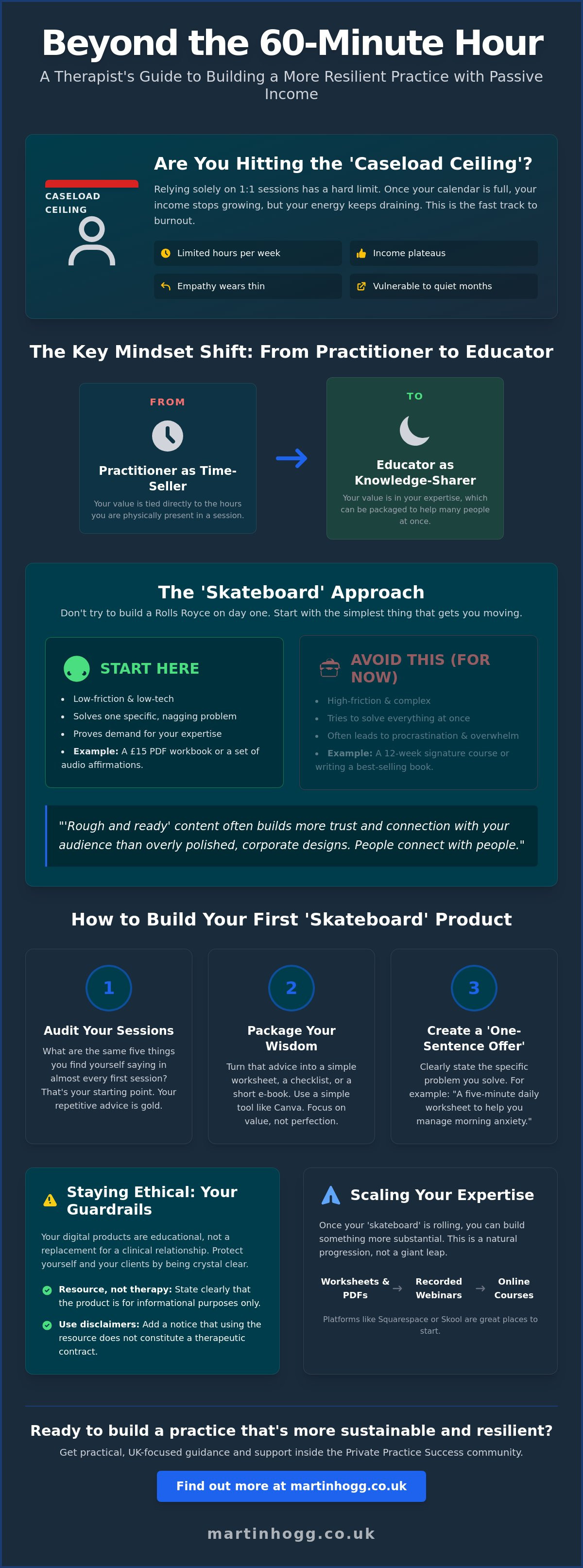
Most of us started in this profession because we wanted to help people, not because we were chasing a massive corporate salary. But there's a hard limit to how many sessions you can do in a week before your empathy starts to wear thin. Once you hit that "Caseload Ceiling," your income stops growing and your energy starts flagging. Relying solely on 1:1 work is a recipe for exhaustion. For therapists, passive income is the process of decoupling your earnings from your physical presence.
It's about front-loading the effort. You spend time now creating something, like a guide or a worksheet, so it can keep helping people while you're sleeping or walking the dog. Passive income isn't about being lazy; it's about being efficient with your expertise. When you look for passive income ideas for therapists, you're actually looking for ways to make your practice more accessible. Not everyone can afford a full fee, but they might be able to afford a £20 digital workbook that helps them manage anxiety. Creating resources allows you to help the many, rather than just the few who can sit in your chair.
The Mindset Shift: From Practitioner to Educator
Many counsellors have been conditioned to feel that making money is slightly icky, or that we should only be paid for our direct presence. I'd argue it's the opposite. You likely say the same five things in almost every first session. If you package that wisdom into a resource, you're becoming an educator. You're recognising that your value isn't just in your time, but in the specific tools you've mastered. Shifting your identity from "time-seller" to "knowledge-sharer" is the first step toward a sustainable business.
Financial Stability in an Uncertain UK Landscape
Private practice in the UK has its own rhythm. August is often quiet while everyone is on holiday, and December can be a ghost town. Having additional streams protects you during these seasonal slumps. It builds a financial buffer, which means you can stop saying "yes" to clients who aren't a good fit just because you need to pay the rent. If you want to explore how to build this community and grow your practice, joining a group like the Private Practice Success Membership can help you stay grounded and focused on what works.
The 'Skateboard' Approach: Low-Friction Digital Products
When people think about passive income ideas for therapists, they often jump straight to complex 12-week courses or writing a best-selling memoir. That’s like trying to build a Rolls Royce when you haven’t even figured out how to ride a bike. I want you to use the "Skateboard Model" instead. A skateboard is the simplest thing that gets you moving. In your practice, this might be a one-page PDF or a simple worksheet that solves one specific, nagging problem for a client.
Don't worry about being overly polished. In fact, "rough and ready" content often resonates more than corporate-looking designs because it feels human and authentic. People connect with people, not with slick marketing agencies. You can use Canva to tidy things up, but keep the focus on the value you're providing. A £10 worksheet is the perfect entry point for passive income because it lowers the barrier to entry for the buyer while proving there is a genuine demand for your specific expertise.
Worksheets, PDFs, and E-Books
Look at the tools you already use. If you have a particular way of explaining a psychological concept or a specific grounding exercise that clients love, you’ve already done the hard work. You just need to package it. To sell it, you need a "one-sentence offer" that tells people exactly what they get. For example: "A five-minute daily worksheet to help you manage morning anxiety without feeling overwhelmed." If you're unsure how to talk about your work, my guide on marketing for therapists in the UK covers this in more detail.
The Ethics of Selling Digital Resources
We have to be careful not to cross the line into offering "unsupervised therapy." Your digital products are educational resources, not a replacement for a clinical relationship. Always add clear disclaimers to your shop. State that the resource is for informational purposes and doesn't constitute a therapeutic contract. Setting these boundaries early protects you and ensures your customers are safe. If you want to see how other therapists are navigating these practical steps, come and join us in the Private Practice Success Membership where we share what’s working right now.
Scaling Your Expertise: Online Courses and Monetised Content
Once you've mastered the "skateboard" version of your digital products, you might feel ready to build something more substantial. Moving from a single PDF to a structured online course is a natural progression. You don't need a massive, expensive hosting platform to start; simple tools like Squarespace or community-focused sites like Skool work brilliantly. This is where you really start to see the potential of passive income ideas for therapists. It's about taking that same empathy you offer in the room and making it available to a much wider audience.
Think about the power of a recorded webinar. You prepare a presentation on a topic you know inside out, deliver it once to a live audience, and then sell the recording as a standalone resource. It’s the ultimate "teach once, sell forever" model. You can also look into affiliate marketing. If you're already recommending books or professional services like Psychology Today to your peers, see if they have a referral programme. It’s a small, ethical way to earn a commission for tools you genuinely believe in. If you want to dive deeper into the logistics, check out my guide on scaling a therapy practice.
Creating Your First Mini-Course
The biggest mistake I see is therapists trying to create a "General Guide to Mental Health." It’s too big and too vague. Instead, focus on a tiny, specific niche. "Anxiety Management for New Dads" is much more powerful and easier to sell than a generic course on stress. You don't need a film crew or a studio. Your smartphone and a room with decent natural light are more than enough. Your clients want your expertise and your human voice, not a Hollywood production.
Monetised Newsletters and Substack
Writing can be a fantastic way to build your practice visibility while getting paid. Platforms like Substack allow you to offer a free newsletter to build trust and a paid "member-only" tier for those who want a deeper dive into your therapeutic approach. It’s a low-pressure way to share your thoughts and create a steady, predictable income stream without needing to be "always on."
If you're ready to start packaging your knowledge, you can find the tools and community you need in the Private Practice Success Membership.
From Idea to Income: Your Practical Action Plan
It’s easy to get lost in the theory of passive income ideas for therapists, but the real magic happens when you actually put something out there. You don't need a five-year plan. You just need a Monday morning task list. Start by auditing your "repetitive advice." Think about the metaphors, grounding techniques, or psychological frameworks you find yourself explaining to almost every client. If you’ve said it more than ten times, it’s a prime candidate for a digital product.
Once you’ve identified that one nugget of wisdom, choose your format using the Skateboard Model I mentioned earlier. Don't overthink it. A simple, well-designed PDF or a recorded audio exercise is enough to start. Set up a basic payment gateway using Stripe or PayPal. It takes about ten minutes to get a "buy now" button live. Then, start sharing it with your audience. Remember that "done is better than perfect." Your first offer doesn't need to be a masterpiece; it just needs to be useful. You can always refine it later based on actual feedback from the people using it.
Tech Without the Tears
I see so many talented counsellors get stuck in "procrastivity." This is where you spend three months choosing a font or designing a logo instead of launching your resource. You don't need a degree in graphic design to succeed. Use Canva for your layouts and Squarespace for your website. If you're offering recorded webinars or one-off consultations, use Calendly to handle the scheduling. These tools are designed to be simple so you can focus on the clinical value, not the code. Keep it "rough and ready" and focus on the help you're providing.
Joining a Supportive Community
Trying to build a new income stream in total isolation is a recipe for self-doubt and overthinking. It’s much easier when you’re surrounded by people who understand the unique ethical and practical challenges of private practice. You don't have to figure it all out on your own. To start scaling your practice and connect with others on the same path, join the Private Practice Success community today. We focus on real-world steps that help you help more people without losing your sanity in the process.
Building a Practice That Breathes
You don't have to keep trading every single hour for pounds until you're too tired to enjoy your own life. We've explored how to break the caseload ceiling by auditing the advice you already give and starting small with the Skateboard Model. Whether it’s a simple PDF or a recorded webinar, these passive income ideas for therapists are about making your expertise more accessible while protecting your own energy. It’s about creating a business that supports you, rather than one that just demands more of you.
I've spent years running BACP Professional Development Workshops, and if there’s one thing I’ve learned, it’s that therapists are brilliant at creating value when they stop overthinking the tech. You don't need to do this alone. There is a community of over 100 UK therapists waiting to support you as you move from "time-seller" to "knowledge-sharer." If you're ready to stop the burnout and start building, get the Practice Visibility Blueprint and start building your passive income today. You have the skills already; now it's just about putting them into a format that works while you're out of the room. You've got this.
Frequently Asked Questions
Is it ethical for a therapist to sell digital products?
Yes, it is perfectly ethical as long as you maintain a clear boundary between clinical therapy and educational resources. You aren't offering a therapeutic relationship in a PDF; you're providing a tool for psycho-education. Always include a clear disclaimer stating that the resource does not replace 1:1 work with a BACP-registered professional. This protects you and ensures your customers understand that they are buying a product, not a clinical service.
How much time does it actually take to create an online course?
Creating a full-scale course can take months, but using the "Skateboard Model" means you could have your first product ready in a single weekend. If you audit your existing worksheets or session notes, you've already done half the hard work. Don't let perfectionism stall your progress. A rough and ready video recorded on your phone in a quiet room is often more relatable and helpful than a polished, corporate studio production.
Do I need a huge social media following to sell passive income products?
No, you don't need thousands of followers to make passive income ideas for therapists work for your practice. It's much more effective to have fifty people who really need your specific niche expertise than five thousand random scrollers. You can share your resources with your existing email list or link to them from your Psychology Today profile to reach people who are already actively looking for the help you provide.
What tech do I need to start selling PDFs or worksheets on my website?
The tech stack for selling digital products is surprisingly simple and doesn't require a computer science degree. You can design your resources in Canva, host them on a Squarespace or Wix site, and take payments securely via Stripe or PayPal. If your offer includes a one-off consultation or a recorded webinar, tools like Calendly can handle the scheduling for you. Keep your setup uncluttered and easy for the user to navigate.
How do I price my digital products for the UK market?
Pricing depends on the depth of the problem you're solving, but starting with low-friction prices like £10 to £25 for a worksheet is a great way to build trust. For a more structured mini-course, you can look at higher price points that reflect your years of expertise. Think about what is accessible for your specific niche while ensuring the price covers your basic business costs and provides a fair return for your front-loaded effort.
Disclaimer
The information provided on this blog is for general informational purposes only and is not intended to be a substitute for professional medical or mental health advice, diagnosis, or treatment. Reading this content does not create a therapist-client relationship.


