
Post-Session Success: A Professional Therapist Checklist

Article by
Martin Hogg
I help Private Practice counsellors in the UK set up and grow an ethical Private Practice they love, work with their ideal clients, and earn the income they deserve. All without guesswork and burnout. I have been a private practice counsellor myself for over 20 years, specialising in anger management. I set up a not-for-profit social enterprise, Citizen Coaching and Counselling, which delivers thousands of counselling sessions a year to adults and young people in Birmingham. I am a registered BACP Counsellor and the author of three books, My Anger Coach, My Anxiety Coach and My Relationship Coach. These are available on Amazon.
What if the most important part of your working day isn't the hour you spend with the client, but the fifteen minutes immediately after the client session? I know how it usually goes. You close the door, let out a long sigh, and stare at a blank notebook while your brain feels like a browser with too many tabs open. It's tempting to shove those notes into a drawer and promise yourself you'll do them on Friday, but we both know that "Friday" usually turns into a Sunday afternoon cloud hanging over your weekend.
I agree that the administrative side of private practice can feel like a heavy, uninvited guest. Between the emotional labour of the work and the pressure to stay on top of BACP standards or the 2026 GDPR updates, it's no wonder many counsellors feel more like exhausted administrators than professional business owners. In this article, I'll show you how to manage those vital minutes to protect your energy, stay compliant, and grow your practice. We will walk through a clear, 15-minute post-session workflow that creates a firm boundary between your clinical work and your home life.
Key Takeaways
- Establish a 5-minute reset ritual to switch off 'therapist mode' and prevent that heavy emotional drain from following you home.
- Learn why writing notes immediately after the client session keeps your clinical insights sharp and ensures you stay on the right side of the 2026 GDPR updates.
- Use your post-session reflections to spot themes that guide your professional development and help you speak more directly to your ideal clients in your marketing.
- Turn your admin into a streamlined 15-minute workflow that handles re-booking and invoicing without making you feel like a reactive office clerk.
- Stop the "Friday afternoon cloud" of piled-up notes by treating your post-session time as a vital business boundary rather than a chore.
The Immediate Decompression: Protecting Your Energy After the Client Session
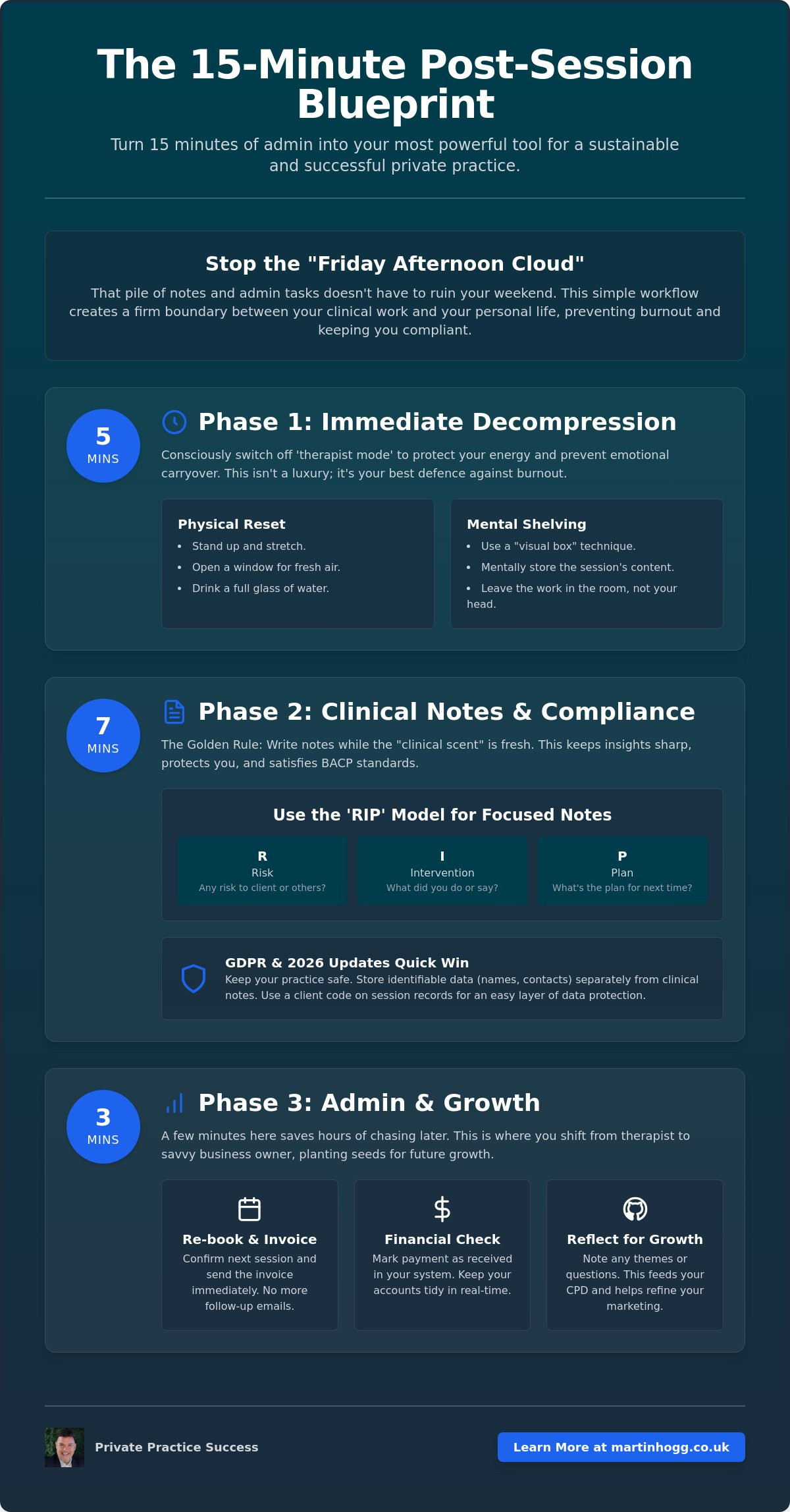
Closing the door at the end of an hour is a physical act, but our brains often need a bit more persuasion to follow suit. If you jump straight into your inbox or, heaven forbid, straight into another session, you are carrying the emotional weight of the last hour into the next. This "therapist mode" needs a conscious off-switch. Without it, you aren't just tired; you're heading for burnout. I've seen too many brilliant counsellors leave the profession because they never learned how to leave the work in the room. The 5-minute reset ritual you perform after the client session is your best defence against compassion fatigue.
The biggest mistake I see is the back-to-back schedule. It looks efficient on a spreadsheet, but it is a disaster for your mental health. You need a 15-minute buffer. This isn't just a "nice to have" luxury; it's a vital part of running a sustainable business. Emotional carryover is the #1 threat to a counselling private practice uk because it turns your professional life into a relentless endurance test that eventually erodes your empathy.
The Physical Reset: Moving Out of the Chair
Stand up. It sounds obvious, but sitting in the same spot for hours keeps you tethered to the clinical space. I recommend a few simple grounding techniques that don't feel like therapy clichés. Open a window to let fresh air in, or change the lighting by switching off a lamp. These small physical shifts signal to your nervous system that the transition has begun. Drink a full glass of water. Hydration is usually the first thing we sacrifice when we're deep in clinical work, but it's essential for clearing that post-session brain fog.
Mental Shelving: Putting the Work Away
We have to differentiate between healthy Reflective Practice and unhelpful rumination. Reflection helps you grow; rumination just keeps you awake at 2 AM. I suggest using a "visual box" technique. Mentally place the difficult material from the session into a sturdy box on a shelf. It's safe there, and you can take it out again when you're in supervision. This allows you to step back into your own life without bringing a client's trauma to your dinner table. It's about being a professional who cares, not a sponge that never gets wrung out.
Clinical Notes and GDPR: The UK Compliance Checklist
There is a "Golden Rule" in this business: write your notes while the "clinical scent" is still fresh in the room. If you wait until the end of the day, or worse, the end of the week, those nuanced insights start to blur. I've found that the ten minutes after the client session are the most efficient time to get this done. You aren't just ticking a box for the BACP; you're protecting yourself and your client by creating an accurate, contemporaneous record. It doesn't have to be a literary masterpiece. In fact, "rough and ready" notes that are finished today are infinitely better than perfect ones that never actually get written.
Staying compliant with UK law is a non-negotiable part of being a professional. The Data (Use and Access) Act 2026 has introduced some specific shifts we need to be aware of. For instance, as of June 2026, you must have a documented internal complaints procedure in place for data issues. It's also worth checking the latest ICO guidance on transparency to ensure your privacy notice is up to scratch. Using tools like WriteUpp or a simple encrypted folder system can take the headache out of this. If you're feeling overwhelmed by the admin side of things, joining a community like the Private Practice Success Membership can help you get these systems sorted once and for all.
The 7-Minute Note-Taking Framework
To keep things concise, I recommend the "RIP" model: Risk, Intervention, and Plan. Did anything happen that suggests a risk to the client or others? What did you actually do or say in the room? What is the plan for the next session? This structure keeps you focused on what matters for BACP standards and prevents you from writing an essay. It’s about clinical utility, not documenting every single word spoken.
GDPR and Data Privacy: The Essentials
A quick win for GDPR is separating your identifiable data from your clinical themes. Your "contacts" list, including names and phone numbers, should be stored separately from your actual session notes. Use a client code instead of a name on the clinical records. This way, if there is ever a breach, the data is much harder to piece together. Remember that under the 2026 rules, Data Subject Access Request (DSAR) timescales can be extended to three months for complex requests, but you still need a system that allows you to find everything quickly. Keeping things tidy after the client session makes this a breeze rather than a panic-inducing chore.
Reflective Practice as a Growth Tool
Reflective practice is often discussed in a purely clinical sense, but in a private practice, it acts as the essential bridge between your clinical skill and your business strategy. I want you to start looking at the minutes after the client session as a form of business intelligence. This is when the "aha" moments are most vivid. If you find yourself repeatedly thinking, "I wish I knew more about how to handle this specific trauma response," that is a clear signal it’s time to look for specific cpd for counsellors uk. Your practice grows when your expertise meets the actual needs of the people sitting in your chair.
These reflections don't just stay in your notebook; they should feed directly into your marketing for therapists uk. When a client uses a particular phrase to describe their struggle, or when you find a metaphor that really clicks, write it down. These are the exact words your future clients are typing into Google. Using real-world language instead of clinical jargon on your website makes you feel like a human being rather than a distant expert. If you want to refine this process and build a practice that feels truly yours, come and join us in the Private Practice Success Membership.
Spotting the 'Niche' Clues
Pay attention to your energy levels. Are you feeling most energised when working with men, or perhaps when helping people through complex grief? If you notice you're consistently more "switched on" with certain types of clients, that is your niche calling to you. Use these insights to update your Psychology Today or Counselling Directory profile. A specialist who speaks directly to one person's pain is always more attractive than a generalist who tries to help everyone. It’s about working smarter, not harder.
Preparing for Supervision
The best time to prepare for supervision is immediately after the client session, while the "stuck" points are still prickly and uncomfortable. I recommend keeping a dedicated supervision log alongside your clinical notes. Don't wait three weeks to try and remember why a particular interaction felt off. Note the countertransference or the moment you felt your internal "expert" take over. This habit ensures your supervision time is high-value and directly contributes to your professional trajectory.
Business Strategy: Retention and the Sustainable Practice
Most counsellors treat their business like a series of isolated events, but a sustainable practice is built on the threads that connect those events. The few minutes after the client session are when you decide if you are running a professional service or just a series of expensive hobbies. I want you to perform a "Retention Check." Ask yourself: did this session feel like a step forward or a plateau? If it felt like a plateau, don't panic. It's simply a prompt to look at your process or perhaps bring it to the Private Practice Success Membership for a second opinion.
Managing the "admin" of your business shouldn't be a weekend-long ordeal. If you handle invoicing and re-booking immediately, you stop the small tasks from snowballing into a mountain of dread. Using tools like Calendly or your practice management software right away keeps the momentum going. It moves you from a state of "solo struggle" to being a supported, organized business owner who actually has time for a cup of tea between sessions.
The Re-booking Routine
The best way to reduce "no-shows" is to ensure the next appointment is in the diary before the client even leaves the room. If that isn't possible, send the booking link or confirmation immediately after the client session. Relying on a client to "email you later" is a recipe for empty slots in your calendar. Automated reminders are your best friend here. They lower your mental load and act as a professional boundary that says your time is valuable.
Building Your Practice Blueprint
A visible and sought-after practice isn't built on luck or the "hope and pray" method of getting clients. It's built on consistent habits. When you treat the post-session window as a strategic business block, you are creating a blueprint for growth. You stop being reactive and start being the architect of your own career. Moving away from the "solo struggle" means realizing that you don't have to figure this all out by yourself. Real growth happens when you combine your clinical heart with a practical, business-focused head.
Building a Practice That Doesn't Eat Your Weekends
Running a private practice is a marathon, not a sprint. We've talked about how a simple five-minute reset can save your sanity and how getting your notes done while the "clinical scent" is fresh keeps you on the right side of the ICO. These habits turn those frantic minutes after the client session into a period of calm, professional growth. You aren't just a therapist; you're a business owner. When you start treating your admin and reflective practice as strategic tools, you'll find that the "Friday afternoon cloud" of dread finally starts to lift.
I've spent over 20 years in UK private practice, and I've learned that you don't have to do this alone. As a BACP-endorsed workshop provider, I offer practical, no-nonsense coaching that cuts through the fluff. If you're ready to build a practice that works for you, join the Private Practice Success Membership today. You've got the skills to help your clients. Now, let's make sure you have the systems to help yourself too. Keep going; you're doing better than you think.
Frequently Asked Questions
How long should I spend on clinical notes after the client session?
You should aim to spend between seven and ten minutes on your clinical notes. If you find yourself typing for twenty minutes or more, you're likely recording a transcript rather than a clinical summary. Focus on the essential "RIP" markers: Risk, Intervention, and Plan. Completing this immediately after the client session ensures the details are fresh and prevents that dreaded pile-up of paperwork on a Friday afternoon.
What is the best way to store therapist notes securely in the UK?
The most secure method is using GDPR-compliant practice management software like WriteUpp or Power Diary. These tools are built specifically for the UK landscape and handle the encryption and backup requirements for you. If you prefer a local system, use a dedicated, encrypted drive and ensure your identifiable client list is kept entirely separate from your clinical notes. This "double-lock" approach is a key part of staying compliant with the ICO.
Is it okay to have back-to-back therapy sessions without a break?
I wouldn't recommend it if you want a long and healthy career. Pushing through without a break leads to "emotional residue" where the feelings from one client bleed into the next. You need at least 15 minutes to reset your nervous system, grab a glass of water, and switch off "therapist mode" for a moment. This buffer isn't a luxury; it is a professional necessity for maintaining your clinical edge and preventing burnout.
What should I do if a client session was particularly distressing for me?
Prioritise a physical reset before you do anything else. Stand up, stretch, or even step outside for two minutes to signal to your body that the session is over. Use the "mental shelving" technique to put the distress away for now, and make a brief note in your supervision log. This ensures you don't forget the impact of the work, but it also gives you permission to stop carrying the weight of it until you're in a safe, supervised space.
Do I need to send a follow-up email after every therapy session?
No, and doing so can actually create unhelpful boundary issues. Unless you've specifically agreed to send a resource or a link, it's better to let the work in the room stand on its own. Constant follow-ups can make clients feel monitored and can significantly increase your unpaid admin time. If you need to handle re-booking, use an automated system like Calendly to keep the process professional and hands-off.
Disclaimer
The information provided on this blog is for general informational purposes only and is not intended to be a substitute for professional medical or mental health advice, diagnosis, or treatment. Reading this content does not create a therapist-client relationship.


