
Private Practice Marketing for Therapists: The 2026 UK Success Checklist

Article by
Martin Hogg
I help Private Practice counsellors in the UK set up and grow an ethical Private Practice they love, work with their ideal clients, and earn the income they deserve. All without guesswork and burnout. I have been a private practice counsellor myself for over 20 years, specialising in anger management. I set up a not-for-profit social enterprise, Citizen Coaching and Counselling, which delivers thousands of counselling sessions a year to adults and young people in Birmingham. I am a registered BACP Counsellor and the author of three books, My Anger Coach, My Anxiety Coach and My Relationship Coach. These are available on Amazon.
What if the very thing you're avoiding is actually the bridge between a struggling business and the clients who desperately need your support? Many UK counsellors feel that private practice marketing for therapists is somehow at odds with their clinical ethics. You might worry that being visible means being pushy, or perhaps you feel completely overwhelmed by the technical jargon of websites and SEO.
I understand that your heart is in the therapy room, not in a spreadsheet. It's exhausting when the phone doesn't ring and you're left wondering if you'll ever have a steady stream of private-pay clients. This guide is designed to change that. I'll show you how to build a professional online presence you can be proud of, without losing your integrity or your mind to tech overwhelm.
By following this 2026 success checklist, you'll learn how to streamline your visibility so you can spend less time worrying about your website and more time focusing on your clinical work. We'll look at practical, ethical steps to ensure your practice remains sustainable and reachable for years to come.
Key Takeaways
- Reframe your approach to visibility by viewing it as an ethical act of service rather than a pushy sales tactic.
- Master the skateboard model for private practice marketing for therapists to launch a functional website that attracts clients immediately without the tech overwhelm.
- Discover why a narrow niche is your greatest asset and how a simple weekly rhythm keeps your directory profiles performing at their best.
- Step away from the isolation of solo practice by embracing a CEO mindset and connecting with a community that understands your professional hurdles.
The Ethical Mindset: Why Marketing for Therapists is Actually an Act of Service
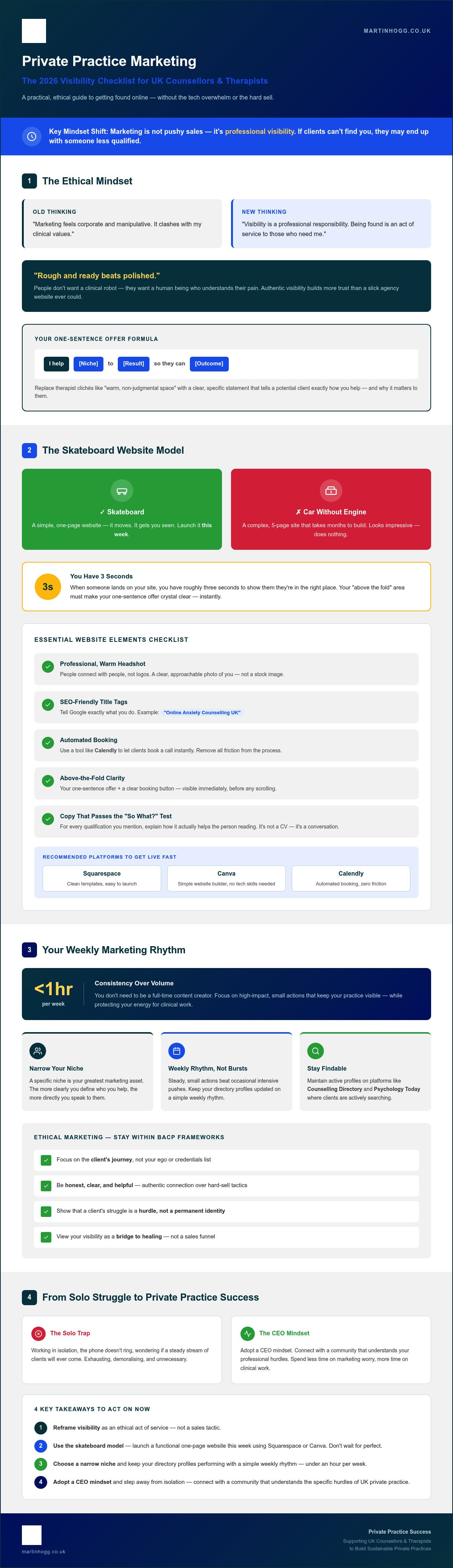
Many counsellors feel a knot in their stomach when they hear the word "marketing." It feels corporate and perhaps even a bit manipulative. But I want to offer you a different perspective. Within the psychotherapy profession, visibility is a professional responsibility. If a client in distress is searching for help and can't find you, they might end up with someone less qualified. Effective private practice marketing for therapists starts with this crucial mindset shift.
Marketing is simply professional visibility. It's about making sure the people you're uniquely trained to help can actually see your door. I often say that "rough and ready" beats a polished corporate facade. People don't want a clinical robot; they want a human being who understands their pain. Showing up authentically, even if it's not perfect, builds more trust than a slick agency website ever could.
Crafting Your One-Sentence Offer
To get started with private practice marketing for therapists, you need clarity. Instead of hiding behind clichés like "providing a warm, non-judgmental space," use a simple formula: I help [Niche] to [Result] so they can [Outcome]. This tells a potential client exactly what you do without the clinical fluff. You can find more help with this by exploring niche building secrets for counsellors.
The Ethics of Being Found
Being visible doesn't mean breaking your ethical code. You can stay firmly within BACP frameworks by being honest, clear, and helpful. Ethical marketing focuses on the client's journey, not your ego. It's about moving from a hard-sell to an authentic connection. When you view your visibility as a bridge to healing, the "icky" factor disappears. It becomes an act of service to those who need you most.
The "Skateboard" Website: Your Minimum Viable Visibility Checklist
Tech overwhelm often stops talented therapists from being seen. I recommend starting with the "skateboard model." A skateboard is a complete vehicle; it moves. A car without an engine is just a heavy box. In private practice marketing for therapists, a simple, one-page website beats a complex, unfinished project every time. Don't wait for a perfect five-page site that takes months to build. Use platforms like Squarespace or Canva to get a functional page live this week.
When someone lands on your site, you have about three seconds to show them they're in the right place. This is vital because of the wide range of talking therapies available in the UK; clients need to know specifically how you help. Ensure your "above the fold" area clearly states your one-sentence offer and includes a clear booking button to remove any friction.
Essential Website Elements Checklist
- A professional, warm photo: People connect with people, not logos. Use a clear headshot where you look approachable.
- SEO-friendly title tags: Use descriptions that tell Google exactly what you do, such as "Online Anxiety Counselling UK" or your specific area of expertise.
- Automated booking: Use a tool like Calendly to let clients book a call instantly.
- Practice tools: Use the Counsellor Efficiency Bundle to manage your new enquiries without the stress.
Writing Copy That Connects
Your website isn't an online CV. Clients care about their own pain, not your long list of certificates. For every paragraph you write, apply the "So What?" test. If you mention a qualification, explain how it actually helps the person reading. Focus on the restoration of their personal trajectory; show them that their current struggle is a hurdle, not a permanent identity. If you're feeling stuck on how to present yourself, joining a supportive community of peers can help you find the right words.
Your Weekly Marketing Rhythm: A Practitioner’s Practical Checklist
Consistency often feels like a heavy word, but in private practice marketing for therapists, it's about rhythm, not volume. You don't need to be a full-time content creator to maintain a steady stream of enquiries. By adopting proven small business marketing strategies, you can focus on high-impact actions that take less than an hour a week. This approach protects your energy for clinical work while ensuring your practice remains visible and reachable.
One of the biggest mistakes is trying to appeal to everyone. If your profile says you help with "anxiety, depression, trauma, and relationships," you risk helping no one. Specialising allows you to speak directly to a specific person's pain. It makes you the obvious choice rather than just another name on a long list. This clarity is the foundation of a sustainable practice.
The Directory Optimisation Checklist
- Lead with the struggle: Update your bio to start with the client's problem. Use "Are you feeling overwhelmed by..." instead of starting with your name and modality.
- Strategic linking: Ensure your directory profile points to your niche building secrets page to show you truly understand their specific experience.
The Referral Network Checklist
- Identify three partners: Look for non-competing professionals like nutritionists, HR managers, or local GPs who already serve your ideal clients.
- The helpful approach: Networking isn't about asking for favours. Ask "How can I help you?" to build a reciprocal bridge. This CEO mindset helps you build a community rather than working in isolation.
Social media shouldn't be a source of stress. Use Canva to create one simple, helpful tip each week that addresses a common hurdle your clients face. Remember that rough and ready content often feels more authentic and trustworthy than a polished corporate post. It's about being a stable, composed presence in your local community.
Moving from Solo Struggle to Private Practice Success
Building a thriving practice requires more than just clinical skill. It demands a shift in how you view your role. Moving from a solo struggle to success means adopting a "CEO mindset." This doesn't mean losing your heart or becoming corporate. It means recognising that your practice needs a stable structure to support both you and your clients. Private practice marketing for therapists is the engine that keeps that structure moving.
Isolation is one of the biggest hurdles in this profession. While some might suggest hiring a financial team, I believe the real key is community. You need peers who understand the weight of your work and the specific challenges of the UK market. My Practice Visibility Blueprint is designed to automate your client attraction, taking the guesswork out of being seen so you can focus on the therapy room.
Scaling Without Burnout
Success shouldn't come at the cost of your well-being. It's vital to set firm boundaries around your marketing time. If you spend all your energy worrying about your next enquiry, you'll have nothing left for your clients. For practical steps on maintaining your health while growing, have a look at my Therapist Burnout Guide. A sustainable practice is one where the practitioner is also thriving.
Your Next Steps
The most important thing you can do today is take one "imperfect" action. Stop overthinking the technical details and start being visible to those who need you. You don't have to figure this out alone. You can join a group of like-minded UK therapists in the Private Practice Success Membership. We provide the tools, the community, and the encouragement to help you restore your professional trajectory and build a future you're proud of.
Building Your Sustainable Future
Marketing your practice is no longer a hurdle to fear; it's the bridge to the people who need your clinical expertise. By adopting the skateboard model for your website and sticking to a simple weekly rhythm, you can create a professional presence that works for you. Private practice marketing for therapists is most effective when it's rooted in authenticity and a genuine desire to serve your local community.
As a BACP Professional Development partner, I've seen how the right tools transform a struggling practice into a thriving one. You don't have to navigate these technical or emotional challenges in isolation. Our UK-based support provides proven systems for rapid growth while ensuring you stay true to your clinical ethics.
You have everything you need to start being seen. Take that first imperfect step today and trust that your practice will begin to flourish as you reach those who need you most.
Frequently Asked Questions
Is it ethical for a therapist to use social media for marketing?
It's entirely ethical to use social media as long as you maintain clear professional boundaries and follow BACP guidelines. Think of it as professional visibility rather than a hard sell. By sharing helpful tips and normalising the therapy process, you are performing an act of service. Ethical private practice marketing for therapists focuses on providing value and being reachable for those in distress, rather than using manipulative sales tactics.
How much should a UK therapist spend on marketing each month?
There isn't a fixed monthly cost, but you should prioritise high-impact, low-cost activities over expensive advertising. Many UK therapists find that investing in a basic website and directory memberships is enough to get started. Instead of spending large sums on a polished corporate look, focus your resources on refining your message. A steady weekly rhythm of activity is far more valuable for your long-term success than a one-off expensive marketing campaign.
Do I really need a website if I am on Psychology Today?
You definitely need your own website because it serves as your digital home where you control the narrative. While directories are useful for discovery, they often feel crowded and competitive. Your own site allows you to explain your unique approach in detail without distractions. A simple, functional skateboard website reduces booking friction and helps potential clients feel a personal connection with you before they even pick up the phone.
What is the best way to get private pay clients in the UK?
Attracting private-pay clients requires you to stop being a generalist and start being a specialist. When you use the Practice Visibility Blueprint to define a clear niche, you become the obvious expert for a specific problem. This clarity builds trust much faster than a generic profile. By showing up consistently where your ideal clients look, you can build a practice that doesn't rely on low-cost insurance referrals or agency contracts.
How long does it take to see results from private practice marketing?
Results typically begin to appear within three to six months of establishing a consistent routine. Private practice marketing for therapists is a marathon, not a sprint. While a well-optimised directory profile might bring a call this week, building a trusted brand and a robust referral network takes time. Focus on taking one small, imperfect action every seven days to ensure your growth remains stable, manageable, and ethically sound.
Disclaimer
The information provided on this blog is for general informational purposes only. It is also not intended to be a substitute for professional medical or mental health advice, diagnosis, or treatment. Reading this content does not create a therapist-client relationship.


