
Private Practice Marketing Plan for UK Therapists

Article by
Martin Hogg
I help Private Practice counsellors in the UK set up and grow an ethical Private Practice they love, work with their ideal clients, and earn the income they deserve. All without guesswork and burnout. I have been a private practice counsellor myself for over 20 years, specialising in anger management. I set up a not-for-profit social enterprise, Citizen Coaching and Counselling, which delivers thousands of counselling sessions a year to adults and young people in Birmingham. I am a registered BACP Counsellor and the author of three books, My Anger Coach, My Anxiety Coach and My Relationship Coach. These are available on Amazon.
What if the most effective way to grow your practice has nothing to do with "selling" yourself at all? Most UK therapists I talk to find the idea of a private practice marketing plan a bit grubby. You didn't invest years of training and thousands of pounds in professional development just to spend your evenings faffing about with social media or feeling like a pushy salesman. It's exhausting dealing with inconsistent enquiries. You worry about where the next private-pay client is coming from, and it drains your energy.
I understand that discomfort, but I also know that people in pain are looking for you right now. I'll show you how to build a simple, ethical system that attracts your ideal counselling clients without compromising your professional soul. We'll look at how to move past the overwhelm of technical SEO by focusing on what actually works for a local practice. I'll guide you through a practical framework that runs in the background, giving you a steady stream of clients and the confidence you deserve.
Key Takeaways
- Reframe marketing as an ethical duty to ensure clients in pain can find your support instead of settling for a less suitable therapist.
- Learn why a simple, one-page "skateboard" website is often more effective at connecting with clients than a complex, multi-page beast.
- Discover how to optimise your directory listings and use basic SEO to make your private practice marketing plan work in the background.
- Establish a sustainable "Marketing Hour" once a week to keep your practice visible without letting technical tasks take over your life.
The Mindset Shift: Why Your Marketing Plan Starts with Connection, Not Selling
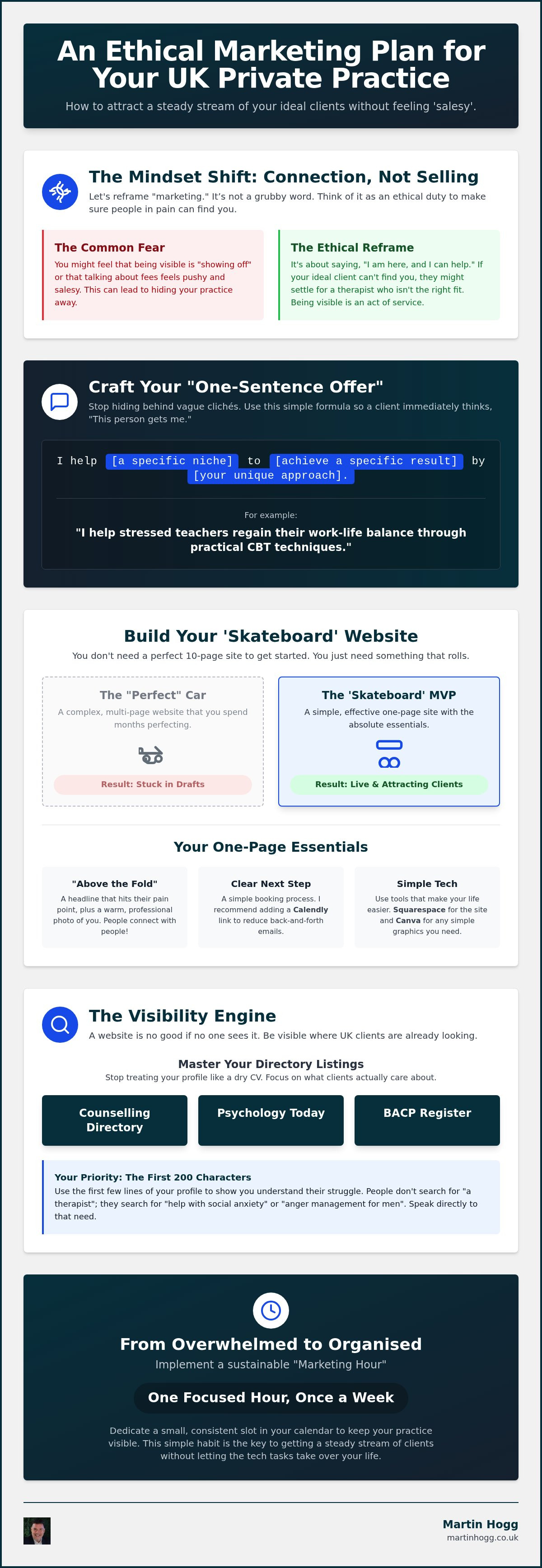
Many therapists feel a bit sick when they hear the word "marketing". It conjures up images of slick adverts and aggressive sales tactics. I want to shift that perspective. Your private practice marketing plan isn't about convincing someone to buy something they don't need. It is simply about being visible to the person who is already searching for help. If you don't show up, they can't find the support they need.
Think of it as an ethical duty. If a potential client can't find you, they might end up with a coach who isn't qualified or a therapist who isn't the right fit. While the standard elements of a marketing plan usually focus on corporate growth, ours focuses on human connection. I've always found that rough and ready content beats a polished, corporate image every time. People want to see a real human being, not a distant medical professional.
Addressing the "Salesy" Fear
We often feel imposter syndrome when talking about fees or services. You might worry that being visible looks like showing off. It isn't. It is about saying, "I am here, and I can help." Talk about what you do in plain English. Avoid the clinical jargon. If you speak like a person, you'll attract people. A solid private practice marketing plan prioritises being found over being perfect.
The One-Sentence Offer Framework
To make this work, you need a clear "one-sentence offer." This stops you from hiding behind vague therapist clichés. The formula is simple: I help [specific niche] to [achieve specific result] by [your unique approach]. For example, "I help stressed teachers regain their work-life balance through practical CBT techniques."
Defining this is the first step in niche building for counsellors. When you get this right, a potential client lands on your page and thinks, "That person finally gets me." It creates an immediate sense of safety and professional authority.
Building Your Skateboard: The Minimum Viable Marketing Infrastructure
I often see therapists get stuck building a "perfect" website. They spend months on a ten-page site that never launches because they're worried about every comma. I recommend the "skateboard model" instead. If you want to get from A to B, you don't need a car yet; you just need something that rolls. A one-page MVP (Minimum Viable Product) site is your skateboard. It's the core of a simple private practice marketing plan because it gets you in front of clients now, not in six months.
Essential Elements of a One-Page Website
What happens "above the fold"? That's the part of the screen visible before anyone scrolls. You need a headline that hits the client's pain point immediately. Don't lead with your BACP letters; tell them you understand why they're feeling overwhelmed. Pair this with a warm, professional photo. People connect with people, not clinical logos. Use Squarespace for the site and Canva for your images. To make the booking process seamless, add a Calendly link. This reduces friction, letting clients book a call without a long email chain. If you want to speed this up, the Counsellor Efficiency Bundle helps streamline these technical bits.
Why "Done" is Better Than "Perfect"
Launching a "good enough" site is infinitely better than hiding a "perfect" one that never goes live. You can always add pages later. Right now, you just need a digital front door that works. If you're feeling isolated while trying to get your tech sorted, joining the Private Practice Success Membership can provide the peer support you need to finally hit "publish". A simple site that exists will always outperform a complex site that is still a draft.
The Visibility Engine: Getting Found Where UK Clients Are Looking
Marketing isn't just about having a website. It's about showing up exactly where people are already looking for help. In the UK, that usually means the Counselling Directory, Psychology Today, or the BACP register. If your private practice marketing plan relies on being a generalist, you're going to struggle to stand out. People rarely search for "a therapist" in a vacuum. They search for "help with social anxiety" or "anger management for men."
Directory Mastery for UK Counsellors
Stop treating your directory profile like a dry CV. Potential clients don't really care where you went to university or how many years you spent in training. They care if you understand their current struggle. The first 200 characters of your summary are vital. That's often all people see in the search results before deciding to click. If those characters don't hook them, they'll scroll right past you. Focus on the transformation you offer. This is where Niche Building Secrets becomes your best friend. Don't forget basic SEO either. Use your title and description tags on your site to tell Google exactly who you are and where you're based.
Networking That Does Not Feel Like Networking
You don't need to attend awkward business breakfasts or hand out glossy cards. Real networking is about building a referral base with "adjacent" professionals. Connect with local GPs, HR managers, or even other therapists. Reach out to colleagues who are already full and looking for a trusted place to send their enquiries. Most therapists would love to have a reliable person to refer to when their own books are closed. It's about being helpful, not being a salesperson.
From Overwhelmed to Organised: Implementing Your Practice Visibility Blueprint
I know how it feels to have a "to-do" list that never seems to get shorter. When you are trying to grow your business, it's easy to get lost in the weeds of technical tasks. The Practice Visibility Blueprint isn't about doing everything at once. It is about moving from a chaotic list to a structured private practice marketing plan that relies on small, consistent actions. I always suggest setting a "Marketing Hour" once a week. Put it in your diary and treat it as a non-negotiable appointment. This keeps your momentum going without marketing taking over your life.
Joining a Community of Peers
You shouldn't try to grow your practice in a vacuum. It is lonely work, and self-doubt often creeps in when you are working solo. The Private Practice Success Membership provides the live training and accountability you need to stay on track. Having a mentor who understands the specific nuances of the UK therapy landscape changes the game. It turns a daunting project into a series of manageable steps alongside people who actually get it.
Your 30-Day Action Plan
It is time to transition from learning to doing. Use this simple four-week framework to get moving:
- Week 1: Define your niche and one-sentence offer.
- Week 2: Build your "skateboard" one-page site using Squarespace.
- Week 3: Optimise your Counselling Directory and Psychology Today profiles.
- Week 4: Reach out to adjacent professionals for referrals.
If you need more help with the specifics of each step, read my supplementary guide on how to get counselling clients UK. Stop overthinking and start being visible. Your future clients are waiting for you to show up.
Time to Put Your Plan into Action
Building a sustainable practice doesn't require you to become a tech genius or a pushy salesperson. It's about shifting your mindset to see marketing as an ethical way to help those in distress find you. By starting with a simple "skateboard" site and optimising your presence on UK directories, you create a private practice marketing plan that actually works in the background. You don't have to get it perfect; you just have to get it done.
Don't let the fear of visibility keep your books empty. You've got the tools now to move from overwhelm to a structured routine. Whether it's setting your weekly Marketing Hour or finally defining your niche, every small step counts. If you want to move faster without the guesswork, come and join us.
You will get immediate access to the Practice Visibility Blueprint, live weekly training sessions, and a supportive community of UK therapists who are on the same journey. I'm looking forward to seeing your practice thrive.
Frequently Asked Questions
How much time should I spend on marketing my private practice each week?
I recommend setting aside just one "Marketing Hour" each week to focus on your business. You don't need to spend hours every day faffing about with complicated strategies. Consistency is much more important than volume. Use this time to update your directory profile or tweak your website copy. By making this a non-negotiable appointment in your diary, you ensure your private practice marketing plan stays active without it becoming a second full-time job.
Do I really need to be on social media to get counselling clients in the UK?
No, you absolutely do not need to be on social media to build a thriving practice. Many therapists find platforms like Instagram or TikTok overwhelming and performative. While some find success there, most UK clients still start their search on Google or professional directories. If the thought of posting daily reels fills you with dread, focus your energy on your website and directory listings instead. People connect with people, not just curated feeds.
What is the most effective directory for therapists in the UK?
The most effective directories in the UK are generally the Counselling Directory and Psychology Today. These sites have high search engine authority, meaning they often appear at the top of Google results. However, simply being listed isn't enough. You need to optimise your profile so it speaks directly to your niche. Don't forget the BACP register, as many clients use it to verify your credentials and professional standing before booking a session.
How long does it take for a marketing plan to start showing results?
You can often see enquiries from directory listings within a few days or weeks if your profile is well-written. Technical SEO on your own website usually takes longer, often three to six months, to show a significant impact on your search rankings. A solid private practice marketing plan balances these quick wins with long-term strategies. Patience is key, but you should see momentum building steadily as your visibility increases across different platforms.
Is it ethical to use SEO and marketing tactics for a therapy practice?
It is entirely ethical to use marketing when your goal is to help people find the support they need. Marketing isn't about manipulation; it is about visibility. If you have the skills to help someone in distress, it is your responsibility to make sure they can find you easily. Using clear language and simple SEO is just a way of being accessible to the people who are already looking for your specific expertise.
Disclaimer
The information provided on this blog is for general informational purposes only. It is also not intended to be a substitute for professional medical or mental health advice, diagnosis, or treatment. Reading this content does not create a therapist-client relationship.


