
Private Practice Therapist Salary UK: Realistic Earnings and Costs in 2026
Gross income is a vanity metric that often hides the stressful reality of what you actually take home at the end of the month. You likely spent years training to help people, not to spend your weekends staring at spreadsheets or worrying about the taxman. It’s completely normal to feel a sense of dread when thinking about leaving a stable, yet exhausting, salaried position for the uncertainty of being your own boss. You want the freedom to work your own way, but the fear of inconsistent income and the "sales" side of the business often keeps you stuck in a role that no longer fits.
I want to take that weight off your shoulders by providing a transparent breakdown of a realistic private practice therapist salary uk as we look toward 2026. We'll move past the surface-level numbers to look at the 35% to 40% of your earnings that typically go toward overheads like supervision, insurance, and room hire. This guide provides a practical framework to set fees that reflect your worth and cover your life. It's about giving you the confidence to build a sustainable practice that serves both you and your clients without the constant financial anxiety.
Key Takeaways
- Understand the practical difference between your gross revenue and what you actually keep, helping you compare private work with NHS Band 6 and 7 roles.
- Learn how to set your fees with confidence and why lower rates might actually stop the right clients from reaching out to you.
- Get a clear view of the essential monthly costs, from BACP memberships to supervision, that every UK therapist needs to account for.
- See realistic case studies of what a private practice therapist salary uk looks like after you have set aside 25-30% for HMRC and National Insurance.
- Discover how to build a more sustainable income by moving beyond hourly sessions and introducing workshops or group work into your practice.
The Financial Reality of Moving into Private Practice
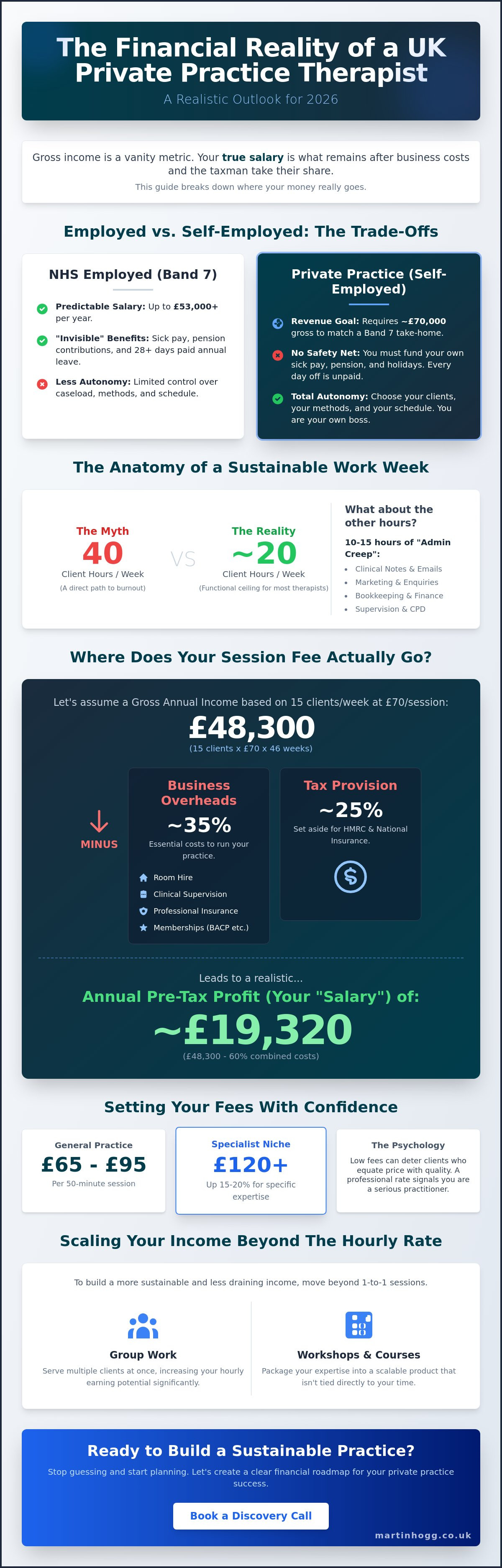
I often speak with counsellors who feel ready to leave the NHS or agency work. They see a session fee of £60 or £70 and multiply it by 40 hours. This is where the trouble starts. Your private practice therapist salary uk isn't your gross turnover. As a sole trader, your actual "salary" is only what remains after you've paid for your room hire, your supervision, your professional insurance, and the taxman. It's vital to distinguish between the money coming into your bank account and the money you can actually spend on your life.
By 2026, NHS Band 6 salaries are expected to range between £37,000 and £45,000, while Band 7 roles will likely reach beyond £53,000. These roles come with "invisible" benefits like sick pay and a death-in-service benefit. To match a Band 7 take-home pay in private practice, you often need to generate closer to £70,000 in gross revenue. The "six-figure therapist" stories you see on social media are often myths or involve running a large agency with multiple associates. For most solo practitioners, a sustainable reality is earning a comfortable, professional living that respects your energy levels.
Your income is now directly tied to your "business owner" hat, not just your clinical skill. You might be the most gifted practitioner in the West Midlands, but if you don't manage your marketing and finances, your practice won't survive. If you're feeling overwhelmed by these numbers, you can book a time on my calendar to discuss your specific situation. Success in this field requires a shift from being a clinical employee to becoming a practical entrepreneur.
Employed vs. Self-Employed: The Trade-offs
When you're employed, your 5% or 10% pension contributions and 28 days of annual leave are guaranteed. Moving to private work means you lose these safety nets immediately. You have to fund your own retirement and every day you take off is a day you don't get paid. However, the value of clinical autonomy is significant. You choose your own clients and work in the way that best supports your training in psychotherapy. Be prepared for a "ramp-up" period of 6 to 12 months before your private practice therapist salary uk becomes stable and predictable.
Realistic Client Numbers for Full-Time Work
Many new therapists plan for 30 clients a week, but they soon find this is a recipe for exhaustion. In my experience, 20 client hours per week is the functional ceiling for most full-time solo workers. You have to account for "admin creep," which is the 10 to 15 hours spent each week on emails, clinical notes, and bookkeeping. Clinical capacity is the balance between generating enough income to live well and maintaining the emotional space to avoid burnout. If you push past your capacity, the quality of your work suffers, and so does your reputation.
Setting Your Fees: The Revenue Equation for UK Therapists
Thinking about your fee isn't just about picking a number that feels safe. It's about ensuring your practice stays open so you can actually help people. In 2026, the average private practice therapist salary uk is heavily influenced by how you value your time. While the National Careers Service highlights starting salaries in the NHS around £43,742, private practitioners have more control, and more responsibility, over their income. Most established therapists in the UK are now charging between £65 and £95 per session for general work, with specialists often reaching £120 or more.
There's a specific psychology to pricing that we can't ignore. If your fees are too low, you might think you're being accessible, but you might actually be deterring the very people you want to help. Clients often equate price with quality. A fee that feels "too cheap" can trigger an internal alarm for a client, making them wonder if you're truly equipped to handle their deepest struggles. When you set a professional rate, you signal that you're a serious practitioner who invests in supervision, training, and a safe environment.
To find your Minimum Viable Fee (MVF), you need to work backwards from your life. Total up your mortgage, bills, savings, and business overheads, then add a 25% buffer for tax. Divide this by the number of weeks you'll actually work. This number is your baseline. If you're offering specialist support like Anger Management or specifically working with men, you should adjust your rates upward by at least 15% to 20%. These niches require specific expertise and often involve more intensive work, which justifies a higher fee.
The Math of a Sustainable Week
I always suggest planning for a 42-week working year. This allows 10 weeks for holidays, illness, and professional development. If you see 20 clients a week at £70, your annual turnover is £58,800. If you increase that fee by just £10 to £80, your turnover jumps to £67,200. That £10 shift creates an extra £8,400 a year, which can be the difference between struggling and thriving. If you want to offer sliding scale slots for those on lower incomes, limit them to 10% of your practice to protect your average hourly rate.
Overcoming Fee Anxiety
It's common to feel a twinge of guilt when charging for "help." You're a compassionate person, and you want to be there for others. However, remember that you're not just "talking"; you're providing a structured, professional intervention that helps someone get their life back on track. When it's time to increase fees for existing clients, be direct and give at least 60 days' notice. Frame it as a necessary step to maintain the quality of the service you provide. If you're feeling stuck on how to structure your business, we could always have a quick chat via my online calendar to look at your specific situation.
Understanding Your Overheads: The Hidden Costs of Going Solo
When you look at a private practice therapist salary uk, the gross figure on your monthly invoice is only half the story. To run a safe, ethical, and sustainable practice, you have to account for the "hidden" costs that chip away at your take-home pay. It's easy to get excited about a £60 or £80 hourly rate, but without a clear budget, you might find yourself working harder for less than you expected. You're not just a healer now; you're a small business owner, and that requires a shift in how you view your finances.
Clinical and Professional Expenses
Professional supervision isn't just a box-ticking exercise for your accreditation; it's your primary safety net. In 2026, expect to pay between £50 and £90 per hour for quality supervision. Trying to save money here is a false economy because poor clinical support leads to burnout and isolation. You also need to factor in your annual membership fees for bodies like the BACP or UKCP, which usually range from £150 to £300. Don't forget your Professional Indemnity Insurance and the mandatory ICO data protection fee, which adds another £120 to £160 to your yearly outgoings. According to Prospects.ac.uk, these overheads are standard across the industry and must be factored into your hourly rate from day one.
Continuous Professional Development (CPD) is another essential investment. To maintain your skills and stay relevant in a changing field, you should budget at least £300 to £500 a year for workshops and training. This isn't just about points on a portfolio; it's about providing the best possible results for your clients so they can get their lives back on track.
Operational and Marketing Costs
Your physical or digital workspace is often your largest monthly bill. If you're hiring a room in a city like Birmingham or Manchester, you'll likely pay between £12 and £25 per hour. Some therapists prefer a block-booking model to reduce costs, while others stick to online work to save on travel and rent. Even if you work from home, you'll need professional software. Practice management tools, encrypted email services, and payment processing fees, which are usually around 1.5% to 3% per transaction, are essential for a modern practice.
Visibility isn't free. Whether it's a monthly fee for a directory like Psychology Today or investing in your own website, you need a marketing budget. I often see therapists struggle with the fear of being seen, but without a clear strategy, your practice won't grow. For a deeper look at how to reach the right people without feeling "salesy," check out this guide on Marketing for Therapists in the UK. Budgeting around £50 to £100 a month for marketing is a realistic starting point for most solo practitioners in the current climate.
Realistic Net Income: What You Actually Take Home
If you have ever looked at your bank balance at the end of a busy month and wondered where the money went, you are not alone. It is a common struggle in our profession. We see the fees coming in, but we often forget that a large portion of that money does not actually belong to us. To understand your true private practice therapist salary uk, you must get comfortable with a concept I call "The Pot."
The Pot is a separate space where you immediately move 25% to 30% of every single fee you receive. This covers your future tax bill and National Insurance. Many therapists feel broke because they treat their business account like a personal wallet. When the tax bill arrives in January, it feels like a crisis rather than a planned expense. I strongly recommend opening a separate business bank account. It provides the psychological clarity you need to see what is yours and what belongs to HMRC.
Consider the difference between two types of practice. A general therapist charging £50 per hour might see 20 clients a week, bringing in £1,000. However, after room hire, supervision, and "The Pot," their actual take-home pay might be less than someone working as a specialist. A specialist charging £80 per hour only needs to see 12 clients to earn nearly the same amount, but with significantly lower overheads and less emotional fatigue. Practicality should always win over pride when setting your rates.
The Tax and NI Breakdown
For the 2026 tax year, your personal allowance is expected to remain at £12,570. This means you do not pay income tax on your first £12,570 of profit. Beyond that, you will likely pay the 20% basic rate. You also need to factor in Class 4 National Insurance contributions, which are currently 6% on profits between £12,570 and £50,270. Most therapists start as Sole Traders because it is simpler. However, if your private practice therapist salary uk begins to exceed £50,000 in profit, it might be time to talk to an accountant about the benefits of becoming a Limited Company to manage your tax more efficiently.
The "Salary" Calculation Example
Let's look at a realistic example. If you see 15 clients a week at £65 per hour and work 46 weeks a year, your total turnover is £44,850. After deducting roughly £8,000 for expenses like supervision, insurance, and room hire, your profit is £36,850. After tax and National Insurance, you are left with approximately £30,500. To keep your life stable, don't just withdraw what is left. Pay yourself a consistent monthly "wage" of £2,500. This helps you manage the months when clients go on holiday or when you need a break yourself. For more help on keeping your business healthy, you can read this guide on Counselling Private Practice UK.
If you want to look at your specific numbers and see how to make your practice more sustainable, let's have a conversation. You can book a time in my calendar here.
Scaling Your Income: Beyond the Hourly Rate
If you rely solely on one-to-one sessions, you will eventually hit a financial ceiling. There are only so many hours in a week, and your energy is not an infinite resource. To truly grow your private practice therapist salary uk, you need to move away from trading every single hour for a set fee. Relying on a single income stream is often what leads to burnout and financial plateau.
Diversifying your work allows you to reach more people while protecting your own wellbeing. You might consider running therapeutic groups, where eight participants pay £25 each for a 90-minute session. This generates £200 for the same block of time that usually brings in £50 to £70. Other options include hosting workshops on specific themes like anxiety management or offering accredited training to fellow professionals. These "one-to-many" models ensure that your income isn't strictly tied to the number of hours you sit in the therapy chair.
The Power of Professional Visibility
When you are easy to find online and in your local community, you stop feeling the pressure to discount your rates. Many counsellors lower their fees because they fear the next client won't come along, but this is a symptom of low visibility rather than a reflection of the market. Using a structured approach like the Practice Visibility Blueprint helps you build a reputation that keeps your diary consistently full. A well-managed waiting list is the ultimate form of salary protection because it ensures that a single cancellation or a client ending their therapy doesn't create a hole in your budget.
Support for Your Journey
The "isolation tax" is a very real cost of running a solo practice. It is the money you lose by making avoidable marketing mistakes, overpaying for software, or staying stuck in a low-fee mindset because you don't have a peer group to challenge you. You don't have to figure out the business side of therapy by yourself. The Private Practice Success Membership is designed to help you handle these financial hurdles alongside a community of people who understand exactly what you are going through.
Moving from a struggling practice to a thriving business requires a shift in how you view your time and your value. It is about being practical, staying grounded, and taking small, consistent steps toward a more sustainable way of working. If you are ready to start making these changes, check our upcoming training and events to help grow your practice and build the professional life you deserve.
Building a Sustainable Future for Your Practice
Success in private practice isn't just about the number of clients you see; it's about the clarity of your business model. We've looked at how the private practice therapist salary uk is shaped by the balance between your hourly fee and the rising costs of room hire, supervision, and professional insurance. By calculating your net profit instead of just focusing on gross turnover, you can ensure your practice remains financially healthy through 2026 and beyond. It's about working smarter, not just harder.
I've spent over 15 years coaching UK therapists, helping them move past the self-doubt that often comes with setting fees. Through my BACP-endorsed workshops and CPD, I provide practical, no-nonsense business strategies that actually work for counsellors. You deserve a career that is as rewarding for you as it is for your clients. If you're ready to take the next step, join the Private Practice Success Membership to scale your earnings. Let's work together to get your practice exactly where you want it to be.
Frequently Asked Questions
Is it realistic to earn £50,000 a year in private therapy practice in the UK?
Yes, earning £50,000 is achievable if you manage your caseload and overheads with a business mindset. If you see 16 clients a week at £75 per session for 44 weeks of the year, your gross income reaches £52,800. You'll need to account for costs like supervision and room hire, but this level of income is a standard benchmark for established UK practitioners who value their professional time.
How many clients do I need to see to match an NHS Band 7 salary?
To match a mid-point NHS Band 7 salary of roughly £45,000, you'll likely need to see 18 to 20 clients per week. This calculation takes into account that as a self-employed therapist, you don't get paid for holidays or sick leave. Your private practice therapist salary uk must also cover your own pension contributions and National Insurance, which typically adds about 15% to your necessary gross turnover.
What are the most common tax-deductible expenses for UK therapists?
You can deduct any cost that's exclusively for your business, such as professional supervision, indemnity insurance, and annual membership fees for bodies like the BACP. Other common expenses include room rental, website hosting, and the cost of CPD courses. If you work from home, you can also claim a proportion of your utility bills based on the hours you spend in your home office.
Should I charge for initial assessments or offer them for free?
I recommend charging for your initial assessment because it's a skilled clinical intervention that sets the tone for the therapeutic work. Some therapists offer a free 15 minute phone call to check for fit, but a full assessment takes significant time and expertise. Charging your standard fee from the start reduces the risk of no-shows and ensures you're compensated for your professional energy.
How much should I set aside each month for my tax bill?
You should save at least 25% of everything you earn to cover your Income Tax and National Insurance liabilities. It's helpful to move this money into a separate savings account the moment a client pays you. This habit prevents the stress of a surprise bill in January and ensures you have the funds ready for your payments on account to HMRC throughout the year.
Can I run a profitable private practice only seeing clients online?
You can certainly run a profitable practice entirely online, and many therapists now prefer this model for its lower overheads. By removing the cost of a physical office, which often takes £10 to £15 per hour from your pocket, you increase your profit margins significantly. It also allows you to reach clients across the UK rather than being limited to your specific local post code.
How often should I review and increase my therapy fees?
Review your fees every year in April to ensure your private practice therapist salary uk keeps pace with rising living costs. Small, incremental increases of £5 are much easier for clients to manage than a large jump every three years. Being transparent about your rates helps build trust and shows that you value your professional development and the quality of service you provide.
What happens to my income if a client cancels at the last minute?
Your income stays stable when you implement a firm 48 hour cancellation policy that's clearly explained in your initial contract. If a client cancels late, you should charge the full session fee to cover your time and potential room costs. While it feels difficult at first, holding this boundary is essential for your financial health and helps maintain the therapeutic frame for the client.

Article by
Martin Hogg
I help Private Practice counsellors in the UK set up and grow an ethical Private Practice they love, work with their ideal clients, and earn the income they deserve. All without guesswork and burnout. I have been a private practice counsellor myself for over 20 years, specialising in anger management. I set up a not-for-profit social enterprise, Citizen Coaching and Counselling, which delivers thousands of counselling sessions a year to adults and young people in Birmingham. I am a registered BACP Counsellor and the author of three books, My Anger Coach, My Anxiety Coach and My Relationship Coach. These are available on Amazon.
Disclaimer
The information provided on this blog is for general informational purposes only and is not intended to be a substitute for professional medical or mental health advice, diagnosis, or treatment. Reading this content does not create a therapist-client relationship.


