
Psychology Today for Therapists: How to Actually Get Clients in 2026

Article by
Martin Hogg
I help Private Practice counsellors in the UK set up and grow an ethical Private Practice they love, work with their ideal clients, and earn the income they deserve. All without guesswork and burnout. I have been a private practice counsellor myself for over 20 years, specialising in anger management. I set up a not-for-profit social enterprise, Citizen Coaching and Counselling, which delivers thousands of counselling sessions a year to adults and young people in Birmingham. I am a registered BACP Counsellor and the author of three books, My Anger Coach, My Anxiety Coach and My Relationship Coach. These are available on Amazon.
Are you paying £19.95 every month just to feel like digital wallpaper? I see so many counsellors treat psychology today for therapists as a chore rather than a business strategy. It's incredibly frustrating to pay a subscription and get zero leads back, especially when you feel like a tiny fish in a massive directory pond. You might even feel a bit cringey about the marketing side of things, worrying you'll sound too 'salesy' or lose your professional integrity in the process.
I'll show you how to transform your profile from a static listing into a high-converting client magnet using my mentor-led visibility strategy. We're going to move past the clinical jargon and look at what actually makes a person click 'email' when they're in distress. I'll preview the specific tweaks needed to your 'above the fold' content and how to craft a 'one-sentence offer' that actually works. By the end, you'll have a practical plan to stand out and start attracting the right clients without the usual overwhelm.
Key Takeaways
- Stop treating your listing as a box-ticking exercise and learn how to escape the "visibility trap" where you're seen but never actually booked.
- See why psychology today for therapists often outranks private websites and how to use that SEO advantage to reach your specific niche.
- Swap clinical jargon for a clear "one-sentence offer" to ensure your profile connects with overwhelmed people instead of confusing them.
- Apply the "skateboard model" to turn your profile into a powerful minimum viable product that builds authority without needing a complex website yet.
Why Psychology Today for Therapists is the UK's Most Popular Directory (And Why Your Profile is Failing)
I see too many counsellors join Psychology Today as a simple box-ticking exercise. You get your insurance, you join the BACP, and you set up your profile. It feels like a chore rather than a business strategy. But just being listed isn't enough. I call this the 'Visibility Trap'. You're on the list. But you're effectively invisible because you look exactly like the hundreds of other therapists in your area.
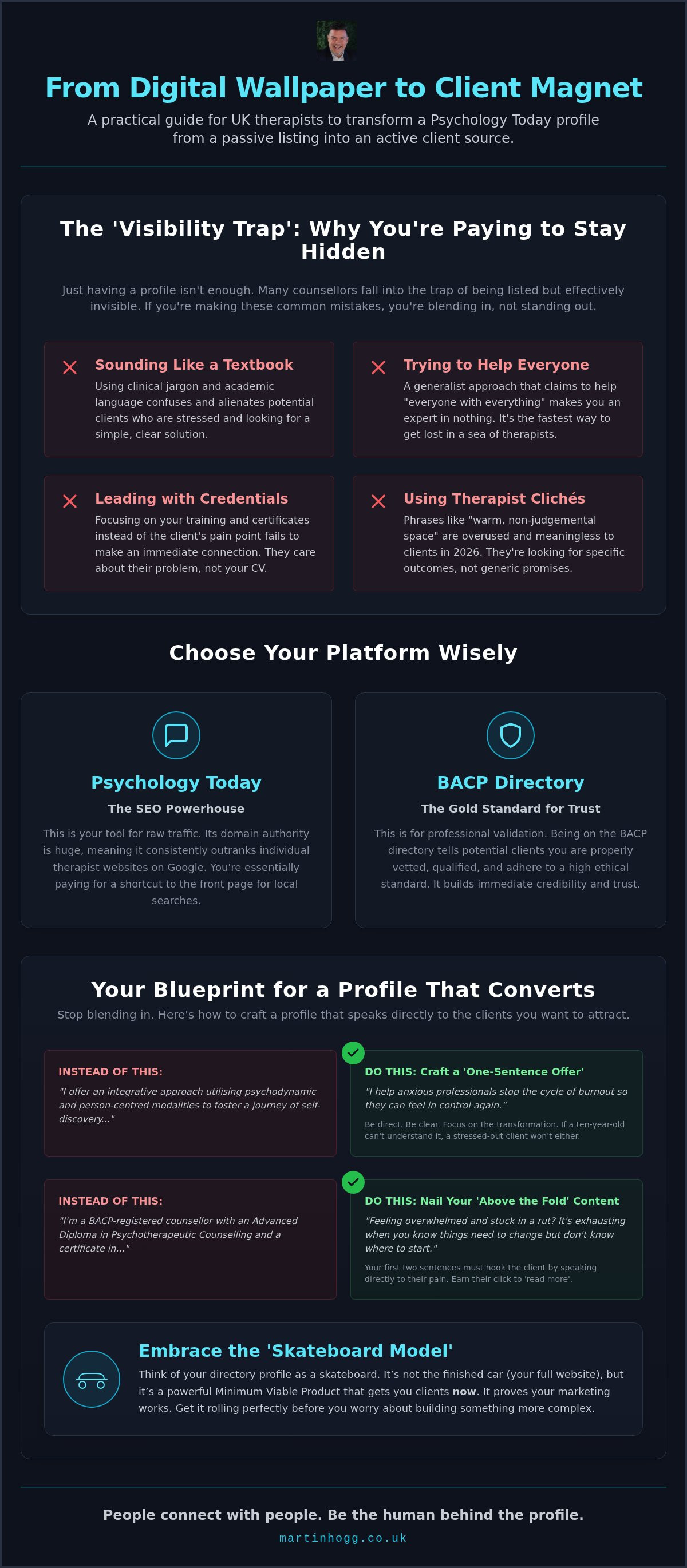
If your profile mentions providing a 'warm, non-judgemental space', you're actually paying to stay hidden. It's the quickest way to blend into the background. Clients in 2026 are looking for solutions to specific problems, not therapist clichés. You want to be the answer to their late-night Google search. Generally, profiles fail for these reasons:
- Sounding like an academic textbook rather than a human being.
- Trying to help everyone with everything.
- Focusing on your training certificates instead of the client's pain.
The Reality of Directory ROI in 2026
At £19.95 a month, psychology today for therapists is a total bargain if you convert just one client. It's a waste of cash if you're a generalist. The reason this platform is a must-have for UK private practices is its sheer SEO power. It consistently outranks individual therapist websites on Google for local searches. You're essentially paying for a shortcut to the front page.
However, you only have seconds to grab attention. Your 'above the fold' content, specifically those first two sentences, must do the heavy lifting. If those lines don't speak directly to a client's pain, they won't click 'read more'. This is where your niche building secrets come into play. You need to stop being everything to everyone. Focus on the transformation you offer. If a ten-year-old can't understand what you do from those first two lines, a stressed-out client certainly won't either.
Choosing Your Platform: Psychology Today vs. Counselling Directory vs. BACP
I suggest looking at where your specific niche hangs out before you part with your cash. Not all directories are created equal, and your choice depends on whether you want professional validation or raw traffic. One of the biggest advantages of using psychology today for therapists is the SEO juice. It almost always outranks individual websites because Google trusts large, established directories. If you don't have a massive marketing budget, riding on their coat-tails is a smart move.
The BACP directory is the gold standard for building professional trust. It tells clients you're vetted and qualified. However, Psychology Today is often the one driving high-volume traffic. While BACP is about your credentials, Psychology Today is about the client's search. When setting up psychology today for therapists, remember that your profile is a bridge, not a CV. You should use filters and the 'Ideal Client Matches' feature properly to ensure you aren't just attracting tyre-kickers who aren't a fit for your way of working.
Which Directory Fits Your Niche?
Different platforms suit different specialisms. For example, if you're working with men, you'll want a platform that allows users to filter by specific, practical issues rather than just generic counselling labels. You should also check your title and description tags. This is the text that appears in Google search results before a client even clicks. If your snippet looks like a clinical list of acronyms, people will scroll right past you.
Getting this right saves you from the frustration of paying for a listing that sits silent. If you want to refine your approach and see what's working for others in the UK, joining a supportive community of therapists can provide the clarity you need to grow your practice with confidence.
Crafting a Psychology Today Profile That Actually Converts
Your profile shouldn't be a list of your qualifications. It needs to be a bridge between a person's current distress and a better future. When setting up psychology today for therapists, your first step is to master your niche building secrets. You need a 'One-Sentence Offer' that speaks directly to a person in pain. Ditch the clinical jargon immediately. If a ten-year-old can't understand what you do, a stressed-out client won't either. They don't care about your modality. They care about their relief.
Next, look at your photo. You need a professional but human headshot. I often suggest using Canva for a quick touch-up to ensure you look approachable and grounded. Don't worry about being perfect; 'rough and ready' content often beats polished corporate shots because it feels more authentic. Finally, you must include a clear Call to Action (CTA). Tell them exactly how to book that first consultation. If you use a tool like Calendly, mention it. Don't leave them guessing about the next step when using psychology today for therapists.
The 'One-Sentence Offer' Framework
Writing 'I am an integrative counsellor' is a snooze-fest. It describes your process, not their result. Instead, try something like 'I help anxious professionals stop overthinking'. This gets clicks because it identifies a specific person and a specific struggle. Focus on the transformation you provide, not the modality you studied for years. People connect with people. They buy solutions to their problems. Keep it simple, keep it direct, and keep it human. This clarity is what transforms a static listing into a magnet for new enquiries.
Beyond the Directory: Why Your Listing is Just the Skateboard
I talk a lot about the 'Skateboard Model' when I'm coaching. Your profile on psychology today for therapists is your skateboard. It's your Minimum Viable Product (MVP). It's the simplest thing that gets you rolling and brings in those first few clients. But you wouldn't try to commute fifty miles on a skateboard. To build a sustainable business, you eventually need to move towards owning your own platform, like a simple Squarespace or WordPress site. This is how you build true authority and stop being purely directory dependent.
Relying only on a directory means you're building your practice on rented land. If they change their algorithm or hike their prices, your business is at risk. I teach counsellors how to create a robust referral machine through the Practice Visibility Blueprint. This moves you beyond just waiting for the phone to ring. Once those leads start arriving, you'll need to manage them efficiently. My Counsellor Efficiency Bundle provides the tools to handle enquiries quickly so you can focus on the actual therapy.
Building Your Practice Visibility Blueprint
The secret to long-term success is creating 'rough and ready' content on your own blog. This beats a static directory profile every time because it shows your personality and expertise. You aren't just a name on a list; you're a living, breathing expert. If you're serious about starting and growing a private practice, you must diversify your lead sources. Psychology today for therapists is a fantastic starting point, but it's just the first step in your journey toward a full and rewarding clinical practice.
Take Your Practice Beyond the Directory
You've now got the tools to turn your profile on psychology today for therapists from a silent listing into a proper client magnet. Remember that clarity beats cleverness every time. By ditching the clinical jargon and focusing on a specific niche, you're already miles ahead of most UK counsellors. I've spent over 20 years in private practice; the most successful therapists treat their directory as a starting point, not the whole journey.
As a BACP-endorsed training provider, I've helped hundreds of therapists move past the visibility trap using the Practice Visibility Blueprint. You don't need a perfect website to start, but you do need a strategy that puts you in control of your own traffic. It's about being seen by the right people, not just being on a list.
You've got this. Start with those small tweaks to your profile today and watch how the quality of your enquiries begins to shift. It's time to build a practice that truly reflects your expertise and restores your professional trajectory.
Frequently Asked Questions
Is Psychology Today worth the monthly fee for UK therapists?
Yes, it is worth the £19.95 monthly fee because the platform's SEO authority is often higher than individual counsellor websites. If you secure just one client who stays for a full course of therapy, you've covered your costs for the entire year. It's a low-risk entry point for those starting out, especially with the six-month free trial often available to new members in the UK.
How do I make my Psychology Today profile stand out from other counsellors?
You stand out by solving a specific problem rather than listing your academic qualifications. Most profiles are full of clinical jargon; yours should use a 'one-sentence offer' that speaks to a niche pain point. Use a warm, professional photo and ensure your first two sentences address the client's internal struggle. This approach makes psychology today for therapists a lead-generating tool rather than just a digital business card.
Should I list my fees on my therapy directory profile?
I recommend listing your fees clearly to filter out clients who aren't a financial match for your practice. Being transparent about your session rate builds trust and saves you from answering repetitive emails from people who cannot afford your support. It also positions you as a professional who values their time and expertise. If you offer a sliding scale for specific demographics, mention that briefly to remain accessible.
Do I still need a website if I have a Psychology Today listing?
You don't need a complex website immediately, but you should eventually aim for one to own your own traffic. Think of your directory listing as the 'skateboard' in my skateboard model; it's a great MVP to get you moving. However, a personal site on Squarespace or WordPress allows you to share 'rough and ready' blog content. This builds deeper authority that psychology today for therapists alone cannot provide.
How long does it take to get your first client from a directory?
You can often see your first enquiry within two to four weeks if your profile is properly optimised. However, this depends on your niche and how competitive your geographic area is on the platform. Some counsellors get lucky in their first few days, while others need to tweak their 'above the fold' text several times. Consistency in checking your messages and responding quickly to enquiries is the key to conversion.
Disclaimer
The information provided on this blog is for general informational purposes only. It is also not intended to be a substitute for professional medical or mental health advice, diagnosis, or treatment. Reading this content does not create a therapist-client relationship.


