Referral Tips From Other Professions: What UK Therapists Can Learn
Why is it that we often feel 'salesy' for wanting a full diary, while other professionals treat referrals as a simple mark of trust? You probably didn't spend years training as a counsellor to become a marketing expert, and the thought of 'networking' can feel cold or even ethically murky. I know that many therapists in the UK feel isolated from other sectors, worrying that looking for work might somehow diminish their clinical standing. However, looking at referral tips from other professions reveals that building a practice is really about creating professional bridges.
I want to help you see that growth and ethics can go hand in hand. Other sectors have already mastered this balance; for example, solicitors saw their guideline hourly rates increase on January 1, 2026, yet they continue to grow through transparent, regulated referral networks. This article explores how you can borrow strategies from law, finance, and executive networking to build a sustainable private practice. We will look at practical ways to increase your visibility and connect with other professionals without ever compromising your therapeutic values.
Key Takeaways
- Learn how to shift your mindset from 'selling' to serving by viewing referrals as a professional bridge that helps clients find the right support.
- Discover how to adopt the 'Expert Network' model used by solicitors to add value to your clients' lives while growing your own circle of professional contacts.
- Explore practical referral tips from other professions, such as the 'Double Opt-In' method, to protect client privacy and maintain clear boundaries.
- Find out how to create a simple, 'referral-ready' professional bio that makes it easy for other professionals to recommend your services with confidence.
- Understand why a steady, consistent approach to networking is more effective for building a sustainable practice than occasional bursts of marketing effort.
Why Therapists Should Look Beyond Counselling for Referral Inspiration
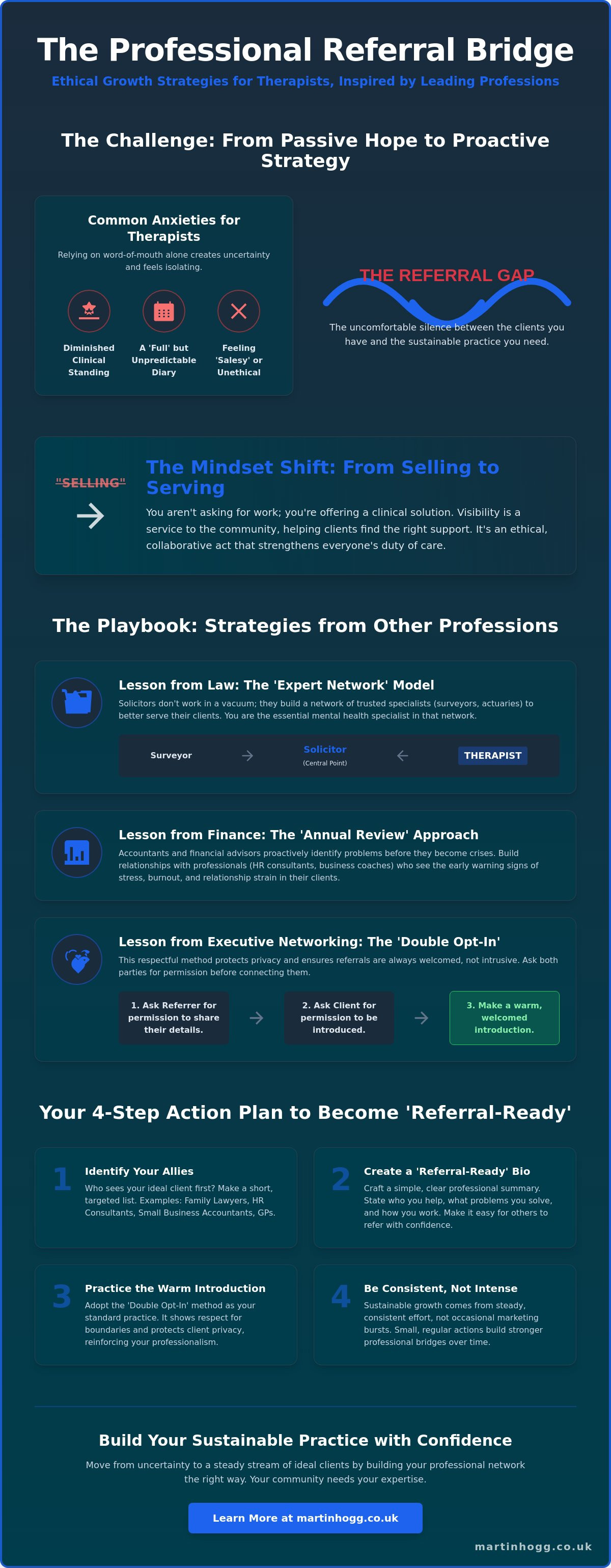
Many of us start our private practice with a quiet hope that word-of-mouth will be enough to keep the diary full. It feels comfortable and avoids that nagging anxiety of being seen as "too commercial" or "salesy." However, relying solely on organic recommendations often creates what I call the 'Referral Gap.' This is the uncomfortable silence between the clients you currently have and the sustainable practice you actually need to stay in business. When you wait for the phone to ring, you're effectively leaving your livelihood to chance.
By exploring referral tips from other professions, we can see that visibility is actually a service to the community. Solicitors and accountants don't view networking as a pushy sales tactic. Instead, they see it as a way to better serve their clients by having a trusted list of specialists on hand. In this context, a Professional Referral Bridge is a cross-sector transfer of trust. It ensures that when someone is struggling, they aren't just given a random name, but a warm recommendation that carries weight.
Understanding the basics of referral marketing allows us to step out of our clinical silos. It helps us realise that other local professionals are often looking for someone like you just as much as you are looking for them. This perspective is vital for those of us who want to build a practice that lasts.
The Ethical Reassurance
I know that ethics are at the heart of everything you do. You might worry that reaching out to a local law firm or a GP practice feels like asking for a favour, but I want you to reframe that entirely. Within the BACP and UKCP ethical frameworks, we're encouraged to work collaboratively for the client's benefit. You aren't asking for work; you're offering a clinical solution. When a solicitor is dealing with a stressful divorce or an accountant is helping a client through a business failure, they need a trusted professional they can refer to with confidence. By being visible, you're helping them fulfill their duty of care while helping a potential client get their life back on track.
Lessons from Law and Finance: The Trusted Advisor Model
In the legal world, solicitors don't try to be experts in everything. Instead, they build an 'Expert Network.' When a family lawyer handles a messy divorce, they often need a surveyor to value a house or an actuary to split a pension. They see these specialists as essential partners who add value to their service. As a therapist, you can position yourself as the mental health specialist in that same network. If you've been looking for marketing for therapists uk, this shift from 'selling' to 'partnering' is one of the most effective moves you can make.
Solicitors are used to clear, structured business models. Their guideline hourly rates were updated on January 1, 2026, to reflect the rising costs of professional expertise. They value clarity and reliability. Accountants use a similar strategy through the 'Annual Review.' They look at a client's situation once a year to spot potential problems before they become crises. We can learn a lot from these referral strategies from financial advisors. In therapy, this means building relationships with professionals who see the early warning signs of stress or burnout months before a person might think to visit a GP.
By adopting referral tips from other professions, you move away from the 'cold' outreach that feels so uncomfortable. You become a trusted advisor. This is a practical way to grow your practice while staying rooted in your clinical integrity. You aren't just another name on a list; you're a specialist solution for their clients' emotional well-being.
Becoming the 'Go-To' Specialist
Start by identifying who sees your ideal client first. If you specialise in relationship work, family lawyers are your natural allies. If you focus on workplace stress, local HR consultants or small business accountants are key. Remember the 'Two-Way Street' principle. These professionals are often relieved to find a therapist they can trust. It gives them a safe place to send clients who are clearly struggling. If you want to explore how to make these connections, our private practice success community offers a supportive space to share what's working for others in the UK.
The Art of the Warm Introduction: Tactic from Executive Networking
If the idea of traditional networking makes you want to retreat into your consulting room, you aren't alone. Many introverted therapists find the high-energy "pitching" style of business events draining. However, we can borrow a more respectful approach from high-end concierge and executive services: the 'Double Opt-In' introduction. This method involves asking both parties for permission before making a connection. It protects everyone's privacy and ensures that when a referral happens, it's welcomed rather than felt as an intrusion. This is one of the most practical referral tips from other professions because it mirrors the boundaries and consent we already value in our clinical work.
To make this work, you need to provide your referral partners with a 'referral-ready' bio. Other professionals are busy, and they might struggle to explain exactly what you do. By giving them a short, three-sentence blurb they can copy and paste into an email, you remove the friction. Recruitment consultants use this tactic constantly; they don't just send a name, they send a clear, concise summary of value. When you make it easy for a GP or a solicitor to recommend you, you're far more likely to stay at the top of their mind.
Closing the loop is equally vital. In the recruitment industry, the 'Follow-Up' is a standard professional courtesy. While we must maintain strict clinical confidentiality, a simple note to a professional referrer saying, "Thank you for passing on my details to your client," acknowledges their trust without breaking any rules. It maintains the professional loop and encourages future collaboration. If you want to refine how you present your practice to others, you can join our private practice success membership to access specific templates and peer support.
Crafting Your Professional Narrative
When someone asks what you do, saying "I am a counsellor" is often too vague for a referral partner to act on. Instead, use the 'Problem-Solution' framework common in professional consulting. Instead of focusing on your modalities, focus on the specific struggle you help people overcome. For example, "I help men manage workplace anger so they can save their relationships" is far more descriptive than "I offer CBT." This clarity helps a referral partner immediately recognise when they are sitting across from someone who needs your specific help to get their life back on track.
Building Your Referral System Without Losing Your Integrity
I often see counsellors get caught in a cycle of "feast or famine." They market intensely when their diary is empty, then stop completely once they have a few clients. To avoid this, I suggest using a Visibility Blueprint. This simply means setting aside thirty minutes a week to maintain your professional connections. We can learn a lot here from the architectural and creative industries. These professionals understand the "long game"; they don't just look for work when a project ends. Instead, they consistently nurture their network so that they are the first person someone thinks of when a new opportunity arises.
Staying "top of mind" doesn't mean being a nuisance or sending constant "salesy" emails. It's about being a helpful presence in your local professional community. Perhaps you see an article about workplace stress that would interest a local HR manager, or you share a resource on supporting bereaved families with a funeral director. These small gestures show you are an active, engaged professional. If you are looking for more ways to grow, my guide on counselling private practice uk offers further advice on building a practice that lasts without burnout.
By applying referral tips from other professions, you create a system that works in the background. You won't feel like you are "asking for work" because you have already established yourself as a valuable peer. Consistency always beats intensity in the world of professional referrals.
Your Next Steps for Practice Growth
I want you to take one small, practical step today. Identify three non-therapy professionals in your area who serve the same people you do. This might be a family solicitor, a local GP, or even a specialised nutritionist. Instead of asking them for referrals, try the "Help First" approach. Ask them what challenges their clients are currently facing and see if there is a resource or a bit of knowledge you can share to help them. This builds trust faster than any business card ever could. If you want to build your visibility alongside others who understand the journey, I invite you to join our Private Practice Success community. Together, we can help you get your practice on track and ensure you have the support you need to thrive.
Start Building Your Professional Network Today
Building a practice doesn't have to feel like a lonely struggle against your own ethics. By borrowing referral tips from other professions, you can move away from the anxiety of "asking for work" and toward a model of professional collaboration. We've seen how solicitors and accountants treat referrals as a standard part of their duty of care, and how executive networking tactics like the 'Double Opt-In' can protect your clinical boundaries. These aren't just business tricks; they're professional bridges that help more people access the support they need.
I've spent over 20 years in private practice, and I know that the hardest part is often just knowing where to start. My approach is always practical and grounded in the reality of working in the UK. Through my BACP Professional Development Workshops, I provide the no-nonsense support you need to get your practice back on track. You have the skills to help people; now let's make sure they can find you.
Ready to grow your practice? Discover the Practice Visibility Blueprint and join a community of therapists who are building sustainable, ethical businesses together. You don't have to do this alone.
Frequently Asked Questions
Is it ethical for a UK therapist to ask for referrals from other professionals?
Yes, it is entirely ethical as long as the referral is made in the client's best interest and with their full consent. The BACP Ethical Framework encourages collaboration with other professionals to ensure clients receive the most appropriate care. As of 2026, with over 70% of UKCP members supporting a move toward statutory regulation, the emphasis on professional transparency and high-quality referral pathways has never been stronger. You are simply ensuring that people in your community know where to find expert help.
How do I approach a GP or lawyer without sounding like I am 'selling' my therapy services?
You can avoid sounding 'salesy' by focusing entirely on the specific problems you solve for their clients. Instead of listing your qualifications, explain how you help people get their lives back on track during difficult periods. For example, when speaking to a family lawyer, focus on how you support individuals through the emotional impact of a divorce. This uses referral tips from other professions like consulting, where the focus is always on the practical solution rather than the service provider.
What should I include in a professional referral pack for other businesses?
Your referral pack should be concise and designed for a busy professional who has very little time. Include a 'referral-ready' bio of around 50 words, your direct contact details, and a clear description of your niche. You might also include a simple one-page sheet that explains your referral process. Professionals like solicitors, who saw their guideline hourly rates increase on January 1, 2026, value efficiency and clear communication above all else.
Should I offer a 'referral-fee' to other professionals who send me clients?
No, you must never offer or accept referral fees in the counselling profession. It is a clear breach of ethical guidelines because it could compromise your clinical integrity and the client's trust. Even in the legal sector, the LASPO Act 2012 banned referral fees for personal injury claims to protect professional standards. Your relationships with other sectors should always be based on clinical suitability and mutual professional respect rather than financial kickbacks.
How can I track where my referrals are coming from in a solo practice?
The most effective way to track your growth is to ask every new client how they found you during their first enquiry. Record this information in a simple spreadsheet or a basic CRM system. This data helps you see which referral tips from other professions are actually working for your specific practice. By identifying which local professionals are your most consistent allies, you can focus your energy on nurturing the relationships that bring the most results.

Article by
Martin Hogg
I help Private Practice counsellors in the UK set up and grow an ethical Private Practice they love, work with their ideal clients, and earn the income they deserve. All without guesswork and burnout. I have been a private practice counsellor myself for over 20 years, specialising in anger management. I set up a not-for-profit social enterprise, Citizen Coaching and Counselling, which delivers thousands of counselling sessions a year to adults and young people in Birmingham. I am a registered BACP Counsellor and the author of three books, My Anger Coach, My Anxiety Coach and My Relationship Coach. These are available on Amazon.
Disclaimer
The information provided on this blog is for general informational purposes only and is not intended to be a substitute for professional medical or mental health advice, diagnosis, or treatment. Reading this content does not create a therapist-client relationship.


