
Scaling a Therapy Practice: A Practical Guide for UK Counsellors in 2026
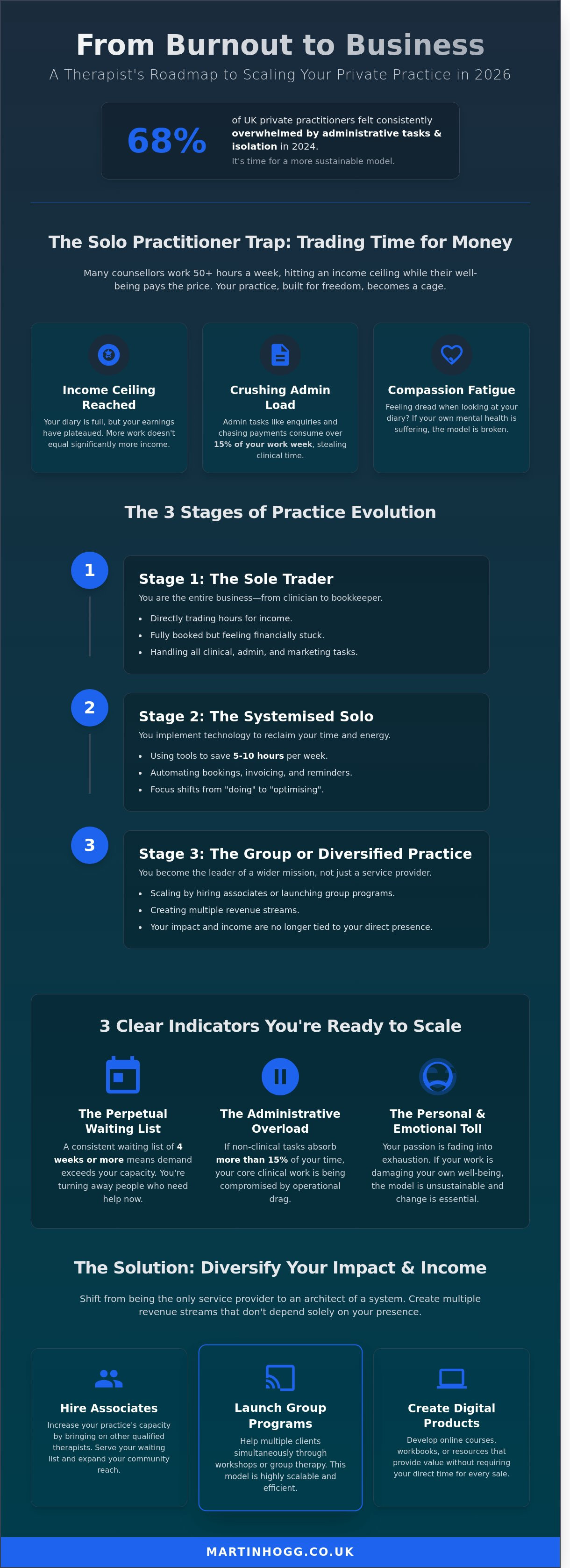
What if the very practice you built to find freedom has actually become a cage? It's a common story for many UK counsellors who find themselves working 50 hours a week just to keep the lights on, feeling more like a tired employee than a business owner. If you're currently considering scaling a therapy practice, you've likely realised that your own well-being is often the price you pay for growth. A 2024 survey of private practitioners showed that 68% felt consistently overwhelmed by administrative tasks and isolation. You probably started this journey to help people, but now you're the one needing a breather.
I believe that growth should never mean losing your clinical heart or your personal life. You can create a sustainable business that provides financial security and more time for yourself without feeling like you've sold your soul. It's about moving from being the only person in the room to being the person who makes the room possible for others. You don't have to choose between ethics and profit. It's possible to get your life back on track while helping more people than ever before.
This guide offers a practical roadmap to help you transition to a thriving, scalable business. I'll show you how to handle the systems, the ethics of hiring, and the mindset shifts needed to increase your impact in 2026.
Key Takeaways
- Learn why the traditional one-to-one model often leads to an income ceiling and how to shift your focus towards building sustainable capacity.
- Identify the manual, repetitive habits that are holding you back and start using a clearer system for scaling a therapy practice without the usual stress.
- Find out how to reach more people through associate models and group workshops, helping you increase your impact while protecting your own wellbeing.
- Work through the "ethical cringe" of making a profit, so you can lead other therapists and grow your business with a clear conscience.
- Take a practical look at your daily tasks to reclaim your time and define the exact figure you need to earn to work the hours you choose.
What Does Scaling a Therapy Practice Actually Mean?
Most counsellors I speak with reach a point where their diary is full, but their bank balance doesn't reflect the emotional toll of the work. Scaling a therapy practice is the process of breaking that 'time for money' trap. It’s a shift from being the only person providing the service to becoming a practice leader who oversees a wider mission. While growth often means just taking on more work yourself, scaling focuses on increasing your capacity so you can help more people in your community without burning out.
This transition requires you to think differently about your role. You aren't just a therapist anymore; you're an architect of a system. Moving from a solo mindset to a leadership one requires a clear business plan to map out how your finances and operations will shift. It’s about creating a sustainable model that can eventually function even when you aren't in the room. This isn't just about profit; it's about making mental health support more accessible to the 1 in 4 people in the UK who struggle each year.
The Three Stages of Practice Evolution
I've seen many practitioners move through these specific phases. Identifying your current stage helps you plan your next move with confidence.
- Stage 1: The Sole Trader. You're trading time for money and doing everything yourself, from clinical work to bookkeeping. You're usually fully booked but feel stuck.
- Stage 2: The Systemised Solo. You use tools to reclaim 5 to 10 hours a week. Invoices send themselves, and clients book directly into your calendar without the back-and-forth emails.
- Stage 3: The Group Practice or Diversified Model. You're scaling a therapy practice by hiring associates or launching a group programme. You now have multiple revenue streams that don't depend solely on your presence.
Signs You Are Ready to Scale Your Practice
Look at your current workload for these three clear indicators that your solo model has reached its natural limit.
- The Waiting List: You have a consistent waiting list of 4 weeks or more, meaning you're turning away people who need help right now.
- The Admin Burden: Administrative tasks like chasing payments or answering enquiries take up more than 15% of your working week.
- The Emotional Cost: You feel a sense of compassion fatigue or dread when looking at your diary. If your own mental health is suffering, your business model is no longer fit for purpose.
Building the Infrastructure for Sustainable Growth
When you first started, managing everything yourself felt manageable. You handled the enquiries, booked the sessions, and sent the invoices. However, scaling a therapy practice requires a shift in mindset from being a solo practitioner to becoming a business owner. If you try to grow using your current manual methods, things will eventually break. I've seen talented counsellors reach a point where admin takes up 15 hours a week, leaving them too exhausted to provide the high-quality care their clients deserve.
To avoid this, you need a Practice Visibility Blueprint. This isn't about flashy marketing; it's about creating a reliable system that ensures a steady flow of leads so you aren't constantly worried about empty slots. Alongside this, you must understand your financial margins. If your overheads, such as room hire in Birmingham or professional insurance, consume 40% of your income, adding staff without adjusting your fees could actually decrease your take-home pay. You need to know exactly what it costs to deliver one hour of therapy before you invite others to join your team.
Standardising your work is the only way to maintain your sanity. Using resources like BACP's private practice toolkit can help you establish the groundwork for these processes. By documenting how you handle everything from a "no-show" to a crisis call, you create a blueprint that others can follow as you grow.
Essential Systems and Software
Moving away from paper diaries and basic spreadsheets is a non-negotiable step for growth. You need robust, UK-compliant practice management software that handles GDPR requirements and clinical notes securely. This technology doesn't just store data; it automates the onboarding journey. When a potential client reaches out, the system should ideally handle the initial forms and booking links without you lifting a finger. For a deeper look at your options, read my guide on the Best Practice Management Software for UK Therapists.
Protecting Your Clinical Standards
As you step back from some of the day-to-day clinical work, your primary challenge is maintaining the quality of care. Scaling a therapy practice shouldn't mean diluting your values. An Operations Manual serves as the heartbeat of your business, detailing your clinical expectations and data protection protocols. This ensures that every client receives the same level of support, regardless of which therapist they see. If you're feeling overwhelmed by the technical side of this transition, feel free to look at my calendar to find a time for us to chat about your specific goals.
Diversifying Your Income: Associates, Groups, and Digital Products
Most of us start our careers because we want to help people, but there is a hard limit on how many 1-to-1 hours you can work before your own wellbeing suffers. Scaling a therapy practice requires a shift in mindset. You have to move from being the only person providing the service to becoming a facilitator of care. This doesn't mean losing the human touch; it means finding ways to reach more people while protecting your energy and financial stability.
Hiring Your First Associate
Bringing another therapist into your practice is often the most logical first step. A common mistake is focusing solely on clinical qualifications. While competence is non-negotiable, values-alignment is what keeps a team together. If your brand is known for being "no-nonsense and practical," hiring a purely academic therapist might confuse your clients. When it comes to the financial split, a 60/40 or 70/30 arrangement is standard in the UK, where the associate keeps the larger portion. This 30% to 40% you retain covers the cost of the room, marketing, and the administrative time you spend managing the referral. To ensure you're ready for this transition, I recommend reading Hiring an Associate Therapist: The Private Practice Growth Checklist.
Leveraging Group Work
Group therapy is one of the most ethical ways to scale. In 2024, many practitioners reported a 25% increase in enquiries from people who could not afford the standard £60 to £100 per hour for 1-to-1 sessions. By offering a group at £25 per person for a 90-minute session, you make therapy accessible to those on lower incomes while potentially earning £150 to £200 for that same time block. Whether you run these online or in a physical space in the West Midlands, the logistics require careful planning around confidentiality and group dynamics. If you're unsure where to start, my guide on How to Start a Therapy Group: A Practical Guide for UK Counsellors covers the essential groundwork.
Beyond face-to-face work, digital products offer a way to generate income while you sleep. This could be a £47 pre-recorded CPD workshop for other counsellors or a £15 digital workbook for clients. These resources serve as a bridge, helping people who aren't ready for full therapy yet. As you grow, remember that scaling a therapy practice also increases your clinical responsibility. If you're managing a team of three or more associates, you'll need to account for the extra 1.5 hours of supervision required by bodies like the BACP to ensure your team is working safely and effectively. It's about building a structure that supports everyone, including you.
Overcoming Mindset Blocks and the Ethical Cringe
Most of us entered this profession to help people, not to build empires. I've spoken with dozens of counsellors in Birmingham and across the UK who feel a genuine sense of guilt when they think about profit. This "ethical cringe" is often the biggest barrier to scaling a therapy practice. You might worry that focusing on the numbers makes you less of a healer. It's a common struggle, but it's one that can stop you from helping the very people you care about.
It's time to reframe your perspective. If you're working 30 clinical hours a week and feeling exhausted, you aren't giving your clients your best. Scaling isn't about greed; it's about sustainability. A 2023 survey of 500 UK-based private practitioners found that 48% reported symptoms of secondary trauma or burnout. Moving to a group model reduces this pressure. Scaling a therapy practice allows you to reach more people without sacrificing your own mental health.
You may also face imposter syndrome. You might ask, "Who am I to lead other therapists?" You don't need to be the world's leading expert to be a good director. You just need to be a facilitator who provides a safe, professional environment. Moving from being an anonymous therapist to the face of a brand can feel exposing. However, it's the most effective way to build trust with your local community. People don't just buy therapy; they buy into a vision of recovery that you represent.
The Ethics of Marketing Your Practice
Marketing doesn't have to feel like a used car pitch. The best way to promote your practice is to focus on service and connection. Share useful information that helps people understand their struggles, such as anxiety or relationship issues. When you follow BACP guidelines on advertising, you focus on clear, factual information about your results. It's about showing a path to getting life back on track rather than "selling" a product. This approach feels natural because it's rooted in your clinical expertise.
Managing the Transition to CEO
The hardest part of scaling is letting go. You've spent years being the one in the room. Now, you have to trust associates to represent your brand. This transition requires clear boundaries to prevent burnout by proxy. You're now a facilitator of healing on a much larger scale. By setting up robust supervision and clear operational standards, you ensure quality without needing to be in every session. This shift allows you to move from being overwhelmed to being truly impactful.
If you feel stuck in the "practitioner" mindset and want to move forward, let's talk about your strategy. You can book a session with me here to discuss your next steps.
Your Roadmap to a Scaled Practice in 2026
Scaling a therapy practice isn't about working harder; it's about working differently. I've seen too many talented UK counsellors burn out because they tried to grow by simply adding more hours to an already full diary. To move forward, you have to stop being the person who does everything. Start by auditing your time. Look at your last working week and identify where you spent hours on tasks that could be done by someone for £12 or £15 an hour. If you're spending five hours a week on basic admin or chasing invoices, and your clinical rate is £70, you're effectively losing £275 every single week.
You also need to define your "Freedom Number." This is the specific amount of money you need to generate each month to cover your business costs and personal life while working the hours you choose. Perhaps you want to earn £5,500 a month while only being "in the room" for 12 hours a week. Once you have this figure, you can decide which vehicle will get you there. You might choose to:
- Hire Associates: Take a percentage of the fee for providing the referrals and the infrastructure.
- Group Programmes: Move from one-to-one work to supporting eight or ten people at once.
- Training and Consultations: Share your expertise with other professionals or organisations.
Investing in your own development is vital. This doesn't just mean more clinical CPD. It means business coaching and learning the mechanics of scaling a therapy practice. You can't lead a team or manage a larger business using only the skills you learned in your initial counselling diploma.
The Importance of a Support Network
Trying to grow a business in isolation is the fastest route to failure. The weight of responsibility can feel heavy when you're making decisions about commercial leases or employment contracts alone. You need a community of like-minded UK practice owners who understand the specific regulations we face here. It provides a sanity check and keeps you grounded. I host regular events to help with these transitions; you can check the Practice Growth Calendar for our upcoming workshops and peer sessions.
Taking the First Step
Don't let the big picture overwhelm you. Commit to improving just one system this week. It might be automating your booking process or setting up a professional email template for new enquiries. Review your pricing too. If you haven't adjusted your fees since 2023, you're likely subsidising your clients' lives at the expense of your own stability. Finally, write a short "Practice Vision." Describe exactly where you want to be in December 2026. Having that destination clearly defined makes the daily decisions much easier to manage.
Your Path to a More Sustainable Practice
You've spent years honing your skills to help others. Now, it's time to build a business that looks after you too. Scaling a therapy practice in 2026 isn't about working more hours; it's about working smarter by using associates and digital products to reach a wider audience. I've spent over 15 years showing UK counsellors how to grow their income without the risk of burnout. Through my Practice Visibility Blueprint, I've helped hundreds of practitioners move past the "ethical cringe" and embrace a more sustainable way of working.
As a BACP-endorsed workshop provider, I understand the unique professional pressures you face. You don't have to choose between being a compassionate therapist and a successful business owner. You can do both. It's about creating a legacy that extends beyond your individual therapy room and into the wider community. You've got the talent and the drive. Now, let's get your practice where it needs to be so you can focus on the work that truly matters.
Ready to stop trading time for money? Join the Private Practice Success Membership and start scaling today.
I'm here to help you take that next step with confidence. You've done the hard work of training; now let's make sure your business works for you.
Frequently Asked Questions
Is scaling a therapy practice ethical according to BACP guidelines?
Scaling a therapy practice is entirely ethical under the 2018 BACP Ethical Framework, provided you maintain clear boundaries and robust supervision. Your primary duty is to the client's wellbeing, so you must ensure your associates are as qualified as you are. I've found that keeping clinical standards at the heart of your growth actually helps more people get the support they need.
When is the right time to hire my first associate therapist?
You should consider hiring your first associate when you're turning away more than 3 clients every week. If your waiting list is longer than 21 days, you're losing people who need help right now. Hiring someone allows you to help those extra 12 to 15 people a month while freeing up your own time to manage the business.
How much does it cost to scale a private practice in the UK?
You can expect to spend between £1,200 and £2,500 on the initial transition to a group model. This covers things like updated professional indemnity insurance, which often rises by £180, and legal fees for associate contracts. It's a manageable investment if you plan your cash flow 3 months in advance to cover these setup costs.
Do I need to become a Limited Company to scale my therapy practice?
You aren't legally required to become a Limited Company, but it's a smart move once your profits consistently exceed £50,000 a year. Operating as a Sole Trader is simpler for small setups, but a Limited Company offers better protection for your personal assets. Most UK counsellors make this switch in their second year of growth to manage their tax more effectively.
Can I still see clients if I move to a group practice model?
You can certainly keep seeing clients, and I actually recommend keeping a small caseload of 6 to 8 hours a week. Staying active in the therapy room keeps your skills fresh and reminds you why you started this journey. It also helps you understand the specific challenges your associates face when they're working with your clients.
What is the most profitable way to scale a therapy business?
The most profitable approach to scaling a therapy practice involves a mix of associate work and structured group programmes. Relying solely on 1-to-1 sessions limits your income to the hours in the day. By adding a workshop or a 6-week support group, you can help 10 people at once, which increases your hourly rate without raising fees.
How do I maintain clinical quality when I am not the one seeing every client?
You maintain quality by implementing a mandatory 90-minute monthly clinical review for every associate you hire. It's not about micromanaging; it's about ensuring they follow the same core values that built your reputation. I suggest reviewing 5% of all client outcome scores every quarter to spot any patterns that might need addressing.
Do I need a business coach to scale my therapy practice?
A business coach isn't a requirement, but 72% of practitioners find that having a mentor speeds up their progress. I've seen many talented counsellors struggle with the transition from therapist to manager because they've never been taught how to run a team. A good coach provides the practical tools you need to get your life back on track while your business grows.


