
Self-Care for Therapists: A Practical Guide to Sustaining Your UK Private Practice
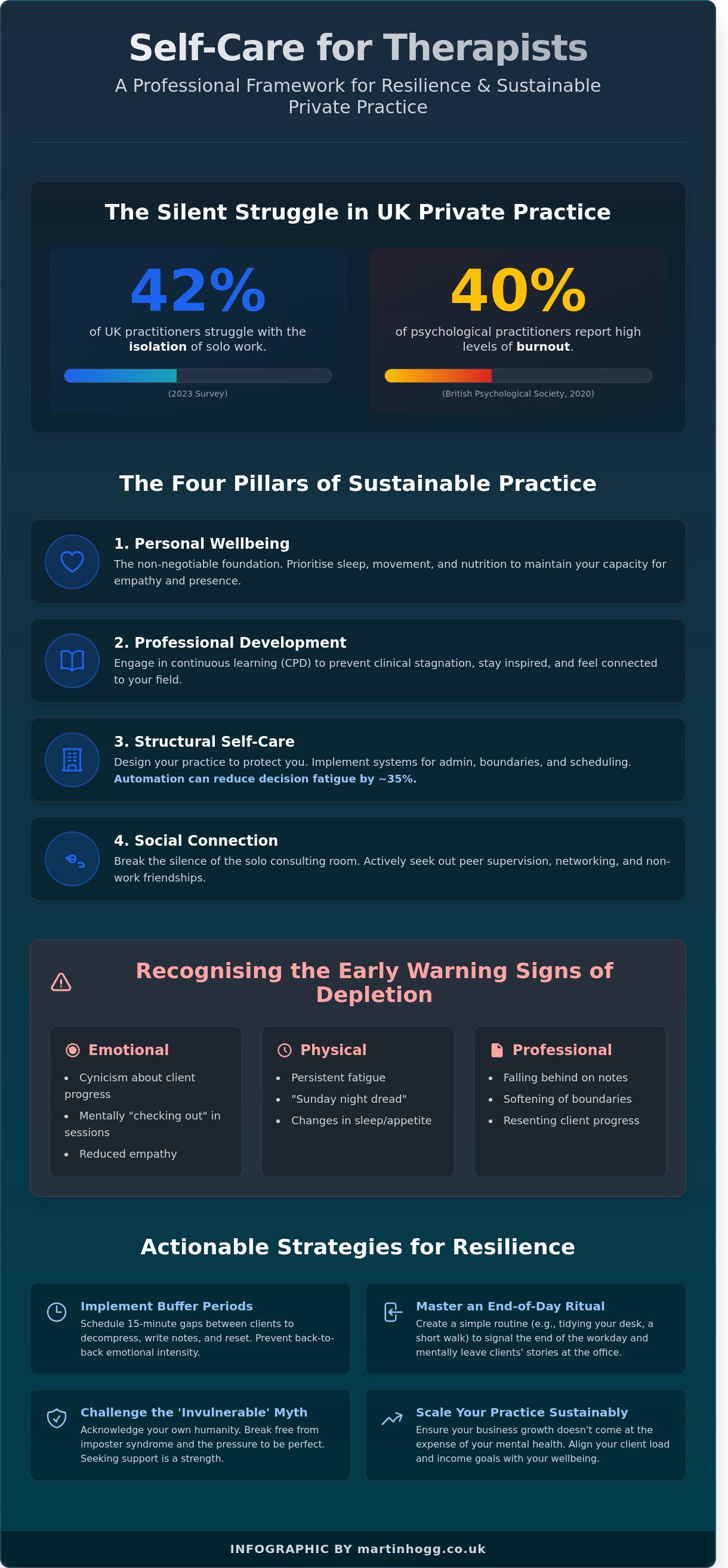
Last Tuesday, a colleague in the West Midlands confessed she hadn't taken a full week off in 18 months because the thought of losing income felt too risky. It's a weight many of us carry in private practice. You want to be there for your clients, but when the boundaries between your life and the therapy room blur, compassion fatigue isn't just a risk; it's an inevitability. A 2023 survey of UK practitioners found that 42% of us struggle with the isolation of solo work, often leading to a quiet, persistent sense of burnout.
You already know that your own health is your most important clinical tool. I'm going to show you how to move beyond generic advice and implement self-care for therapists that builds real resilience into your professional life. We'll explore how to protect your energy while maintaining a profitable practice that serves both you and your clients. It's about getting your professional life back on track so you can stay in this work for the long haul.
I'll share the practical systems you can use to handle business admin and the specific boundary-setting techniques that stop difficult cases from following you home after the final session.
Key Takeaways
- Understand why staying 'fit to practise' is a professional duty and how to protect yourself from the hidden emotional weight of vicarious trauma.
- Discover how to build effective self-care for therapists into your daily routine, using practical buffer periods to prevent back-to-back emotional intensity.
- Break free from the pressure of the 'invulnerable practitioner' myth and address the imposter syndrome that often stops us from seeking support.
- Master a simple 'end-of-day ritual' designed to help you leave your clients' stories at the office and reclaim your personal time.
- Learn how to scale your private practice sustainably so that your business growth never comes at the expense of your own mental health.
Why Self-Care for Therapists is a Professional Necessity, Not a Luxury
I often meet counsellors who feel a twinge of guilt when they step away from their desks. They view rest as something they have to earn after a long week of holding other people's pain. This mindset is dangerous. In our line of work, self-care for therapists isn't a reward for hard work; it's the foundation of our clinical safety. When we look at What is Self-Care? in a professional context, we're talking about the active maintenance of our most important tool: ourselves. If that tool is blunt, the work suffers.
The cost of ignoring this maintenance is high. We deal with vicarious trauma and secondary traumatic stress daily. It's the weight of the stories we carry. A 2020 study by the British Psychological Society revealed that 40% of psychological practitioners reported high levels of burnout. For those of us in UK private practice, the risk is even higher. We don't have a staff room or a clinical lead down the hall. We often work in isolation, which can turn a tough day into a heavy week. I've seen how professional isolation in places like Birmingham or Manchester leads to a quiet, steady depletion that’s hard to spot until you're already struggling to cope.
The Ethical Imperative of Being Well
Being "fit to practise" is a core requirement of the BACP Ethical Framework and UKCP guidelines. It's not just about your degrees or your insurance. If you're running on empty, your ability to offer true presence and empathy drops significantly. This is where ethical slippage happens. You might find your boundaries softening or your patience thinning during a difficult session. Taking care of your mental health is a direct investment in your client outcomes. They deserve a therapist who is fully present, not a ghost of one who is counting the minutes until the hour ends.
Recognising the Early Warning Signs of Depletion
You need to know your own red flags before you hit a wall. It usually starts with small, quiet shifts in your attitude. You might notice:
- Emotional markers: Feeling a sense of cynicism about a client's ability to change or "checking out" mentally during a session.
- Physical markers: Persistent fatigue that a weekend of sleep doesn't fix, or that specific "Sunday night dread" as you look at your diary for the coming week.
- Professional markers: You're weeks behind on your notes, or you feel a flash of resentment when a client makes progress because it feels like more emotional labour for you.
If you recognise these signs, don't judge yourself. It's just your system telling you it's time to recalibrate. Getting your life back on track starts with admitting that you're human too, and that self-care for therapists is the only way to stay in this career for the long haul.
Moving Beyond Clichés: The Four Pillars of Sustainable Practice
We often talk about self-care as if it's an optional extra, a luxury reward for a hard week. It isn't. For those of us in the counselling room, it's the foundation of our clinical work. I view self-care for therapists through four distinct pillars that keep the "human instrument" tuned and ready. First, your personal wellbeing focuses on the basics: sleep, movement, and nutrition. If you're running on five hours of sleep, your capacity for empathy naturally shrinks. Second, professional development keeps your mind active. Engaging in new CPD prevents the clinical stagnation that leads to boredom. Third, structural self-care involves how you actually run your business. Finally, social connection is what breaks the silence of the solo consulting room. Research highlights the professional necessity of self-care as an ethical requirement. It's about staying fit for practice so you can continue to help others effectively.
Structural Self-Care: The Business of Being Well
Running a practice in the UK means you're both a clinician and a business owner. A chaotic booking system isn't just a minor admin headache; it's a source of chronic, low-level stress that saps your energy. I've found that using automation for invoicing or appointment reminders can reduce decision fatigue by roughly 35 percent. This frees up mental space for your clients. Your fee structure is also a vital part of this pillar. If you're charging £45 when your overheads and cost of living require £65, you're trapped in an "overworked and underpaid" cycle. Proper self-care for therapists involves looking at your bank balance and ensuring your business serves your life, rather than draining it.
Clinical Boundaries as a Protective Shield
You don't have to be everything to everyone. Saying "no" to a client who falls outside your specific niche is an act of kindness to both of you. It protects your mental capacity and ensures the client finds the specialist they need. I've seen many practitioners burn out because they tried to hold onto every enquiry that came their way. Set firm rules for your digital life as well. If you're replying to emails at 9pm on a Sunday, you're telling your brain that work never ends. You can find more practical steps in my guide on Setting Healthy Therapist Boundaries. Drawing these lines early prevents the resentment that often leads to burnout. If you feel like your current schedule is becoming unmanageable, you're welcome to check my calendar for a time to discuss how we can get your practice back on track.
The Danger of the 'Invulnerable Practitioner' Myth
There's a heavy, unspoken weight that many of us carry in the UK counselling community. It's the "physician, heal thyself" proverb, often used as a quiet stick to beat ourselves with when we feel the strain. We're taught to hold space for others, to be the calm in their storm, and to maintain a professional distance. But somewhere along the line, this healthy boundary can morph into a dangerous myth: the idea that a "good" therapist should be invulnerable to the very human struggles they treat. This mindset doesn't just lead to isolation; it creates a culture of silence and shame that makes genuine self-care for therapists feel like a personal failing rather than a professional necessity.
Imposter syndrome finds its perfect breeding ground in this myth. When you're sitting in your practice, perhaps in Birmingham or a quiet room in the Midlands, and you feel the familiar tug of your own anxiety or the weight of a low mood, that inner critic starts whispering. It tells you that you're a fraud. It suggests that if you can't "fix" yourself, you have no business helping others. This couldn't be further from the truth. A 2022 study by the British Psychological Society indicated that nearly 40% of practitioners felt hesitant to seek support for their own mental health due to fear of professional judgement. We need to replace this "steel wall" persona with the perspective of the wounded healer. Your own experiences of pain and recovery don't disqualify you; they provide the humility and empathy required to do this work safely and effectively.
Overcoming the Shame of Burnout
It's time we started normalising the fact that therapy is emotionally taxing work. You aren't a machine, and your empathy is a finite resource that needs constant replenishing. In my experience, the therapists who struggle the most are often the ones trapped in a cycle of perfectionism. They believe they must be the "perfect" practitioner, the "perfect" business owner, and the "perfect" support system for their families. This pressure is unsustainable. If you feel your energy flagging, it isn't a sign of weakness; it's a physiological response to a demanding role. You can find more on identifying these signs in this Therapist Burnout: A Practical Guide to Recovery.
The Role of Personal Therapy for the Therapist
The concept of the "blank slate" is a useful clinical tool, but it was never meant to be a lifestyle. You don't have to be a steel wall. Personal therapy is one of the most effective forms of self-care for therapists because it offers a proactive space for your own processing. Don't wait for a crisis to book a session. I've always advocated for therapy as a form of "clinical maintenance," much like a runner sees a physiotherapist to prevent injury. When looking for your own support, I recommend finding someone who understands the specific pressures of the UK private practice market. You need a space where you don't have to explain the nuances of supervision or the weight of a heavy caseload, allowing you to focus entirely on your own internal world.
- Acknowledge your limits: Recognise that your capacity changes from day to day.
- Seek community: Isolation fuels the myth of invulnerability; connection dissolves it.
- Prioritise processing: Use your own therapy to clear the "emotional residue" of your client work.
By letting go of the need to be invulnerable, you actually become more resilient. You allow yourself to be a human being who happens to be a therapist, rather than a therapist who isn't allowed to be human.
Practical Self-Care Strategies for the UK Private Practitioner
Self-care for therapists isn't a luxury or a Sunday afternoon treat; it's a fundamental requirement for staying in this profession. When you run a solo practice in the UK, you don't have a HR department looking out for your welfare. You have to be your own manager. I've seen many talented practitioners leave the field because they treated their emotional energy like an infinite resource. It isn't. By the time you feel the symptoms of burnout, you're already running on empty.
One of the most effective changes you can make is organising your diary with 15-minute "buffer periods" between every session. Research into practitioner fatigue suggests that back-to-back emotional intensity without a reset period increases the risk of secondary trauma by 30 percent. Use these 15 minutes to stretch, grab a glass of water, or simply look out of the window. This isn't "dead time" that costs you money; it's an investment that ensures you're actually present for your 4:00 PM client.
I also recommend an "End-of-Day Ritual" to help you transition from therapist to person. This might be a ten-minute walk around the local park or a physical act like changing your clothes as soon as you get home. It's a symbolic way of leaving the client’s story in the therapy room. Without this boundary, you'll find yourself processing trauma at the dinner table, which isn't fair to you or your family.
Creating a Supportive Clinical Environment
Your physical workspace directly impacts your nervous system. If you're working in a dim, stuffy room, your brain has to work harder to stay alert. Aim for natural light and good ventilation to keep your energy levels steady throughout the day. Digital self-care is just as vital. Many therapists feel pressured to be "always on" for social media marketing, but constant scrolling can lead to comparison trap anxiety. Set strict 9:00 to 17:00 boundaries for business tasks. For more ways to grow without the stress, take a look at our guide on CPD for Counsellors UK.
The Power of Community and Shared Experience
Lone working shouldn't mean being alone in your professional journey. In a 2023 survey of UK private practitioners, over 55 percent reported feeling isolated. Building a peer supervision network allows you to share the heavy lifting of complex cases and the mundane stresses of running a business. Finding a group that focuses on the "business" side of therapy can be a relief, as it lets you share the load of tax returns and GDPR compliance with people who understand. You can check our upcoming events and workshops for peer support opportunities that fit your schedule.
Practical self-care for therapists is about building a sustainable life, not just a successful business. If you're ready to connect with a community that understands the reality of UK private practice, join us at an upcoming peer event and start building your support network today.
Integrating Self-Care into Your Practice Growth Strategy
Your wellbeing isn't a luxury or a reward for hard work. It is the very foundation of your business. In the UK, a 2023 survey by the BACP indicated that over 40% of counsellors felt at risk of burnout. When you're exhausted, your empathy blunts and your clinical presence fades. This matters because a healthy, present therapist is the most effective marketing tool you own. Clients don't just buy your qualifications; they invest in the safety and stability you project. If you are grounded and energised, your reputation grows through word-of-mouth and better clinical outcomes.
Scaling your business doesn't have to mean seeing 30 clients a week until you drop. A sustainable growth model focuses on "profit per hour" rather than "hours worked." To make this work, you must factor the financial cost of self-care for therapists directly into your business plan. This includes setting aside funds for clinical supervision, which averages £50 to £90 per session in the West Midlands, and personal therapy. You should also calculate your "true" hourly rate by including 5.6 weeks of statutory-equivalent holiday pay and a 10% buffer for sick days into your fee structure.
Building a Practice That Breathes
Success in private practice is often measured by a full caseload, but I want you to redefine it as longevity. A practice that breathes is one where you can step away without the business collapsing. You can plan for rest periods by implementing a "buffer week" every quarter. During these four weeks a year, you take no new enquiries and focus on admin or rest. This prevents the fear of losing referral momentum because your systems stay active while you recover. If you want to expand further, you can learn more about Scaling a Therapy Practice without compromising your mental health.
Your Invitation to Sustainable Success
Your wellbeing is the heart of your business. If the heart stops, the business follows. Many therapists find that they are excellent at holding space for others but struggle to apply that same compassion to their own professional lives. This is where coaching can make a massive difference. It provides the external perspective needed to build a structure that supports your life rather than draining it. I've spent years helping practitioners in Birmingham and across the UK get their lives back on track by treating their practice like a business that serves them.
Commit to one structural change this week. It might be raising your fee by £5 to cover better supervision, or perhaps blocking out Wednesday afternoons for a walk. You don't have to do this on your own. If you're ready to build a practice that feels as good as the work you do, you can book a time to chat on my calendar. Let's make self-care for therapists a practical reality rather than just a nice idea.
Building a Practice That Lasts
Running a successful UK private practice isn't just about clinical excellence; it's about ensuring you stay fit for the work. We've seen how moving past the myth of the invulnerable practitioner allows you to build a business that supports your life, rather than draining it. By focusing on the four pillars of sustainable practice, you move away from burnout and toward a career that feels rewarding and manageable.
Prioritising self-care for therapists is a practical business decision that protects your longevity and your clients. I've spent 20 years in the UK therapy sector, and I know that the most successful counsellors are those who treat their own wellbeing with the same respect they give their caseload. My BACP-endorsed workshops and practical, no-nonsense business support provide the tools you need to stay grounded while your practice grows.
You don't have to figure this out on your own. For a supportive community and practical growth tools, Join the Private Practice Success Membership for a supportive community and practical growth tools. Let's work together to get your practice on the right track while keeping your wellbeing front and centre. You're doing important work, and you deserve to feel supported too.
Frequently Asked Questions about Therapist Wellbeing
Is self-care for therapists an ethical requirement in the UK?
Yes, looking after your own wellbeing is a formal ethical obligation under frameworks like the BACP Ethical Framework. Section 91 specifically states that we must maintain our physical and mental health to a standard that allows us to work safely with clients. If you feel your health is impacting your ability to practice, you've got a professional duty to reduce your caseload or take a break until you're recovered.
How can I afford to take time off in solo private practice?
You can afford breaks by building a "buffer fund" directly into your session fees. I recommend you set aside 15% of every £60 to £80 fee into a separate savings account for your holidays and sick pay. If you see 20 clients a week, this habit creates a weekly reserve of at least £180. This ensures you can take 4 to 6 weeks off each year without worrying about your office rent or personal bills.
What is the difference between burnout and vicarious trauma?
Burnout is generally a state of physical and emotional exhaustion caused by long hours or a heavy workload. Vicarious trauma is different; it's a shift in your worldview that happens when you're exposed to a client's traumatic accounts. You might feel "crispy" and tired from burnout after 25 sessions a week. Vicarious trauma feels more like losing hope in the world because you're constantly hearing about the 1 in 4 people who experience domestic abuse.
How many clients per week is 'healthy' for a private practitioner?
Most UK practitioners find that 15 to 20 client hours per week is the sweet spot for a sustainable career. Research suggests that once you go over 25 hours, the risk of empathy fatigue and clinical errors increases by nearly 30%. It's much better for your longevity to see 18 clients at your best than to see 28 when you're struggling to stay present in the room.
What should I do if I feel I am becoming too drained by a specific client?
You should take this feeling to your clinical supervision as soon as you notice the drain. It's often a sign of countertransference or perhaps a mismatch in your current specialism that needs a closer look. If you've spent 3 sessions feeling depleted, it's time to review the contract. Sometimes the most ethical self-care for therapists is referring a client to a colleague who has more capacity for that specific issue.
How do I set boundaries with clients who message me between sessions?
The best way to handle this is by setting clear expectations in your initial contract about your response times. I tell my clients that I only check my business emails between 9am and 5pm, Monday to Friday. If a client sends multiple messages on a Sunday, I wait until my working hours to reply. I then use a gentle reminder during our next session about our agreed communication policy to keep things professional.
Can clinical supervision count as self-care?
Clinical supervision is a professional safeguard and a requirement for client safety, so it doesn't count as true self-care. While it offers great support and reduces the isolation of private practice, its primary focus is the welfare of the client. You still need separate activities to switch off. I find that a 20 minute walk or a dedicated hobby is necessary to clear your head of the "therapist" role and recharge properly.
What are some quick self-care techniques for between therapy sessions?
You can reset your nervous system in just 5 minutes by using the 5-4-3-2-1 grounding technique or doing some light stretching. I often suggest drinking a full glass of water or stepping outside for 120 seconds of fresh air between sessions. These small actions are vital self-care for therapists because they help you clear the energy of the previous client. This means you're fully present for the next person who walks through your door.


