
SEO for Therapists: A Practical Guide to Getting Your Practice Found in 2026
Last Tuesday, a counsellor I know checked her analytics and realised her beautiful new website hadn't received a single visitor in 30 days. It's a frustrating, quiet place to be when you've spent hundreds of pounds and hours of your life trying to get things right. You likely feel that same sense of invisibility, especially when trying to understand seo for therapists without losing your professional identity. I know it's exhausting to balance your clinical work with the technical anxiety of keeping a practice afloat. You want to help people, not spend your weekends wrestling with algorithms.
I've put together this guide to show you how to ethically and effectively improve your visibility so the clients who truly need your help can actually find you. It's a clear, manageable plan for 2026 that focuses on practical steps rather than abstract jargon or pushy marketing tactics. We'll walk through how to build a website that reflects your values, ranks well on Google, and brings in a steady stream of enquiries from the right kind of people.
Key Takeaways
- Reframe SEO as an ethical bridge that connects people in distress with your professional support, making visibility a core part of your duty of care.
- Identify the specific "long-tail" phrases your favourite clients actually use, allowing you to speak directly to their personal struggles rather than using clinical jargon.
- Master the practical essentials of seo for therapists to ensure your website is a fast, mobile-friendly space that feels safe and welcoming from the very first click.
- Adopt a "Citizen Coaching" mindset to create helpful, jargon-free content that answers your clients' unspoken questions and builds immediate rapport.
- Build a steady, manageable strategy for 2026 that focuses on consistent progress and helping more people, rather than becoming overwhelmed by complicated data.
Understanding SEO as a Digital Bridge to Your Clients
In the world of private practice, we often view technology as a barrier rather than a tool. By 2026, the way people search for mental health support in the UK has fundamentally shifted. It's no longer just about appearing on a list; it's about being the right answer at the right moment. Understanding Search Engine Optimization (SEO) is about building a digital bridge between your consulting room and the person sitting at their kitchen table, feeling overwhelmed and searching for a way out. This bridge ensures that when someone is ready to take that first step, you're there to meet them.
Effective seo for therapists isn't about tricking a computer or using "black hat" tactics. It's an ethical commitment to visibility. If you have the skills to help someone manage trauma or recover from addiction, you have a responsibility to be findable. Google's algorithms now prioritise "E-E-A-T", which stands for Experience, Expertise, Authoritativeness, and Trustworthiness. This means the old days of keyword stuffing are gone. Today, search engines reward empathy and genuine expertise, ensuring that people in crisis find professional, safe support rather than generic, AI-generated fluff.
Reframing Marketing as a Form of Service
I know many counsellors feel a sense of "salesy" dread when they hear the word marketing. It feels at odds with our clinical training and the quiet nature of our work. However, consider the person searching for "anxiety help Birmingham" at 2 AM. If your website is buried on page five, they might never find the specific help they need to start getting their life back on track. Well-optimised content reduces the barrier to entry for someone in distress. You aren't "selling" a product; you're providing a clear path to recovery. It's about being found by those who already need your unique skills, making the process of seeking help as calm and straightforward as possible.
The Core Pillars of Therapy SEO
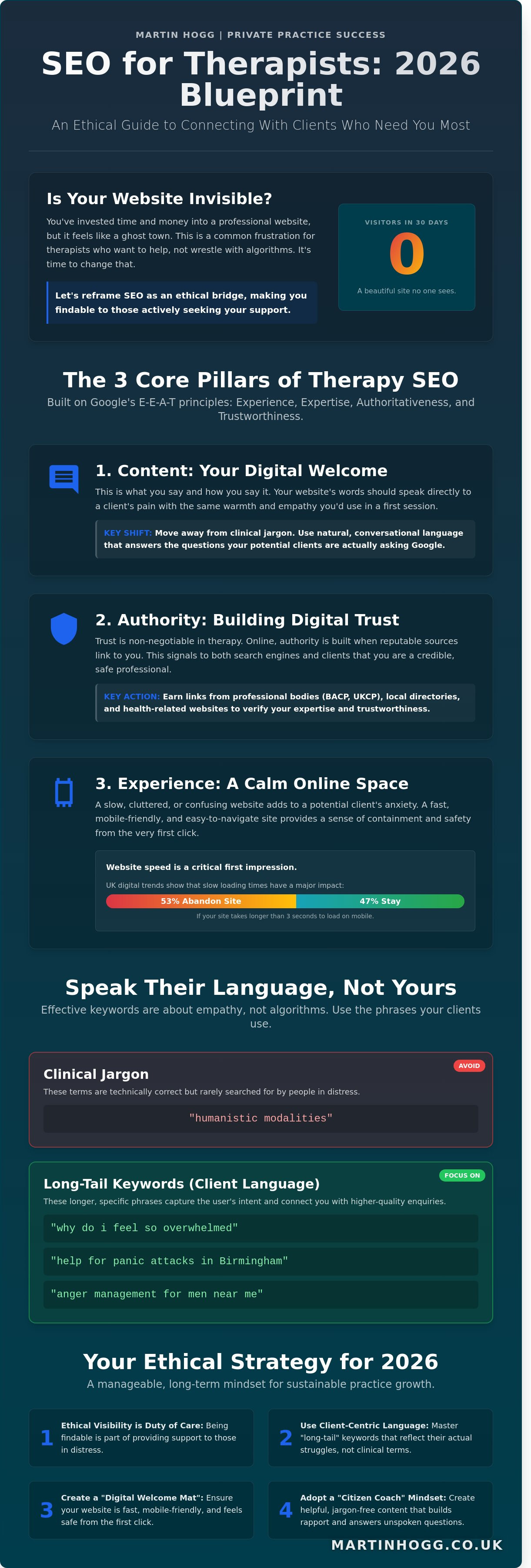
To build this bridge effectively in the current UK market, we focus on three practical areas that search engines value:
- Content: This is what you say and how you say it. It needs to speak directly to the reader's pain with the same warmth you'd use in a first session. According to 2024 search data, users are increasingly moving away from clinical jargon toward natural, conversational queries.
- Authority: This involves trust. When reputable bodies like the BACP, UKCP, or local West Midlands directories link to you, it signals to search engines that you're a safe pair of hands.
- Experience: Your website must be easy to use. A slow, cluttered site adds to a client's anxiety. A 2024 report on UK digital trends showed that 53% of mobile users abandon a site if it takes longer than three seconds to load. A clean, fast site provides a sense of containment before they even book a call.
If you're ready to look at how these pillars apply to your own practice, you can check my calendar for a chat about your specific goals and how to reach the people who need you most.
Finding the Right Keywords Without Losing Your Professional Voice
Finding the right keywords isn't about gaming a system. It's about making sure your door is visible to the person walking down a dark street looking for help. When we talk about seo for therapists, we are really talking about empathy. You need to identify the exact phrases your favourite clients type into Google when they are at their lowest or most hopeful. Often, these aren't the clinical terms we used during our training. A client rarely searches for "humanistic modalities"; they search for "why do I feel so overwhelmed" or "help for panic attacks in Birmingham."
I've found that the most effective strategy involves focusing on long-tail keywords. These are longer, more specific phrases that indicate a clear need. For example, "anger management for men" or "postnatal depression support groups" attract people who know exactly what they require. While general terms have higher search volumes, these specific phrases often lead to higher quality enquiries because the person is already looking for your particular niche. In the UK, it is also vital to use the terminology our clients prefer. While we might distinguish between a counsellor and a psychotherapist, many clients use these terms interchangeably. Data from UK search trends suggests that "counsellor" is often the more common search term for general support, while "psychotherapist" is frequently used by those seeking long-term, depth-oriented work.
You don't need a marketing degree to find these words. Simple tools like Google's "People Also Ask" feature or the autocomplete suggestions at the bottom of a search page provide a direct window into the client's mind. While you are researching, referencing resources like the APA's guide to SEO can help you understand how search engines categorise your clinical expertise without losing your professional integrity.
Identifying Client Intent
Search intent is the "why" behind a search. Informational intent involves someone looking for grounding techniques or trying to understand why they feel anxious. They aren't ready to book yet; they are looking for a guide they can trust. Transactional intent happens when someone searches for "private therapist near me" or "book CBT session." They are ready to take action. A successful website needs a mix of both. By providing helpful information on anxiety, you build the trust that leads them to choose you when they are finally ready to click that "book" button.
Building Your Keyword List
Start with your specialisms, such as EMDR or working with addiction. Avoid jargon like "modalities" or "interventions" that clients don't use. Instead, use "ways of working" or "how I can help." Organise these into clusters. For instance, if you specialise in trauma, you might have a cluster of pages covering PTSD, childhood trauma, and EMDR. This tells Google you are an authority on the subject. If you feel stuck on how to categorise your own specialisms, you can always book a brief chat with me to clear the fog and get your practice moving forward.
Optimising Your Website for Both Search Engines and Human Connection
When someone searches for help, they're often at their most vulnerable. Your website shouldn't feel like a cold medical directory. It needs to feel like a safe space from the very first click. This is where effective seo for therapists meets genuine human empathy. If your site is slow or confusing, you're inadvertently creating a barrier for someone who is already struggling to reach out. Practicality matters here. According to 2023 data from Statista, 58% of UK web traffic now comes from mobile phones. If your page takes more than 2.5 seconds to load on a smartphone, you risk losing a potential client before they've even read your name.
I recommend a "Practice Visibility Blueprint" approach to your site structure. This means organising your content in a way that feels logical to a person in distress. Your internal linking should act like a gentle guide, moving a visitor from a blog post about anxiety to your specific anxiety service page, and finally to your contact details. This isn't just about search engine rankings; it's about making the journey to support as short and easy as possible. Every click should feel like a step toward a solution.
The Essential Pages Every Therapist Site Needs
Your "About Me" page is often the second most visited page on a counselling site. It isn't a place for a dry CV. It's a bridge. You need to balance your professional authority with human relatability. Mention your training in modalities like CBT or EMDR, but explain what those actually mean for the client's daily life. Service pages should be specific. Instead of a generic "Counselling" page, have dedicated sections for depression, trauma, or stress. On your contact page, reduce friction. A simple contact form or a direct link to my calendar can make that first, difficult email much easier to send.
Title Tags and Meta Descriptions with Heart
Title tags and meta descriptions are the "behind-the-scenes" code that tells Google what your page is about. They also form the snippet people see in search results. Clarity always beats cleverness here. Instead of a vague title, use something like "Anxiety Counselling in Birmingham | Your Practice Name." Include your primary keyword, seo for therapists, naturally if you're writing for other professionals, or focus on your specific service for clients. Write descriptions that offer hope without sounding like a desperate advert. A good meta description acknowledges the struggle and offers a clear path forward, encouraging a click through quiet confidence rather than pushy marketing speak.
Writing Content That Ranks and Builds Trust
Every person who enters your therapy room carries a secret question. It is often something they feel too embarrassed or overwhelmed to ask out loud, such as "Am I actually going mad?" or "Why can't I just be happy when my life looks fine on paper?" When you write content that answers these unspoken worries, you are doing more than just seo for therapists. You are offering the first hand of support before a client even books a session.
My 'Citizen Coaching' philosophy is built on making mental health support accessible to everyone. This means we leave the clinical jargon at the door. Your readers don't need a deep dive into the mechanics of the prefrontal cortex when they are in the middle of a panic attack. They need to know that you understand their struggle and that change is possible. By 2026, search engines will place even higher value on "Experience, Expertise, Authoritativeness, and Trustworthiness." Writing like a human being rather than a textbook is your greatest SEO asset.
I know you are busy with clients. You don't need to post every day to see results. Consistency matters far more than frequency. One well-researched, empathetic post every fortnight is significantly more effective than three rushed, shallow updates. We must also hold our clinical ethics close. SEO never comes before client safety or professional boundaries. Avoid using specific case details that could identify a person, and ensure your tone remains that of a professional guide rather than a friend. You are building a bridge to your practice, not conducting therapy in the comments section.
Creating Your Content Plan
You don't need to look far for topics. Listen to the common themes in your sessions this week. If three different people mentioned feeling "stuck" in their careers, that is a clear signal to write about professional burnout. To keep yourself organised, you can use the Practice Visibility Blueprint to schedule your writing time. Once you've written a post, repurpose it. A 600-word blog can easily become a monthly newsletter or a series of short, helpful posts for your local community groups.
The Anatomy of a High-Ranking Therapy Post
Start with a hook that validates the reader's experience immediately. Use clear subheadings to make the text easy to read. Data from the Nielsen Norman Group shows that 79 percent of users scan a page rather than reading every word. Short paragraphs help an overwhelmed reader feel they can cope with the information. Finish with a gentle call to action. Invite them to take a small, manageable step, like checking your current session times. It’s about helping them realise they can get their life back on track.
If you want to simplify your marketing and focus on your clients, book a clarity call with me today.
Maintaining Momentum: Your Long-term Visibility Strategy
Building a presence online isn't a task you finish; it's a practice you maintain. By 2026, search engines have become more sophisticated in how they reward consistent, helpful content. You won't see results overnight. It typically takes three to six months for Google to fully recognise and rank your efforts. Effective seo for therapists is a marathon that requires steady patience rather than a frantic burst of energy.
I suggest checking your data once a month. Looking at your stats daily leads to unnecessary anxiety and doesn't show the true trend of your growth. Focus on two main numbers: how many people are finding you and how many of those are actually getting in touch. If your traffic is up but your phone isn't ringing, you might need to look at your messaging. SEO works best when it's part of a wider approach, such as networking for therapists, which helps build your reputation both online and in your local community.
Avoiding Burnout While Growing Your Practice
You already give so much of yourself to your clients. You don't need your marketing to become another source of exhaustion. Set firm boundaries with your time. Dedicate just one hour a week to your website tasks. Focus on the "low-hanging fruit" first, such as updating your Google Business Profile or refreshing an old blog post. These small actions often give the best return on your effort. Remember that a supportive community makes the business side of therapy feel much less lonely. You don't have to figure everything out on your own.
Your Next Steps for Practice Growth
Start by taking an honest look at your current site. Many practitioners fall into the same traps that keep their calendars empty. You can begin by auditing your pages for these five common therapist website mistakes to see where you can make immediate improvements. If you find the technical side overwhelming, the Private Practice Success Membership offers the coaching and community you need to grow with confidence. You have the skills to help people get their lives back on track. Now, let's make sure those people can find you. If you want to discuss your specific situation, you can book a slot on my calendar to talk about your goals.
Taking the Next Step Toward a Thriving Practice
Building a digital presence doesn't mean you have to lose your professional identity or sound like a marketing executive. It's about creating a clear, steady path for people in distress to find your door. By choosing keywords that reflect real human struggles and optimising your site for genuine connection, you're doing more than just ranking. You're being helpful before a client even books their first session. Remember that consistency beats perfection every time when it comes to seo for therapists.
I've spent over 20 years working within the UK therapy sector, and I understand the unique pressures of running a private practice. My approach is rooted in my experience as a social enterprise founder and delivering BACP-endorsed workshops that provide accredited CPD. I've seen first-hand how practical, no-nonsense strategies help counsellors move past the fear of being seen and start reaching the people they're meant to support. You've got the skills to help your clients; now it's time to make sure they can find you.
Ready to get your practice noticed? Join the Private Practice Success Membership today.
You've already done the hard work of becoming a qualified professional. Now, let's work together to get your practice on the track you've always envisioned.
Frequently Asked Questions
How long does it take for a therapy website to rank on the first page of Google?
You can expect to see your website reach the first page within four to nine months of consistent effort. This timeline depends on how competitive your local area is, such as Birmingham or Manchester. Google needs time to trust your content and see that you're a reliable professional. It's a marathon, not a sprint, but the steady growth in your enquiries makes the wait worthwhile.
Is it ethical to use SEO keywords in my clinical writing?
Using keywords is entirely ethical when your goal is to help a person in distress find the right support. Think of seo for therapists as a digital signpost rather than a marketing trick. If a client searches for "trauma therapy," using that phrase helps them find your door. As long as your writing remains honest and focused on the client's wellbeing, you're making yourself accessible.
Do I need to hire an expensive agency to do my SEO?
You don't need to hire an expensive agency to handle seo for therapists for your private practice. Many solo practitioners manage their own growth by spending just two hours a week on their site. While agencies have their place for larger clinics, a dedicated counsellor can often achieve better, more personal results by learning the basics. It's about being consistent rather than having a massive marketing budget.
What is the most important SEO factor for a solo therapist practice?
Your Google Business Profile is the most critical factor for a local practice. Statistics show that 46 percent of all Google searches have local intent, meaning people want a therapist near them. Ensuring your name, address, and phone number are consistent across the web helps Google verify your location. This simple step often does more for your visibility than complex technical tweaks or backlink strategies.
Should I focus on blogging or fixing my technical SEO first?
You should ensure your website's technical foundation is solid before you start writing weekly blog posts. If your site takes longer than three seconds to load, 40 percent of visitors will leave before reading a single word. Once your pages load quickly and work well on mobile phones, your blogging efforts will have a much greater impact. Think of it like setting up a safe room.
How do I know if my SEO efforts are actually bringing in new clients?
The best way to measure success is by tracking how many people fill out your contact form or click your phone number. You can use free tools like Google Search Console to see exactly which phrases people use to find you. If you notice a 15 percent increase in enquiries over three months, your SEO is working. It's about tangible growth, not just high numbers.
Can I do SEO myself if I'm not a 'tech-savvy' person?
You can certainly manage your own SEO without being a technical expert. Most modern website builders include simple tools that guide you through the process step by step. If you can write an email or a social media post, you have the skills to improve your search presence. At Citizen Coaching, I've seen many counsellors overcome their initial fear and successfully grow their practices through simple actions.
What happens if I stop doing SEO—will my rankings disappear?
Your rankings won't vanish overnight, but you will likely see a gradual decline over three to six months. SEO is a bit like maintaining your physical health; if you stop exercising, you'll lose your fitness eventually. Your competitors will continue to update their sites, and Google prefers fresh content. Keeping things ticking over is usually enough to help people keep getting their life back on track.


