
SEO for Therapists in the UK: Reach Local Clients

Article by
Martin Hogg
I help Private Practice counsellors in the UK set up and grow an ethical Private Practice they love, work with their ideal clients, and earn the income they deserve. All without guesswork and burnout. I have been a private practice counsellor myself for over 20 years, specialising in anger management. I set up a not-for-profit social enterprise, Citizen Coaching and Counselling, which delivers thousands of counselling sessions a year to adults and young people in Birmingham. I am a registered BACP Counsellor and the author of three books, My Anger Coach, My Anxiety Coach and My Relationship Coach. These are available on Amazon.
SEO isn’t a quick fix, but it isn’t guesswork either. Search visibility often takes sustained work, and the pace depends on your website, location, specialisms and the competition around you.
If you’ve been putting time into your practice website and wondering why enquiries haven’t followed, you’re not alone. SEO for therapists in the UK is about helping the right people find you when they’re looking for support nearby, not chasing rankings for their own sake.
This guide explains what affects SEO progress, how local search can help potential clients find you, and how to choose keywords that reflect your work. It also covers why nobody can honestly promise a first-page or number-one ranking, and which practical steps can strengthen your website.
Key Takeaways
- Make it easier for nearby clients to find you by keeping your local profile accurate and useful.
- Choose search terms that reflect your location and the support you actually offer, rather than chasing broad keywords.
- Give your website a clear, mobile-friendly structure so potential clients can quickly understand how you can help.
- Build visibility steadily, and be wary of anyone promising a particular Google ranking.
Local SEO and Google Business Profile
Start local SEO by making your private practice easy to identify and contact online. Your Google Business Profile and website should give potential clients a clear, consistent picture of your work.
Google Business Profile optimisation
Use your Google Business Profile to explain where you practise and how people can contact you. Keep opening hours up to date, add relevant practice photos, and describe your services plainly. For example, specify whether you offer counselling in person, online, or both. Make sure your practice name, location and contact details match across your website and directory profiles.
Indexing and search tracking setup
To check whether Google has indexed your website, search Google for site: followed by your domain. Set up Google Search Console to review indexing and search queries, and Google Analytics to understand how visitors use your site. For example, check whether people visit your contact page after landing on a service page. Use what you learn to choose your next improvement.
Google visibility and client referrals
Google visibility can help people searching independently and those checking your details after a referral from a GP or colleague. Keep service information consistent across your website, Google listing and directory profiles, such as Counselling Directory or Psychology Today. Make the next step clear, whether that means explaining how to enquire or offering a Calendly booking option.
Guidelines, reviews and SEO risks
I’d keep your online marketing accurate and follow your professional membership body’s guidance. BACP members can consult BACP guidance; I’d also discuss review decisions with your clinical supervisor. Protect confidentiality, and don’t reveal someone’s client status when replying to a review. Avoid incentivising feedback, and respond carefully to positive and negative reviews. I’d steer clear of misleading claims, exposed client information and anyone promising guaranteed rankings.
Choosing keywords based on what potential clients search for
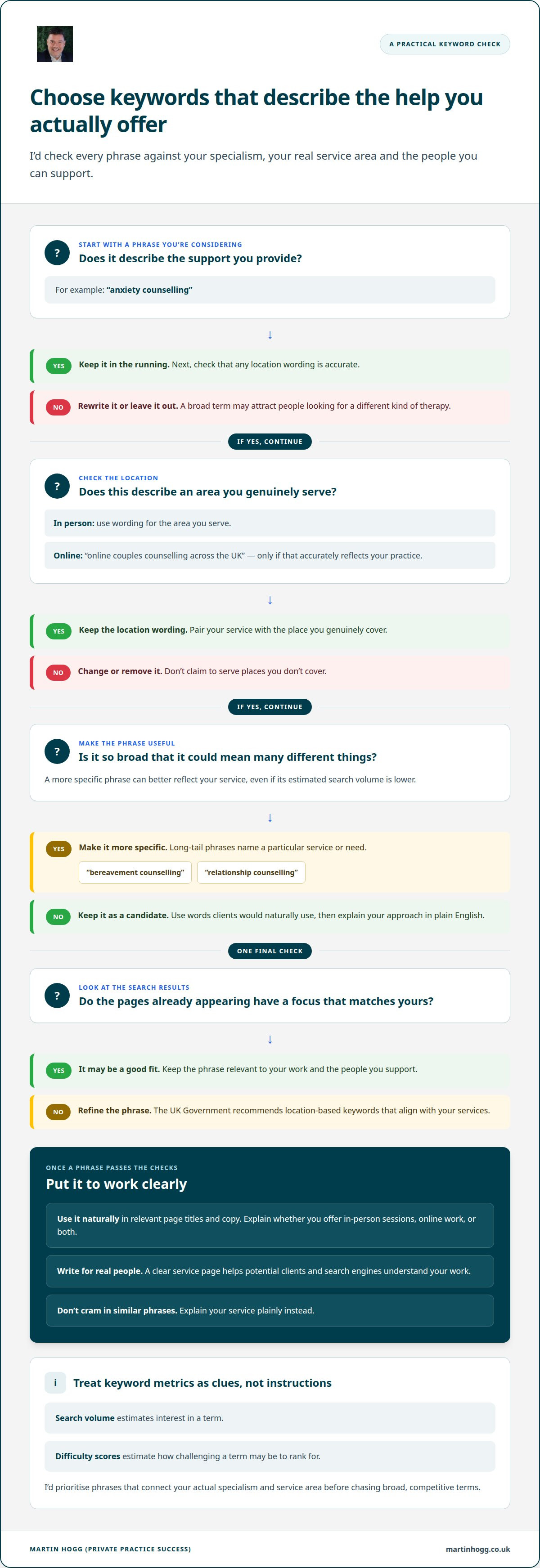
Choose keywords based on your name, location and specialisms. The key question isn’t simply which phrase gets searched most, but whether it describes the help you provide and the people you can support.
Search volumes and difficulty scores
Keyword research identifies the terms people type into Google, according to the UK Government. Search volume estimates interest, while difficulty scores estimate how challenging a term may be to rank for. Treat both as clues, not instructions. A broad term may attract people seeking a different kind of therapy. A more specific phrase can bring your practice into relevant search results, even if its estimated volume is lower. Review the pages already appearing and ask whether their focus matches yours.
Discipline-specific long-tail keywords
Long-tail keywords describe a particular therapy service or need. For example, a counsellor specialising in bereavement could use “bereavement counselling”, while a couples therapist might use “relationship counselling”. Choose words clients would naturally use, then explain your approach in plain English. Avoid cramming similar phrases into one paragraph. A clear service page written for real people helps search engines and potential clients understand your work.
Location keywords for local search
Pair your service with the area you genuinely serve, such as “anxiety counselling in my local area” or “online couples counselling across the UK”, where those descriptions accurately reflect your practice. The UK Government recommends location-based keywords that align with your services. Use suitable location wording in relevant page titles and copy, then explain whether you offer in-person sessions, online work, or both. Don’t claim to serve places you don’t cover.
SEO costs depend on the scope, including keyword research, service-page work, technical changes and tracking. The price depends on the case and is given after a quote request. I’d prioritise phrases that connect your actual specialism and service area before chasing broad, competitive terms.
If you want a structured way to plan your practice visibility, explore these private practice visibility resources.
How Long Does SEO Take for a Therapist Website?
SEO builds over time; it won’t transform a therapist’s website overnight. To assess progress, look at your site structure, competition, content and the changes being made. A new counselling website starts from a different position than an established practice site, so the most useful improvements depend on the foundations already in place.
Start with the experience potential clients get on their phones. Check that the menu, contact details and enquiry form work on a small screen. Compress oversized images, remove unnecessary page elements and test whether key pages load promptly. A mobile-friendly, fast-loading site makes it easier for someone seeking anxiety counselling to find useful information. Keep the site secure and its software maintained.
Then make each page clear to people and search engines. Give every page a descriptive title tag and meta description, using natural phrases such as “anxiety counselling near me”. Keep one H1 heading for the main page title, followed by H2 headings for sections and H3 headings for supporting details. In Squarespace, make sure page titles describe the service, rather than repeating the practice name everywhere.
Useful pages include a homepage, a service page for your practice area, an about page and clear contact information. If you work with anxiety, a dedicated counselling page can explain who you support, your approach, whether sessions are online or in person, and how to enquire. Use clear menu labels such as “Counselling”, “About” and “Contact” so visitors can find details easily.
Publish helpful content that answers real client questions, such as what happens in an initial counselling session. Keep it specific to your work and link to the relevant service page. Review progress in Google Search Console and use what you learn to improve your pages. Better rankings grow from useful content, clear structure and steady work, not a hurried pile of keywords.
Can you guarantee first-page or number one rankings on Google?
No. Google determines search rankings, so an SEO provider cannot control or promise a first-page or number-one position. Be wary of anyone selling guaranteed placements or remarkable results through link building. Focus on changes you can assess, such as whether useful pages appear in Google Search and visitors can find your enquiry details.
Start with the page title and description. A title such as “Anxiety counselling in your area | Your Practice” tells Google and potential clients what the page covers. Write a distinct description that accurately summarises the service, rather than repeating the same wording across your website. These details help people decide whether to click.
Use headings to give each page a clear structure. The main heading should describe the page, while subheadings make sections easier to scan. For example, an anxiety counselling page could cover who you support, your approach, session format and how to enquire. Keep the content relevant to your actual work; a string of search phrases won’t help someone decide whether your service suits them.
Supporting articles can answer specific questions and connect readers to a relevant service page. You might write about preparing for a first counselling session, then link naturally to your counselling information. Publish when you have something useful to say, not just to fill a calendar. A straightforward article is more useful than polished material that never gets published.
Localised content should reflect the community you genuinely serve. Explain where you offer in-person sessions and whether you also work online, without claiming to cover places where you don’t practise. Ground each article in the needs and language of potential clients. This builds a credible online presence over time, though it can’t dictate where Google places your pages.
Martin Hogg Private Practice Success
Martin Hogg’s Private Practice Success helps counsellors turn marketing ideas into practical steps. If you’re unsure which keywords fit your work or your website feels like a collection of unfinished tasks, the Practice Visibility Blueprint can help you decide where to focus. For individual support with positioning and practice growth, One-to-One Practice Growth Coaching is another option.
Good visibility comes from clear choices and steady effort, not a promise of a particular Google position. Start with what would help most, whether that’s clarifying your direction or working through your next practice-growth decisions.
If you’d like support with your practice visibility, contact Martin Hogg Private Practice Success.
Make your next marketing step manageable
Your next step doesn’t need to be a complete website overhaul. Choose one improvement that helps potential clients understand your practice and what to do next. For example, a clearer explanation of who you support can make your online presence feel more like you.
For SEO for therapists in the UK, keep the person reading in mind. Search visibility matters, but your page also helps someone decide whether to enquire. Make each change with that real conversation in mind, then allow time to assess its effect.
You don’t need every marketing decision settled before you begin. A thoughtful, manageable step can help you build a practice that feels clearer to you and easier to find for the people you hope to support.
Keep going at a pace you can sustain. Your next useful step is closer than it feels.
Frequently Asked Questions
How long does SEO take to produce results?
SEO usually takes sustained work over months rather than days. Your starting point matters: pages already indexed may respond sooner than a new site with unclear services. Watch early signs in Google Search Console, such as impressions for relevant service pages, then assess whether those searches lead to suitable enquiries. A change in rankings alone doesn’t mean a steady flow of clients.
How long does SEO take to work?
SEO starts as Google discovers and evaluates changes, but visible progress depends on your website and its competition. A technical fix may help search engines access a page, while useful content takes ongoing attention to create. For example, a clear page about your main specialism gives Google more context than a homepage trying to describe every service at once.
Reality Check: How Long Does SEO Take?
Think of SEO as gradual practice-building, not a switch you flick before next week’s diary is full. Check whether the right people are finding your pages and taking useful next steps, such as reading about your approach or making an enquiry. If visits rise but enquiries don’t, review the page’s clarity and contact route before assuming you need more traffic.
Should Therapists Do SEO Themselves?
Yes, you can handle the essentials yourself if you have time to learn and keep the work moving. Start with clear service descriptions, accurate page titles and a simple way to enquire. Squarespace lets you edit page content without starting from scratch. If the technical side or planning feels like another job, focused support can help you decide what deserves attention first.
What does SEO for therapists in the UK involve?
SEO for therapists in the UK means making your practice easy to understand and find online. This can involve researching how people describe your specialism, improving relevant pages, checking technical access and building trustworthy professional signals. Make your training, experience and membership details easy to find, and ensure your website reflects the work you actually offer.
How do therapists optimise their Google Business Profile and local search presence in the UK?
Give your Google Business Profile accurate practice details and a clear description of your services. Keep the information consistent with your website and professional directory profiles, such as BACP or Counselling Directory. Help people understand whether your practice suits their needs, and make the next step clear. Review the listing when your services or contact details change.
Disclaimer
The information provided on this blog is for general informational purposes only. It is also not intended to be a substitute for professional medical or mental health advice, diagnosis, or treatment. Reading this content does not create a therapist-client relationship.


