
SEO for Therapists: UK Guide to Getting Found (2026)

Article by
Martin Hogg
I help Private Practice counsellors in the UK set up and grow an ethical Private Practice they love, work with their ideal clients, and earn the income they deserve. All without guesswork and burnout. I have been a private practice counsellor myself for over 20 years, specialising in anger management. I set up a not-for-profit social enterprise, Citizen Coaching and Counselling, which delivers thousands of counselling sessions a year to adults and young people in Birmingham. I am a registered BACP Counsellor and the author of three books, My Anger Coach, My Anxiety Coach and My Relationship Coach. These are available on Amazon.
Your Psychology Today profile isn't a marketing strategy; it's a digital filing cabinet where you're tucked away alongside three hundred other people. It's a blunt truth, but it's the reality for many UK counsellors. You've likely spent hours wrestling with complex tools or worrying about the complexities of SEO for therapists, only to feel like you're shouting into a void. According to the BACP, 37% of UK adults have now had therapy, so the demand is clearly there. Yet, if you aren't visible, those clients will simply find someone else. Staying invisible doesn't help the people who need you.
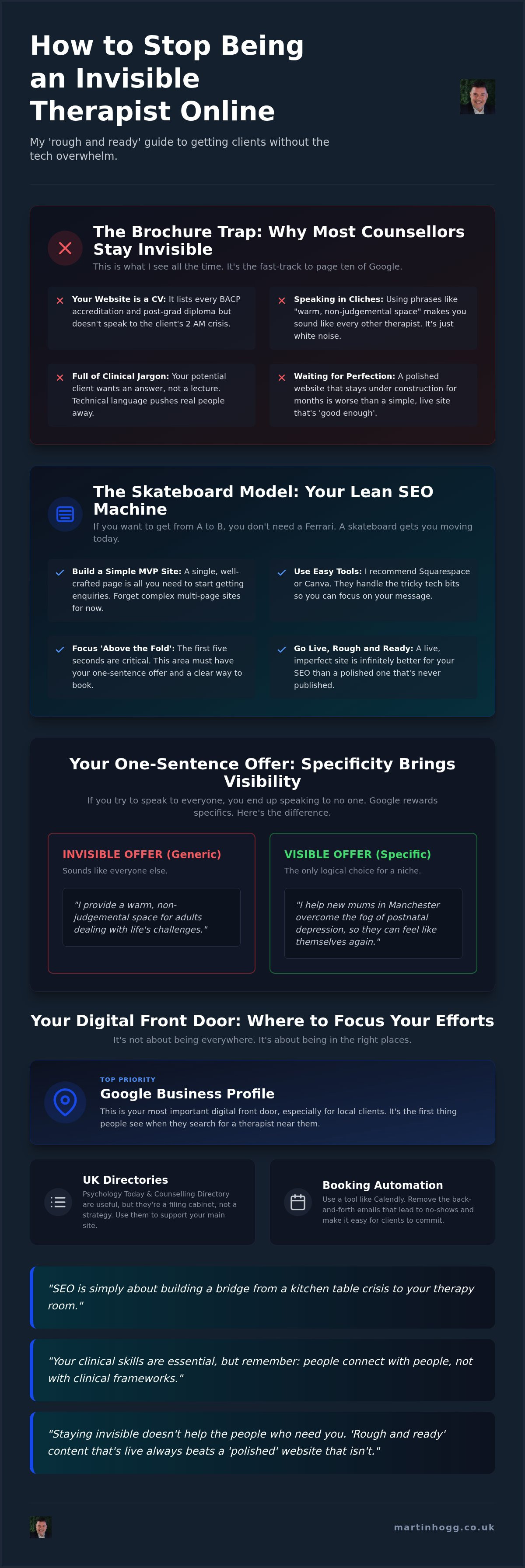
I'll show you how to stop being invisible online using a rough and ready approach that actually brings clients through your door without the tech overwhelm. Here at Martin Hogg Private Practice Success, we'll explore a range of practical strategies, from why a simple 'skateboard website' beats a complex one, to crafting a one-sentence offer that clicks, and leveraging your Google Business Profile as your most important digital front door. SEO is simply about building a bridge from a kitchen table crisis to your therapy room.
Key Takeaways
- Learn why clinical jargon often pushes clients away and how a "people connect with people" approach makes your practice more visible to both Google and real humans.
- Discover the "skateboard model" for your website, using simple tools like Squarespace or Canva to get a professional, high-ranking site live without the usual tech overwhelm.
- Master the fundamentals of seo for therapists by crafting a one-sentence offer that targets a specific niche, making it much easier to reach page one of the search results.
- Understand why your Google Business Profile is your most important digital front door and how to balance it with UK directories like Psychology Today and the Counselling Directory.
Why Most Therapist Websites Stay Invisible (The Brochure Trap)
I see it all the time. A counsellor's website that looks like a CV. It lists the BACP accreditation, the post-grad diplomas, and every clinical framework under the sun. This is what I call the Brochure Trap. While your qualifications matter for professional standards, your potential client is usually staring at their phone at 2 AM, feeling overwhelmed. They don't want a lecture; they want an answer. In the context of Search Engine Optimization (SEO), being found means being the solution to that specific moment of distress.
Effective seo for therapists isn't about gaming an algorithm. It's about building a bridge. You're moving from clinical distance to human connection. Google's systems now prefer content that feels like a person talking to another person. If your site sounds like a medical textbook, you're scaring people away before they've even clicked contact. I define SEO as the art of being the answer to someone's 2 AM search.
The Problem with 'Warm and Non-Judgemental'
We've all used the clichés. Phrases like providing a warm, non-judgemental space have become white noise in the UK market. If every therapist says the same thing, you become invisible. You need to sound like a real person who understands the specific, messy struggle your client is facing. Specificity brings visibility. When you speak directly to a niche, you stop being a generic option and start being the only logical choice.
Rough and Ready Beats Polished and Invisible
Many counsellors get stuck in tech overwhelm, waiting for the perfect website before they launch. Perfectionism is just a fancy word for fear. A rough and ready site that clearly states how you help people is infinitely better for SEO than a polished masterpiece that stays under construction for months. If you want to grow your practice, you have to be willing to be seen, even if it's not perfect yet.
The Skateboard Model: Building a Lean SEO Machine
I'm a big believer in the skateboard model. If you want to get from A to B, you don't need a Ferrari; a skateboard gets you moving today. In counselling private practice uk, we often over-complicate things. Many counsellors spend months wrestling with complex WordPress plugins, but for effective seo for therapists, a simple one-page MVP site is often all you need to start getting enquiries.
I usually recommend Squarespace or Canva over WordPress for solo practices. They handle the technical bits like mobile responsiveness and security automatically. The most critical part is your "above the fold" content. This is what a client sees in the first five seconds. It must include your one-sentence offer and a clear button to book. If it's cluttered, they'll leave.
Title Tags and Descriptions for the Tech-Phobic
Your title tag is the headline Google shows to the world. Don't waste it on your name alone. It should clearly state your niche and location. Your description tag is your chance to "stop the scroll" by acknowledging the client's struggle. Think of it as a helpful signpost rather than a technical hurdle.
Removing the Friction: Calendly and Automation
Your website's job is to get the first session booked, not to explain your entire therapeutic philosophy. Using a tool like Calendly removes the back-and-forth emails that often lead to "no-shows". I've created a Counsellor Efficiency Bundle to help you streamline this. Making it easy for clients to reach you is a vital part of building trust. For more guidance on this lean approach, you can find us in the Martin Hogg Private Practice Success community.
Copywriting That Ranks: The One-Sentence Offer
I often tell my students that if you try to speak to everyone, you end up speaking to no one. In the world of seo for therapists, being a generalist is a fast track to page ten of Google. You need a one-sentence offer that hooks the person who is currently sitting at their kitchen table, feeling like they've hit a wall. This isn't about being clever; it's about being clear and showing you truly understand their pain.
Google rewards specificity because its job is to find the most relevant answer. If someone searches for "counselling for postnatal depression", a generalist site will almost always lose out to a specialist page that speaks directly to that experience. I've put together some Niche Building Secrets to help you find that sweet spot. When you master seo for therapists, you start using the words your clients actually use when they're in distress, not the clinical jargon from your textbooks.
The 'About Me' Page That Isn't Actually About You
Your About Me page should be a mirror. When a potential client reads it, they should feel seen and understood. Frame your experience as evidence that you get what they are going through. While your BACP credentials and diplomas are vital for building trust, they belong in the footer or a small sidebar. Your main headline should always be about the client's journey and the restoration of their future.
Creating a Clear Call to Action (CTA)
A vague "Contact Me" button often creates an unnecessary barrier. It's a bit too open-ended for someone in a crisis. I recommend using a "Free 15-minute consultation" button instead. This reduces the client's anxiety by giving them a clear, low-pressure next step to see if you're the right fit. It's about making the bridge to your therapy room as easy to cross as possible.
Local Visibility: Directories and Google Business Strategy
Your Google Business Profile is your most powerful tool for being seen locally. It often acts as the first interaction a client has with you. According to 2026 data from BizIQ, 46% of Google searches have a local intent, such as "therapist near me". When you get seo for therapists right at a local level, you become the obvious choice for someone in your immediate area. It's a simple, free way to ground your practice in your community.
I also recommend managing the "Big Three" UK directories: the Counselling Directory, Psychology Today, and the BACP. These sites have high authority, but they shouldn't be your final destination. Use them as a funnel to lead people back to your own "Skateboard" website. This strategy is a vital piece of the puzzle when learning how to get counselling clients uk because it gives you control over the client's journey.
Launch and Learn: The Path to Private Practice Success
Don't wait for a perfect website that never arrives. Launch your lean site today and refine it as you go. Real-world feedback from actual clients is worth more than a dozen design meetings. Your website should be the steady hub for your practice. Effective seo for therapists isn't a one-off task; it's about staying visible where your clients are looking, whether that's through online search or offline referrals.
Taking the Next Step with the Blueprint
Moving from a basic site to a busy practice requires a clear plan. My Visibility Blueprint is designed to take the guesswork out of growth. If you're feeling overwhelmed or just want to be part of a supportive group of peers, come and join us. You can find ongoing guidance and a straight-talking community in the Private Practice Success Membership.
Building Your Bridge to New Clients
You don't need a degree in computer science to get found on Google. The "skateboard model" gets you moving today, while a clear "one-sentence offer" connects you with people in distress. Mastering seo for therapists is simply about being the reliable answer to a client's search. It's about moving from being invisible to being the bridge that helps someone restore their personal trajectory.
I've spent over 20 years in UK private practice. As a BACP-endorsed training provider, I designed the Practice Visibility Blueprint to be the antidote to tech overwhelm. You don't have to struggle with complex tools in isolation. There's a straight-talking community ready to help you turn these practical steps into a thriving practice.
Take that first small step today. Your future clients are already out there looking for you; it's time to make sure they can finally find you.
Common Questions About Therapist SEO
Do I really need a website if I am already on the Counselling Directory?
Yes, you definitely do. While a directory profile is a useful tool, it’s like renting a room in a shared house where you look just like everyone else. Your own website gives you total control over your "one-sentence offer" and allows for a deeper human connection. It acts as the destination for your local search strategy, helping you stand out from the hundreds of other profiles on the Counselling Directory.
What is the best website builder for a UK-based therapist?
I usually recommend Squarespace or Canva for solo practitioners. Squarespace is excellent because it handles the technical bits like mobile responsiveness and security automatically, costing around £17 per month for a standard plan. Canva is a brilliant, low-cost option for a one-page "skateboard" site. Avoid complex WordPress setups unless you have a dedicated tech team; they often lead to the tech paralysis that stops you from actually helping clients.
How much should SEO for therapists actually cost to do yourself?
Effective seo for therapists doesn't have to be expensive if you do the legwork yourself. Your main costs will be your website hosting, roughly £12 to £17 per month, and perhaps a tool like Canva Pro for around £12 per month. Beyond that, it costs nothing to optimize your Google Business Profile or write better copy. The real investment is the time you spend learning how to speak your client's language.
Should I list my session prices on my therapist website?
I strongly suggest you do. Transparency builds trust immediately. A 2026 BACP survey found that 35% of people who considered therapy but didn't proceed cited cost as the primary reason. By listing your fees clearly, you remove that uncertainty and filter for clients who can afford your support. It also prevents the awkwardness of discussing money for the first time during a sensitive introductory call or session.
How long does it take for a therapy website to show up on Google?
It generally takes between three to six months to see significant movement in organic search results. This is why seo for therapists is a slow-burn strategy rather than a quick fix. However, you can show up much faster in local searches by setting up a Google Business Profile. While you wait for the algorithm to trust your new site, use your directory profiles and offline networking to drive traffic to your offer.
Disclaimer
The information provided on this blog is for general informational purposes only. It is also not intended to be a substitute for professional medical or mental health advice, diagnosis, or treatment. Reading this content does not create a therapist-client relationship.


