
Setting Therapist Fees in the UK: A Practical Guide to Pricing Your Practice

Article by
Martin Hogg
I help Private Practice counsellors in the UK set up and grow an ethical Private Practice they love, work with their ideal clients, and earn the income they deserve. All without guesswork and burnout. I have been a private practice counsellor myself for over 20 years, specialising in anger management. I set up a not-for-profit social enterprise, Citizen Coaching and Counselling, which delivers thousands of counselling sessions a year to adults and young people in Birmingham. I am a registered BACP Counsellor and the author of three books, My Anger Coach, My Anxiety Coach and My Relationship Coach. These are available on Amazon.
What if I told you that charging a fee that actually covers your mortgage isn't a betrayal of your "helping" identity, but the only way to keep your doors open? Most of us entered this profession because we care deeply about people, not because we wanted to be accountants. It feels incredibly awkward to talk about money when someone is sharing their deepest struggles. When you're setting therapist fees uk, you might even worry that if you raise your rates, your phone will stop ringing and your current clients will leave immediately.
I want to help you move past that guilt. I'll show you how to set a sustainable fee that reflects your expertise and keeps your practice running for the long term. We'll look at the real costs of 2026, from BACP memberships to insurance, and I'll give you a clear formula to state your price without the apologies. I'll also touch on finding the right clients who value your work, so you can stop worrying and focus on the therapy.
Key Takeaways
- Reframe fee-setting as a vital clinical boundary that prevents resentment and protects the therapeutic relationship from the weight of burnout.
- Map out your "Life Cost" first to ensure your practice supports your home life rather than just covering the rent for your therapy room.
- Stop trying to be the cheapest person on the Counselling Directory; setting therapist fees uk requires a strategy that values your specific expertise.
- Implement a "Legacy Client" model to raise your fees confidently without the fear of losing the clients you already work with.
The Psychology of Setting Fees: Why Counsellors Struggle
I know that asking for money often feels like a dirty secret in our world. We want to help. Charging feels like putting a price tag on compassion. However, setting therapist fees uk isn't just a business task; it's a vital clinical boundary. When you undercharge, resentment can quietly leak into the room. You might find yourself checking the clock or feeling drained because your practice is costing you more than it brings in. That doesn't help your client, and it certainly doesn't help you.
You have to remember that you aren't a charity. Charities have external funding and grants to keep the lights on. You have a private practice that must be sustainable so you can continue to show up for the people who need you. A fair fee protects your energy and ensures you aren't burnt out by the time your Wednesday afternoon client arrives.
The "Money Guilt" Barrier
Fee-related countertransference is simply the internal discomfort or bias a therapist feels when discussing money, which can cloud clinical judgment if left unchecked. When a potential client says they can't afford your rate, your first instinct might be to fold. Don't. Instead, have a clear policy for a limited number of lower-cost slots, or refer them to a service that fits their budget. Sticking to your fee shows that you value the work and the professional space you've created.
Valuing Your Professional CPD
Your fee doesn't just go into your pocket. It pays for your supervision, your insurance, and your CPD for counsellors UK. Maintaining high standards, as outlined by the British Association for Counselling and Psychotherapy (BACP), requires ongoing investment. Your price reflects the years of training you've completed and the expertise you bring to every 50-minute hour. You've earned the right to charge a professional rate.
The Practical Math: How to Calculate Your Sustainable Rate
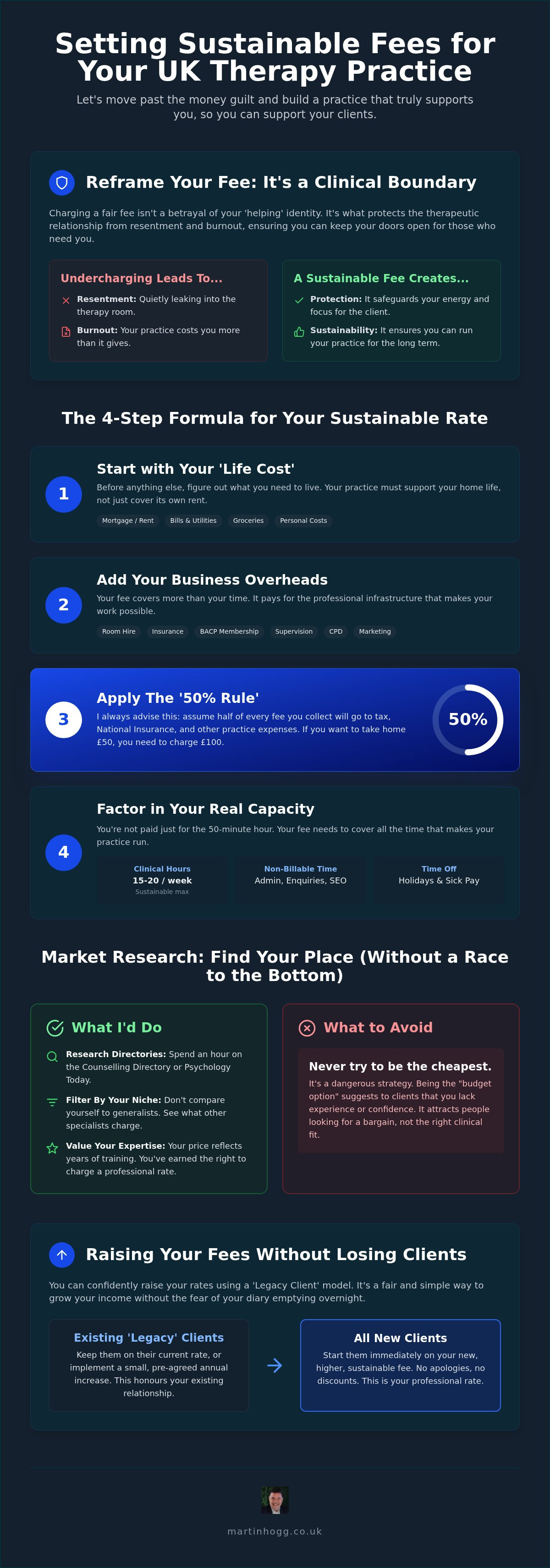
Calculating your rate shouldn't involve guesswork. Start with your "Life Cost." What do you actually need to earn to pay your mortgage and put food on the table? Once you have that figure, add your business overheads. This includes room hire, professional indemnity insurance, and your BACP membership fees. I always suggest following the "50% Rule." Assume that half of every fee you collect will vanish into tax, national insurance, and practice expenses. If you don't account for this, you'll end up working for far less than you think.
Be realistic about your capacity. Most therapists can only manage 15 to 20 clinical hours a week before the quality of their work drops. Overstretching yourself is a recipe for burnout. Even the UK government's work on mental health: prevention and resilience suggests that maintaining our own wellbeing is crucial for supporting others. If you're struggling to make the numbers work, it might be time to look at the Private Practice Success Membership for a bit of extra guidance.
Factoring in Non-Billable Time
You aren't just paid for the 50 minutes you spend with a client. You need time for admin, answering enquiries, and working on your SEO for therapists. If you don't build these hours into your fee, you're essentially working for free. Remember to factor in "holiday pay" and sick leave too. You deserve a break without your income hitting zero.
The Sliding Scale Dilemma
I'm not a fan of lowering your overall fee for everyone. Instead, limit the number of low-cost slots you offer. Use your full-fee clients to subsidize a few concession spaces. This keeps your practice healthy while still making your work accessible to those who need it most. Setting therapist fees uk is about balancing your heart for helping with the reality of running a small business.
Market Research: What Are Other UK Therapists Charging?
When you start setting therapist fees uk, your first stop is usually a directory. It's a sensible move. I suggest spending an hour on the Counselling Directory or Psychology Today. Don't just look at every listing. Filter by your specific niche or the issues you treat. You'll quickly see a range. Some might charge £40, while others are at £120. The middle ground is usually where the "generalists" live.
Whatever you do, don't try to be the cheapest person in your area. It's a dangerous strategy. Being the "budget option" often suggests to potential clients that you lack experience or confidence. It also attracts people who are looking for a bargain rather than the right clinical fit. You want clients who value your expertise, not just your price tag. Positioning yourself as a specialist allows you to step away from the price wars of general practice.
Niche vs. General Practice
A specialist can almost always justify a higher fee than someone who "sees everyone." For example, if you focus on working with men, you're solving a very specific set of challenges. People will pay more for a guide who truly understands their unique world. If you're struggling to find your focus, my niche building secrets will help you identify a group of people you're excited to help. This clarity is the foundation of your "one-sentence offer."
Communicating Your Fee Clearly
Stop hiding your prices. I recommend putting your fee "above the fold" on your website. This means a visitor should see it without having to scroll down. It builds trust immediately. You can also use Canva to design a simple, professional price list for your introductory pack. It's a practical way to show you run a professional business. Clear pricing prevents awkward conversations later and ensures you attract clients who are already comfortable with your rate.
Raising Your Fees Without Losing Your Clients
Raising your rates doesn't have to be a "rip the band-aid off" moment. I prefer a gentler approach that respects the therapeutic bond. When setting therapist fees uk, I recommend the "Legacy Client" model. You announce the new rate for new enquiries immediately, but you give your current clients a clear notice period, perhaps three months, before their rate changes. This honours the work you've already done together while moving your business forward.
Timing is everything. I've found that April is the most natural time for an increase. Since it's the start of the new tax year, people are already expecting price adjustments from their utility companies or subscriptions. It feels like a standard professional update rather than a personal slight. This is a vital step in scaling a therapy practice. You're shifting the focus toward the high value you provide, ensuring you can afford to stay in the profession for years to come.
Handling Pushback with Grace
If a client says they can no longer afford to see you, don't immediately fold. Use it as a chance to review the clinical work. You might find they're actually ready to move toward ending therapy, or perhaps you can offer a fixed number of sessions at the old rate to conclude the work safely. If they truly need ongoing support they cannot afford, having a solid referral list of lower-cost services is the most professional and kindest response.
Automating Your Income
Chasing payments is a massive drain on your empathy. I use tools like Calendly and Stripe to handle the logistics. Taking payment at the time of booking removes the awkward "money talk" from the end of your sessions. It keeps the boundaries clean. For more help with streamlining these tasks, take a look at the Counsellor Efficiency Bundle. It's designed to help you spend less time on admin and more time doing the work you love.
Build a Sustainable Practice Today
You've looked at the maths behind your "Life Cost" and seen why being the cheapest on the directory is a losing game. Setting your fee as a specialist isn't just about the money; it's about respecting your training and your energy. You now have a formula that works and a model to raise your rates without the guilt.
Setting therapist fees uk is often the hardest part of being in private practice, but it's the bridge to a more functional and fulfilling future. You don't have to do it alone or feel like you're "selling out" just to pay your bills. Practical, grounded changes are what will keep your practice running for the long term.
I've helped a community of over 500 UK therapists through my BACP-endorsed workshops and the Practice Visibility Blueprint system. We value action and tangible improvement over abstract theory. You've got the tools now; it's time to use them.
Frequently Asked Questions
What is the average therapist fee in the UK for 2026?
The average cost for a private therapy session in the UK currently sits between £60 and £80. However, data from the BACP directory shows that over half of therapists still advertise rates between £40 and £60. When you are setting therapist fees uk, remember that these averages vary by experience and niche. Psychologists often charge £100 to £180, while specialist counsellors usually sit somewhere in the middle.
How often should I review and raise my counselling fees?
I recommend reviewing your fees annually, ideally in line with the new tax year in April. This keeps your practice sustainable against rising costs like BACP renewals or room rent. You don't always have to raise them, but checking your numbers every twelve months prevents you from falling behind. If your expenses have jumped or you've completed new training, a modest increase ensures you aren't working for less each year.
Is it ethical for a therapist to charge different rates to different clients?
It is perfectly ethical to have a tiered fee structure, provided you are transparent about it. Many therapists use a sliding scale or offer a set number of concessionary slots for students or those on low incomes. The key is to be consistent. I suggest setting a firm full fee for most clients and then deciding exactly how many reduced rate spaces your business can actually afford to support.
Should I display my fees on my website or wait for the first enquiry?
You should absolutely display your fees clearly on your website, ideally on a dedicated pricing page. Hiding your rates often creates a barrier for potential clients who are already feeling vulnerable. When people know the cost upfront, it saves you from having awkward money talks during an initial enquiry. It also ensures the leads you do get are already comfortable with setting therapist fees uk at your professional level.
What happens if a client misses a session; should I still charge the full fee?
I suggest charging the full fee for sessions missed without 48 hours' notice. Your time is your inventory, and a late cancellation means you cannot offer that hour to someone else. Make this policy clear in your initial contract so there are no surprises. Using tools like Calendly and Stripe to take payment in advance can help automate this process and reduce the discomfort of asking for payment later.
Disclaimer
The information provided on this blog is for general informational purposes only. It is also not intended to be a substitute for professional medical or mental health advice, diagnosis, or treatment. Reading this content does not create a therapist-client relationship.


