
Setting Therapy Fees UK: A Practical Guide to Sustainable Practice in 2026

Article by
Martin Hogg
I help Private Practice counsellors in the UK set up and grow an ethical Private Practice they love, work with their ideal clients, and earn the income they deserve. All without guesswork and burnout. I have been a private practice counsellor myself for over 20 years, specialising in anger management. I set up a not-for-profit social enterprise, Citizen Coaching and Counselling, which delivers thousands of counselling sessions a year to adults and young people in Birmingham. I am a registered BACP Counsellor and the author of three books, My Anger Coach, My Anxiety Coach and My Relationship Coach. These are available on Amazon.
Your therapy fee isn't a measure of your kindness; it's the survival fund for your mortgage, your pension, and your sanity. If you've ever felt a wave of "helper's guilt" while setting therapy fees uk on your website, you aren't alone. Most of us started this work to help people, not to obsess over spreadsheets. However, resentment is a heavy price to pay for clinical work that doesn't actually cover your bills.
I know how daunting this process can feel, especially with the 2026 BACP Ethical Framework updates and the rising costs of running a room. You want to be accessible, but you also need to eat. I promise that you can set a rate that reflects your true value, covers your sick pay, and prevents the burnout that comes from overworking just to stay afloat.
In this guide, we'll walk through a clear, practical formula for your practice. We will look at how to factor in the latest tax allowances, pension contributions, and why your "clinical hour" needs to account for more than just the 50 minutes you spend with a client. By the end, you'll have the confidence to state your fees clearly and build a sustainable practice that supports your lifestyle.
Key Takeaways
- Reconcile the conflict between your vocation and your business so you can stop feeling guilty about earning a decent living.
- Use a clear formula for setting therapy fees uk that factors in your actual life costs, from your mortgage to your 2026 pension contributions.
- Move beyond the local average trap by using the skateboard model to test a niche that reflects your true value.
- Find out why transparency on your website and a solid annual review clause in your contract make fee management much easier.
- Learn how to calculate your overheads correctly, including BACP fees and directory costs, so they don't eat into your take-home pay.
Overcoming 'Helper's Guilt': The Psychology of Setting Therapy Fees
Money is an emotive topic in the UK counselling community. Most of us entered this profession because we care deeply about people, not because we wanted to run a profit-led corporation. This often creates a conflict between our "vocation" and the reality of being a business owner. When you're setting therapy fees uk, you might feel like you're putting a price tag on your empathy. It feels uncomfortable, almost as if charging a professional rate somehow diminishes the heart of what you do.
However, we need to be clear about what psychotherapy entails. It's a highly skilled professional service that requires years of expensive training, ongoing supervision, and significant emotional labour. A sustainable fee isn't just about covering your room hire and insurance. It's about your professional future. It must account for your pension, your sick pay, and the reality of the 2026 cost of living. If your fee only covers your basic expenses, you're one quiet month or one broken boiler away from a financial crisis.
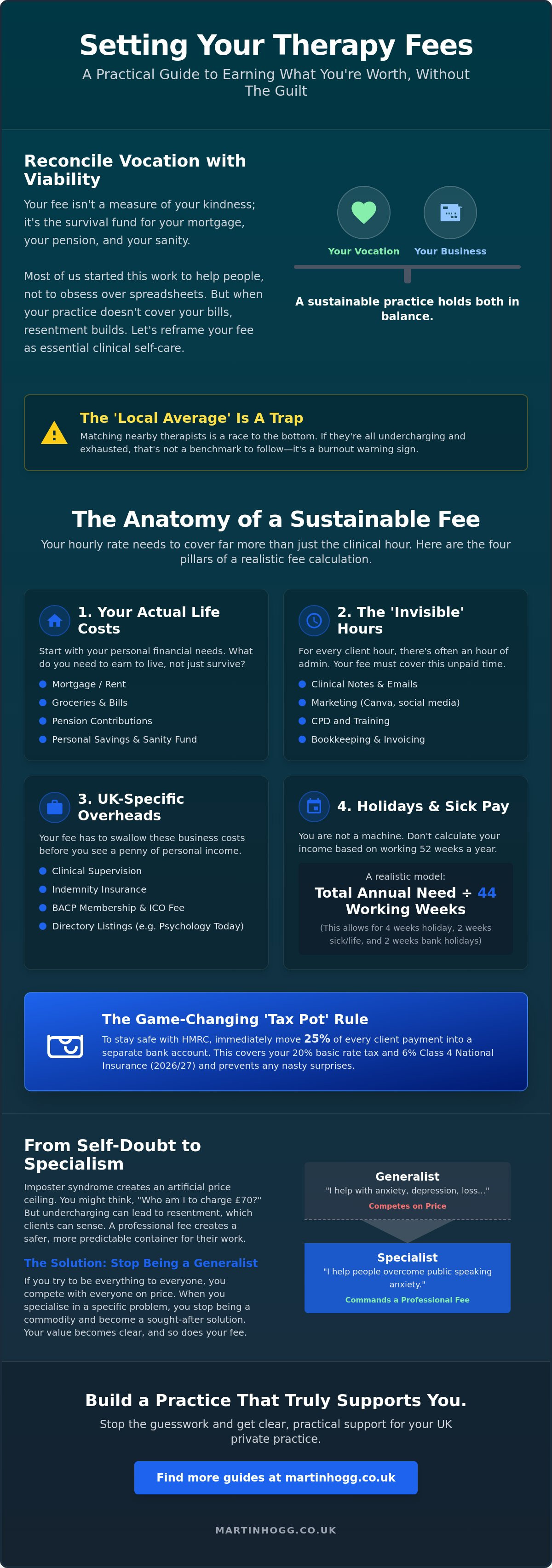
I often see therapists falling for the "going rate" trap. Matching the average fee in your local town is a race to the bottom. If every therapist in your area is charging £45 but they're all exhausted, resentful, and struggling to pay their bills, that's not a benchmark you should follow. Instead, try reframing your fee as a form of clinical self-care. It's the most direct way to prevent therapist burnout. When you aren't worried about your own bank balance, you have the mental space to be fully present for your clients.
Imposter Syndrome and the Price Ceiling
Self-doubt often leads to chronic under-pricing. You might think, "Who am I to charge £70?" or fear that clients will leave if you raise your rates. This imposter syndrome creates an artificial price ceiling that keeps you stuck. If you under-charge, you might subconsciously start to feel resentful toward your clinical work, which clients can often sense. A stable, professional fee creates a safer and more predictable container for the client to do their work.
The Business Maths: Calculating Your Sustainable Hourly Rate
Most counsellors I know pick a number out of thin air. They look at a few profiles on Counselling Directory, see what the "local average" is, and hope for the best. But setting therapy fees uk requires a bit more rigour if you want to avoid a financial headache. You need to start with your "Life Costs". This includes your mortgage, grocery bills, and that all-important pension contribution. If you look at NHS salary bands, you'll see a clear structure for what a professional should earn. Your private practice needs to match or beat that once your overheads are paid.
The biggest mistake is ignoring the "Invisible Hours". You might see twenty clients a week, but you're likely working forty hours when you factor in clinical notes, marketing on Canva, and your own CPD. If you don't account for this admin time, your actual hourly rate is half of what you think it is. I always suggest putting aside 25% of every payment into a separate "Tax Pot" immediately. Between the 20% basic rate tax and the 6% Class 4 National Insurance for the 2026/27 tax year, that 25% will keep you safe when HMRC comes calling.
A Checklist of UK-Specific Overheads
Your fee has to swallow your business costs before you see a penny of profit. Don't forget to include:
- Clinical supervision and professional indemnity insurance.
- BACP membership fees and ICO registration.
- Marketing costs like your Psychology Today subscription and Squarespace hosting.
- The cost of practice management software uk to keep your notes secure.
Accounting for Sick Pay and Holidays
You are not a machine. If you calculate your income based on working 52 weeks a year, you're setting yourself up for a fall. I recommend dividing your total annual financial need by 44 weeks. This allows for four weeks of holiday, two weeks for bank holidays, and two weeks of "life happens" sick pay. If you're feeling overwhelmed by these numbers, you might find the community and resources in our Private Practice Success Membership helpful for getting your head around the business side of things.
Moving Beyond the 'Local Average': Niche Positioning and Value
If you try to be everything to everyone, you end up competing with everyone. Most therapists are generalists. They list twenty different issues on their profile and wonder why potential clients haggle over the price. When you specialise, you stop being a commodity. If I have a specific, painful problem, I don't want a generic "warm, non-judgmental" space. I want someone who knows my struggle inside out. This is the secret to setting therapy fees uk that actually work for your business. Specialists thrive because they offer a specific solution to a specific pain.
Setting your rates becomes much easier once you understand that setting therapy fees uk is about the value of the outcome, not just the time you spend in the chair. I use something called the "skateboard model" to help therapists test this. Instead of building a massive website, you start with a simple one-page MVP. Your goal is to test a "one-sentence offer". For example, "I help high-stress professionals manage anger so they don't blow up at their families." It's direct. It's clear. It allows you to test a higher fee with a specific group of people who value that exact result. You can back this up by investing in targeted cpd for counsellors uk, which gives you the clinical tools to match your marketing.
Testing Your Rates with a Niche
Let's take Anger Management as an example. A specialist in this area can justify a premium rate because the cost of the problem, such as divorce, job loss, or health issues, is so much higher than the therapy fee. While you must always follow BACP's ethical guidance on setting fees, being an expert isn't unethical. It's practical. It allows you to work with fewer clients at a deeper level.
Remember, people connect with people. You don't need a corporate, clinical-looking site. In fact, "rough and ready" content usually beats polished every time. A quick video on your phone or a honest blog post builds more trust than a list of qualifications. If you're ready to stop being a generalist and start building a practice that pays, check out our Private Practice Success Membership.
Communicating Your Fees and Managing Increases Ethically
I am a huge fan of transparency. Don't hide your rates behind a "price on application" button. It's frustrating for potential clients and wastes your time on enquiries that will never convert. When you are setting therapy fees uk, put your price right there on your website. It acts as a helpful filter. It ensures that the people reaching out to you already know what to expect, which makes that first phone call much less awkward for everyone involved.
Start as you mean to go on by including an "Annual Fee Review" clause in your clinical contract from day one. This doesn't mean you are forced to raise your rates every year, but it gives you the professional permission to do so. It shifts the narrative from a personal request to a standard business procedure. When the time comes to actually have the "fee increase conversation," you can simply refer back to the agreement you both signed. It feels much less like a sales pitch and more like a routine update.
Handling Concessions and Sliding Scales
You can be a compassionate human without bankrupting your business. I recommend a "One for One" model. For every client paying your full specialist rate, you can afford to subsidise one lower-cost concessionary spot. This prevents the "helper's guilt" from dragging your average session price down to an unsustainable level. It's a practical way of setting therapy fees uk that balances your social conscience with your need to pay the mortgage.
Confidence in the Consult
When a potential client asks about the cost, state your fee clearly and then stop talking. Don't apologise. Don't over-explain. If you've done your business maths, you know your numbers are fair. This "above the fold" confidence is exactly what clients are looking for in a therapist. They want to know they are in the hands of a professional who is stable, composed, and knows their own value. If this transition feels daunting, we can help you build that confidence and structure in our Private Practice Success Membership.
Building a Practice That Pays You Back
Your clinical skills are vital, but they shouldn't come at the expense of your own financial security. We have covered how to move past the "helper's guilt" and why setting therapy fees uk based on your actual life costs is the only way to stay in this profession for the long haul. By finding your niche and using the skateboard model to test your rates, you can create a business that supports your lifestyle without the constant fear of burnout or financial instability.
As an experienced practice coach, I have seen many therapists transform their work by finally getting their heads around the maths. My BACP-endorsed workshops focus on these practical "easy win" strategies because I know you want to spend more time helping clients and less time worrying about the mortgage. Ready to build a practice that supports your life? Join the Private Practice Success Membership and get the clarity you need.
It's entirely possible to be both a compassionate counsellor and a successful business owner. Take that first step today, get your numbers right, and start building the sustainable future you deserve. You've got this.
Frequently Asked Questions
What is the average hourly rate for a private therapist in the UK in 2026?
The national average for a private therapy session in the UK currently sits between £60 and £80. For established therapists or those operating in environments with higher overheads, rates are typically 15% to 25% higher, with many charging between £70 and £110 per session. While over half of those on the BACP directory still list fees between £40 and £60, these lower rates often don't reflect the true cost of running a sustainable practice today.
Should I offer a sliding scale or concessions for lower-income clients?
You should only offer concessions if your full-fee sessions are priced high enough to subsidise those lower rates. I recommend a "one for one" model where you cap the number of low-cost spots you provide. This allows you to offer professional support to those who need it most without putting your own financial stability at risk. It's about being a compassionate practitioner while maintaining a viable business.
How do I tell my existing therapy clients that I am raising my fees?
Give your clients at least one month's notice in writing and frame the increase as a standard part of your annual professional review. If you have built a fee review clause into your initial contract, this conversation becomes a routine update rather than an awkward negotiation. Most clients understand that business costs like room hire and insurance rise, and they will value your transparency and professional boundaries.
Is clinical supervision tax-deductible for UK counsellors?
Yes, clinical supervision is a tax-deductible business expense because it is "wholly and exclusively" required for you to carry out your professional work. When you are setting therapy fees uk, remember that HMRC allows you to deduct supervision, professional insurance, and BACP memberships from your total income. These deductions lower your taxable profit, ensuring you only pay tax on what you actually take home.
How often should I review my therapy practice fees?
I suggest reviewing your fees once a year, ideally in April to coincide with the start of the new UK tax year. Regular annual reviews allow you to make small, manageable adjustments that keep up with inflation and your rising overheads. It is much easier for a client to process a small yearly increase than a sudden, large price jump after you've kept your rates stagnant for five years.
Disclaimer
The information provided on this blog is for general informational purposes only and is not intended to be a substitute for professional medical or mental health advice, diagnosis, or treatment. Reading this content does not create a therapist-client relationship.


