Setting Therapy Fees UK: A Practical Guide to Sustainable Practice in 2026

Article by
Martin Hogg
I help Private Practice counsellors in the UK set up and grow an ethical Private Practice they love, work with their ideal clients, and earn the income they deserve. All without guesswork and burnout. I have been a private practice counsellor myself for over 20 years, specialising in anger management. I set up a not-for-profit social enterprise, Citizen Coaching and Counselling, which delivers thousands of counselling sessions a year to adults and young people in Birmingham. I am a registered BACP Counsellor and the author of three books, My Anger Coach, My Anxiety Coach and My Relationship Coach. These are available on Amazon.
What if the very thing you think is helping your clients, keeping your rates as low as possible, is actually the quickest way to burn out and close your practice? I know that familiar twinge of helper's guilt. It's that knot in your stomach when you have to talk about money or the anxiety that comes from seeing a lower local average on the Counselling Directory. You want to be accessible, but you also need to pay for your BACP membership, your supervision, and your own life. It's a struggle many of us face when we're first setting therapy fees uk style, trying to balance our hearts with our overheads.
I'm here to tell you that your fee is a clinical boundary, not just a business transaction. If you aren't charging enough to sustain yourself, you can't show up fully for the people who need you. In this guide, I'll show you how to move past the guilt and use a professional formula to set fees that support both your clinical excellence and your personal wellbeing. We'll break down the 2026 costs for things like ICO registration and indemnity insurance, and I'll give you a clear, step by step strategy to state your fees on your website with total confidence.
Key Takeaways
- Understand why your fee is a vital clinical boundary that protects your practice from burnout and "financial leakage."
- Use our 2026 formula for setting therapy fees uk to ensure you actually cover your tax, BACP fees, and pension.
- Learn how to escape the "generalist trap" and use a specific niche to justify rates that reflect your true expertise.
- Take the heat out of money talk by using tools like Stripe or Calendly to automate your bookings and payments.
- Discover how to write an ethical annual fee review into your therapy contract so increases are expected and professional.
The Psychology of Pricing: Overcoming the Helper’s Guilt Trap
I’ve seen it hundreds of times. A prospective client calls, the chemistry is great, and then comes the question: "How much do you charge?" Suddenly, your palms get sweaty and you feel like you’re doing something wrong. This "helper’s guilt" is a massive hurdle when setting therapy fees uk therapists often face. We’ve been conditioned to think that being a "paid helper" is somehow grubby. But let’s be direct here. If you don’t charge a sustainable rate, you’re not being a "better" person; you’re just a therapist on the fast track to burnout.
Undercharging isn’t a noble sacrifice. It’s a clinical risk. When you’re worried about how you’ll pay your own bills, that stress leaks into the room. You might find yourself checking the clock more often or feeling a flicker of resentment when a client cancels. That’s what I call "financial leakage." By reframing your fee as a firm clinical boundary, you protect the therapeutic space. It ensures you can show up fully, without the distraction of your own financial survival hanging over the session.
Maths vs. Drama: Stripping the Emotion from the Number
We often project our own "money stories" onto our clients. You might assume a client can’t afford £70 because you wouldn't spend that on yourself right now. That’s a mistake. Your clients are adults who make their own financial choices. Instead of getting caught in the drama, look at the evidence. Understanding psychological pricing strategies can help you see your fee as a neutral data point rather than a moral judgement. Financial Self-Care is a core competency for an ethical private practice; it’s the practice of ensuring your business is healthy enough to serve others.
The Sliding Scale Dilemma
I get the desire to be accessible. However, having too many low-cost slots is a recipe for exhaustion. If your mortgage requires a certain income, but half your diary is filled with reduced rates, you’ll eventually run out of steam. I suggest using the Counsellor Efficiency Bundle to track these numbers properly. You can offer a few specific slots for those in need, but don't let your kindness compromise your ability to keep the lights on.
The Sustainable Practice Formula: Calculating Your 2026 Rate
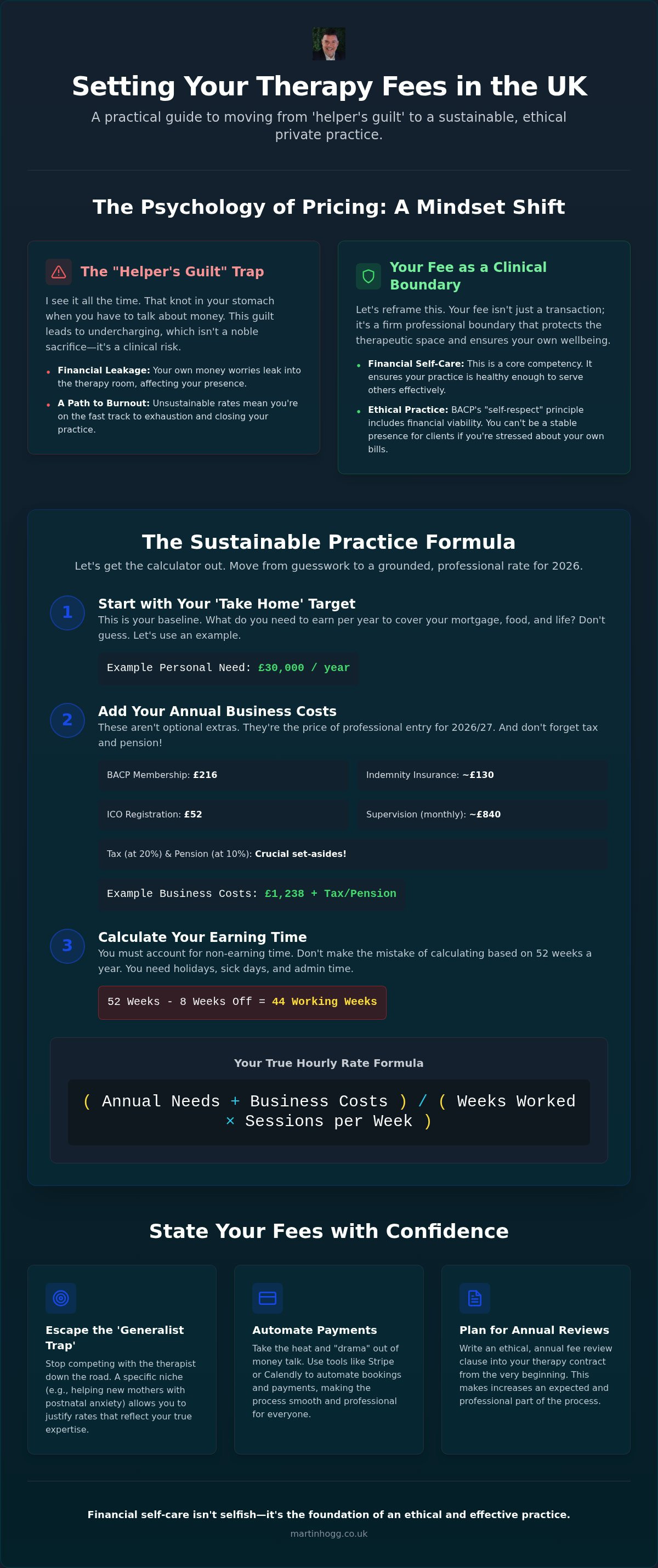
Let’s get the calculator out and move from guesswork to grounded reality. When you’re setting therapy fees uk style, you can't just pick a number that feels "fair" or matches the therapist down the road. You need to work backwards from your life. Start with your "Take Home" target. If you need £2,500 a month to cover your mortgage, food, and life, that is your baseline. But remember, as a sole trader in 2026, you only keep what’s left after HMRC takes their slice. With the personal allowance at £12,570, you’ll be paying 20% tax on everything above that, plus your pension contributions. If you aren't setting aside at least 10% for your future, you’re essentially subsidising your clients' therapy with your retirement.
Then we have the "invisible" costs that eat into your hourly rate. These aren't optional extras; they are the price of professional entry. For the 2026/27 period, you’re looking at:
- BACP Accredited Membership: £216 per year
- ICO Registration: £52
- Professional Indemnity Insurance: Typically £80 to £180
- Clinical Supervision: Between £50 and £90 per hour
The BACP Ethical Framework highlights "self-respect" as a core principle. This includes ensuring your practice is financially viable so you can remain a stable presence for your clients. If you're constantly stressed about your own bank balance, you aren't practising ethically.
The Hourly Rate Calculation
To find your true rate, use this formula: (Annual Personal Needs + Annual Business Costs) divided by (Weeks Worked × Sessions per Week). Don't make the mistake of calculating based on 52 weeks. You must account for at least 6 to 8 weeks of "non-earning" time. This covers holidays, sickness, and those essential admin days. Crucially, remember that seeing 20 clients a week isn't a 20-hour job; it's a full-time commitment once you add notes and admin. If you want to see the maths clearly, the Counsellor Efficiency Bundle is a great way to manage these figures. If you're finding the business side of practice a bit lonely, you might enjoy the community in our Private Practice Success Membership.
Positioning and Niche: Why Generalists Struggle with Fees
When you try to help everyone with everything, you fall straight into the "Commodity Trap." If your profile on Psychology Today looks exactly like the ten people listed above you, a potential client has no way to distinguish your value. In that scenario, the only thing they can compare is the price. You become a price-taker, forced to stay within a few pounds of the local average just to stay in the game. This makes setting therapy fees uk counsellors can actually survive on feel like an uphill battle.
I’ve found that the most sustainable practices are built on a specific niche. Think about it. If someone is looking for "Anger Management for Professionals," they aren't searching for the cheapest person in town. They are looking for the expert who understands their specific world. Expertise signals higher value. When you stop being a generalist, you stop being a commodity. If you're ready to find your specific corner of the market, I recommend looking into Niche Building Secrets to help you stand out.
The One-Sentence Offer
You need to move away from the vague "I am a qualified counsellor" introduction. Nobody buys "counselling"; they buy a solution to a problem. I want you to craft a one-sentence offer. Use this formula: "I help [who] achieve [what] through [how]." For example, "I help stressed teachers manage burnout through practical CBT tools." This clarity tells a client exactly what they are paying for, making your fee much easier to justify.
Your Website as a Value Signal
Trust is built "above the fold" before a client even sees your price list. You don't need a complex, expensive site. A "skateboard model" one-page site built on Squarespace with clean Canva graphics is often better than a cluttered, outdated mess. It is also where you can get specific with your title and description tags. If your Google listing clearly states your niche, you've already started justifying your fee before the client even clicks. For more on how to present your practice effectively, check out my guide on Marketing for Therapists in the UK.
Handling Fee Conversations and Increases Ethically
Money is often the most uncomfortable part of the job. But if you've done the heavy lifting on setting therapy fees uk correctly, the actual conversation becomes a matter of fact rather than a source of dread. I always suggest automating the awkwardness where you can. By using tools like Stripe or Calendly, the payment happens before the session even starts. This leaves the therapy hour for therapy, not for fumbling with a card reader or sending chasing emails. It’s a cleaner boundary that benefits both you and the client.
To avoid surprises, write an Annual Fee Review into your initial contract. I tell my clients right from the start that my fees are reviewed every April. When you do decide to increase your rate, give plenty of notice. A four-week timeline is the absolute minimum; eight weeks is much better for long-term work. This shows respect for their financial planning and gives you space to process any feelings that come up in the room about the change.
Tools for a Smoother Practice
Your profiles on Psychology Today and the Counselling Directory must always reflect your current professional rate. Don't let these go out of date. I also find that "rough and ready" content on social media helps justify your fee. When people see the real you sharing useful advice, they connect with the person, not just the price tag. It builds trust before the first phone call. If you're handling a price enquiry on the phone, stay calm and direct. You are a professional offering a valuable service; there is no need to sound like you're asking for a favour.
Scripting the Conversation
When you need to inform a client of a fee adjustment, keep it brief and non-apologetic. A simple script works best: "As per our initial agreement, my fees will increase to £X from [Date]. This ensures I can continue to invest in the high-quality CPD and supervision that supports our work." If a client says they can't afford it, don't fold immediately. You might offer a temporary transition period or discuss moving to fortnightly sessions, but remember that your boundaries are what keep your practice sustainable. For more help with these tricky conversations, you can find specific scripts and peer support in the Private Practice Success Membership.
Your Practice is Worth Protecting
We've covered a lot. From shifting your mindset away from "helper's guilt" to the nitty-gritty of tax and pension calculations for 2026. Setting therapy fees uk practitioners can actually live on isn't just about the money; it's about making sure you're still here to help people in five years. If you don't look after your own bank balance, you simply can't look after your clients. A sustainable fee is the foundation of an ethical, long-term career.
Remember that your niche is your best friend. It moves you away from being a "commodity" and allows you to charge for the specific value you provide. Use the tools we've discussed, like Calendly and Stripe, to keep those boundaries firm and professional. It's time to stop apologising for being a professional and start treating your practice with the respect it deserves.
I've spent over 20 years in UK private practice. As a BACP-endorsed training provider, I've seen how much a sustainable fee can change a therapist's life. You deserve a practice that supports you as much as you support your clients. My no-fluff mentorship is here to help you get there. Let's get to work on making that a reality.
Frequently Asked Questions
What is the average hourly rate for a private therapist in the UK in 2026?
The average hourly rate for a private counsellor in the UK in 2026 typically ranges between £50 and £90. When setting therapy fees uk style, you'll find CBT therapists usually charge £70 to £120, while clinical psychologists range from £100 to £180. These figures can vary significantly in London. While these averages provide context, your fee should ultimately reflect your specific overheads and the niche expertise you offer.
Is it ethical to charge different fees for different clients or use a sliding scale?
It is perfectly ethical to use a sliding scale, provided you don't let it undermine your practice's survival. When setting therapy fees uk practitioners often feel they must be accessible to everyone, but the BACP Ethical Framework reminds us that self-respect is key. I suggest capping your reduced-fee slots to a specific number, such as 10% or 20% of your caseload. This allows you to offer support without risking your own financial stability.
How do I tell existing therapy clients that I am increasing my fees?
You should inform your clients of a fee increase directly and in writing, giving at least four to eight weeks' notice. I find it helpful to frame this as part of your annual business review rather than an apology. A simple email or a brief mention at the end of a session is usually enough. Most clients understand that your overheads, such as supervision and professional memberships, increase over time just like their own bills do.
Should I display my therapy fees on my website or wait for an enquiry?
I strongly recommend displaying your fees clearly on your website rather than waiting for an enquiry. Potential clients often feel anxious about the cost, and seeing a clear price on your Squarespace site or Counselling Directory profile builds immediate trust. It also acts as a helpful filter. You want to attract people who are ready to pay your professional rate, saving you both time on awkward introductory calls.
How much should I set aside for tax and NI as a self-employed counsellor?
You should generally set aside between 25% and 30% of your gross income for tax and National Insurance as a sole trader. For the 2026/27 tax year, the personal allowance is £12,570, meaning you pay 20% tax on profits above that amount. I suggest moving this money into a separate savings account every time a client pays you. This simple habit prevents any panic when your HMRC bill arrives in January.
Disclaimer
The information provided on this blog is for general informational purposes only. It is also not intended to be a substitute for professional medical or mental health advice, diagnosis, or treatment. Reading this content does not create a therapist-client relationship.


