
Setting Therapy Fees UK: A Practical Guide to Sustainable Practice in 2026

Article by
Martin Hogg
I help Private Practice counsellors in the UK set up and grow an ethical Private Practice they love, work with their ideal clients, and earn the income they deserve. All without guesswork and burnout. I have been a private practice counsellor myself for over 20 years, specialising in anger management. I set up a not-for-profit social enterprise, Citizen Coaching and Counselling, which delivers thousands of counselling sessions a year to adults and young people in Birmingham. I am a registered BACP Counsellor and the author of three books, My Anger Coach, My Anxiety Coach and My Relationship Coach. These are available on Amazon.
What if I told you that undercharging for your work is actually a clinical boundary issue? It sounds a bit harsh, doesn't it? Most of us entered this profession to help people, not to pore over spreadsheets. However, if you're constantly stressed about your own bills, you aren't bringing your best self to the chair. Setting therapy fees uk practitioners can actually live on isn't about greed; it's about professional excellence and long-term sustainability.
I know that "helper's guilt" is a heavy weight to carry. You likely worry that being more expensive than the local average makes you elitist or inaccessible. I promise that by the end of this guide, you'll have a clear, professional formula to calculate your hourly rate. We will factor in your 2026 tax allowances, your pension contributions, and even those annual BACP membership costs.
We're going to move past the anxiety and look at the practical numbers. I'll show you how to state your fees on your website with confidence and how to handle annual increases ethically. Let's get your practice on a stable footing for the years ahead.
Key Takeaways
- I'll show you how to reframe your fee as a clinical boundary so you can move past helper's guilt and protect your practice from burnout.
- You want a clear, step-by-step formula for setting therapy fees uk that accounts for 2026 tax, pension contributions, and professional overheads.
- We'll look at why generalists often struggle with pricing and how building a specific niche helps you move away from the "commodity trap."
- I'll explain how to automate your payments and write ethical fee reviews into your contracts to remove the "awkward factor" from money conversations.
The Psychology of Pricing: Overcoming the Helper’s Guilt Trap
Do you feel that sudden knot in your stomach when a client asks about your rate? You aren't alone. Most of us were drawn to this work by a genuine desire to help; not to chase invoices. This "helper's guilt" creates a social stigma where we feel that charging a professional rate somehow dilutes our empathy. It's a trap that keeps many talented therapists struggling to make ends meet.
In reality, undercharging is a clinical risk. Financial stress leads to "leakage" in the room, where your own worries about the mortgage start to crowd out the client's needs. I've seen it lead to resentment and eventual burnout far too often. We need to stop asking what the local average is and start asking what your specific practice needs to thrive. Think of your fee as a vital clinical boundary that protects the therapeutic space for both of you.
Maths vs. Drama: Stripping the Emotion from the Number
It's easy to project our own money issues onto our clients. We assume they can't afford us without actually knowing their circumstances. Understanding Psychological Pricing Strategies can help you see how numbers influence perception; but your priority should be "Financial Self-Care." I define this as the core competency of maintaining a profitable practice so you can remain a stable, present resource for your clients. Using tools like the Counsellor Efficiency Bundle can help you manage these "back office" realities without the emotional baggage.
The Sliding Scale Dilemma
Accessibility is a noble goal, but too many low-cost slots will drain your energy. If you can't pay your own bills, you won't be in practice long enough to help anyone. The process of setting therapy fees uk counsellors usually follow often ignores the reality that every reduced slot is a direct subsidy from their own pocket. Limit your sliding scale spaces so your practice remains sustainable and your focus stays sharp.
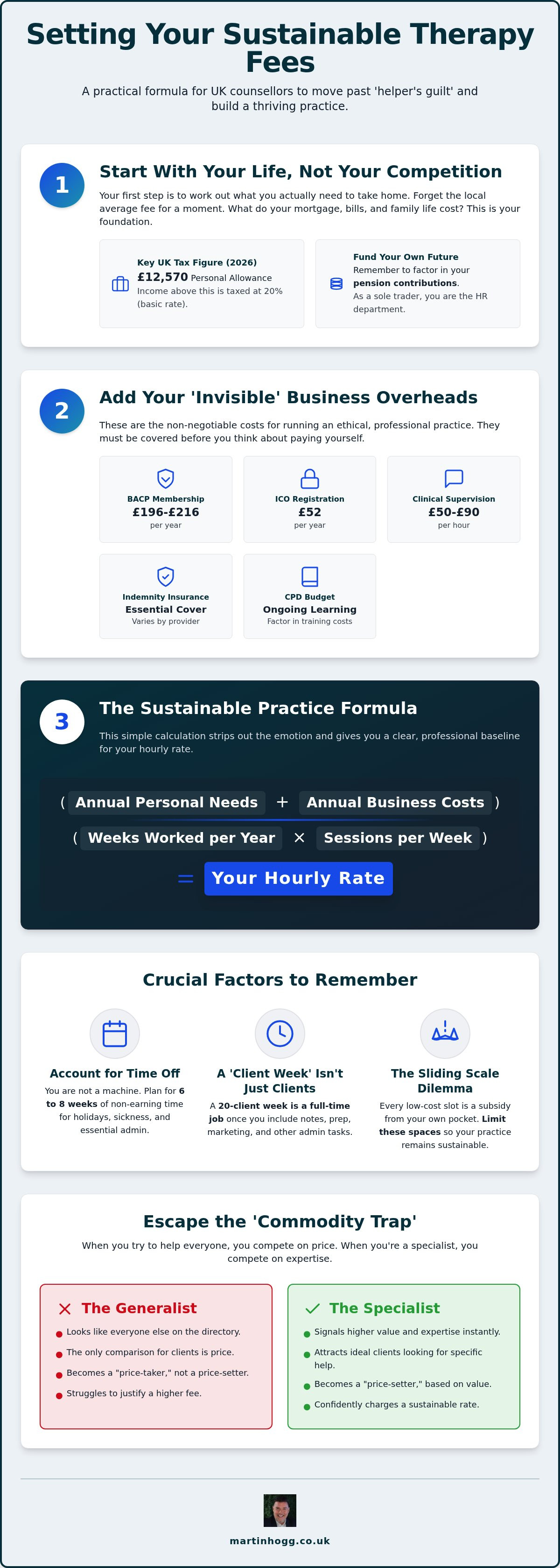
The Sustainable Practice Formula: Calculating Your 2026 Rate
Setting your income target starts with your life, not your competition. First, decide what you actually need to take home to cover your mortgage, food, and bills. In 2026, remember that the personal tax allowance is £12,570; anything above that is taxed at 20% for the basic rate. Don't forget your pension contributions. As a self-employed therapist, you are the HR department, and nobody is going to fund your retirement for you.
Next, add your "invisible" business costs. Your BACP membership is currently between £196 and £216 per year, and the ICO registration fee is £52. Clinical supervision typically costs between £50 and £90 per hour. Add your professional indemnity insurance and a realistic budget for CPD. These costs are non-negotiable for an ethical practice. If you want to stay accessible, you might consider Ethical Sliding Scale Fees, but only after your core survival costs are covered.
The Hourly Rate Calculation
You need a simple formula to get this right: (Annual Needs + Annual Costs) divided by (Weeks Worked × Sessions per Week). Crucially, you must account for 6 to 8 weeks of non-earning time. This covers holidays, sickness, and the hours you spend on admin or marketing. A 20-client week is actually a full-time job when you include notes and preparation. If these numbers make your head spin, the Counsellor Efficiency Bundle can help you track your practice finances without the headache.
Setting therapy fees uk practitioners can actually live on requires looking at these cold, hard facts. It's about building a foundation that lasts. If you want to dive deeper into these numbers with a supportive community, come and join our Private Practice Success Membership for more tailored guidance.
Positioning and Niche: Why Generalists Struggle with Fees
When you try to help everyone with everything, you fall into the "Commodity Trap." If your profile on the Counselling Directory looks exactly like the ten people listed above you, the only thing a potential client has to compare is your price. You become a price-taker rather than a price-setter. This makes setting therapy fees uk practitioners can actually survive on incredibly difficult because you're constantly looking over your shoulder at what the person in the next town is charging.
Compare that to a specialist. If someone is searching for "Anger Management for Professionals," they aren't looking for the cheapest option; they're looking for the expert who understands their specific world. A niche signals higher value and expertise instantly. If you're ready to stop being a generalist and start being the "go-to" person in your area, my Niche Building Secrets for therapists will help you find that focus.
The One-Sentence Offer
I want you to move away from the vague "I am a counsellor" introduction. It's too broad and tells the client nothing about the transformation you offer. Instead, craft a one-sentence offer: "I help [who] achieve [what] through [how]." For example, "I help stressed teachers regain their work-life balance through focused CBT." This tells a client exactly what problem you solve before they even think about your hourly rate.
Your Website as a Value Signal
Trust is built "above the fold." Your website doesn't need to be a masterpiece; I always recommend the "skateboard model," which is a simple, effective one-page site. Using professional-looking Canva graphics and clear Squarespace templates builds far more trust than a cluttered profile. You can find more tips on this in my guide on Marketing for Therapists in the UK.
Handling Fee Conversations and Increases Ethically
Talking about money doesn't have to be a cringeworthy experience. One of the best ways to remove the friction is to automate the process. Using tools like Stripe or Calendly allows clients to book and pay before they even step into the room. This shifts the focus back to the therapeutic work. When setting therapy fees uk practitioners often forget that the "back office" tech can do the heavy lifting for them. If someone calls to enquire, state your fee with calm, mentor-like confidence. No stuttering; just the facts.
Tools for a Smoother Practice
Your profiles on Psychology Today and the Counselling Directory should always reflect your current professional rate. Consistency builds trust. I also encourage you to share "rough and ready" content on social media. A simple video or post helps potential clients connect with you as a person. When they see the human behind the brand, your fee becomes a secondary consideration to the value you provide.
Scripting the Conversation
The secret to ethical fee increases is transparency. When you're setting therapy fees uk style, I recommend writing an "Annual Fee Review" into your initial contract. This means a price adjustment isn't a shock; it's a scheduled business process. Give your clients at least 90 days of notice before any change takes effect.
If a client says they can't afford the new rate, stay calm. You might say: "I understand that this is a change. My new rate reflects the rising costs of running a professional practice. While I can't lower the fee, we could discuss moving to fortnightly sessions or I can help you find a low-cost service that fits your budget."
Don't apologise for your value. Staying firm on your boundaries is part of being a professional guide. If you want more help with these difficult conversations, come and join the Private Practice Success Membership where we share scripts and strategies that actually work.
Building a Practice That Lasts
You now have the tools to move from financial anxiety to professional confidence. Remember that your fee is a clinical boundary; not just a business figure. By using a clear formula that accounts for your 2026 costs and tax, you ensure that you can stay in this profession for the long haul. We've seen how finding a specific niche helps you move away from the "commodity trap" and how automation takes the sting out of money conversations.
Setting therapy fees uk practitioners can actually live on is the foundation of the Practice Visibility Blueprint. With over 20 years of experience in UK private practice and as a BACP-endorsed training provider, I've seen how practical, no-fluff mentorship helps therapists scale without losing their heart. It's time to stop guessing and start building something that supports both your life and your clients.
You have the skills to change lives. Now, give yourself the financial stability to keep doing it. I'm here to help you every step of the way.
Frequently Asked Questions
What is the average hourly rate for a private therapist in the UK in 2026?
Most counsellors in the UK currently charge between £50 and £90 per session. CBT therapists usually sit between £70 and £120, while clinical psychologists often range from £100 to £180. These figures are often higher in London due to increased overheads. Remember that an average is just a mid-point; your specific niche and training should dictate where you sit on that scale rather than just following the crowd.
Is it ethical to charge different fees for different clients or use a sliding scale?
Yes, using a sliding scale is an ethical way to improve accessibility. When setting therapy fees uk therapists should limit the number of reduced-fee slots they offer. If you have too many, your business becomes unsustainable. I recommend setting a clear cap on these spaces. This allows you to maintain your own financial stability while still offering support to those who might otherwise struggle to afford your full rate.
How do I tell existing therapy clients that I am increasing my fees?
I suggest giving your clients at least 90 days of notice before any price adjustment takes effect. It is best to have an annual review written into your initial contract so it isn't a surprise. When you tell them, be direct and warm. You don't need to over-explain or apologise. Simply state the new rate and the date it begins, and offer a brief window for discussion if they have concerns.
Should I display my therapy fees on my website or wait for an enquiry?
You should absolutely display your fees clearly on your website. Transparency builds trust and saves you from having awkward conversations with people who cannot afford your rate. When you're setting therapy fees uk clients can see upfront, you are qualifying your enquiries. It ensures that the people who reach out are already comfortable with the financial side, which makes the initial consultation much easier for both of you.
How much should I set aside for tax and NI as a self-employed counsellor?
I recommend setting aside around 25% to 30% of your gross income to cover your tax and National Insurance. While the basic income tax rate is 20% on taxable income over £12,570, you also need to account for NI contributions. Keeping this money in a separate account ensures you aren't caught short when your bill arrives. It is a vital part of maintaining a sustainable and stress-free private practice.
Disclaimer
The information provided on this blog is for general informational purposes only. It is also not intended to be a substitute for professional medical or mental health advice, diagnosis, or treatment. Reading this content does not create a therapist-client relationship.


