
Setting Therapy Fees UK: Sustainable Pricing Guide 2026

Article by
Martin Hogg
I help Private Practice counsellors in the UK set up and grow an ethical Private Practice they love, work with their ideal clients, and earn the income they deserve. All without guesswork and burnout. I have been a private practice counsellor myself for over 20 years, specialising in anger management. I set up a not-for-profit social enterprise, Citizen Coaching and Counselling, which delivers thousands of counselling sessions a year to adults and young people in Birmingham. I am a registered BACP Counsellor and the author of three books, My Anger Coach, My Anxiety Coach and My Relationship Coach. These are available on Amazon.
Setting your therapy fees isn't an ethical compromise. It's a mathematical necessity if you want to stay in business long enough to help anyone. I know the money drama is real. You've likely felt that familiar pang of guilt when a prospective client asks for your rate, or perhaps you're terrified of being the most expensive person on the Counselling Directory in your postcode. If you're struggling with how to set fees as a therapist UK without losing your soul or your shirt, you're in the right place.
I'll show you how to move past the awkwardness and calculate a sustainable price that reflects your professional value. We'll look at the actual costs for the 2026/27 tax year, including your £216 BACP membership and £52 ICO fee. We'll even factor in the new Data Act 2025 requirements that arrived this June. I'll also link this to my Practice Visibility Blueprint, because your fee doesn't matter if clients can't find you. By the end, you'll have a clear pricing strategy and the confidence to state your fee on a first call.
Key Takeaways
- I'll help you move past the "money drama" and guilt so you can see that a sustainable fee is an ethical requirement for staying in practice.
- You'll learn exactly how to set fees as a therapist uk by accounting for your 2026 overheads and those inevitable unpaid "gap weeks."
- I'll explain why being the cheapest option in your area often scares off clients and how to price based on the professional value you offer.
- You'll get a simple strategy for displaying your fees "above the fold" on your website to make that first enquiry call much easier for everyone.
Overcoming the Money Drama: Why Therapy Pricing Feels So Personal
Most of us got into this job because we care, not because we want to spend our weekends looking at spreadsheets or knocking a fiver off our rates. This creates a bit of a "Helper's Paradox." We want to be accessible, so we treat our fees like a guilty secret. If you're currently wrestling with how to set fees as a therapist uk, you've likely felt that internal tug-of-war between wanting to help and needing to pay the mortgage on time.
When you're figuring out how to set fees as a therapist uk, remember that undervaluing yourself isn't just a financial issue; it's a fast track to burnout. If you're stressed about your own bills, you aren't bringing your best self to the chair. We need to redefine "ethical pricing." It isn't about being the cheapest person in your postcode. It's about setting a rate that allows you to stay in business long-term. For therapy to be a truly sustainable profession, practitioners must be well-resourced to help others effectively.
Sustainable Pricing is the intersection where your financial requirements as a professional meet the client's investment in their personal growth.
The Trap of the 'Local Average'
I see many counsellors research the 'local average' and hover just below it. It feels safe, but copying the person down the road is a mistake. You have no idea if they're actually making a profit. "Average" pricing usually leads to an exhausted practice where you're chasing volume to stay afloat. Instead of price wars, using niche-building secrets helps you stand out for your expertise.
Calculating Your Sustainable Living Number: The UK Practice Overheads
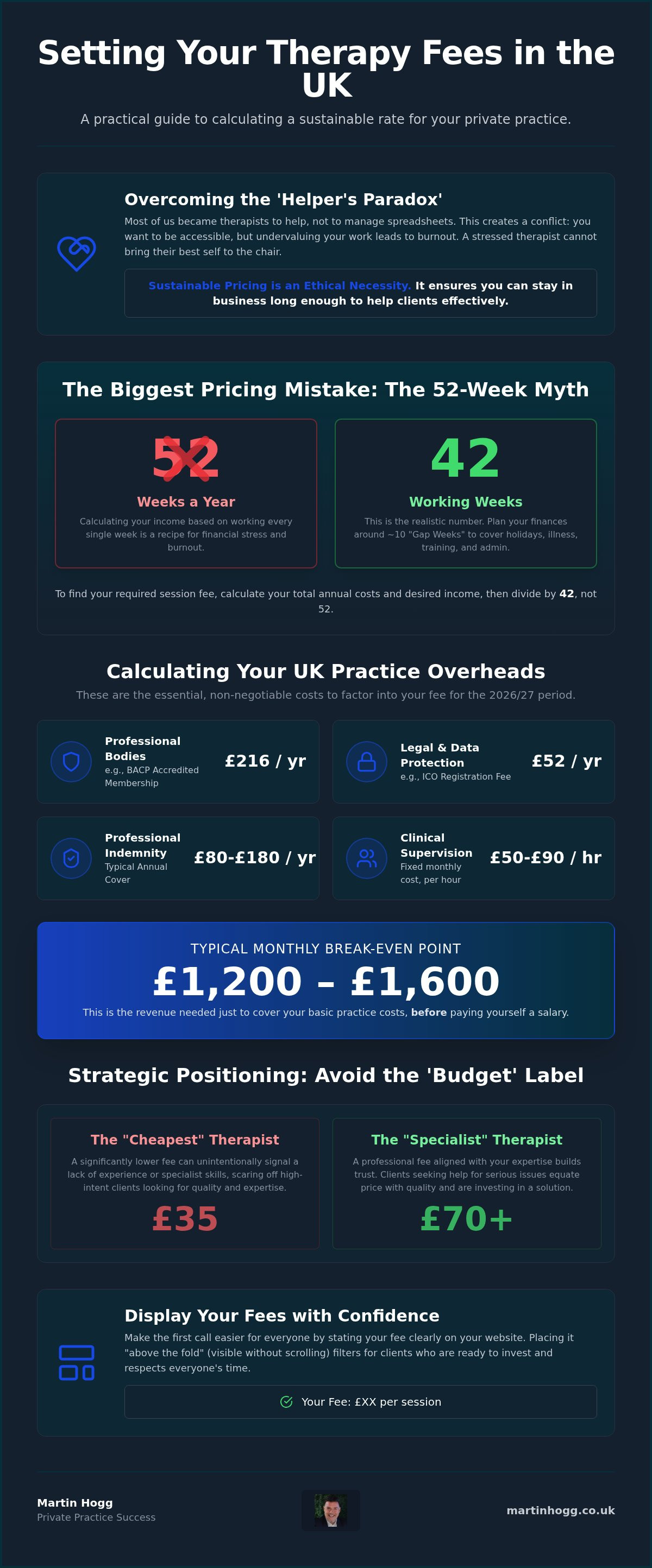
Once you've cleared the emotional hurdles, we need to look at the cold, hard numbers. Identifying every penny that leaves your business is the only way to avoid a nasty surprise at tax time. If you're wondering how to set fees as a therapist uk, start by acknowledging that most practices require between £1,200 and £1,600 in monthly revenue just to reach the break-even point. This covers your basics before you've even considered taking home a salary.
One of the biggest mistakes I see when people look at how to set fees as a therapist uk is calculating based on a 52-week year. That’s a recipe for burnout. You need to account for "Gap Weeks." Between bank holidays, illness, CPD, and your own well-earned time off, you should divide your annual financial needs by 42 weeks. This ensures your fee covers the times when you aren't sitting in the chair.
The UK Therapist's Essential Costs Checklist
To get your number right, you must factor in these mandatory professional costs for the 2026/27 period:
- Professional Bodies: BACP Accredited Membership (£216) or similar UKCP/NCS annual fees.
- Legal & Protection: ICO registration (£52) and Professional Indemnity Insurance, which usually sits between £80 and £180.
- Clinical Supervision: A fixed monthly cost regardless of client volume, typically between £50 and £90 per hour.
- Marketing Stack: Your Squarespace hosting, Psychology Today profile, and Counselling Directory listing.
I always advocate for the "skateboard model" of business. Don’t overcomplicate your tech; use simple tools like Canva for your social posts and Calendly for bookings. Keeping your overheads lean while maintaining a professional presence is key. If you need a community to help you navigate these numbers, my Private Practice Success Membership is a great place to start. Understanding the landscape of accessing therapy in the UK helps you see where your practice fits into the wider mental health system.
Strategic Positioning: Why the 'Budget Therapist' Label Fails
It's tempting to think that lowering your price makes you more accessible. In reality, being the cheapest therapist in town often backfires. When clients are looking for help with deep-seated trauma or a relationship breakdown, they aren't looking for a bargain. They're looking for a solution. If your fee is significantly lower than the local average on the Counselling Directory, you might accidentally signal that you're inexperienced or lack specialist skills.
High-intent clients often equate price with quality. By undervaluing your work, you're actually making it harder for them to trust you. When you're deciding how to set fees as a therapist uk, you should consider moving from "generalist" to "specialist" pricing. If you've invested in CPD for specific areas like anger management, your rate should reflect that expertise. Using the Counsellor Efficiency Bundle from Martin Hogg Private Practice Success can help you reclaim the time spent on admin so you can focus on these higher-value sessions.
The Problem with Sliding Scales
I see many counsellors fall into the trap of an "unlimited" sliding scale. Before they know it, their practice is full of clients at concessionary rates that don't even cover the room hire. This is a fast track to resentment. Instead, I suggest setting a "Floor Price" that you never go below. If you want to offer accessibility, limit yourself to two or three pro-bono slots or use a "Pay it Forward" model. This ensures you're helping others without draining your own bank account. Learning how to set fees as a therapist uk means protecting your own financial health so you can continue to show up for your sessions with full presence.
Implementation: How to Display and Discuss Your Fees Confidently
Once you've done the maths, you need to show your work. I always recommend placing your fee "above the fold" on your website. This means a visitor shouldn't have to scroll or click three different links just to find out if they can afford you. Transparency builds trust before you've even said hello. If you're still unsure about how to set fees as a therapist uk, remember that being clear about the cost is the first step in a professional therapeutic relationship.
Try using a "One-Sentence Offer" to frame the cost. Instead of just stating a price for a 50-minute session, link it to the transformation you provide. For example: "I help parents navigate post-natal anxiety so they can enjoy their new family, and the investment is £75 per session." This shifts the focus from the cost to the outcome. If you need more help with the marketing side of things, you can read more on how to get counselling clients uk.
Don't forget to schedule an annual fee review every April. It's a standard business practice, not a personal attack on your clients. I suggest giving current clients at least 60 days' notice before any increase. Most people understand that rent and BACP costs go up. They won't leave just because of a small, well-communicated adjustment. Mastering how to set fees as a therapist uk is an ongoing process of refinement.
The Enquiry Call Script
When someone asks your rate on a call, state it clearly. Don't use an "awkward stutter" or start apologising for your price. Just say: "My fee is £X per session." If they ask for a discount, be firm but kind. You might say: "I don't offer discounts, but I do have a limited number of concessionary slots which I review every quarter." This keeps your "Floor Price" intact while remaining human.
Take Control of Your Practice Finances Today
Deciding how to set fees as a therapist uk doesn't have to be a source of constant anxiety. By moving past the money drama and grounding your rates in the reality of UK overheads, you're protecting both your future and your clients' care. You've seen that a sustainable practice needs to account for those gap weeks and the professional costs that keep you registered and insured. Pricing is more than just a number; it's a reflection of the commitment you've made to your professional development and your community.
Setting a professional fee is an act of integrity. It allows you to show up fully without the shadow of financial stress. If you're looking for a no-fluff mentor approach to help you navigate these business hurdles, I'm here to support you with BACP-endorsed professional development and practical, UK-focused business coaching.
You have the tools, the math, and the mindset. Now, it's time to state your value with confidence and build the practice you deserve.
Frequently Asked Questions
What is the average cost of a private therapy session in the UK in 2026?
According to 2026 industry data published by vertexaisearch.cloud.google.com, average rates for counsellors sit between £40 and £90, while CBT therapists range from £70 to £120. The same source notes that London fees are typically 15% to 30% higher than the national average. Use these as a guide, but remember your "sustainable living number" is what really matters for your specific practice needs.
Should I put my therapy fees on my website or wait for the enquiry?
I strongly recommend putting your prices "above the fold" on your site so they are visible without scrolling. Transparency acts as a natural filter, ensuring those who call you are already comfortable with your rate. It removes the awkwardness from the first conversation and shows you're a professional who knows their value. Rough and ready transparency beats a polished but hidden price list every time.
How do I tell my existing therapy clients that I am raising my fees?
Give your clients at least 60 days' notice and aim to align increases with the new tax year in April. You don't need a long, academic explanation; a simple, direct update is much more respectful. Most clients understand that business costs like BACP membership and room hire naturally increase. Frame it as a standard annual review to keep the therapeutic relationship focused on the clinical work.
Is it ethical to charge more for specialized niches like Anger Management?
It is perfectly ethical to set higher rates when you offer specialist expertise, such as Anger Management or Working with Men. Specialist training involves a significant investment of your time and money, which should be reflected in your fee. When considering how to set fees as a therapist uk, remember that clients are often paying for a specific outcome that a generalist might not be able to provide.
How many client hours a week do I need to be financially sustainable in the UK?
Most sustainable practices aim for 15 to 20 client hours a week to avoid burnout and leave room for admin. If your monthly break-even is around £1,500, you'll need a clear strategy to ensure your hourly rate covers both your life and your business overheads. Learning how to set fees as a therapist uk means doing the maths so you can stay in the chair for the long haul.
Disclaimer
The information provided on this blog is for general informational purposes only. It is also not intended to be a substitute for professional medical or mental health advice, diagnosis, or treatment. Reading this content does not create a therapist-client relationship.


