
Setting Up a Private Practice Checklist UK: A Practical Guide for 2026

Article by
Martin Hogg
I help Private Practice counsellors in the UK set up and grow an ethical Private Practice they love, work with their ideal clients, and earn the income they deserve. All without guesswork and burnout. I have been a private practice counsellor myself for over 20 years, specialising in anger management. I set up a not-for-profit social enterprise, Citizen Coaching and Counselling, which delivers thousands of counselling sessions a year to adults and young people in Birmingham. I am a registered BACP Counsellor and the author of three books, My Anger Coach, My Anxiety Coach and My Relationship Coach. These are available on Amazon.
Most counsellors spend months agonising over a fifty page business plan when all they really need is a "skateboard" to get rolling. It's a bit like waiting for the perfect weather to go for a walk; if you wait for total certainty, you'll never actually leave the house. You likely feel that familiar knot in your stomach when someone mentions HMRC deadlines or the technical side of building a website. It is completely normal to worry about "selling" yourself or getting the legal bits wrong, but you do not need to be a tech genius or a corporate shark to succeed.
I know the fear of visibility is real, but I also know that people connect with people, not polished corporate logos. This setting up a private practice checklist uk provides a linear, no-nonsense path to help you move from clinical training to a thriving, visible practice. We will cover everything from your 2026/27 tax requirements to the "one-sentence offer" that actually attracts clients. I'll show you how to get your legal ducks in a row and build a practice that feels like you, without the usual therapist clichés or expensive mistakes.
Key Takeaways
- Identify the "legal minimums" you need to stay safe, from professional indemnity insurance to your ICO registration.
- Learn how to handle the HMRC side of things and why a dedicated bank account is better than mixing your session fees with the weekly shop.
- Follow our setting up a private practice checklist uk to launch a simple, effective website that attracts clients without needing a degree in web design.
- Discover why a "one-sentence offer" is more powerful than a ten-page business plan for filling your diary.
- Understand why saying "no" to the wrong clients and joining a supportive community is vital for your long-term sanity.
The Legal and Ethical Non-Negotiables for UK Private Practice
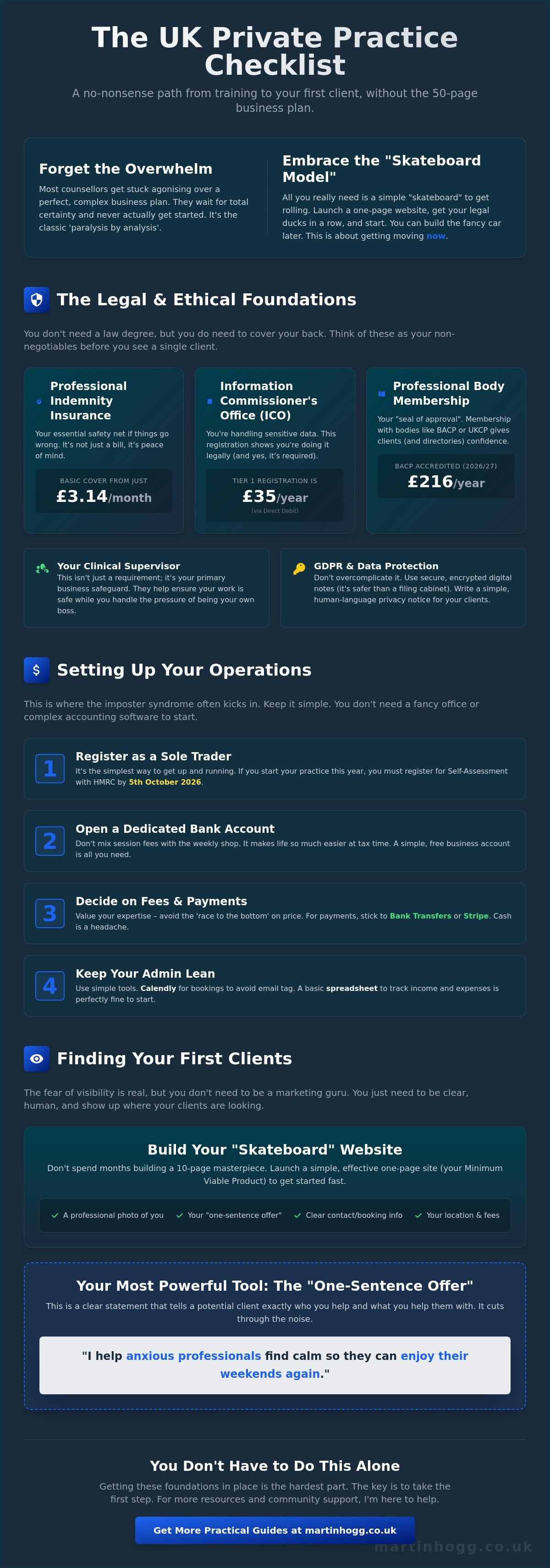
You don't need a law degree to get started, but you do need to cover your back. When you are looking at your setting up a private practice checklist uk, the "legal minimum" boils down to three core items: insurance, professional membership, and data registration. Think of these as your foundations. Without them, you are building on sand. To keep everything ethically upright, remember that a Clinical Supervisor acts as your primary business safeguard, ensuring your work remains safe while you manage the pressures of being your own boss.
Professional indemnity insurance isn't just another bill; it is your safety net. In 2026, you can find basic cover for as little as £3.14 per month, which is less than a flat white in most cities. You also need to register with the Information Commissioner’s Office (ICO). For most of us starting out, this is a Tier 1 registration, costing £35 a year if you pay by direct debit. Most therapists find that understanding the sole proprietorship model is the easiest way to get up and running while keeping these legal requirements simple and manageable.
Professional Bodies and Ethical Frameworks
Membership with a body like the BACP or UKCP gives your practice a "seal of approval" that clients and directories look for. For the 2026/27 period, a BACP accredited membership fee is £216. This isn't just about the certificate on the wall; it’s about having a proven ethical framework to lean on when things get tricky. Before you open your doors, double-check that your clinical hours and supervision ratios meet their specific private practice standards.
GDPR and Data Protection for Therapists
GDPR sounds intimidating, but it is mostly about being sensible with people's stories. I often suggest "rough and ready" digital note-taking using secure, encrypted platforms over traditional paper files. It is much easier to secure a password-protected device than it is to lug around a heavy filing cabinet. Keep your privacy notice simple. Use human language to tell clients what data you keep and why, rather than hiding behind pages of legal jargon that neither of you will ever read.
Logistics, Finances, and Setting Your Space
Sorting out the logistics is often where the imposter syndrome kicks in. You start wondering if you need a fancy office or a complex accounting system. You don't. When working through your setting up a private practice checklist uk, start with the basics. Registering as a sole trader is the simplest way to work. You can follow the official government guide to setting up to ensure you meet the HMRC deadlines. If you started this year, you must register for Self-Assessment by 5th October 2026.
Next, get a dedicated business bank account. It doesn't have to be a high-street giant. Keeping your therapy fees separate from your grocery shopping makes your life much easier when tax season rolls around. For your day-to-day admin, keep it lean. Use Calendly for your bookings so you aren't playing email tag. A simple spreadsheet to track your expenses is perfectly fine for now.
Managing the Money Without the Headache
Setting your fees often feels like an ethical minefield. Many new therapists fall into the trap of a 'race to the bottom' by charging the lowest rate in town. This only leads to burnout. Value your expertise. When you are looking at your setting up a private practice checklist uk, remember that how you take payments matters. I recommend bank transfers or Stripe. Cash is a headache to track and deposit. Digital payments create an automatic paper trail. If you're feeling isolated while figuring this out, joining a supportive community of peers can make these decisions feel much less daunting.
Your Working Environment
The 'Room vs. Zoom' debate is personal. If you work from home, consider your physical safety and professional boundaries. If you rent a shared room, factor those costs into your hourly rate. For online work, you don't need a TV studio. A tidy, neutral backdrop and a good headset are all you need to look professional. People connect with people; they aren't checking if your bookshelf is colour-coded.
The Practice Visibility Checklist: Finding Your First Clients
Visibility is often where the heart rate goes up. We spend years training to be the "blank slate" in the room, then suddenly we have to be the face of a business. It is a huge shift. If you are following this setting up a private practice checklist uk, don't let perfectionism stop you from being seen. You don't need to be everywhere at once. You just need to be where your clients are looking.
I always recommend the "Skateboard Model" for marketing. Instead of building a complex ten-page website that takes months to finish, launch a one-page MVP (Minimum Viable Product). It gets you rolling. You also need a "One-Sentence Offer". This is a clear statement that tells a potential client exactly how you help them. For example: "I help anxious professionals find calm so they can enjoy their weekends again." It is direct and human. Ultimately, people connect with people is the most important rule of therapist marketing because your potential clients are looking for a human being who understands their pain, not a distant clinical expert.
Building Your Skateboard Website
Choose a simple platform like Squarespace or Wix. They are "rough and ready" but professional. Focus on what is "above the fold", which is the part of the screen people see before they even start scrolling. In the first five seconds, a visitor should know exactly what you do and how to book a session. Use Canva to create clean, professional images. You don't need a design degree; you just need clear, uncluttered visuals that reflect your personality.
Directory Profile Mastery
Directories like Psychology Today and Counselling Directory are your bread and butter. Avoid "Therapist-Speak" at all costs. Words like "congruence" or "modalities" mean nothing to someone who can't sleep because of work stress. Write for the person in distress. Your headshot should be warm and approachable. A gloomy, passport-style photo won't build the trust you need to get that first enquiry. If you want to move past the fear of being seen and start attracting clients, our Private Practice Success Membership provides the step-by-step support you need to build visibility with confidence.
Sustainability and Growth: Avoiding the Burnout Trap
The final item on your setting up a private practice checklist uk isn't a legal form or a website plugin. It is your own well-being. Private practice can be incredibly lonely. You go from a busy agency or NHS team to sitting in a room, or a Zoom call, by yourself for hours on end. Without a plan for sustainability, the initial excitement of being your own boss can quickly turn into a heavy sense of isolation. I've seen many brilliant therapists burn out because they forgot to build a support system for themselves.
Setting firm boundaries is your best defence. Many new practitioners feel they have to say "yes" to every enquiry that hits their inbox. I'm here to tell you that saying "no" to the wrong clients is a massive win for your practice. If you work with people who aren't a good fit for your niche, you'll feel drained and they won't get the best results. If you find yourself hitting a ceiling or feeling stuck, it might be time to look into one-to-one practice growth coaching. It helps to have someone who has been there before to guide you through the transition from "Solo to CEO" and explore the possibilities of scaling a therapy practice.
Connecting with Your Peers
You don't have to do this alone. Joining a community like Private Practice Success allows you to share the highs and lows with people who actually get it. Networking isn't just about "selling"; it is about building a referral base that works for you. When you know other therapists' specialisms, you can refer on with confidence, and they will do the same for you when they meet a client who fits your "one-sentence offer".
Continuous Professional Development (CPD)
In the UK, CPD for counsellors uk is often seen as a clinical box-ticking exercise. I view it as an opportunity for both clinical and business growth. Plan your training year in advance. This stops that frantic end-of-year "CPD panic" where you sign up for anything just to meet your hours. A well-rounded setting up a private practice checklist uk includes space for your own professional growth, ensuring your practice remains as healthy and functional as the clients you support.
Take the First Step Toward Your Practice
Building a practice doesn't have to be a lonely slog through paperwork and technical glitches. By now, you should see that the legal minimums are manageable and your marketing can be as simple as a one-page "skateboard" site. You don't need to be perfect to start; you just need to be professional and human. Remember that your potential clients aren't looking for a corporate machine. They are looking for a real person who understands their struggle.
This setting up a private practice checklist uk is your roadmap to move from clinical training to a visible, sustainable business. You already have the clinical skills to help people change their lives. Now it's time to build the structure that lets those people actually find you. I know the transition can feel daunting, but it is entirely possible when you stop overthinking and start taking practical steps.
Ready to build your practice without the overwhelm? Join the Private Practice Success Membership today. You will get access to our Practice Visibility Blueprint system, BACP Professional Development Workshops, and a supportive community of 100+ UK therapists who have been exactly where you are now. Let's get your practice moving.
Frequently Asked Questions
Do I need a business plan to start a private practice in the UK?
You don't need a fifty page business plan to get started. Most counsellors get bogged down in abstract theory when they should be focusing on the "skateboard model" of getting rolling. I recommend a simple one page plan that defines your niche and your "one sentence offer". This keeps you moving forward instead of stuck in analysis paralysis or perfectionism.
Which insurance is best for UK counsellors?
Professional indemnity insurance is the non-negotiable cover you need to protect your practice. There isn't a single "best" provider, but many therapists use specialists who understand the clinical risks involved. In 2026, basic policies can start from as little as £3.14 per month. Always check that your cover includes your specific way of working, whether that is online, in person, or a hybrid of both.
How much does it cost to set up a private practice?
You can get started for a few hundred pounds if you keep your overheads lean. Your main initial outlays include your BACP membership at £216 for the 2026/27 year, your ICO registration at £35 via direct debit, and your insurance. This setting up a private practice checklist uk is designed to help you avoid expensive mistakes, like high office rents, before you have a steady stream of enquiries.
Do I have to register with the ICO if I keep paper notes?
Yes, you almost certainly still need to register with the Information Commissioner's Office. Even if your clinical notes are handwritten, you likely use a smartphone or laptop to manage bookings, send emails, or store client phone numbers. If you process any personal information electronically, you are a data controller. It is a small annual fee that provides essential legal and ethical protection for your business.
How many clients do I need to make a private practice sustainable?
Sustainability is about your "magic number", which is the balance between your session fee and your actual living costs. Most full time private practitioners find that fifteen to twenty clients per week is the sweet spot to avoid burnout. If you charge a fair rate that reflects your expertise, you don't need a massive caseload to make a good living. Focus on attracting the right clients rather than just chasing high volume.
Disclaimer
The information provided on this blog is for general informational purposes only and is not intended to be a substitute for professional medical or mental health advice, diagnosis, or treatment. Reading this content does not create a therapist-client relationship.


